5️⃣ Five Freedoms + QOL

5.0(1)
Studied by 3 people
call kaiCall Kai
learnLearn
examPractice Test
spaced repetitionSpaced Repetition
heart puzzleMatch
flashcardsFlashcards
GameKnowt Play
Card Sorting

1/22

encourage image

There's no tags or description

Looks like no tags are added yet.

Last updated 1:14 AM on 4/6/26
Name
Mastery
Learn
Test
Matching
Spaced
Call with Kai

No analytics yet

Send a link to your students to track their progress

23 Terms

1
New cards

Learning Objectives 1

1 Historical Foundations of Animal Welfare Science

 Describe historical foundations of animal welfare science
 Explain early welfare approaches such as the Five Freedoms
 Identify scientific reasons for negative-state focus
 Identify societal reasons for negative-state focus
 Identify historical reasons for negative-state focus

2 Scientific Shift Toward Modern Welfare Frameworks

 Explain scientific shift toward modern welfare frameworks
<p>1 Historical Foundations of Animal Welfare Science</p><p> Describe historical foundations of animal welfare science<br> Explain early welfare approaches such as the Five Freedoms<br> Identify scientific reasons for negative-state focus<br> Identify societal reasons for negative-state focus<br> Identify historical reasons for negative-state focus</p><p>2 Scientific Shift Toward Modern Welfare Frameworks</p><p> Explain scientific shift toward modern welfare frameworks</p>
2
New cards

Learning Objectives 2

3 Quality of Life

 Define Quality of Life
 Apply Quality of Life concepts

4 Positive Animal Welfare

 Understand emergence of Positive Animal Welfare

5 Positive Affective States

 Recognize scientific evidence supporting animals’ capacity for positive affective states

6 Key Welfare Terminology

 Use and interpret key welfare terminology
 Define and differentiate: affective state, emotion, sensory pleasure, mood, suffering
<p>3 Quality of Life</p><p> Define Quality of Life<br> Apply Quality of Life concepts</p><p>4 Positive Animal Welfare</p><p> Understand emergence of Positive Animal Welfare</p><p>5 Positive Affective States</p><p> Recognize scientific evidence supporting animals’ capacity for positive affective states</p><p>6 Key Welfare Terminology</p><p> Use and interpret key welfare terminology<br> Define and differentiate: affective state, emotion, sensory pleasure, mood, suffering</p>
3
New cards

The Five Freedoms

Development
 Created by the UK Farm Animal Welfare Council (FAWC) in 1979
 Became the foundation of modern animal welfare thinking
 First widely accepted way to describe essential welfare needs of animals

Focus
 Emphasized prevention of suffering
 Reflected scientific priorities of the time
 Focus on biological functioning including health, survival, and physical state

Impact
 Hugely influential globally
 Shaped legislation, welfare audits, farm assurance schemes, and public understanding
<p><strong>Development</strong><br> Created by the <strong>UK Farm Animal Welfare Council (FAWC)</strong> in 1979<br> Became the <strong>foundation</strong> of modern <strong>animal welfare</strong> thinking<br> First widely accepted way to describe essential <strong>welfare needs</strong> of animals</p><p><strong>Focus</strong><br> Emphasized prevention of <strong>suffering</strong><br> Reflected <strong>scientific priorities</strong> of the time<br> Focus on <strong>biological functioning</strong> including <strong>health</strong>, <strong>survival</strong>, and <strong>physical state</strong></p><p><strong>Impact</strong><br> Hugely influential <strong>globally</strong><br> Shaped <strong>legislation</strong>, <strong>welfare audits</strong>, <strong>farm assurance schemes</strong>, and <strong>public understanding</strong></p>
4
New cards

The Five Freedoms – 1979 FAWC

Freedom from Hunger and Thirst
 Ensures access to fresh water and a diet to maintain full health and vigour

Freedom from Discomfort
 Provides an appropriate environment including shelter and comfortable resting area

Freedom from Pain, Injury, and Disease
 Prevention or rapid diagnosis and treatment of illness or injury

Freedom to Express Normal Behaviour
 Provision of sufficient space, proper facilities, and social companionship for natural behaviors

Freedom from Fear and Distress
 Ensures conditions and treatment that avoid mental suffering

Key Figures
 Developed by UK Farm Animal Welfare Council (FAWC)
 Promoted by Dr. John Webster
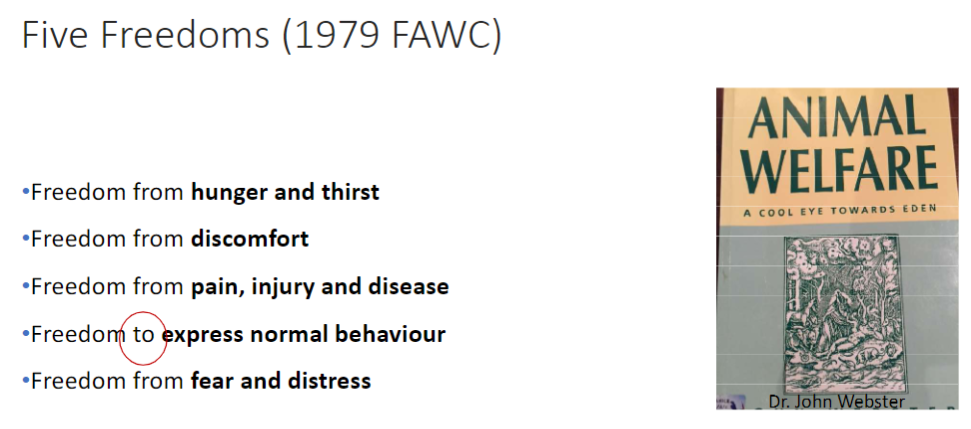
<p><strong>Freedom from Hunger and Thirst</strong><br> Ensures access to <strong>fresh water</strong> and a <strong>diet</strong> to maintain full <strong>health</strong> and <strong>vigour</strong></p><p><strong>Freedom from Discomfort</strong><br> Provides an appropriate <strong>environment</strong> including <strong>shelter</strong> and <strong>comfortable resting area</strong></p><p><strong>Freedom from Pain, Injury, and Disease</strong><br> Prevention or <strong>rapid diagnosis and treatment</strong> of illness or injury</p><p><strong>Freedom to Express Normal Behaviour</strong><br> Provision of <strong>sufficient space</strong>, <strong>proper facilities</strong>, and <strong>social companionship</strong> for natural behaviors</p><p><strong>Freedom from Fear and Distress</strong><br> Ensures conditions and treatment that avoid <strong>mental suffering</strong></p><p><strong>Key Figures</strong><br> Developed by <strong>UK Farm Animal Welfare Council (FAWC)</strong><br> Promoted by <strong>Dr. John Webster</strong></p>
5
New cards

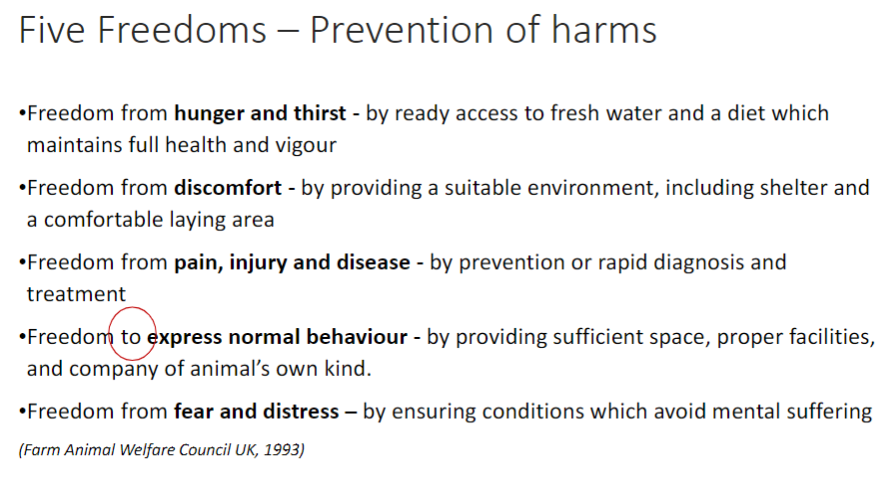
Five Freedoms – Prevention of Harms

Freedom from Hunger and Thirst
 Achieved by ready access to fresh water and a diet that maintains full health and vigour

Freedom from Discomfort
 Provided through a suitable environment, including shelter and a comfortable laying area

Freedom from Pain, Injury, and Disease
 Ensured by prevention or rapid diagnosis and treatment

Freedom to Express Normal Behaviour
 Enabled by sufficient space, proper facilities, and company of the animal’s own kind

Freedom from Fear and Distress
 Maintained by ensuring conditions that avoid mental suffering
<p><strong>Freedom from Hunger and Thirst</strong><br> Achieved by ready access to <strong>fresh water</strong> and a <strong>diet</strong> that maintains full <strong>health</strong> and <strong>vigour</strong></p><p><strong>Freedom from Discomfort</strong><br> Provided through a suitable <strong>environment</strong>, including <strong>shelter</strong> and a <strong>comfortable laying area</strong></p><p><strong>Freedom from Pain, Injury, and Disease</strong><br> Ensured by <strong>prevention</strong> or rapid <strong>diagnosis</strong> and <strong>treatment</strong></p><p><strong>Freedom to Express Normal Behaviour</strong><br> Enabled by sufficient <strong>space</strong>, proper <strong>facilities</strong>, and <strong>company</strong> of the animal’s own kind</p><p><strong>Freedom from Fear and Distress</strong><br> Maintained by ensuring <strong>conditions</strong> that avoid <strong>mental suffering</strong></p>
6
New cards

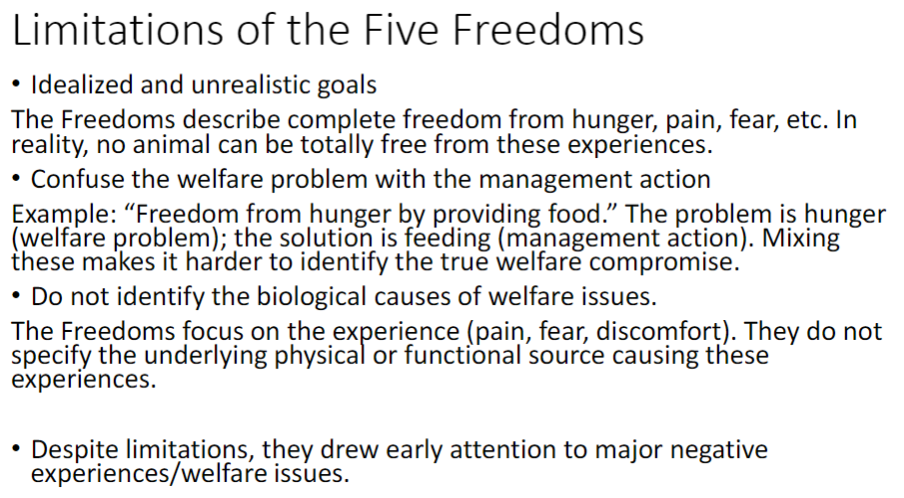
Five Freedoms – Limitations

Idealized and Unrealistic Goals
 Describe complete freedom from hunger, pain, fear, etc.
 No animal can be totally free from these experiences

Confusion of Welfare Problem and Management Action
 Welfare problem = the animal’s negative experience (e.g. hunger)
 Management action = human solution (e.g. feeding)
 Mixing these up = saying the problem was “not being fed” instead of recognizing the real problem was hunger, which can hide what the animal actually felt
 Mixing these makes it harder to identify the true welfare compromise

Lack of Biological Causes
 Focus on the experience (pain, fear, discomfort)
 Do not specify the underlying physical or functional causes

Positive Impact Despite Limitations
 Drew early attention to major negative experiences and welfare issues
<p><strong>Idealized and Unrealistic Goals</strong><br> Describe complete freedom from <strong>hunger</strong>, <strong>pain</strong>, <strong>fear</strong>, etc.<br> No animal can be totally free from these experiences</p><p><strong>Confusion of Welfare Problem and Management Action</strong><br> Welfare problem = the animal’s negative experience (e.g. <strong>hunger</strong>)<br> Management action = human solution (e.g. <strong>feeding</strong>)<br> Mixing these up = saying the problem was “not being fed” instead of recognizing the real problem was <strong>hunger</strong>, which can hide what the animal actually felt<br> Mixing these makes it harder to identify the true welfare <strong>compromise</strong></p><p><strong>Lack of Biological Causes</strong><br> Focus on the <strong>experience</strong> (pain, fear, discomfort)<br> Do not specify the underlying <strong>physical</strong> or <strong>functional causes</strong></p><p><strong>Positive Impact Despite Limitations</strong><br> Drew early attention to major <strong>negative experiences</strong> and welfare issues</p>
7
New cards

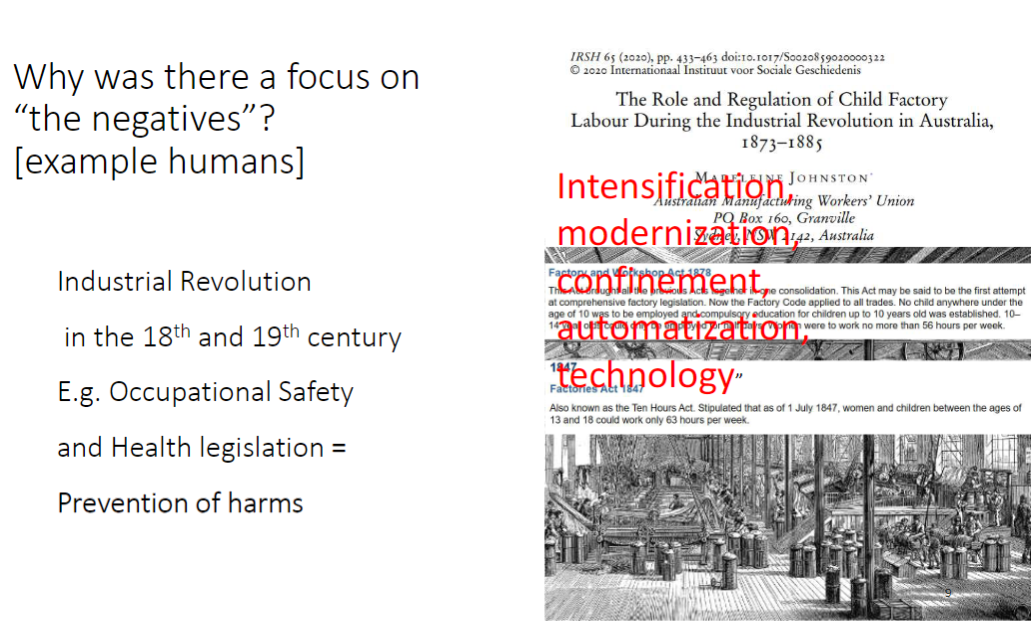
Focus on Negatives – Historical Context

Industrial Revolution
 Occurred in the 18th and 19th century
 Led to intensification, modernization, confinement, automatization, technology in human work and animal management

Prevention of Harms
 Example in humans: Occupational Safety and Health legislation
 Focus was on avoiding injury, pain, and suffering rather than promoting positive experiences
<p><strong>Industrial Revolution</strong><br> Occurred in the 18th and 19th century<br> Led to <strong>intensification, modernization, confinement, automatization, technology</strong> in human work and animal management</p><p><strong>Prevention of Harms</strong><br> Example in humans: <strong>Occupational Safety and Health legislation</strong><br> Focus was on avoiding <strong>injury, pain, and suffering</strong> rather than promoting positive experiences</p>
8
New cards

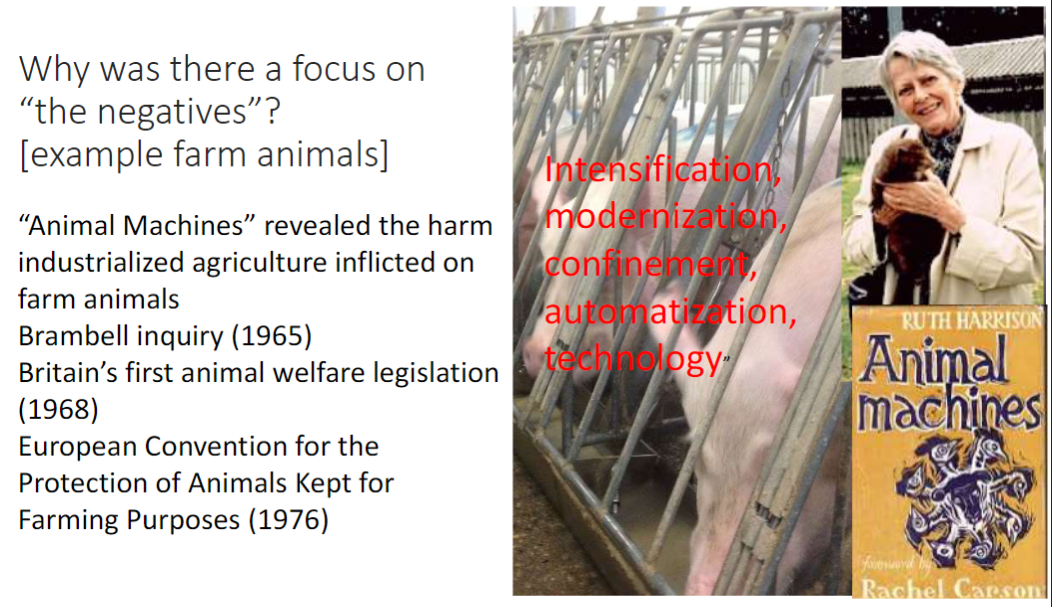
Focus on Negatives – Farm Animals

Industrialized Agriculture
“Animal Machines” revealed the harm inflicted on farm animals

Key Events
Brambell Inquiry (1965) – investigated conditions in farms
Britain’s first animal welfare legislation (1968) – early legal protection
European Convention for the Protection of Animals Kept for Farming Purposes (1976) – international framework
Ruth Harrison – highlighted poor welfare in intensive farming

Drivers of Negative Focus
Intensification, modernization, confinement, automatization, technology
 Aim was prevention of harms such as pain, injury, and distress
<p><strong>Industrialized Agriculture</strong><br> <strong>“Animal Machines”</strong> revealed the harm inflicted on farm animals</p><p><strong>Key Events</strong><br> <strong>Brambell Inquiry (1965)</strong> – investigated conditions in farms<br> <strong>Britain’s first animal welfare legislation (1968)</strong> – early legal protection<br> <strong>European Convention for the Protection of Animals Kept for Farming Purposes (1976)</strong> – international framework<br> <strong>Ruth Harrison</strong> – highlighted poor welfare in intensive farming</p><p><strong>Drivers of Negative Focus</strong><br> <strong>Intensification, modernization, confinement, automatization, technology</strong><br> Aim was <strong>prevention of harms</strong> such as pain, injury, and distress</p>
9
New cards

Focus on Negative Affective States

Clear Action Tendencies
Negative emotions trigger strong, single actions
  Fear → urge to escape
  Anger → urge to attack
  Disgust → urge to expel

Physiological Link
Action tendencies occur alongside physiological changes (e.g. fear triggers escape responses)

Evolutionary Advantage
 Behaviours helped early humans survive life-or-death situations

Health Effects
 Prolonged negative emotions show observable health impacts
 Reinforced impression that negative states are more significant
<p><strong>Clear Action Tendencies</strong><br> <strong>Negative emotions</strong> trigger strong, single actions<br>  <strong>Fear</strong> → urge to escape<br>  <strong>Anger</strong> → urge to attack<br>  <strong>Disgust</strong> → urge to expel</p><p><strong>Physiological Link</strong><br> <strong>Action tendencies</strong> occur alongside <strong>physiological changes</strong> (e.g. fear triggers escape responses)</p><p><strong>Evolutionary Advantage</strong><br> Behaviours helped <strong>early humans survive life-or-death situations</strong></p><p><strong>Health Effects</strong><br> Prolonged <strong>negative emotions</strong> show observable <strong>health impacts</strong><br> Reinforced impression that <strong>negative states</strong> are more significant</p>
10
New cards

Animal Quality of Life – Five Freedoms
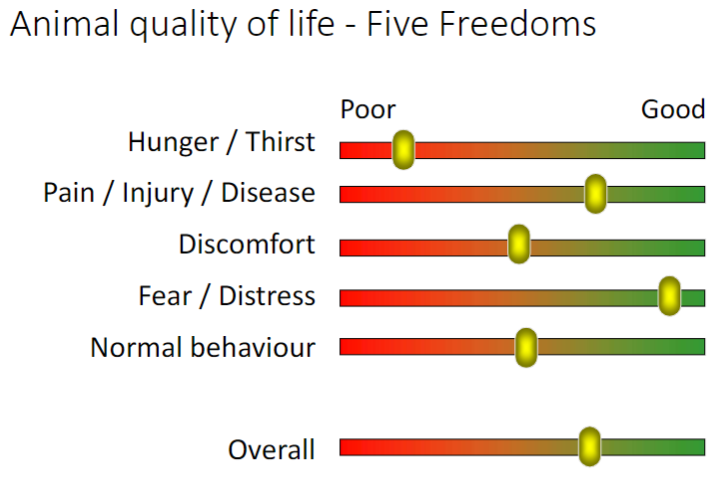
<p></p>
11
New cards

Five Freedoms – Conflict Examples

Freedom from Disease
 Conflict: Fear from handling during treatment

Freedom to Express Normal Behaviour
 Conflict: Distress during normal social interactions
<p><strong>Freedom from Disease</strong><br> Conflict: <strong>Fear</strong> from handling during treatment</p><p><strong>Freedom to Express Normal Behaviour</strong><br> Conflict: <strong>Distress</strong> during normal social interactions</p>
12
New cards

Normal Behaviour – Farming Examples

Restriction by Farming Systems
 All farming systems restrict normal behaviour to some extent (see Five Freedoms)

Grazing Behaviour
 Cows spend ~8–9 hours/day grazing
 Move slowly across pasture, muzzle close to the ground
 Bite and tear grass, swallow with little chewing
 Ruminate when resting (~¾ of grazing time)

Restrictions
 Fences and housing limit normal ranging behaviour

Feeding & Food-Seeking Behaviour
 When grazing, cows stand with one front leg forward and graze while walking forward
 Do not naturally walk backwards
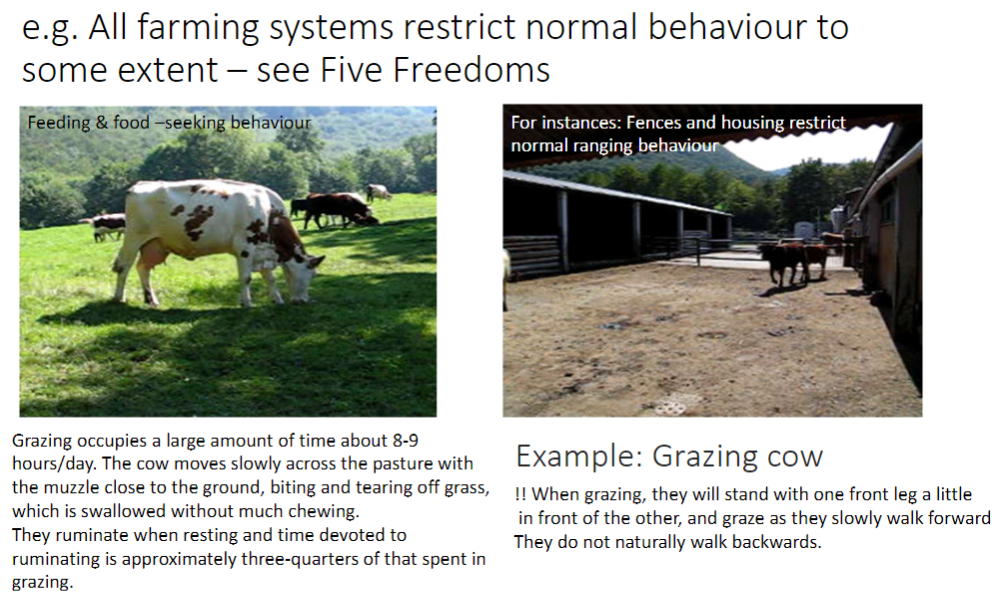
<p><strong>Restriction by Farming Systems</strong><br> All farming systems restrict <strong>normal behaviour</strong> to some extent (see <strong>Five Freedoms</strong>)</p><p><strong>Grazing Behaviour</strong><br> Cows spend ~8–9 hours/day grazing<br> Move slowly across pasture, <strong>muzzle close to the ground</strong><br> Bite and tear grass, swallow with little chewing<br> Ruminate when resting (~¾ of grazing time)</p><p><strong>Restrictions</strong><br> Fences and housing limit <strong>normal ranging behaviour</strong></p><p><strong>Feeding &amp; Food-Seeking Behaviour</strong><br> When grazing, cows stand with <strong>one front leg forward</strong> and graze while walking forward<br> Do not naturally walk backwards</p>
13
New cards

Five Freedoms – Limitations – Summary

First Framework
 Offered the first widely used structure for thinking about animal welfare

Focus on Negatives
 Mainly focused on preventing negative states, reflecting early problem-solving approaches

Biological Limits
 “Freedom from…” conditions are not biologically achievable
 Cannot grade how mild or severe welfare impacts are

Positive Experiences Missing
 Does not address positive experiences or broader emotional needs (e.g. pleasure, curiosity, social comfort)

Need for Modern Framework
 Highlighted the need for a science-driven framework that includes both negative and positive aspects of animal experience
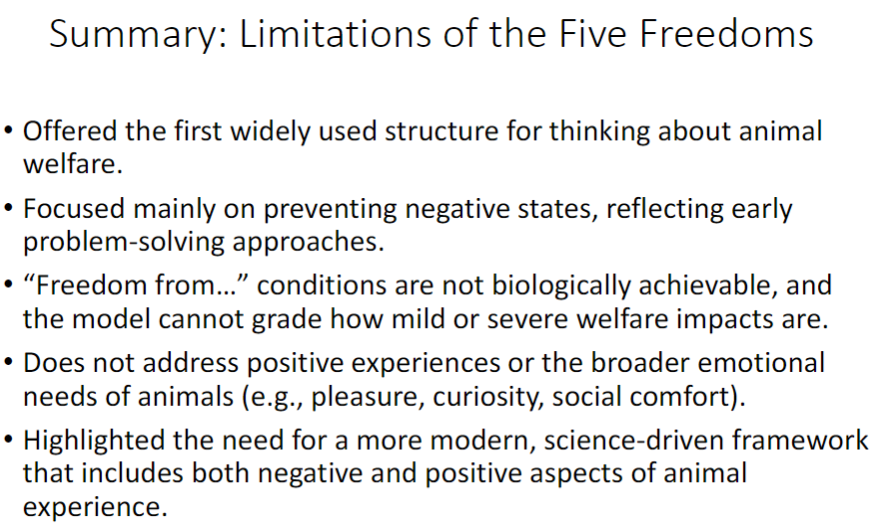
<p><strong>First Framework</strong><br> Offered the first widely used structure for thinking about <strong>animal welfare</strong></p><p><strong>Focus on Negatives</strong><br> Mainly focused on preventing <strong>negative states</strong>, reflecting early problem-solving approaches</p><p><strong>Biological Limits</strong><br> “Freedom from…” conditions are <strong>not biologically achievable</strong><br> Cannot grade how <strong>mild or severe</strong> welfare impacts are</p><p><strong>Positive Experiences Missing</strong><br> Does not address <strong>positive experiences</strong> or broader <strong>emotional needs</strong> (e.g. <strong>pleasure, curiosity, social comfort</strong>)</p><p><strong>Need for Modern Framework</strong><br> Highlighted the need for a <strong>science-driven framework</strong> that includes both <strong>negative and positive</strong> aspects of <strong>animal experience</strong></p>
14
New cards

Animal Welfare – Shifting Perspectives – Life Sciences

Scientific Interest
 Focus on positive psychology in animal welfare

Quality of Life
 Emphasizes overall well-being, not just absence of harm

Happiness Concepts
Pleasant Life – experiencing enjoyment and comfort
Good Life – fulfilling natural behaviours and needs
Meaningful Life – having purpose or engagement in activities
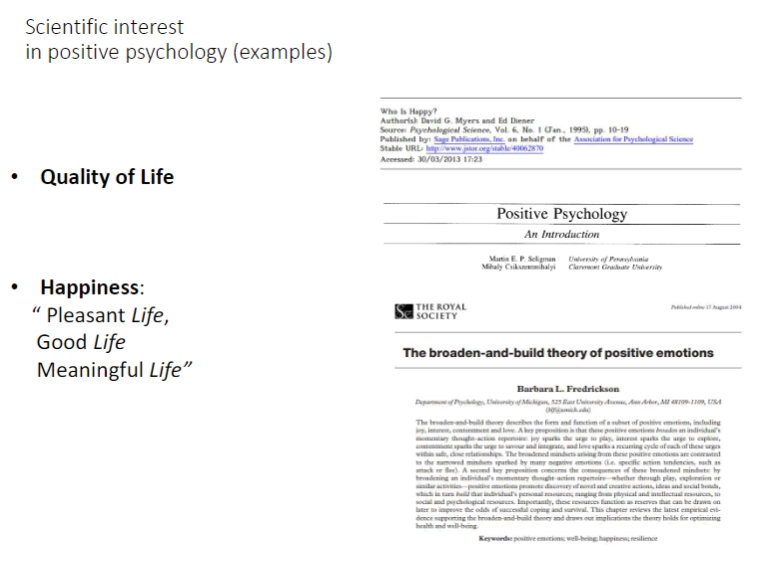
<p><strong>Scientific Interest</strong><br> Focus on <strong>positive psychology</strong> in animal welfare</p><p><strong>Quality of Life</strong><br> Emphasizes overall <strong>well-being</strong>, not just absence of harm</p><p><strong>Happiness Concepts</strong><br> <strong>Pleasant Life</strong> – experiencing enjoyment and comfort<br> <strong>Good Life</strong> – fulfilling natural behaviours and needs<br> <strong>Meaningful Life</strong> – having purpose or engagement in activities</p>
15
New cards

Quality of Life – Human Example

Behaviour Restriction
 City living limits normal behaviour to some extent

Comparing Cities
 Different cities offer varying levels of quality of life

Example Outcome
New York was not ranked highest for quality of life
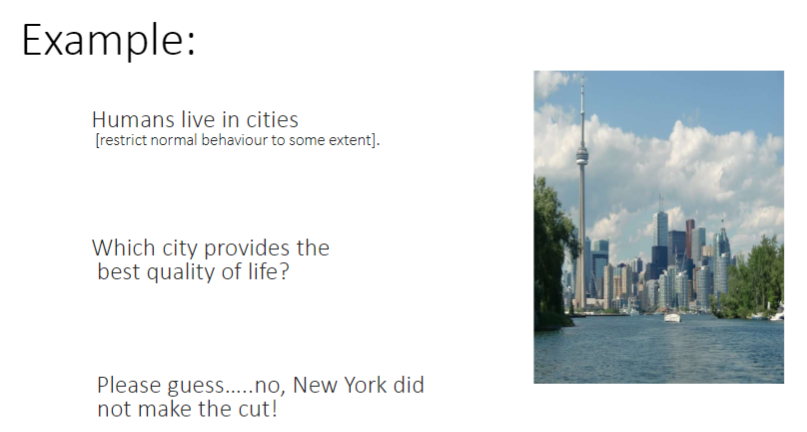
<p><strong>Behaviour Restriction</strong><br> City living <strong>limits normal behaviour</strong> to some extent</p><p><strong>Comparing Cities</strong><br> Different cities offer varying levels of <strong>quality of life</strong></p><p><strong>Example Outcome</strong><br> <strong>New York</strong> was <strong>not ranked highest</strong> for quality of life</p>
16
New cards

Animal Welfare – New Perspectives

Quality of Life
 Focus on understanding what makes a good life for animals
 Growing interest in positive experiences and well-being

Key Question (Bentham, 1748–1832)
 Not: “Can animals reason?” or “Can they talk?”
 But: “Can they suffer?”
 Emphasis on avoiding negative experiences
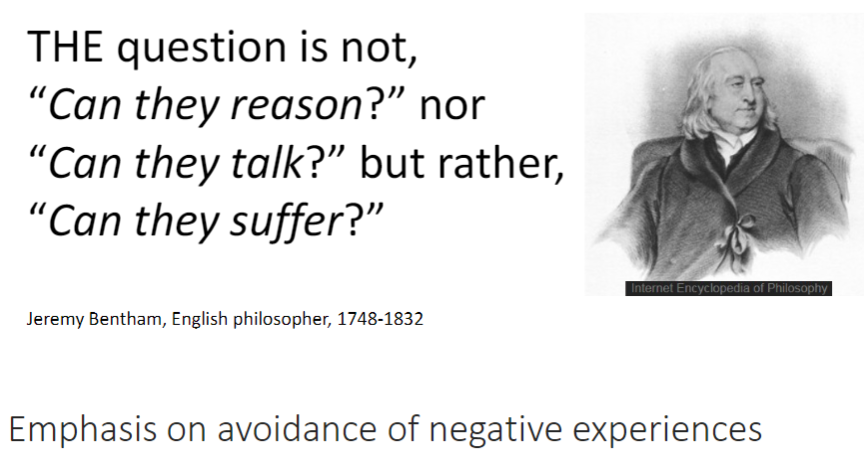
<p><strong>Quality of Life</strong><br> Focus on understanding what makes a <strong>good life</strong> for animals<br> Growing interest in <strong>positive experiences</strong> and <strong>well-being</strong></p><p><strong>Key Question (Bentham, 1748–1832)</strong><br> Not: “Can animals <strong>reason</strong>?” or “Can they <strong>talk</strong>?”<br> But: “Can they <strong>suffer</strong>?”<br> Emphasis on <strong>avoiding negative experiences</strong></p>
17
New cards

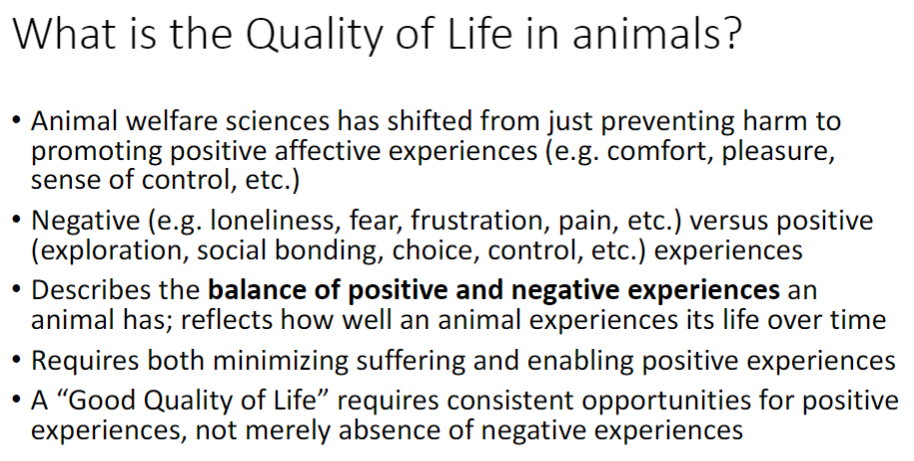
Animal Quality of Life – Key Points

Shift in Welfare Science
 From just preventing harm to promoting positive affective experiences (comfort, pleasure, sense of control)

Negative vs Positive Experiences
 Negative: loneliness, fear, frustration, pain
 Positive: exploration, social bonding, choice, control

Definition
 Balance of positive and negative experiences over time
 Reflects how well an animal experiences its life

Requirements for Good Quality of Life
 Minimize suffering
 Enable positive experiences
 Consistent opportunities for positive experiences, not just absence of negatives
<p><strong>Shift in Welfare Science</strong><br> From just preventing <strong>harm</strong> to promoting <strong>positive affective experiences</strong> (comfort, pleasure, sense of control)</p><p><strong>Negative vs Positive Experiences</strong><br> Negative: <strong>loneliness, fear, frustration, pain</strong><br> Positive: <strong>exploration, social bonding, choice, control</strong></p><p><strong>Definition</strong><br> Balance of <strong>positive and negative experiences</strong> over time<br> Reflects how well an animal <strong>experiences its life</strong></p><p><strong>Requirements for Good Quality of Life</strong><br> Minimize <strong>suffering</strong><br> Enable <strong>positive experiences</strong><br> Consistent opportunities for <strong>positive experiences</strong>, not just absence of negatives</p>
18
New cards

Quality of Life – Key Points

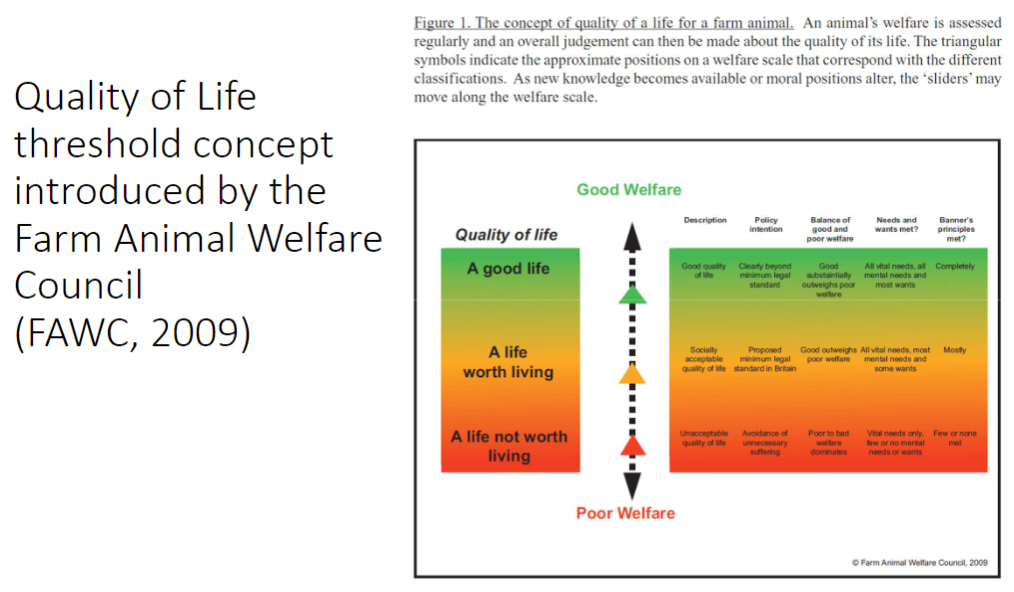
Threshold Concept
 Introduced by the Farm Animal Welfare Council (FAWC, 2009)

Categories of Quality of Life
A good life – consistently positive experiences, high welfare
A life worth living – overall more positive than negative experiences
A life not worth living – negative experiences outweigh positives, poor welfare
<p><strong>Threshold Concept</strong><br> Introduced by the <strong>Farm Animal Welfare Council (FAWC, 2009)</strong></p><p><strong>Categories of Quality of Life</strong><br> <strong>A good life</strong> – consistently positive experiences, high welfare<br> <strong>A life worth living</strong> – overall more positive than negative experiences<br> <strong>A life not worth living</strong> – negative experiences outweigh positives, poor welfare</p>
19
New cards

Quality of Life – Definition

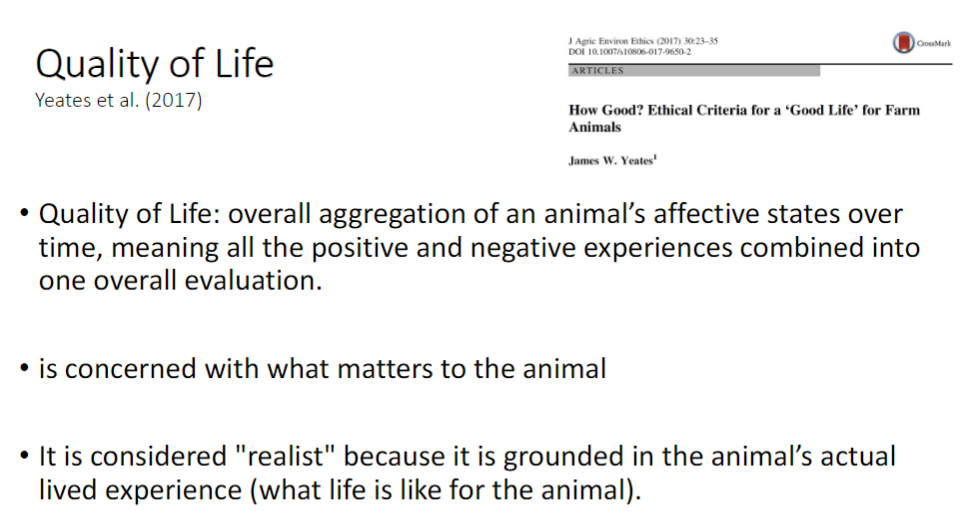
Overall Evaluation
Quality of Life – aggregation of an animal’s affective states over time, combining all positive and negative experiences into one overall assessment

Key Points
 Concerned with what matters to the animal
 Considered realist – based on the animal’s actual lived experience
<p><strong>Overall Evaluation</strong><br> <strong>Quality of Life</strong> – aggregation of an animal’s <strong>affective states</strong> over time, combining all <strong>positive</strong> and <strong>negative experiences</strong> into one overall assessment</p><p><strong>Key Points</strong><br> Concerned with what <strong>matters to the animal</strong><br> Considered <strong>realist</strong> – based on the animal’s actual <strong>lived experience</strong></p>
20
New cards

Life Worth Living – Definition

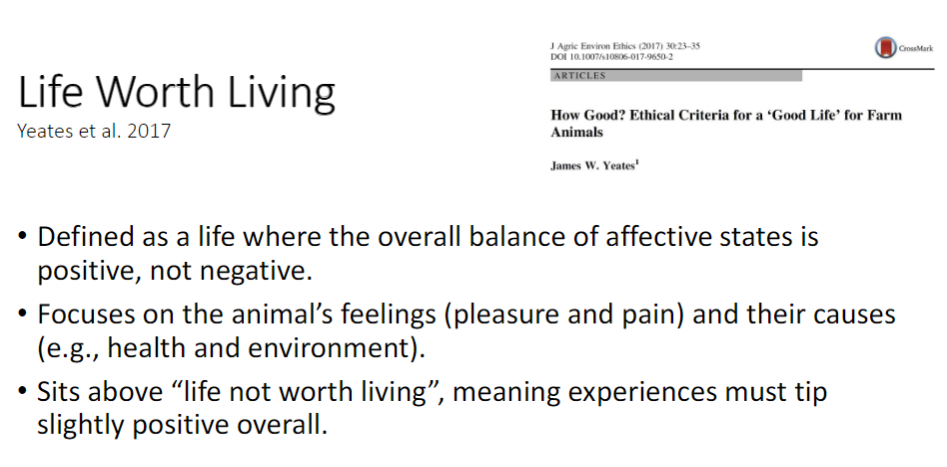
Life Worth Living
 A life where the overall balance of affective states is positive rather than negative

Key Points
 Focuses on the animal’s feelingspleasure and pain – and their causes (e.g., health, environment)
 Sits above Life Not Worth Living – experiences must tip slightly positive overall
<p><strong>Life Worth Living</strong><br> A life where the overall balance of <strong>affective states</strong> is <strong>positive</strong> rather than negative</p><p><strong>Key Points</strong><br> Focuses on the animal’s <strong>feelings</strong> – <strong>pleasure</strong> and <strong>pain</strong> – and their <strong>causes</strong> (e.g., health, environment)<br> Sits above <strong>Life Not Worth Living</strong> – experiences must tip slightly <strong>positive</strong> overall</p>
21
New cards

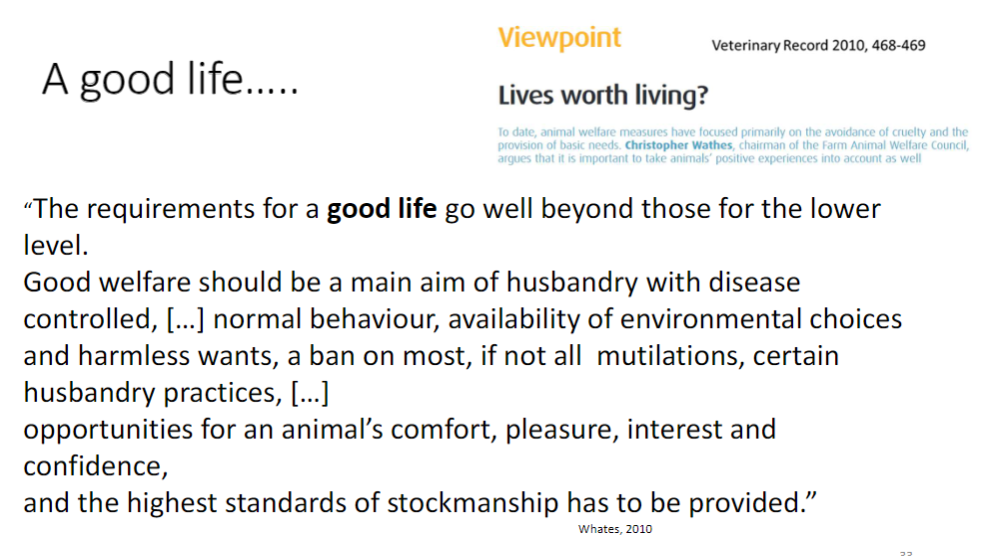
A Good Life – Definition

A Good Life
 Requirements go beyond basic welfare and prevention of harm

Key Points
Good welfare should be a main aim of husbandry
Disease controlled, normal behaviour allowed, environmental choices provided
Harmless wants met, ban on most or all mutilations and certain husbandry practices
 Opportunities for comfort, pleasure, interest, and confidence
 Highest standards of stockmanship must be provided
<p><strong>A Good Life</strong><br> Requirements go beyond basic welfare and prevention of harm</p><p><strong>Key Points</strong><br> <strong>Good welfare</strong> should be a main aim of husbandry<br> <strong>Disease controlled</strong>, <strong>normal behaviour</strong> allowed, <strong>environmental choices</strong> provided<br> <strong>Harmless wants</strong> met, ban on most or all <strong>mutilations</strong> and certain <strong>husbandry practices</strong><br> Opportunities for <strong>comfort</strong>, <strong>pleasure</strong>, <strong>interest</strong>, and <strong>confidence</strong><br> Highest standards of <strong>stockmanship</strong> must be provided</p>
22
New cards

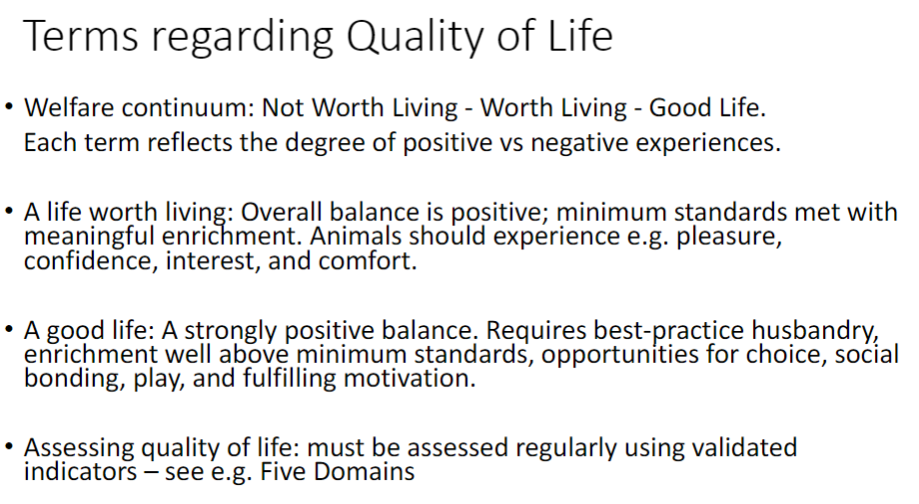
Quality of Life – Key Terms

Welfare Continuum
 Not Worth Living – Worth Living – Good Life
 Each term reflects the balance of positive vs negative experiences

A Life Worth Living
 Overall balance is positive
 Minimum standards met with meaningful enrichment
 Animals experience pleasure, confidence, interest, comfort

A Good Life
 Strongly positive balance
 Requires best-practice husbandry, enrichment above minimum standards
 Opportunities for choice, social bonding, play, fulfilling motivation

Assessing Quality of Life
 Must be assessed regularly using validated indicators (e.g., Five Domains)
<p><strong>Welfare Continuum</strong><br> Not Worth Living – Worth Living – Good Life<br> Each term reflects the balance of <strong>positive vs negative experiences</strong></p><p><strong>A Life Worth Living</strong><br> Overall balance is <strong>positive</strong><br> Minimum standards met with meaningful <strong>enrichment</strong><br> Animals experience <strong>pleasure</strong>, <strong>confidence</strong>, <strong>interest</strong>, <strong>comfort</strong></p><p><strong>A Good Life</strong><br> Strongly <strong>positive balance</strong><br> Requires <strong>best-practice husbandry</strong>, enrichment above minimum standards<br> Opportunities for <strong>choice</strong>, <strong>social bonding</strong>, <strong>play</strong>, fulfilling <strong>motivation</strong></p><p><strong>Assessing Quality of Life</strong><br> Must be assessed regularly using <strong>validated indicators</strong> (e.g., <strong>Five Domains</strong>)</p>
23
New cards

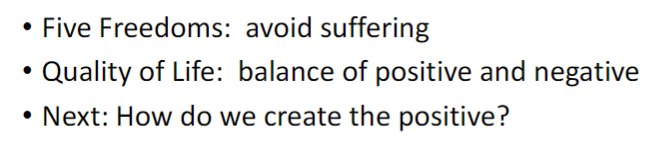
Animal Welfare – From Avoiding Suffering to Promoting Positives

Five Freedoms
 Focus on avoiding suffering

Quality of Life
 Focus on the balance of positive and negative experiences

Next Step
 Consider how to create positive experiences for animals
<p><strong>Five Freedoms</strong><br> Focus on <strong>avoiding suffering</strong></p><p><strong>Quality of Life</strong><br> Focus on the <strong>balance of positive and negative experiences</strong></p><p><strong>Next Step</strong><br> Consider how to <strong>create positive experiences</strong> for animals</p>



