PSY280 Lecture 8: Motion & Intro to Colour
 Call Kai
 Learn
Learn Practice Test
 Spaced Repetition
 Match
Match Flashcards
 Knowt Play
1/47

There's no tags or description
Looks like no tags are added yet.
Name | Mastery | Learn | Test | Matching | Spaced | Call with Kai |
|---|
No analytics yet
Send a link to your students to track their progress
48 Terms
What information does visual motion provide?
Helps recognize objects
Helps distinguish depth relations
Helps us interact with the environment
Helps direct our attention
Environmental Interaction- What is vection? What is optic flow?
Vection: perception of self-motion due to optic flow
Optic flow helps us know which way we are headed
Example pilot uses this to land a plane, using optic flow cues to judge where they are going to land
It's the expansion of the image on your retina as you move forward or the contraction of it as you move backward, but it changes in the expansion of the retinal image as you move through space
Also underlies phenomenon called vection
If show motion may feel like moving but not actually
In movie theatre, sitting up close, IMAX movie, feel like flying or moving but are actually stationary.
In car/train and car next to you starts moving, that's next to you.
Environmental Interaction- What is Optic Flow & Tau?
Need to know when something is going to collide with you (like a baseball or a boxing glove)
Could calculate this based on how far something is & how fast its moving: Time to collision = distance/speed
Problem is the visual system is bad at estimating distance
Useful for knowing when something going to reach/hit me.
One possibility, slow, clunky inefficient way-to calculate it based on how far something is and how quickly it is moving.
We do not do this
Use high school physics formula time to collusion=distance/speed
Very slow & clunky way, not way brain does this
If use this garbage at figuring/estimating out distance
Use a lot of depth cues but not very precise
Instead if want to know when something will hit me a more efficient way is to do faster computer & use rate at which the image expands, use our optic flow information to figure out when something will hit me.
What is Tau?
Optic flow gives us access to Tau (τ), which is related to time to collision but is easier for the visual system to calculate than physical distance
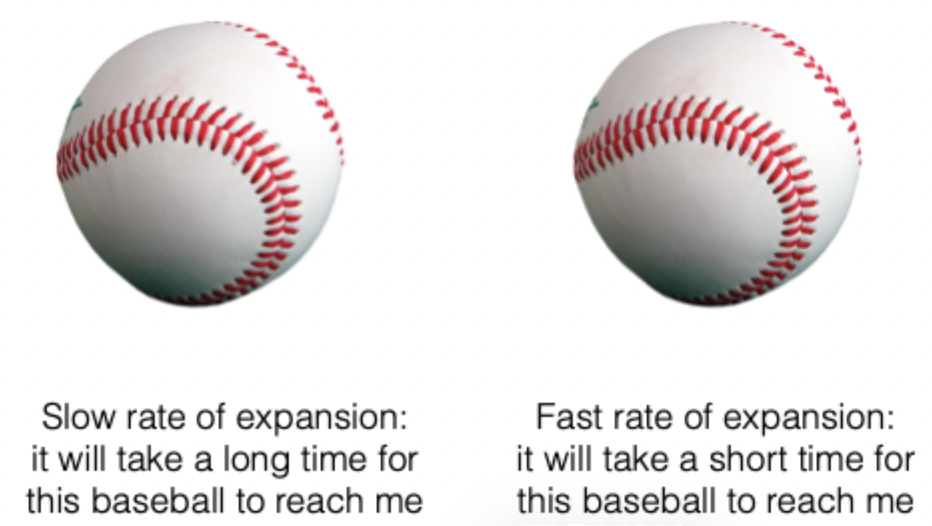
Tau is inversely proportional to the rate that the retinal image expands
Objects expanding quickly will reach you sooner than objects expanding more slowly
Slow rate of expansion: it will take a long time for this baseball to reach me
Fast rate of expansion: it will take a short time for this baseball to reach me
Many organisms use Tau, including gannets, flies, and pigeons (who have specialized cells that respond at a fixed interval before contact)
Environmental Interaction
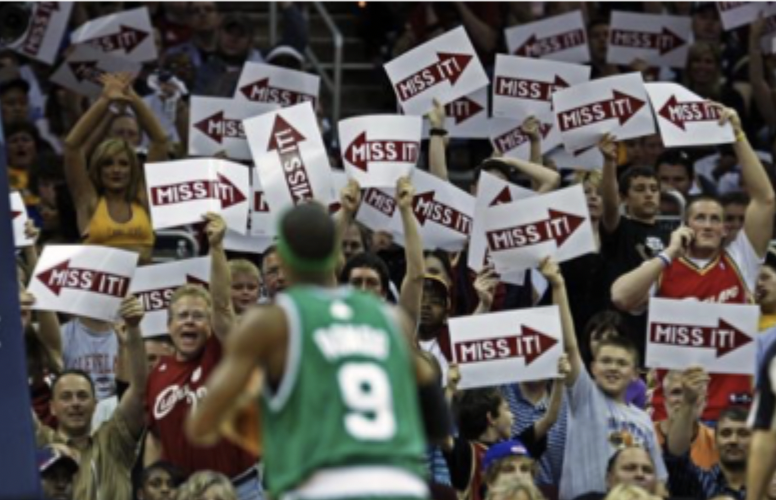
Motion capture can influence reaching, pointing & throwing
Need to factor in motion to figure out where I'm reaching
Motion influences reaching, pointing and throwing
Fo example in basketball if you have people who are adding optic flow by adding these arrows & moving them, there's motion back here that can throw people off
Because you have this very strong optic view, the environments moving this way, maybe I need to counteract that.
But motion is very important for impacting reaching, throwing & pointing motion
What is Guided attention?
When have motion can’t help but pay attention to it. Motion captures attention.
For example, look for the backwards ‘R’ among a bunch of ‘Rs’. This is very hard to do. However when added motion to the image, captured attention instantly.
Interim Summary
Motion is critical to many aspects of vision
Object recognition (structure from motion)
Depth perception (parallax)
Navigation (optic flow)
Attentional Guidance (visual search)
How do we perceive motion? Is motion directly measured or inferred from position change?
One possibility is motion is directly measured by our visual system
Cells selective for motion & have distinct physiological mechanisms for sensing motion directly
Neurons in brain sensitive to movement
Something we can potentially directly tap into via the responses of our cells.
Have evidence that motion is something directly measured not inferred by our visual system.
We have some evidence for these low-level detectors. So the idea is that there is some evidence that we have neurons in our brain that are directly sensitive to movement & operate at very early stage of visual processing
Another possibility is the slower & clunkier route, which is that we might have to infer motion from position change.
Need to do a comparison. This object was here at time 1 and this object was here at time 2. So here it's like an A-B comparison.
I've noticed that this thing changed position so I infer because it has changed position that there must be movement
Indirect, clunky, included inference
Evidence for low level detectors
Motion aftereffect, we perceive motion due to adaptation
Looking at something for prolonged time, decrease in firing rate of neurons that respond to that stimulus
Can do same thing and apply it to movement
Kinematograms, motion then shape
Direct measurement of motion- What is Motion After-Effect (MAE)?
Star at blue dot in middle of screen, motion is going inward. Then shown photo of stationary Buddha but it looks like its moving outward to you. Looks like it is expanding
Motion is in opposite direction of what you adapted to.
Looking at something stationary but moving
Motion directly measured & NOT inferred from position change.
Adapting to motion & seeing something opposite of what you adapted to. Looking at something stationary yet perceiving movement. This suggests motion really cannot be inferred from position change because I have something that isn't moving at all, there is no physical position change happening with the Buddha & yet you are seeing movement
NOT inferred from position change but motion is directly measured
No physical movement but seeing movement.
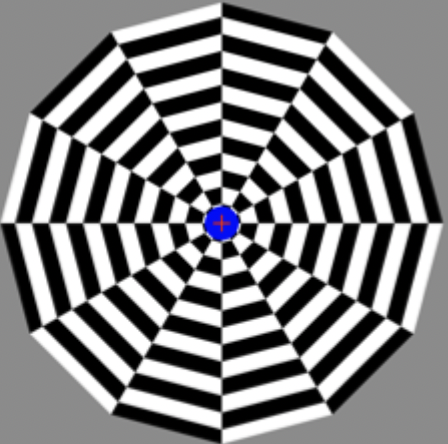
What is Motion After Effect (MAE)?
Similar to tilt aftereffect
Have different populations of neurons- some neurons prefer inward, some prefer outward.
Pre-test
When looking at something not moving/static, they are both firing a little but but not a lot, firing at their spontaneous firing rate. They are in balance, perception stationary, nothing moving
Adaptation
When looking at movement, physical stimulus moving inward, inward cells are happy and have a high firing rate for inward motion
Outward motion cells at their spontaneous rate
Now tipped in favour of inward preferring neurons, perception of inward movement
While adapting seeing inward. Overtime, when adapt firing rates will decrease. Fatigue analogy.
Post-test
After adapted for prolonged period, looking at static image, inward preferring cells have adapted out and stop responding.
Outward preferring neurons spontaneous level of activity.
Outward at spontaneous level, inward stop responding. Balance of system is tipped, in favour of outward motion
Therefore perceive outward orientation
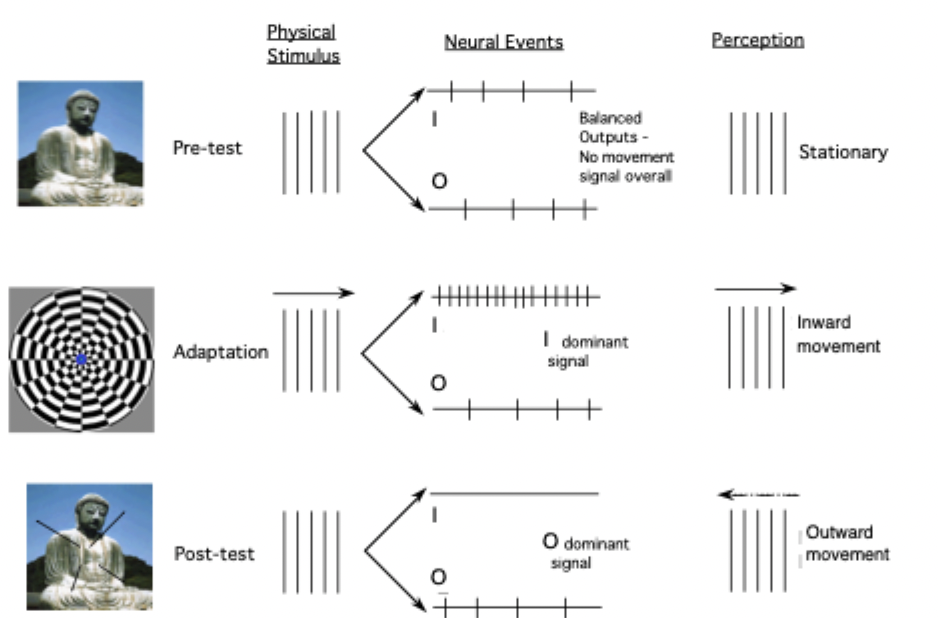
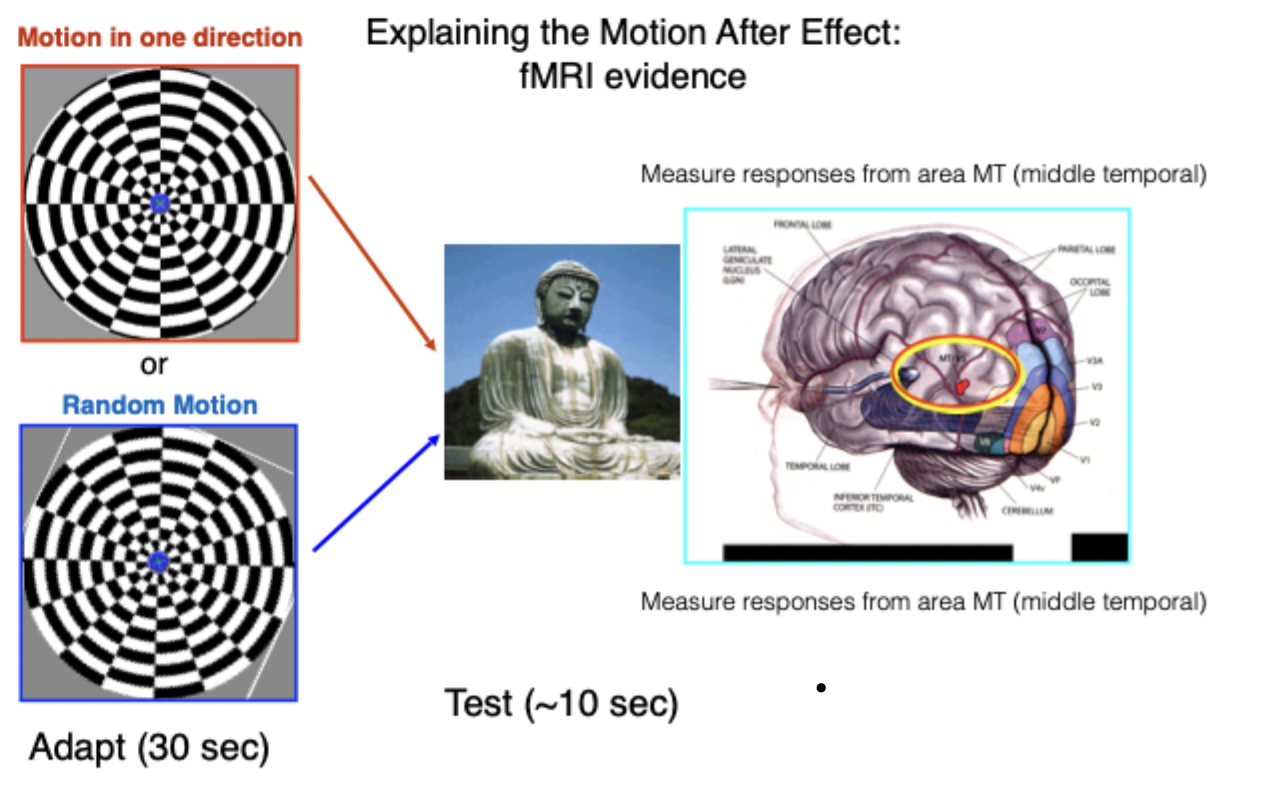
Explaining the Motion After Effect: What is the Medial Temporal Area? What is some fMRI evidence?
Motion directly measured
Motion processed at many different stages of visual processing, certain areas particularly sensitive
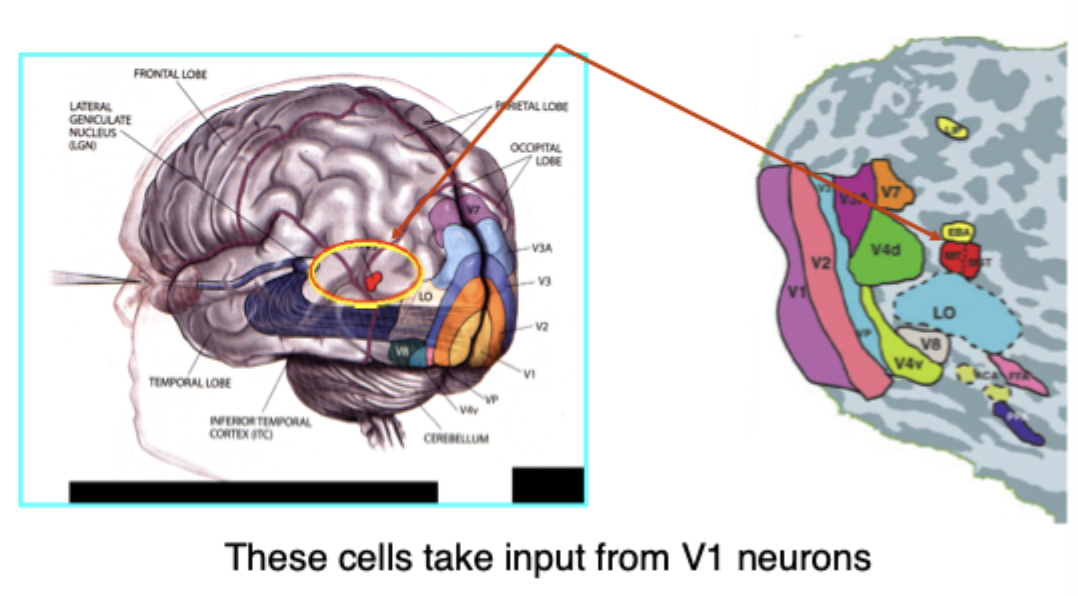
MT (medial temporal area), V5, motion selective area
Important for our conscious experience of motion
Many cells in the brain respond to motion but all of those cells send cells to this area, area MT
Compare two different conditions to see where in the brain the motion after effect is happening, what kind of responses do we see in a situation where there's no actual movement & yet we have this experience, our conscious experience is of movement
One condition participants adapting to motion in one direction (inward movement) then look at stationary image of Buddha
In the second condition have random motion, neither inward or outward, flicker, random. Movement but not consistently in one condition
Would expect motion after-effect in condition at the top and NO motion aftereffect in the one at the bottom, since its random and not moving consistently in one way.
Compare how area MT responds to aftereffect for each condition & then look at statis Buddha image.
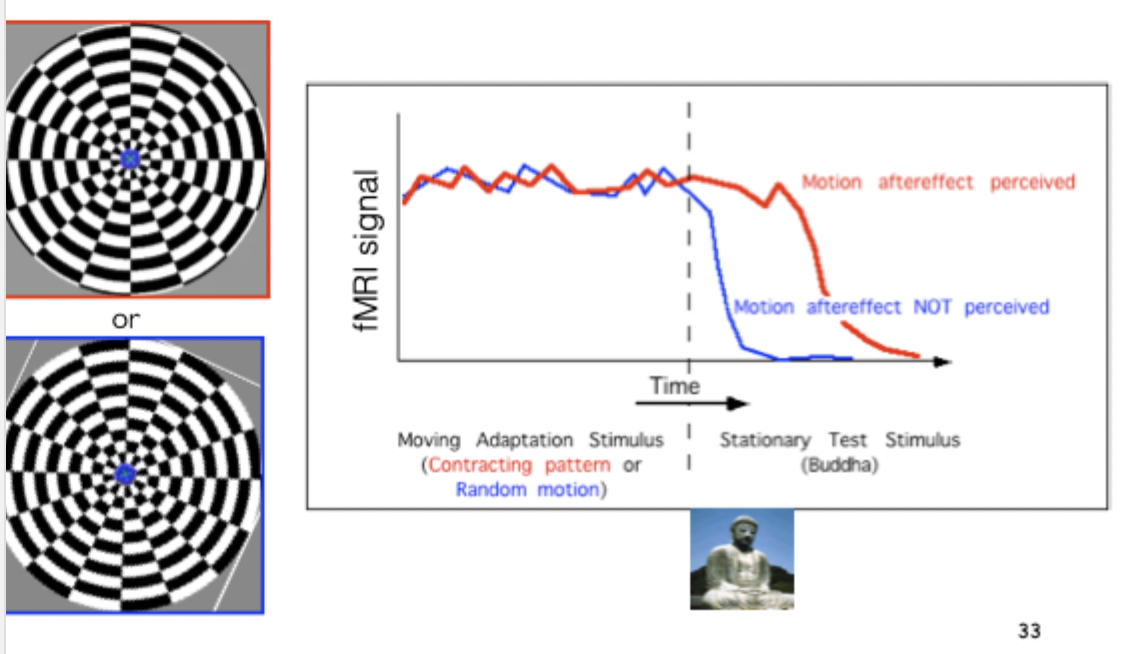
Result from fMRI MAE
Red line is the condition in which I expect to get a motion aftereffect, the dashed line represents where have shift from adapting to looking at the stationary image.
Everything to left of dashed line is during adaptation. Right switched over to stationary Buddha image.
Area MT responds very strongly when adapting, at dashed line have change over to static image.
In one condition expect to get motion in one direction, and in blue don’t expect to get motion aftereffect. Red motion aftereffect perceived
In area MT see response while looking at a stationary image but only in the condition where I perceive the motion aftereffect. Area MT is responding very strongly when I experience the aftereffect even though there's no movement.
In the condition where there's no aftereffect activity drops pretty quickly, right away. The idea is that im seeing a stationary image, I haven't adapted to motion in one direction so there is no aftereffect.
Conclusion
So area MT seems to be largely related to our experience of the motion aftereffect
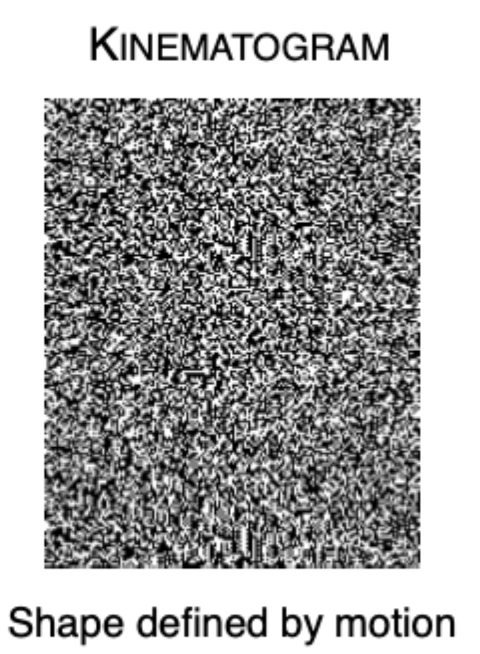
Direct Measurement of Motion- Kinematogram
Shape defined by motion
Another piece of evidence that motion is something that we directly measure is something seen in kinematograms.
See black and white TV static, now add movement to it, see a rectangle.
When no motion there is no shape, when add motion add shape out of that motion.
Motion and then shape
In order to perceive shape, have to perceive motion/movement first.
Motion directly measured, I cannot compare the position of the rectangle at one point in time to the other point in time unless I see the shape. Here this is just one point in time, nothing to infer/compare between A and B
Shape as result of movement.
Stereograms vs. Kinematogram
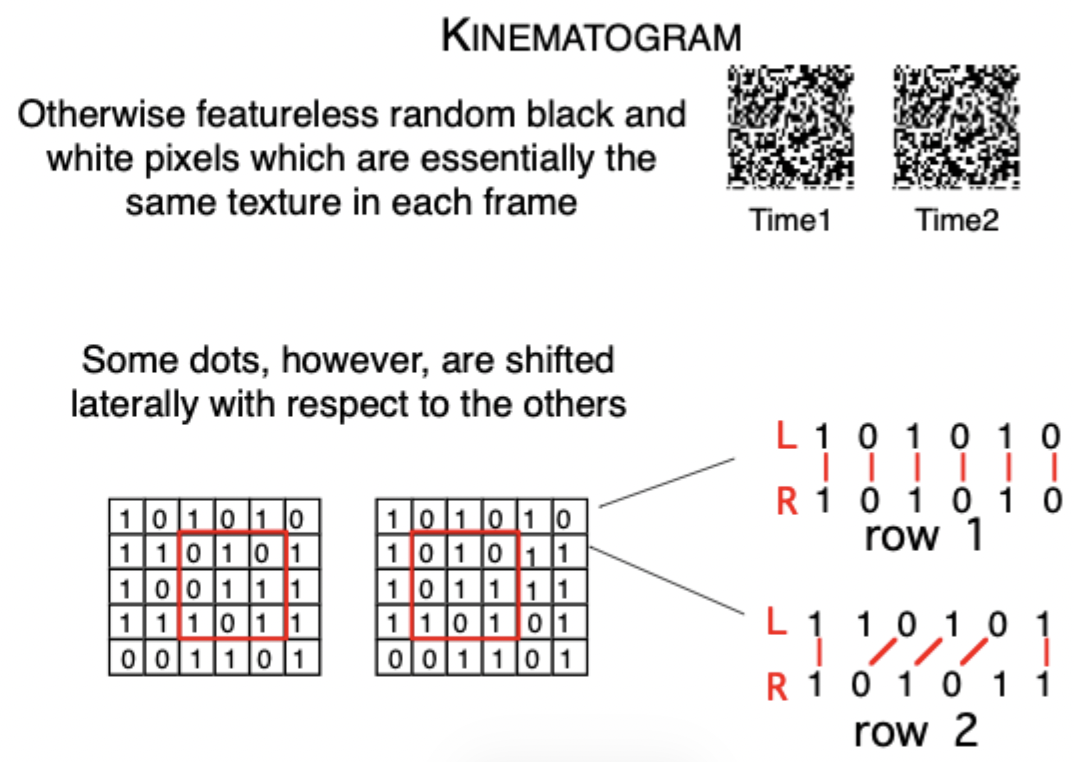
Kinematograms are similar to random dot stereograms, only with motion instead of disparity
Random dot kinematogram are just like these stereograms except here with stereograms I had a left eye image & a right eye image.
With kinematograms what I’m doing is just shifting them over time. Time 1, time 2, which is what lets me see the shape.
So is motion directly measured? Or inferred from position change of object?
Saw motion where there was no change in position of object (motion aftereffect)
Saw motion where there was no noticeable object (kinematogram)
Therefore, Motion directly measured by our visual system, not inferred
MAE
Kinematograms
Motion is Directly Measured
Motion is directly measured, not inferred
That means we have parts of the brain that are explicitly sensitive to motion (e.g, MT)
What are Receptive fields?
Receptive field: an area on the retina corresponding to an area in the visual field to which a cell is responsive
An area out there in space corresponding to point in retina to which a neuron responds
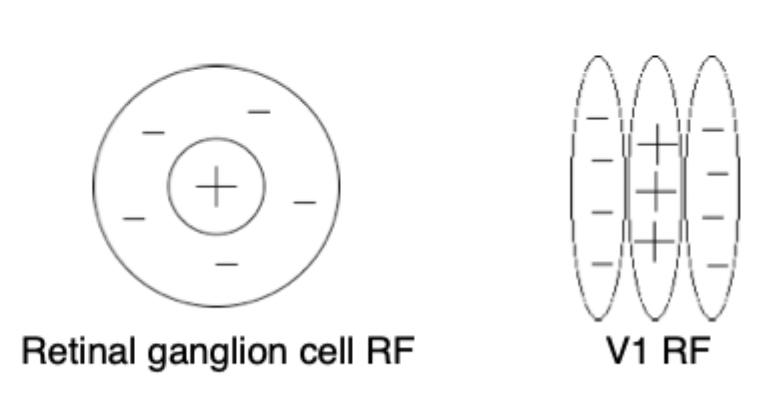
Physiology of motion detection
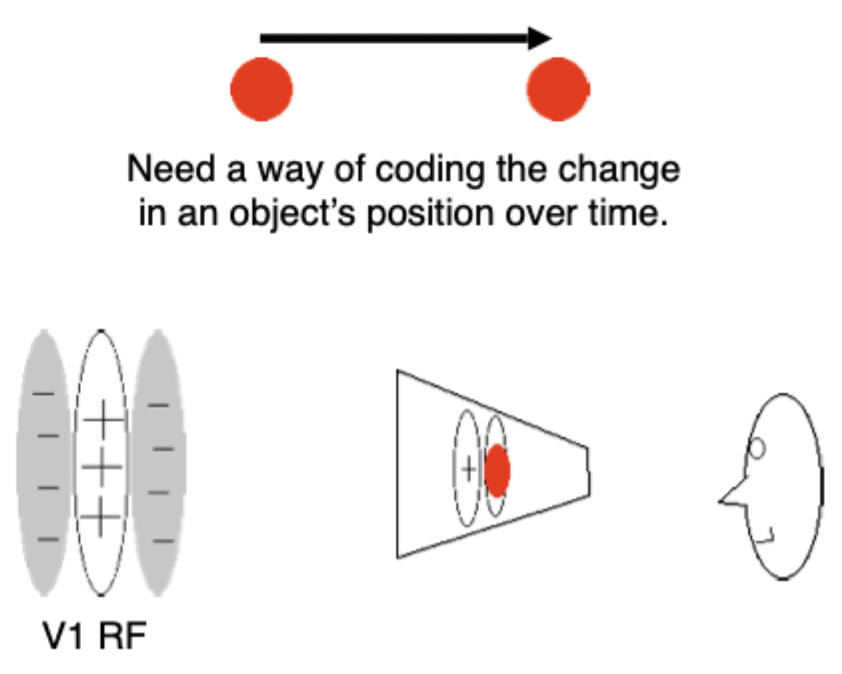
If I need to have a neuron that's directly sensing motion I have to have some way of coding or responding to the change in an objects position over time. That is essentially what movement is. I need some way of directly sensing that.
Have V1 receptive field, set aside on & off regions. Looking at a picture, need some mechanism to tell me that I have one thing at one point in time & another thing at another point in time. Need some way of coding fact something is here on the receptive field on the left & then something is here on the receptive field on the right at different points in time.
Build circuit for detecting motion
Need to build circuit for motion detection.
Hypothetical circuit for detecting motion-exists as mechanism for motion detection.
Physiology of motion detection- What is Reichardt Detector?
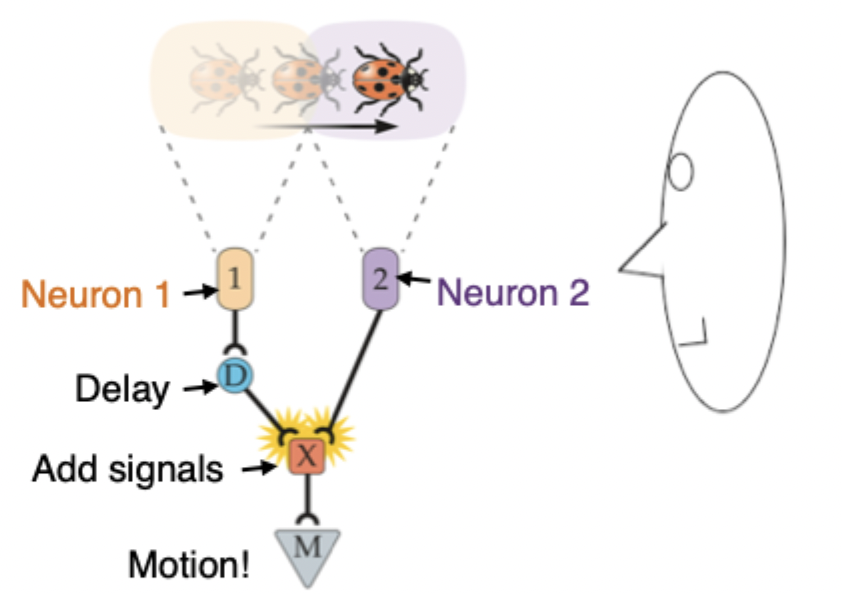
Reichardt Detector- Directionally Selective Unit
These motion detecting circuits are called Reichardt detectors
They are simple neural circuits that our brains use for detecting movement
One neuron not enough
Have one neuron in peach, another in purple. This is my neuron & somewhere in the world is its receptive field
Looking at bugs for example. Looking at bug in peach, if its in this receptive field, if it moves to purple receptive field, neuron 2 will respond
Need some mechanism of combining those signals over time in order to sense motion.
Let's say neuron 1 fires once the ladybug enters its receptive field & then it sends its signals off to another neuron. This neuron allows signal to be delayed a little but, now added a delay into my circuit & then that neuron passes the signals on to yet another neuron down here
When lady bug enters this cells RF, neuron 2 responds & sends signals down to same neuron
If these signals reach X signal at the same time, and these signals added together, that is what signals movement to our brain
So this particular circuit will allow us to detect motion that is going rightward
Reichardt Detector Demo
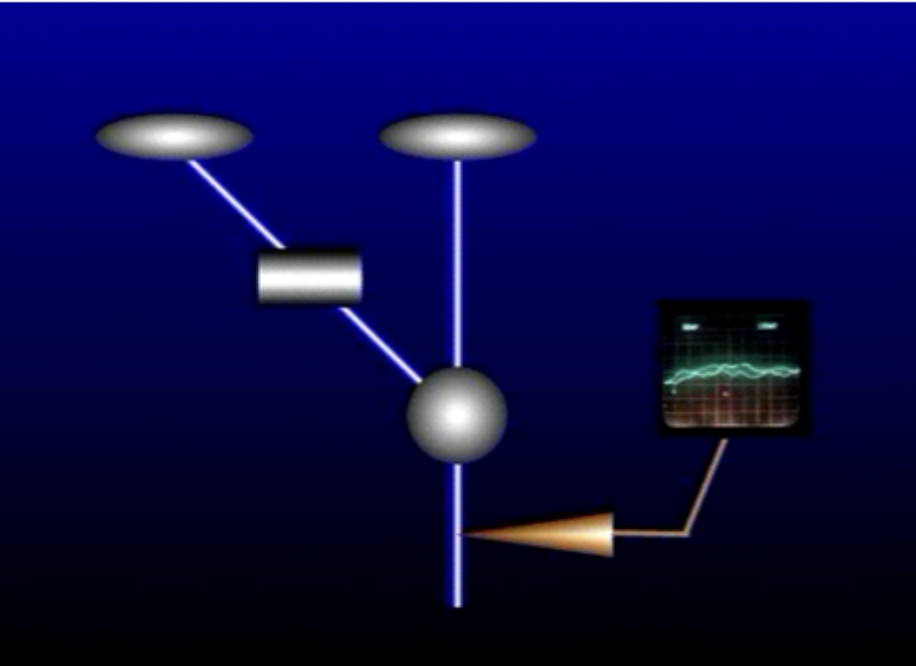
Light enters first cells RF, it fires, sends its signals to another neuron in which delays its responses for a little bit. Then the light passes through RF, then signals combined, when reach at the same time, this triggers an AP
If do motion in opposite direction, that neuron will not respond. Depends on which side delay is on.
Reichardt Detector Demo
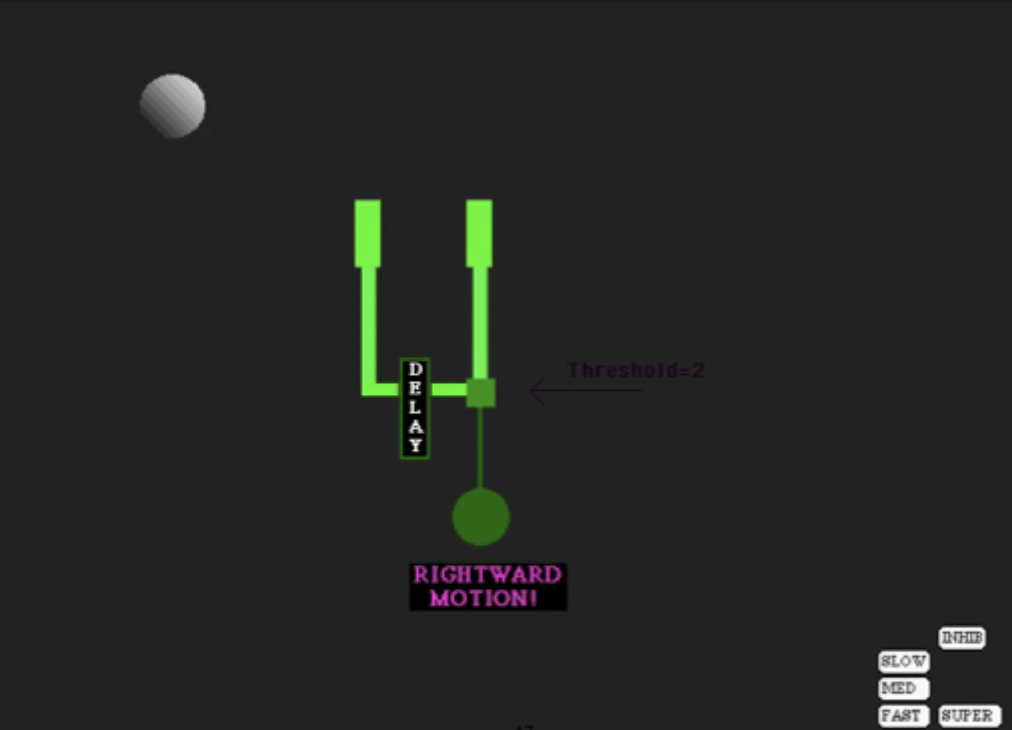
Sensitive to rightward, will not respond to leftward motion
If want to built another circuit this time sensitive to leftward motion, change which side delay on.
The direction the circuit is sensitive to depends on which side has the delay.
Reichardt Detectors
Mechanisms like the Reichardt detector can operate in the retina & the visual cortex (e.g, V1)
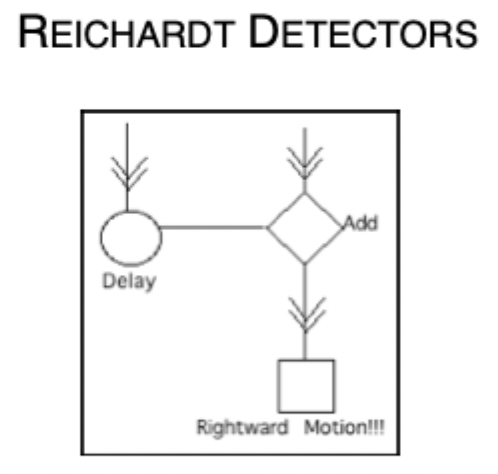
Left to right
Delay always on the side where the first input is received. So for leftward motion it would be on the left side.
Exam Question: show diagram & ask which direction this circuit sensitive to, based on which side has the delay.
Can operate in the retina & the visual cortex (V1)-complex & hypercomplex cells.
Delay fixed
What if we presented two images successively in the RFs of a Reichardt detector at the cells preferred timing?
Can trick this system into seeing motion where there is actually none.
Have Reichart detector, can show something in RF of this cell and then this cell over here where there is no actual movement
Have pic of dog in first RF in one point of time, I take it away and I put it over here at another point in time. Notice there is no actual movement but this will trigger my circuit to respond.
Interpret as motion even though there is no motion.
Trick the system.
Work when have moving object but also if have two stationary flashes
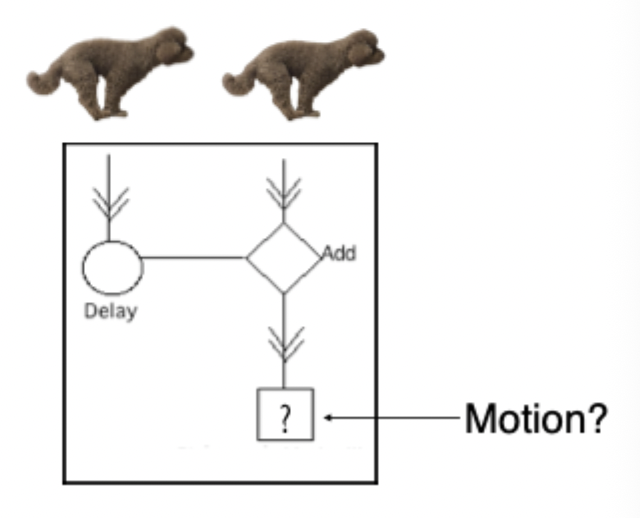
What is apparent motion?
Reichardt detector operates when a moving object is presented to two adjacent receptive fields sequentially
But two stationary flashes of light should work just well
Examples of apparent motion
Lights at entrance of theatres
Vegas
Airport Runway Lights
Movies, TV, computers, cellphone displays, etc
When you’re watching movies or TV, all you’re seeing is a series of stills. Not actual movement, series of stills
Videos made up of set of still frames
Christmas lights
Animations just a series of frames
Flip Book
Impression of motion when don’t have physical movement
Two different frames, frame 1 & 2. One in one point of time and another dot at another point of tie.
Called apparent motion.
Perceive movement when there isn't anything physically moving but triggering these detectors

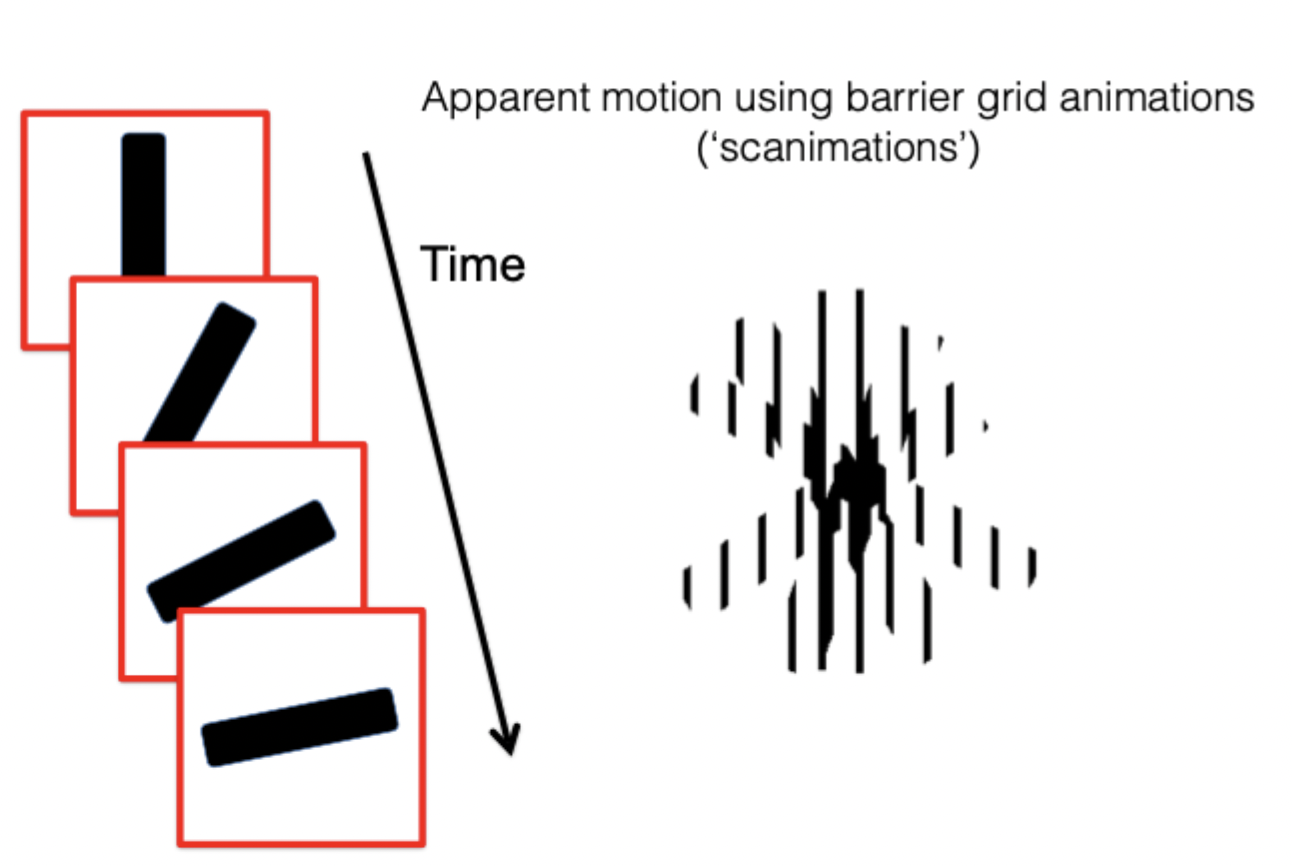
Apparent motion using barrier grid animations (scaminations)
Barrier grade animations
Horse example, horse, as moved the grid looking like it was running
When slide over way running over way
When sliding it quicker, running quicker, when slow down the running slows down
Cover & uncover parts of image to uncover different portions of the image
Brain creating impression of motion from a series of still frames
Middle Temporal are (MT) or V5
The middle temporal area (MT) or V5 (same area that liked MAE) also has neurons that are directionally sensitive & is important for our experience of motion
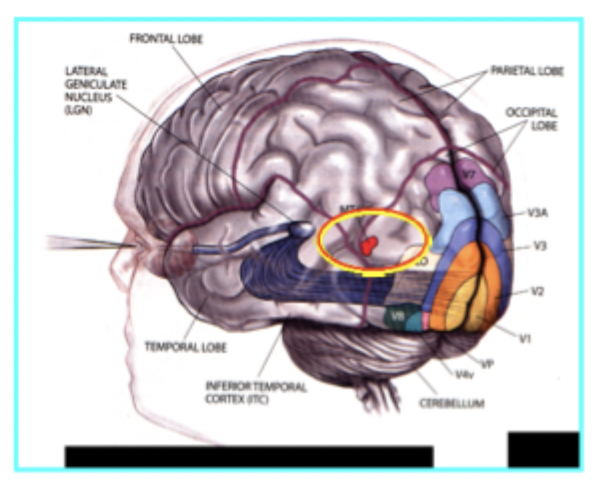
Motion Blindness- What is Akinetopsia?
Damage to area MT (middle temporal lobe) results in Akinetopsia
Lose ability to detect motion/movement
Incredibly rare cases, has to happen on both sides
Like living under a strobe light
One person here at one point of time, another at another point of time
Pouring coffee or tea, see motion when see level change, if don’t see motion, at one point in time its like oh my cup is empty, the next thing you know you spilled coffee or tea all over the table because you didn't detect that motion that led to that change.
Have to rely on this comparison of one point in time to another point in time
Interim Summary
Motion is critical to many aspects of vision
Motion is directly measured, not inferred
MAE
Kinematograms
Reichardt detectors
Apparent motion
Akinetopsia (Motion Blindess)
Low-Level, Mid-Level & High-Level Vision
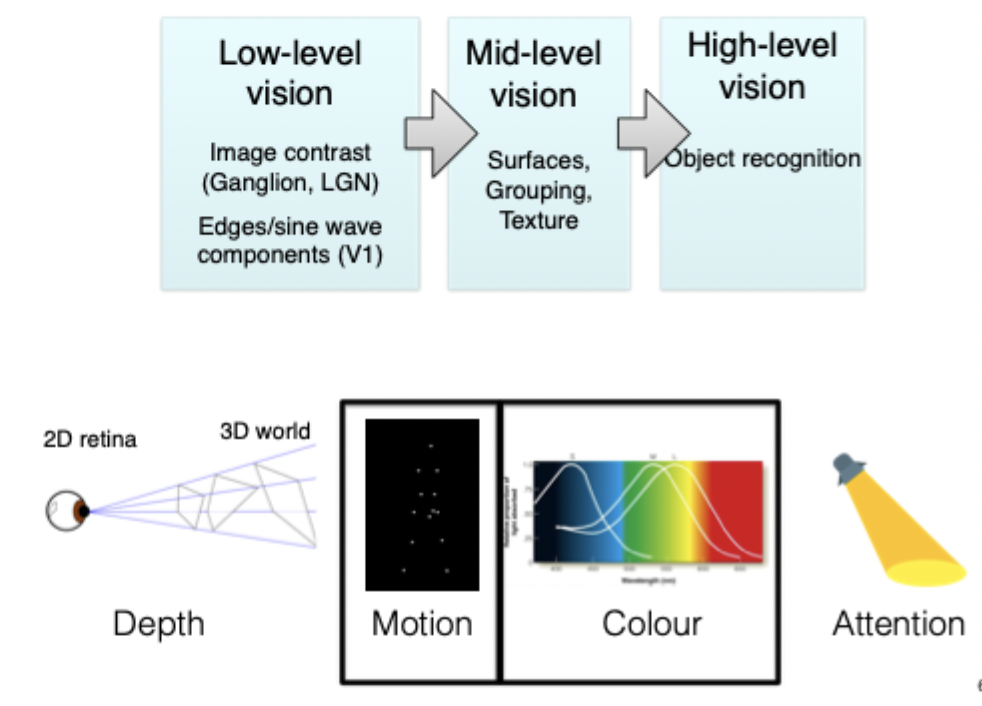
The Importance of Perceiving Colour
Foraging
Camouflage
Helping us find foods to eat
Finding mates
Finding which food is most cooked
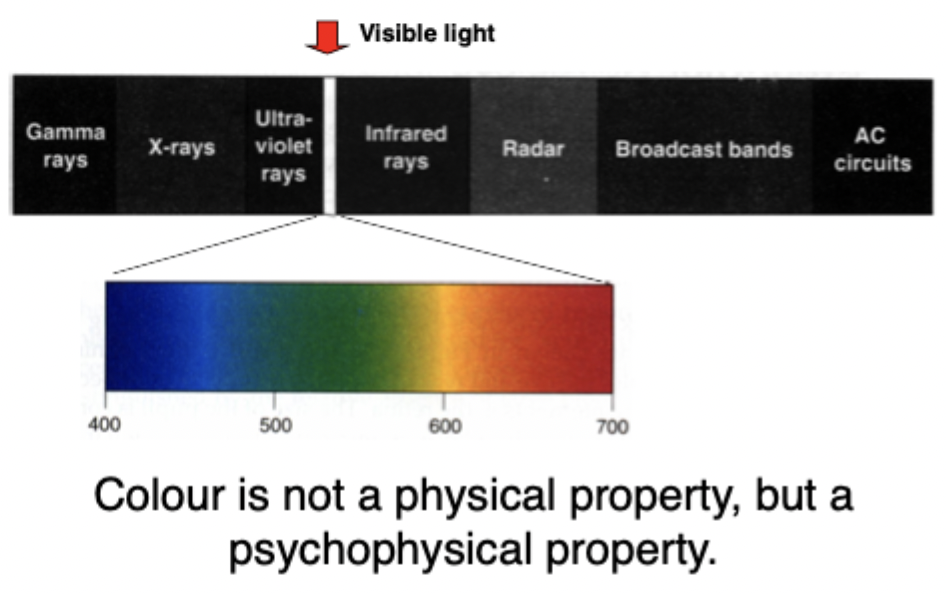
Colour is not just a physical property, but a psychophysical property
How map on physical property to psychological state.
Can only see small sliver of these wavelengths 400nm-700nm (visible light)
Shorter on left, we perceive as blue
Longer wavelengths, we perceive as red
Photons themselves have no colour, it is how we perceive them.
Nothing about photon itself that gives it its 'blueness or redness'
It is psychophysical property: have some physical stimulus and mapping it to a psychological state.
So when we say colour is a psychophysical property it has to do with how we map on the physical property, that is the wavelength of those photons to our psychological states to us
Shorter wavelength impression of blue, nothing about photon itself, how the brain interprets it
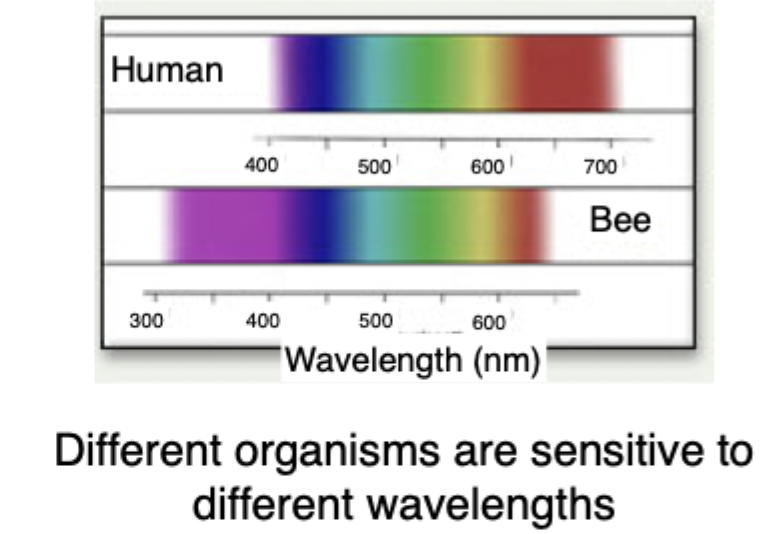
Different Organisms are sensitive to different wavelengths
Our peak sensitivity is in the visible spectrum but it also corresponds to the maximum output of the sun which is our light source
Different organisms that can shift around a little bit
Bees different range of wavelengths
Bees shorter set of wavelengths, closer to 300nm-650nm
We see wavelengths they cant, they can see wavelengths we can't
Flowers look different in different wavelengths, allows bees to pick up on this
Valuable to different organisms and different organism are sensitive to different wavelengths
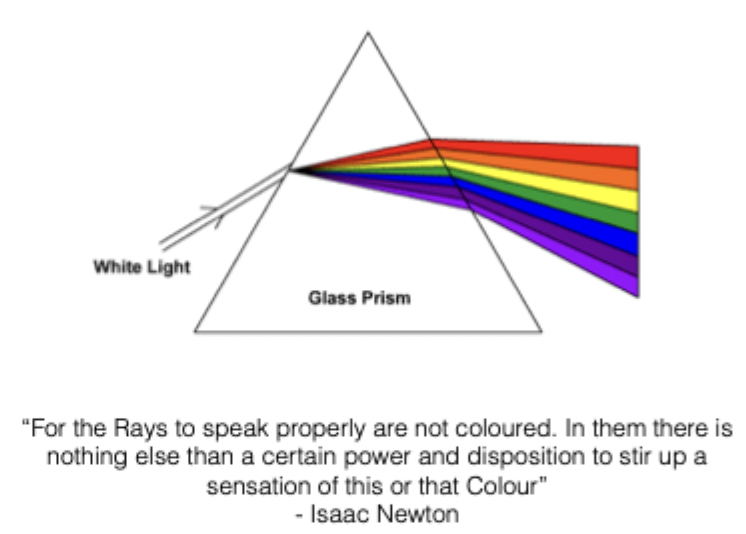
Sunlight is composed of many different wavelengths
Sunlight our main light source is composed of many different wavelengths
Light from sun white light consists of whole range of different wavelengths 400-700nm
Here we have white light going through glass prism (discovered by Newton), light refracted differently depending on the different wavelengths.
Psychophysical property: he noticed it was 'in our heads'
Colour not property of light itself but in our brain.
Objects Reflect Light at Different Wavelengths
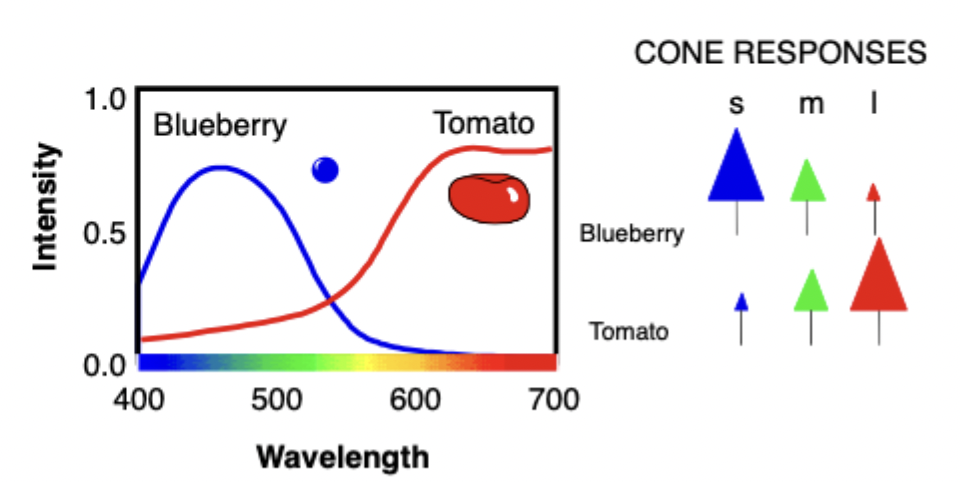
Why is tomato red? A blueberry blue?
We have the sun which is our main light source, inputting a whole bunch of energy in the visible range but also outside of the visible range. Sun emitting lots of electromagnetic energy. All these photons bombarding from 700-400nm the tomato.
Different objects reflect different kinds of wavelengths
Tomato reflecting longer wavelengths which we interpret as red.
Light that doesn't get reflected gets absorbed.
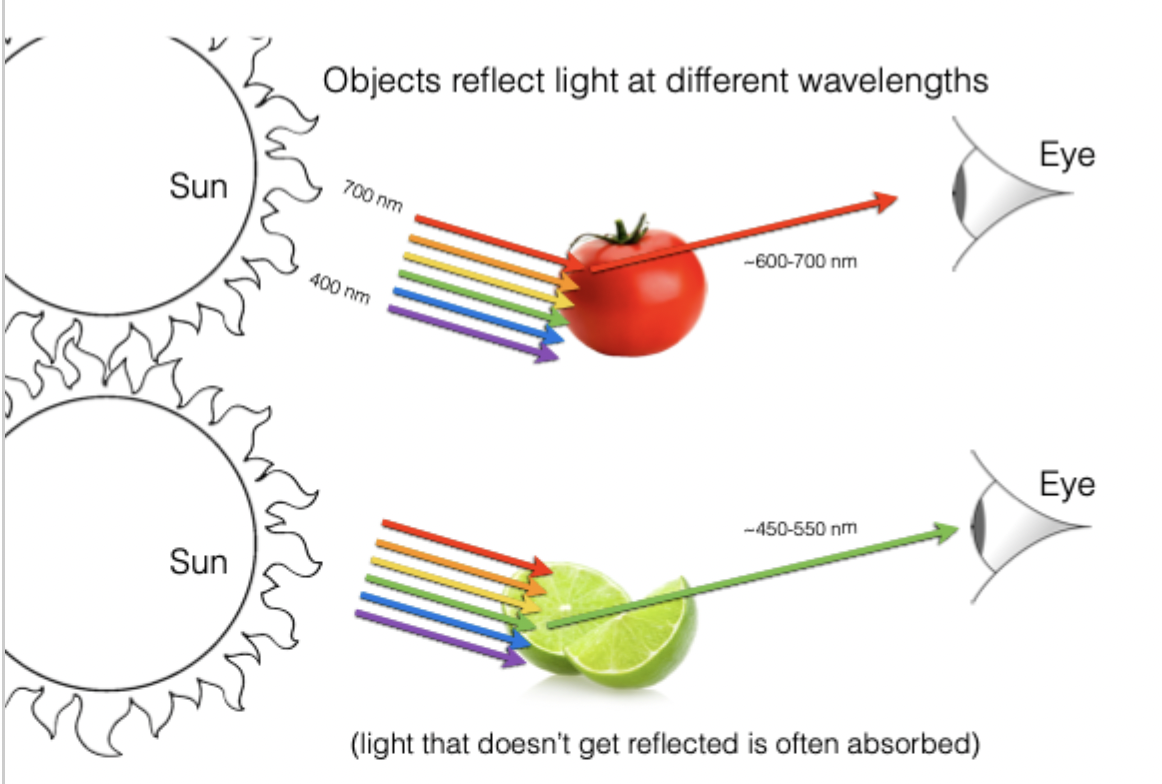
Reflectance Spectrum
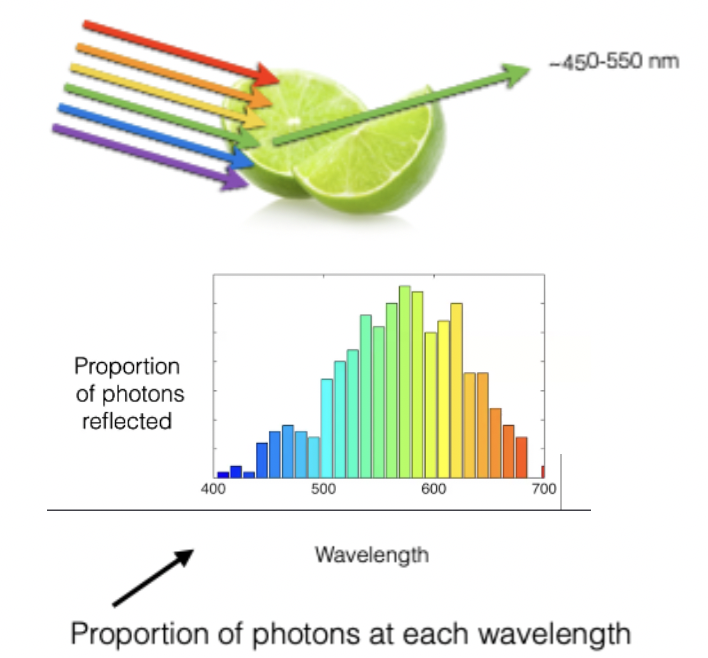
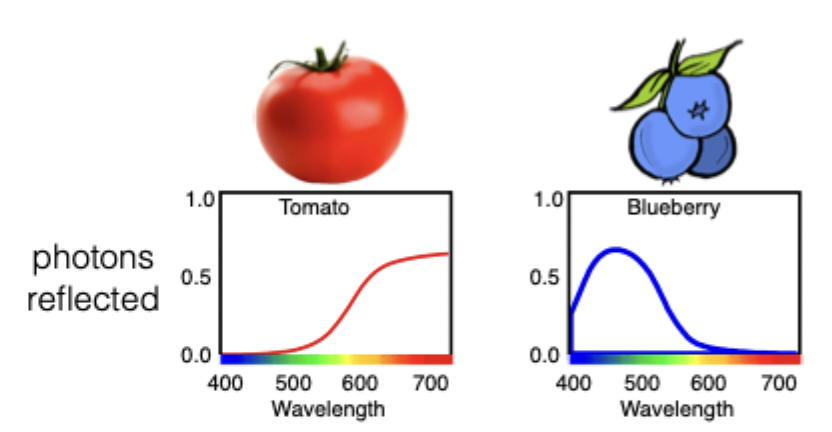
Different Objects have Different Reflanctance Spectra
What proportion of photons are reflected
For the blueberry selectively reflect more short wavelength photons, not so many of long wavelength photons
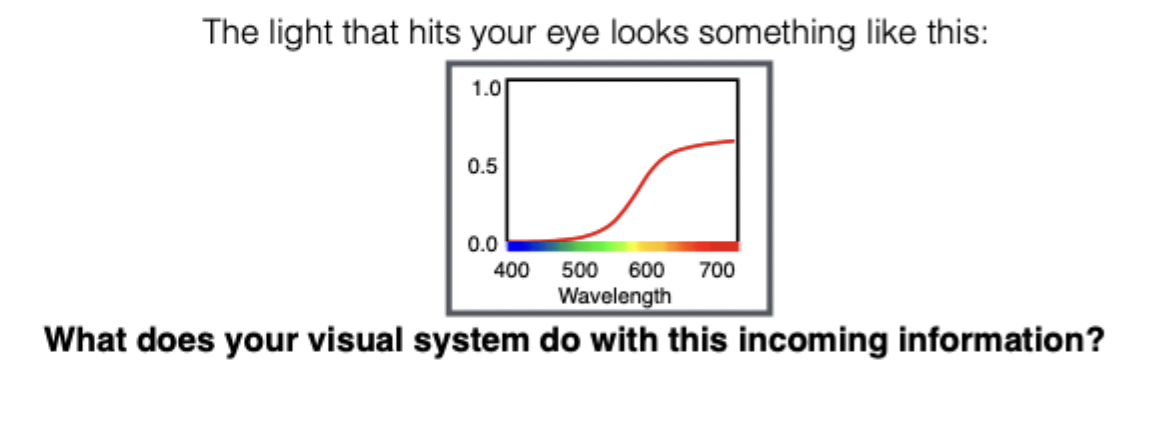
How is colour coded?
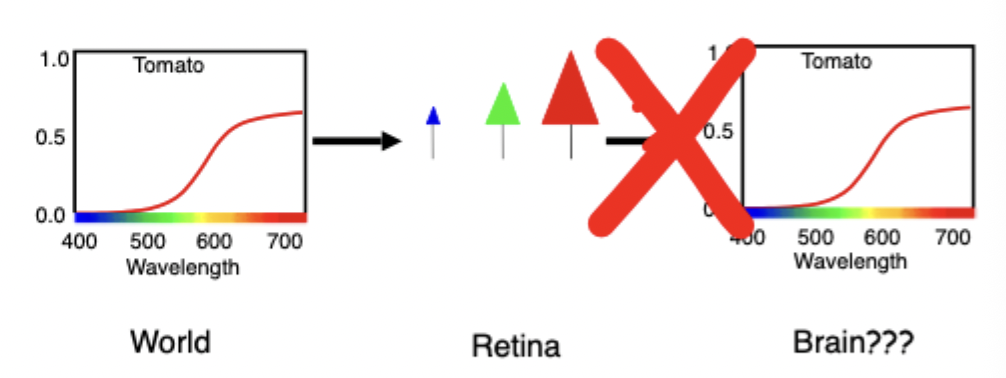
Photons themselves are NOT coloured. The light that hits your eye looks like something like this
How is colour coded? What are the 2 theories?
Trichromatic Theory
Opponent process theory
Both are true, both describe how colour perception works but operate in different stages
Colour processed first in trichromatic theory then opponent process stage/theory
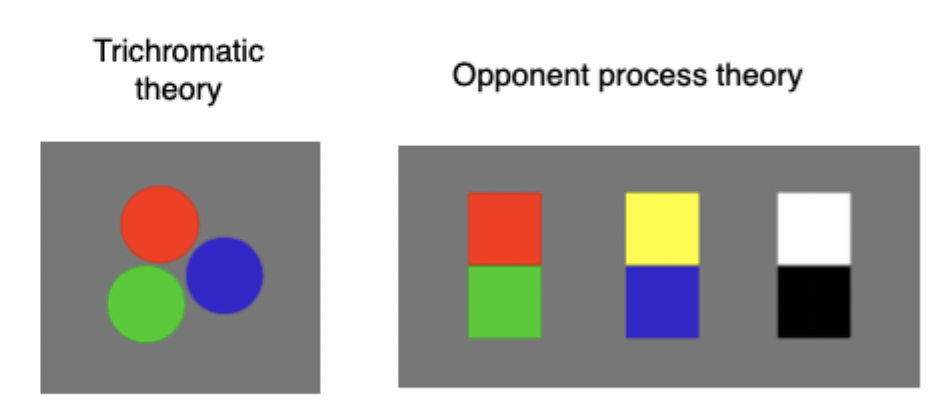
What is Young- Helmholtz Trichromatic Theory?
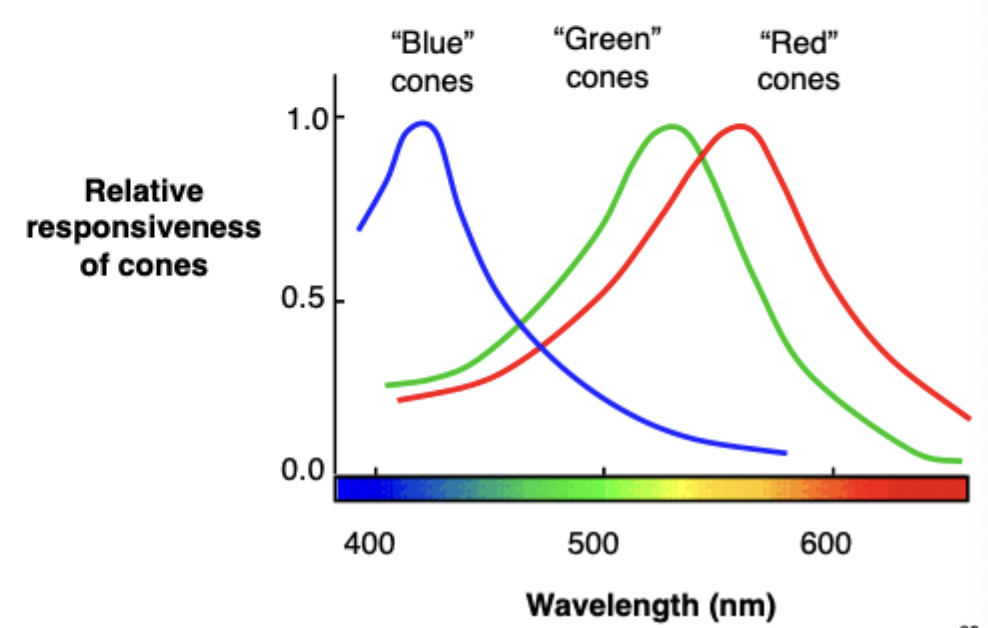
There are only 3 cones, each broadly tuned to wavelength
Perceived colour depends on the relative strength of their activation
Any colour can be formed by combining different amounts of 3 primary colours (corresponding to 3 cone types)
Observed that there are 3 kind of receptors & each is broadly tuned to one part of the spectrum or one range of wavelengths
Short, medium, long
Colour we perceive is determined based on response of each type of cone, short, medium and long wavelength cone & that determines the colour.
Have all this information, all these different wavelength photons are getting picked up by my cones. Idea is have some response from each type of cone, for my short, medium & long wavelength cone and the idea is that any colour I perceive can be combined by just combining different amounts of short, medium & long wavelengths. Or different amounts of red, green & blue.
Cone photoreceptors
3 cone types.
Still pick up other colours not just blue, green or red. But what they maximally pick up on.
S, M & L better representative
Not actually coloured this way.
Cone photoreceptors
Images of the 3 kinds of cones in the living human retina
Colours used here are just the popular labels for each kind of cone
Pattern of trichromatic cones differs greatly from person to person
Our colour perception is largely similar, despite these differences. This is likely due to long-term auto calibration process.
Distribution of cones in the retina, not actually coloured this way.
In general people tend to have more long wavelength cones compared to medium wavelengths cones and more medium wavelength cones than short wavelength cones.
Variation between person to person
But people usually agree and colour perception tends to be similar broadly speaking across individuals
Young- Helmholtz Trichromatic Theory
Perceived colour varies with ratio of responses of the three cones
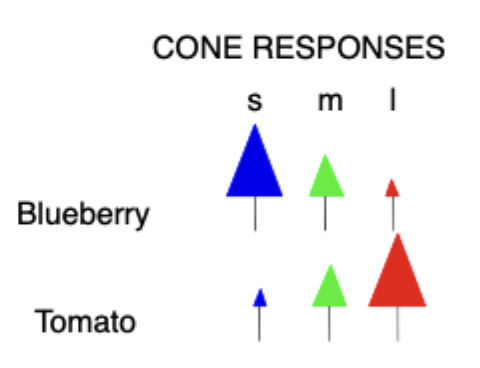
One response from short, another from medium, another to long. Blueberry respond most to short, least to long wavelength photons.
Big triangle big response, little triangles little response.
Human Colour Vision has only 3 dimensions
Perceived colour varies with ratio of responses of the three cones
Young-Helmholtz trichromatic theory proposed that the colour that we see just depends on how much activation do I have from each type of cone.
Ratio of response of 3 wavelengths gives us colour.
Human Colour Vision has only 3 dimensions
Human vision measures only 3 values, one for each cone
Your brain only knows what the cones tell it
non-invertible: can’t recover the wavelength distribution
Colour is noninvertible cannot work way backward
Only information I have access to is how much of a response I have from each cone type, I can't solve backwards and figure out what kind of spectrum produced that pattern of responses
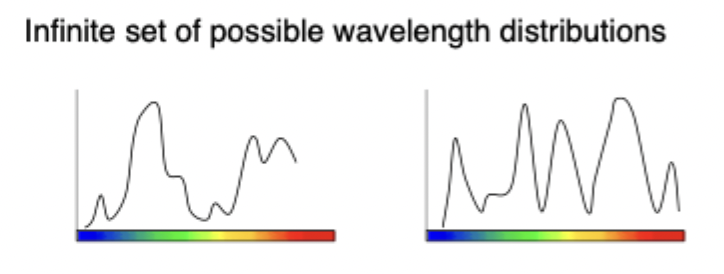
Colour is non-invertible
Cannot recover the true reflectance spectrum out there in the world, only have 3 numbers to work with
An infinite number of different spectra could produce the same response from the 3 cones, so the brain can’t interpret which spectra is correct
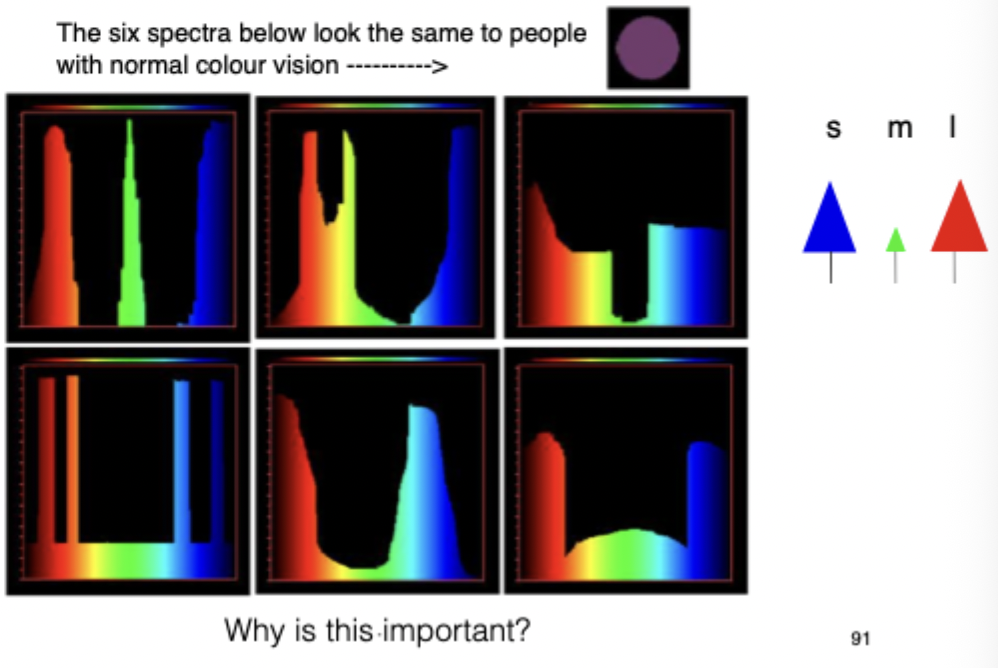
What are Metamers?
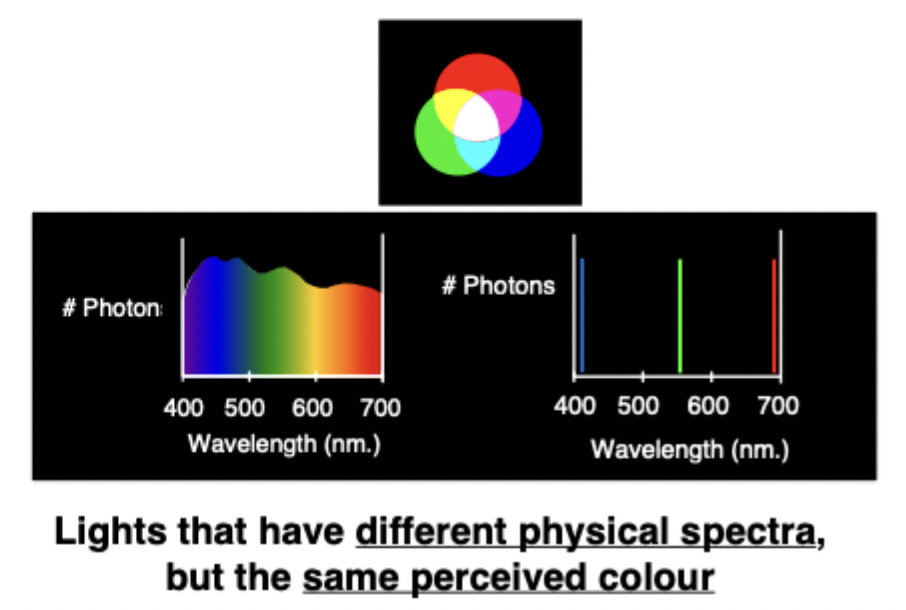
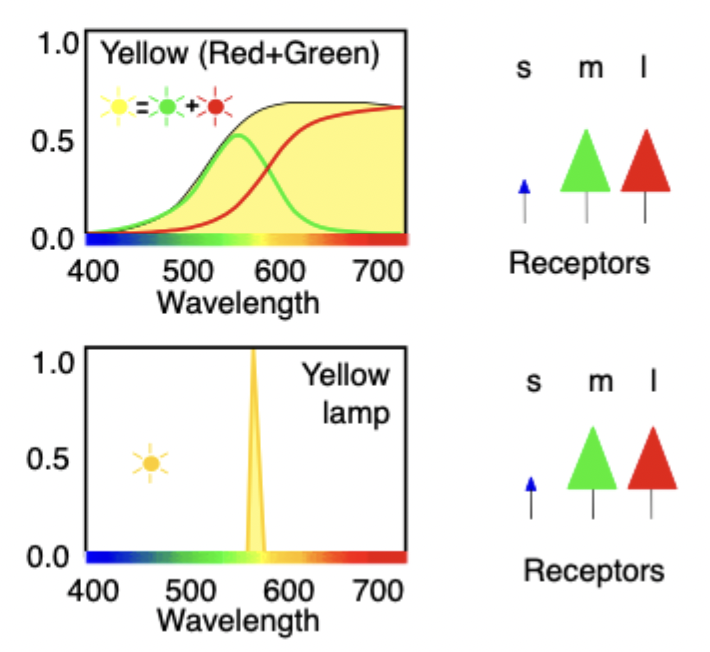
Metamers: different spectra, same colour appearance
We can think of metamers as being confusions, where we can mix up one colour for another because we don't have the receptors to distinguish them. We are reducing information down to 3 different numbers
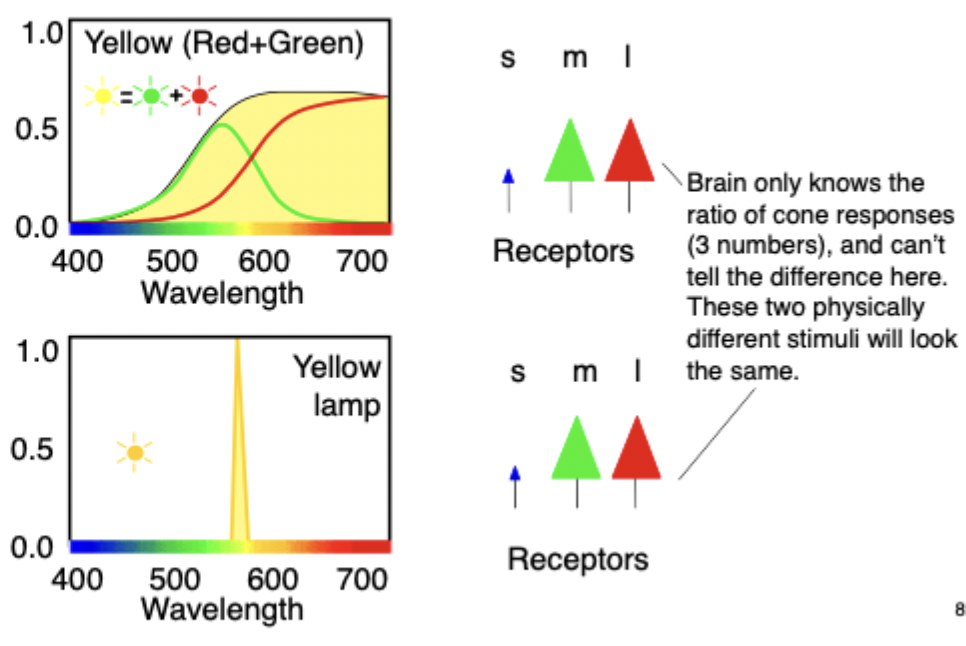
Have yellow light, by mixing green & red light
Strong response from long wavelength cones & medium wavelength cones & not much of a response from my short wavelength cones
Have exactly the same pattern of responses for two very different sources of light.
One kind of a broad range and the other is fairly narrow
Metamers as confusions, colours that we can mix up because they have different spectra but they look the same to us.
Metamers
Brain only knows the ratio of cone responses (3 numbers) & can’t tell the difference here. These two physically different stimuli will look the same.
Metamers
Lights that have different physical spectra, but the same perceived colour