Exam 3
 Call Kai
 Learn
Learn Practice Test
 Spaced Repetition
 Match
Match Flashcards
 Knowt Play
1/141

There's no tags or description
Looks like no tags are added yet.
Name | Mastery | Learn | Test | Matching | Spaced | Call with Kai |
|---|
No analytics yet
Send a link to your students to track their progress
142 Terms
What is plasticity?
“In a broad sense, plasticity refers to adaptation in real time: the various adjustments that an individual can make within a single lifespan.”
How is plasticity different from adaption in the evolutionary sense?
Adaption over a single lifespan rather than beyond that with evolution.
What is omnivory?
Dietary habit of organisms that consume both plant and animal matter, allowing them to adapt to various environments
Intersexual Selection
Males demonstrate quality to females; females choose
What does male-male competition to determine mating imply?
Social hierarchy, fighting, and territoriality of harem and resources
What is hybridization?
the interbreeding of distinct populations, subspecies, or species, creating offspring with mixed ancestry
Predator- Prey Cycles
Populations oscillate. Out of phase, but regular
Top-down vs. Bottom-up control of populations refer to
trophic levels in a food chain
Top-down control
Consumers at top of food chain (predators) control size of populations lower in food chain
Bottom-up control
Resources at base of food chain control size of consumer populations
Top-down control can lead to
Trophic cascades, an indirect top-down effect that benefits food of prey
Under top-down control, can predators control prey populations?
An example is how lions preyed one young, old, and ill. Which influenced wildebeest populations more influences by forage and rainfall.
What is predator-mediated coexistence?
an ecological mechanism where a predator prevents a dominant prey species from competitively excluding inferior competitors, thereby maintaining higher biodiversity.
What is a trophic cascades
An ecological phenomenon where adding or removing top predators causes powerful, indirect ripple effects down the food chain, altering ecosystem structure
What does it mean if a predator is a keystone species
The predator has disproportionately large impact on its ecosystem relative to its low populations size, holding the entire ecosystem structure together
Terrestrial
N-facing slopes, deep narrow ravines, talus slopes, ice caves
Aquatic
deep water (marine, lakes), upwelling ocean currents, headwater streams, groundwater springs in lakes and rivers
Salinity at surface is high due to
evaporation
Why do invasive species often compete with native species?
Broad ecological niches, r selected growth rate, expand range quickly, fewer limitations (ecological release), successful invaders
Invasive species are an even bigger problem for islands because of
-High endemism
-Limited areas
-Small population size
-Island ecosystems often lack mammalian predators
-Simpler species interaction (ecosystem can lose its balance easily)
What kind of trout was an issue in Flathead Lake, Montana
Lake trout
What is an invasivore
A person who deliberately eats invasive species
The predator-prey theory is a
Biological and mathematical concept explaining how predator and prey populations influence each other's size in cycles
The flow of energy in ecosystem ecology is a
One-way flow
There is a ____ of nutrients between parts of the biosphere
Cycling
The levels of organization in nature
Atom → Molecule → Cell → Organism → Population → Community → Ecosystem → Biosphere
Natural Capital Degradation
Building roads into previously inaccessible forests
What is the extent of tropical deforestation in percentage
64%
Fragmentologist
Researchers specializing in the study of biological fragmentation
Fragmentation in biology is
A form of asexual reproduction where an organism breaks into smaller pieces, or fragments, with each fragment developing into a new, genetically identical adult.
Refugee effect
A phenomenon in ecology and population genetics where individuals from a destroyed or disturbed habitat (“refugees”) flee to other, often marginal, habitats to survive
What is ecological relaxation
The process of species loss from an ecosystem following a disturbance that reduces its capacity to support biodiversity, such as habitat fragmentation or isolation
What are anthromes
The terrestrial biosphere's modern, human-altered ecosystems, characterized by sustained, direct human interaction rather than just climate
What are wildlands
Terrestrial or aquatic areas that are not significantly modified by human activity, where natural ecological processes are allowed to proceed with minimal human interference
What is extinction debt
The future, delayed extinction of species caused by past environmental changes, such as habitat loss or fragmentation
What are ecological corridors
Linear, managed landscape features (like forests, rivers, or hedgerows) that connect isolated habitat patches, allowing wildlife to move, migrate, and maintain genetic diversity
How do ecological conditions and biodiversity of “islands” created by fragmentation compare to those of true islands?
They differ significantly in their ecological dynamics, primarily because fragments are recently isolated, surrounded by a "matrix" of human-altered land, and subject to intense, rapid environmental changes that are often more devastating than those on true islands
How does habitat fragmentation interact with climate change impacts?
This interaction increases extinction risks, disrupts connectivity, and reduces ecosystem resilience to extreme events like fires and droughts
The larger the island then the
Higher the diversity
Species-area equation
S = cA^z
S = richness
c = constant
A = island area
z = slope relating S and A
In general, diversity doubles for every
10-fold increase in area
In order to predict species loss due to loss of habitat area we use
A in the species-area equation
What are other conditions that affect the eventual response of habitats to fragmentation
matrix quality, edge effects, patch isolation, and temporal changes. The surrounding land use (matrix), such as urban sprawl or agriculture, dictates movement permeability, while edge effects create microclimatic changes (wind, light) that alter interior conditions
Equilibrium Model (MacArthur and Wilson 1963)
Balance of immigration of new species and extinction of species determines diversity on islands
Species richness is related to
Remoteness (immigration potential) and size (extinction risk) of the island
How can island biogeography be applied to the current extinction crisis?
Habitat fragmentation and biodiveristy
The goal of reserve design is to
Maximize diversity by maintaining integrity of habitats
“SLOSS” debate
Single large reserve or several small reserves that are connected
Single large reserve
Pros: better for animals overall, high biodiversity, untouched and don’t need to maintain
Cons: political implications, more costly, not many different habitats
Several small reserves
Pros: better in a city/urban area, cheaper, library of habitats
Cons: need to be connected, less overall biodiversity
Elements of reserve design
Maximize size of protected areas, connect the protected areas with wildlife corridors, buffer conservation areas from adjacent heavily used areas
An example of the goal of reserve design being accomplished is
Costa Rica’s 8 megareserves to preserve biodiversity (National parkland surrounded by buffer zones)
How can we preserve biodiversity?
Designate protected areas, create wildlife corridors that ensure gene flow, and resource access under metapopulation model
A metapopulation model is
A conceptual and mathematical framework (often representing "populations of populations") that analyzes how patchy habitats, separated by unsuitable areas, interact through colonization and extinction
What are the components of community structure
Mix of species found in a community
Abundance (relative, importance)
Distribution of individuals among species
The fundamental question of community ecology
Whether biological communities have tightly prescribes organization and composition, or if they merely loose assemblages of species
What factors determine biological structure and diversity of communities
Climate, topography (biomes), biological interactions, (competition, predation) disturbance and time
Jenkins and Bukema experiment (1998)
12 identical ponds with no preexisting organisms, examined water samples from each pond over time and identified the plankton species present in each sample. Found that species have evidence of predictability and stochasticity
Ecological succession
Changes in community structure over time
-Affects all species in a community “community assembly”
What is community assembly
The study of the processes that determine which species arrive, persist, and interact to form ecological communities
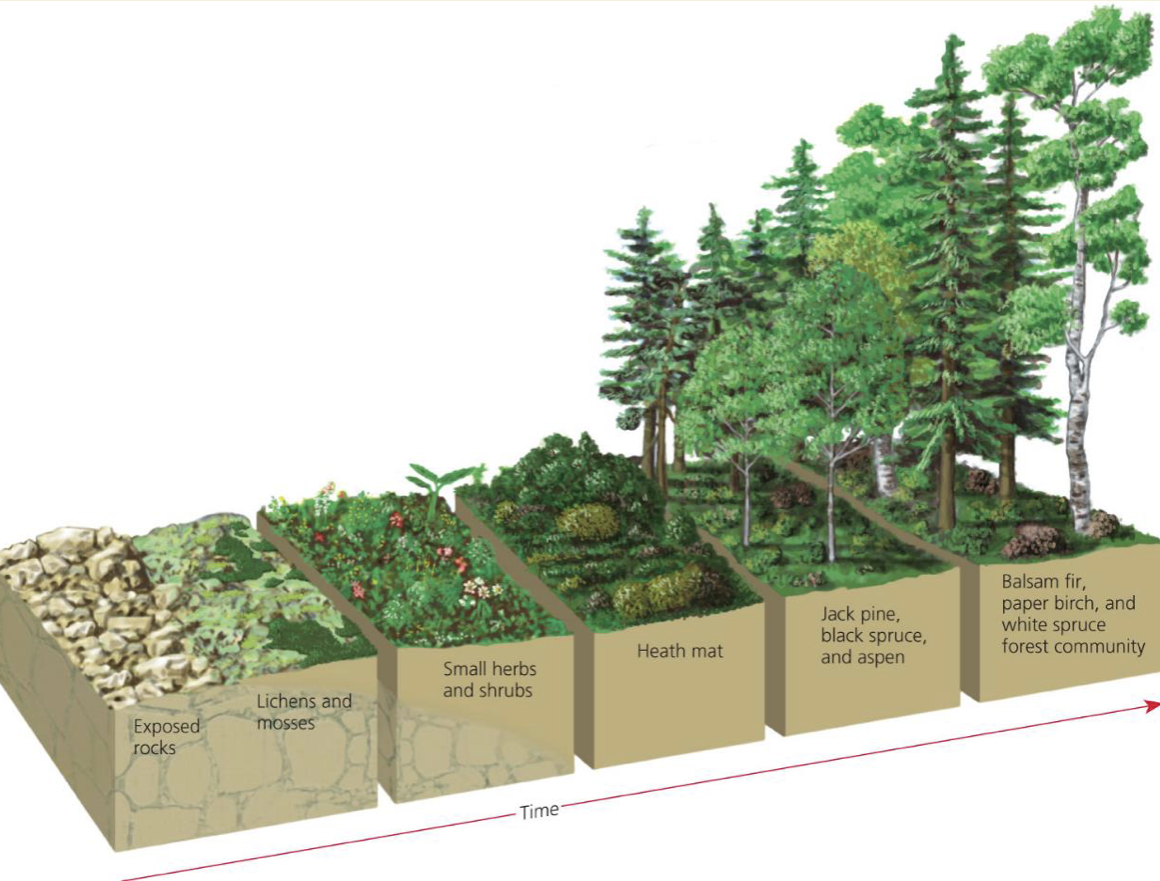
Primary succession
Developmental sequence of communities on abiotic medium, terrain that never had life on it before (ex. lave)
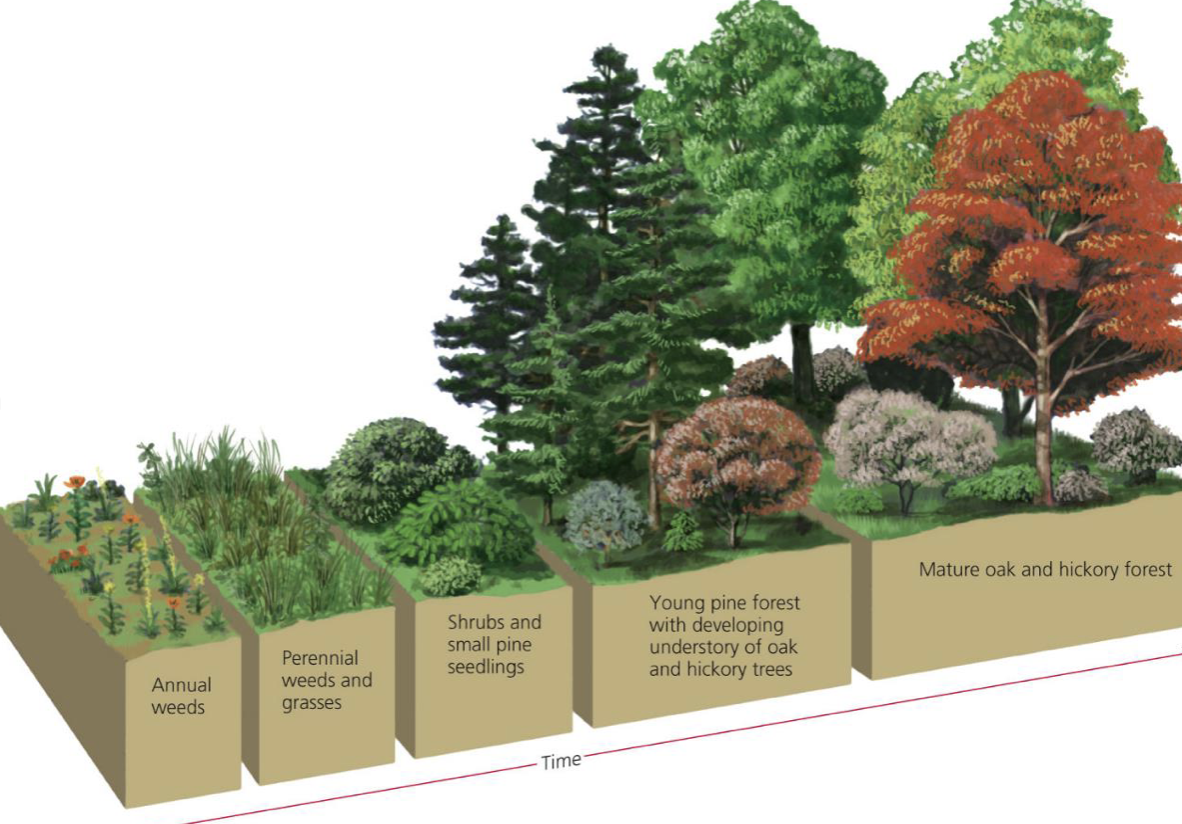
Secondary succession
Developmental sequence of communities on previously vegetated soil, can start with an area that had a mild fire (ex. Yellowstone’s fire adapted species)
What is the relationship between succession and diversity?
Initially, diversity increase during succession but later diversity declines due to biotic interactions like competition
Intermediate disturbance hypothesis (Connell 1978)
Disturbances can reduce competition by limiting size of populations, enable coexistence
Shannon diversity index
Measures the species richness and evenness in a community
Population
Group of individuals of the same species that live in the same area
Communities
Different populations that live together in a defined area
Resistance
Ability of a living system to “resist” moderate disturbance (ex. tropical forests are resistant to hurricanes by recolonizing)
Resilience
Ability of a living system to recover from disturbance (ex. tree sprouting from their stumps, steam)
System with no resistance or resilience
Alpine tundra
Resistance and resilience determine
Stability
Examples of how some systems have one property but not the other
Tropical wet forests have high resilience, and streams have high resistance
Metapopulations
Groups of populations consisting of small subpopulations of the same species that occupy distinct habitat patches
The overall population size of metapopulation stays relatively stable when there is
A sufficient migration rate among populations
Although some subpopulations go extinct over time
Migration can restore or establish subpopulations
Under metapopulation theory, are all populations in a metapopulation expected to go extinct at some point in time
Yes, that is true
Metapopulation Dynamics Implications for conservation of endangered species
The core implication is that long-term survival of an endangered species often depends on maintaining a network of habitats, rather than focusing solely on protecting a single, isolated population.
HLPS Ch. 5 “Global weirding”
Clear predictions of where species are going but no predictions of what will happen when they get there
HLPS Ch.7 “Adaptive movement
Shiftiness
HLPS Ch. 5 & 7
30,000 documented climate-driven range shifts (likely 25A%-85A% of ALL species will shift ranges). Which will be the greatest redistribution since the last ice age
What is ecological naviety
The failure of native prey to recognize or properly respond to novel predators (or competitors) because they lack evolutionary experience with them
California coast in Ch.5 and Tasmania in Ch. 7
Topicalization of cold ocean areas
What percentage of tree species shifted between 1980 and 2015
75%
Pros to plasticity
Rapid adaptation to fluctuating environments, enhanced survival against predators, and increased reproductive success.
Cons of plasticity
Direct metabolic costs, the risk of producing a maladaptive phenotype due to inaccurate environmental cues, and developmental instability.
What are some ways “plasticity” is shown by organisms?
Organisms alter their body shape, size, or structure to better fit their environment
Outcomes of plasticity in populations
Allows populations to survive rapid environmental changes, increases colonization success, and aids adaptation to novel habitats
An animals that exhibits plasticity
Bears adjust their physiology, behavior, and body composition in response to environmental changes and food availability -they exhibit plasticity through varied denning times, adaptable diets, and changing body size based on regional conditions
Omnivory & energetics of grizzly bears on Kodiak Island
Life history – 5 to 7-month hibernation (do not eat, drink, urinate, or defecate; metabolism slows by ~50%; live off fat layer, lose ~25% of their body weight), hyperphagia to build fat stores (~30,000 calories/day, “Fat Bear Week”)
What are benefits of omnivory in the face of climate change
Ability to adaptively switch food sources based on availability, providing high dietary flexibility and increased resilience against food scarcity caused by environmental disruptions
Humbolt squid in Gulf of California
“Disappeared” after water warmed - became smaller in size due to having to eat smaller food
HLPS Ch.9 Evolve
Climate change might modify mechanisms of natural selection, and in response to climate change population’s traits may change
Arboreal lizards (anoles)
Became more wind -resistant by hanging onto the trees during tropical storms
Brown tree snakes
Introduced to Guam, caused native bird extinctions and power outages
Keystone species
A species on which other species in an ecosystem largely depend, such that if it were removed the ecosystem would change drastically
Wooly adelgid
Species that is good with warm winters and destroy Hemlocks
Autotrophs
Organisms that make their own food, photosynthetic organisms
Carnivores
2º consumers that eat meat (ex. lion)
Eurosta Gal Midges
Small flies that do better with colder winters and seek refuge in golden rod plants
Food chain
Movement of energy and nutrients from one trophic level to the next