digital electronics
 Call Kai
 Learn
Learn Practice Test
 Spaced Repetition
 Match
Match Flashcards
 Knowt Play
1/51

There's no tags or description
Looks like no tags are added yet.
Name | Mastery | Learn | Test | Matching | Spaced | Call with Kai |
|---|
No analytics yet
Send a link to your students to track their progress
52 Terms
XOR gate
either, or but NOT BOTH
XNOR gate
inverse XOR
if A and B are equal
If A and B are true
or if A and B are false
de morgans law
NOT(AB) =NOT(A) + NOT(B)
combining groups of ones in karnaugh map
sum of products (multiply them)
karnaugh map rules
construct largest group first
progressively smaller groups added
can overlap groups if singular one
sum of products
for each line of truth table thats a minterm (F=1)
multiply the variables together to get expression for that line
then add the multiplied expressions
eg. ABC + AB
product of sums
for each line on the truth table thats a maxterm (F=0)
add the variables together in the row
then multiply all the added up rows
eg (A+B+C)(A+B)
maxterms from karnaugh map
group 0s and multiply groups together
then use de morgan law to turn multiplication into addition
order of combinations for karnaugh map
00, 01, 11, 10
NAND and NOR gates
not what is intuitive
think and gate and then not (01=1)
think or gate and then not (01=0)
so flip whetever and and or ouptut would be
making karnaugh map hazard free
create more groups of ones so there are no gaps in between original groups
static hazard reason
all real gates take a finite amount of time to operate and so produce a delay in the signals passing through them
function hazard
unsolvable hazard, occurs when more than one input variable changes at the same time
only way to avoid is to restrict change of input variables to one at a time
binary arithmetic 1+1
=10
write the 0 carry the 1
the thing you carry in binary arithmetic
carry = AND function
the thing you carry in binary arithmetic
“sum” = XOR function
logical depth
the max number of gates through which a signal will pass from input to output (carry and sum)
if depth of C output = 1 and S output = 3 then C will reply before S causing hazard
1 + 1 + 1
11
10-1
1
full adder vs half adder
half adder: inputs = A, B outputs = carry, sum
full adder: inputs = A, B, carryin outputs = carryout, sum
11 + 1
100
hexadecimal
ends at 9 then goes A, B, C… (A = 10, B=11, C = 12)
uses base 16 so decimal-hexadecimal is divide by 16
ones complement
just flip all the bits
problem: gives two values for zero
twos complement
flip all the bits then add 1 to the end
adding ones complement
overflow (adding extra place at front) must be wrapped around
adding twos complement
if the 2 last numbers u carry over are both 1 or both 0 overflow can be ignored
if they are different then overflow cannot be ignored
sign magnitude
add sign bit to the left of biggest digit
0 = positive
1 = negative
combinational vs sequential logic
combinational: output depends only on current inputs
sequential: output depends on current inputs + previous outputs (memory)
latches, flip flops
SR latch high input
NOR gates
SR high input set + reset
set: S = 1, R = 0, Q = 1
reset: S = 0, R=1, Q = 0
SR high input hold + forbidden
00 = hold, 11=forbidden
SR low input
NAND gates
gates r just all flipped
how does SR latch high input fix switch debouncing
stores a stable state (hold)
if switched to A bounce between reset and hold
if switched to B bounce between set and hold
reset and set switch for low input
bouncing between hold just stays the same
SR latch with enable
E = 0 means hold doesnt matter what SR arre
E = 1 means listen to inputs
“4 bit detector”
circuit with 4 inputs
even/odd parity
add zero to front if uneven number of 1s (for even)
add 1 to front if uneven zeros (for odd)
parity detection
xor all bits together using answer from last one with next
XOR result = 0 means even 1s
XOR result = 1 means odd 1s
BCD digit
1-9
1 is 0001 then just add that to get to 9
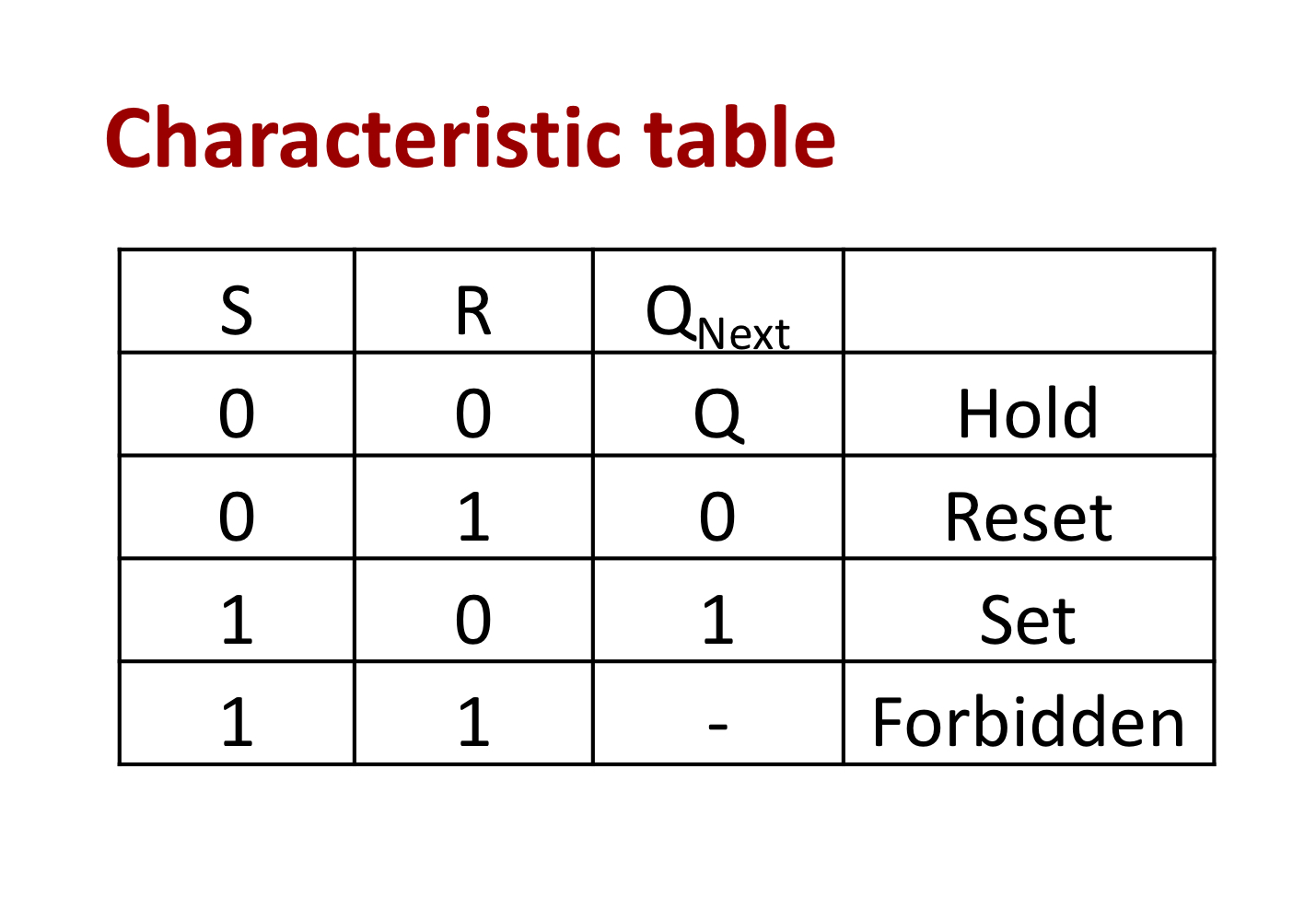
S-R characteristic table
11 fobridden
remeber S =1 = set
D latch basic
one input
S = D
R = not(D)
if E = 0 — Qnext = Qold (hold)
if E = 1 and D = 0 (S=0, R = 1) so Qnext = 0
if E = 1 and D =1 (S=1, R = 0) so Qnext = 1
active low D latch
enable = 0 - circuit on Qnext=D
enable =1 - circuit off Qnext = Qthe same
active low with SR latch
enable = 0 - circuit off, holds S=R =1
enable = 1 - circiut follow input S=S R=R
A + not(A)=
1
1 + A=
1
AA=
A
A(A+B)=
A
A + AB
A
AnotA=
0