Economics - Year 12
 Call Kai
 Learn
Learn Practice Test
 Spaced Repetition
 Match
Match Flashcards
 Knowt Play
1/42

There's no tags or description
Looks like no tags are added yet.
Name | Mastery | Learn | Test | Matching | Spaced | Call with Kai |
|---|
No analytics yet
Send a link to your students to track their progress
43 Terms
AUSTRALIA’S INTERNATIONAL TRADE
What are the four linkages between Australia and the global economy?
Trade, investment, tourism and immigration
Explain trade
The first and most significant link between Australia and the global economy is through trade. Australia is both an importer and exporter of goods, services and resources. Australia’s exports tend to be dominated by commodities (i.e. mineral and energy resources and agricultural produce), accounting for approximately 71% of Australia’s exports in 2024. Australia’s exports are the equivalent of 25% of our GDP. In terms of imports, Australia tends to import large quantities of capital goods (machinery/equipment, factories, tools, etc) as well as consumer goods such as motor vehicles. However, the largest category of our imports are intermediate goods (i.e. products or materials used to produce other goods and services, which accounted for approximately 33% of Australia’s imports in 2024. Australia trades with almost every country in the world, however despite this face, the vast majority of Australia’s trade is concentrated in the Asia-pacific region, with China, the USA and Japan being Australia’s top three two-way trading partners. The composition and direction of Australia’s trade is largely influenced by economic complementarity, and comparative advantages (our exports) and comparative disadvantages (our imports). 25% of Australia’s workers are directly involved in trade related activities.
Explain investment (foreign investment)
Australia has traditionally relied on foreign investment to finance the gap between national investment and national savings. During 2024, foreign investment into Australia was $245 billion, while Australia investment abroad was $142 billion. Australia has a relatively small population and does not generate enough savings to fund its investment needs and therefore relies on the inflow of foreign investment. Much of the infrastructure, such as transportation systems and communications networks, to support industry is financed from overseas funds. The mining sector would not have been developed without foreign investment. Countries such as the US and UK have a surplus in savings due to high population and high saving ratios. This can then be reinvested into countries such as Australia and are in fact the two countries that are Australia’s largest sources of capital inflow, or foreign investment into Australia.
Explain tourism
Tourism is considered to be a service import and export for countries. Personal travel (outbound tourism) was Australia’s largest import in 2024. The reopening of Australia’s international borders in 2021, and continued improvements in transport and communications have contributed to a significant increase in outbound tourism over the past few years. Australians spend more money on tourism, than overseas residents spend in Australia and as a result, inbound tourism was Australia’s 6th largest export in 2024. Australia’s vast range of cultural and natural attractions encourages overseas visitors to travel to Australia.
Explain immigration
Immigration has played a crucial role in Australia’s history, with migrants coming to Australia after World War II. Australia has been able to expand the quantity and quality of its workforce by issuing short term work permits by promoting long term migration. Immigration has been an important source of skilled labour in Australia, which has been used to fill labour shortages in certain occupations and industries.
Why is trade important in the Australian economy?
Trade is important because it has expanded Australian consumption possibilities through importing and has increased our production possibilities through exporting.
Trade is a large part of the Australian economy, equating to over 48% of GDP.
Trade has been an important driver of economic growth
Exporting allows producers to reach global markets. By exporting for a world market, Australian producers can develop economies of scale (average costs of production decrease as the scale of output produced by firms increases).
Trade liberalisation (eliminating absolute government control over economic activity) over the past 30 years has benefited Australia economy, with real GDP and real incomes being higher than would otherwise be the case.
Many Australian jobs rely on trade- about 1 in 5 workers are involved in trade related activity. This includes workers in export focused industries like agriculture, minerals and energy, but also in the many industries with the importation of goods and services.
Consumers benefit from trade as they have access to a wider variety of goods and services at more competitive prices, this boosts living standards. The price of audio, visual and computer equipment has fallen over 50% in the past 5 years.
Imports reduce Australian production costs and increase employment. Over half of all Australian imports are essentially imputs that businesses use to produce goods locally.
Exposure to competition overseas compels Australian firms to innovate and adopt more efficient production methods. This helps promote economic growth as productivity increases.
What is Australia's top 5 exports and imports?
Exports
Iron ore
Coal
Natural gas
Education
Gold
Imports
Personal travel
Refined petroleum
Passenger motor vehicles
Professional, technical and other business services
Transport services
What is Australia's top five two way trading partners, export destinations and import sources?
Two way trading partners
China
USA
Japan
Korea
India
Export destinations
China
Japan
USA
Korea
India
Import sources
China
USA
Japan
Singapore
Thailand
Why does Australia export and import these certain goods and service?
The development of value chains, where products are part made in several countries has increased the importing of intermediate goods and some exports.
Australia’s resource endowments of commodities (raw materials or agricultural products) has provided us with comparative advantages. e.g. minerals and energy resources (our climate and geography has also influenced what we export).
Australia’s failure to process raw materials into finished goods (e.g. a lack of steel industry has meant that we export iron ore to be processed in other countries).
Free trade agreements and protectionism- trade agreements between Australia and other countries can impact on trade in various products (e.g. import telecommunications equipment from china, export livestock to china)
The fact that China and other East Asian economies have become the ‘world’s factory’ because of industrialisation, state investment and low wages influenced the demand for our exports of raw materials to this region and the manufactured products that we import from there as well. The Chinese have required vast amounts of iron ore, coal and natural gas to assist with their industrial production.
How has Australia's direction of trade shifted?
There has been a significant shift in the direction of Australia’s trade over time. This shift in direction has been primarily from Europe to the Pacific– Asian region, comprising East Asia, North America and Oceania. This region has become the dominant trading group for Australia, accounting for over 80 per cent of Australia’s exports and 70 per cent of imports.
Why does Australia predominantly trade with countries in the Asia-Pacific region?
There is much lower transport costs for Australia compared to Europe.
The region has a growing population - increased the demand for resources from Australia (our exports)
The complementarity of these economies- China and east asia are highly competitive in manufacturing, whilst Australia is highly competitive in the production of minerals and energy resources. (Asia needs minerals and energy resources while Australia needs manufactured goods)
The free trade agreements Australia has with these nations has contributed to their dominance in our trade relations with them.
Define free trade agreement and list the two main types
A free trade agreement is an international treaty between 2 or more economies that reduce the barriers to trade. Two types of free trade agreements are:
Regional
Bilateral
Regional free trade agreement
Regional trade agreements involve more than 2 countries who are looking to reduce or eliminate barriers to trade between participants in the agreement.
More than half of international trade is covered by regional trade agreements.
Regional trade agreements result in both trade liberalisation (reduction of barriers) and trade discrimination (treating specific trading partners differently).
Regional trade agreements can be attractive because it may be easier for a small number of neighbouring countries with similar concerns to agree on market opening in a particular area than to reach agreement in a wider forum such as the WTO.
Regional trade agreements also risk making it harder for countries outside the region to trade with those inside and may discourage further opening of markets, ultimately limiting growth prospects for all. As such, they may be trade diverting instead of trade creating. Trade creating refers to a free trade agreement that is responsible for increasing the volume of trade that occurs between nations. Whilst trade diverting refers to a policy that is responsible for shifting the direction of trade toward a particular country or group of countries away from another country or group of countries. It sees trade be diverted from a low cost producer outside the FTA to a higher cost producer within the FTA.
Bilateral free trade agreement
A bilateral free trade agreements is an agreement between 2 countries and are designed to reduce or remove artificial advantages provided by the domestic government to local producers over their foreign counterparts.
Bilateral FTAs have become increasingly more popular because they are easier to negotiate than with regional or multilateral FTAs.
FREE TRADE AND PROTECTION
What is absolute advantage?
It is when one nation can produce a product more efficiently than another nation. i.e. can produce a greater amount of output with the same quanity of resources or use fewer resources to produce the same quantity of output.
What is comparative advantage?
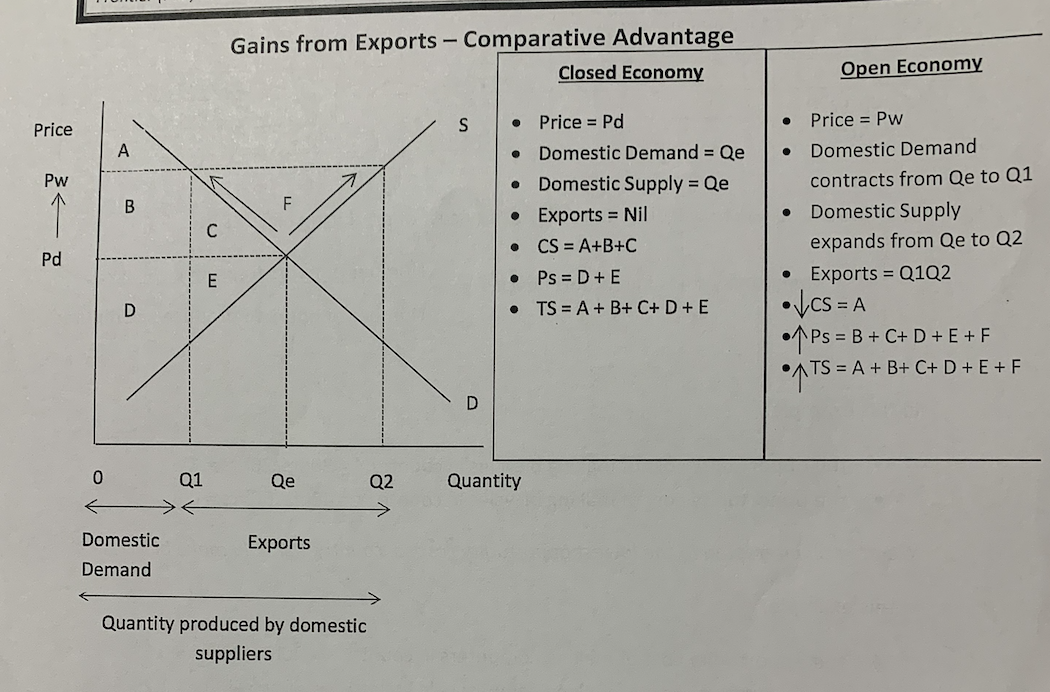
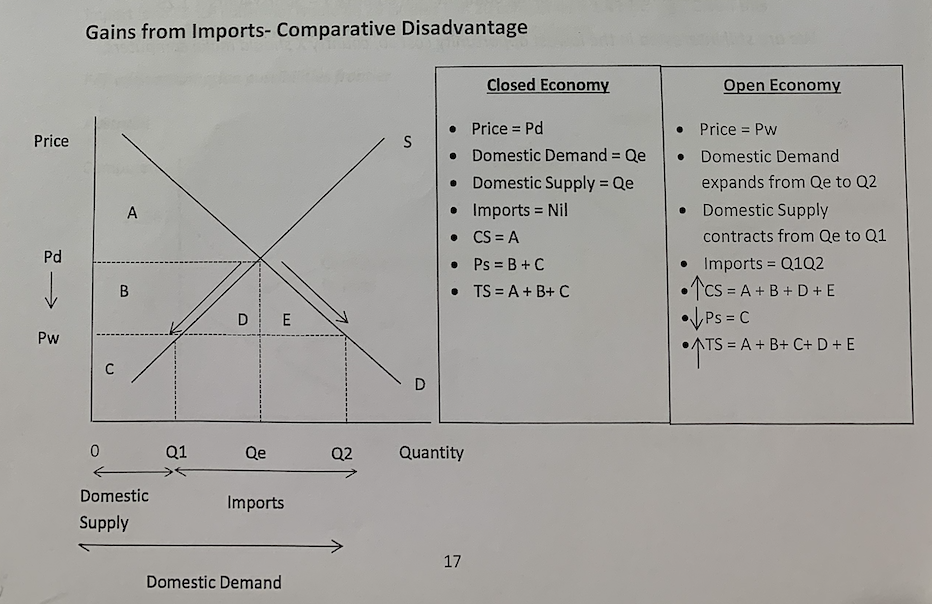
It occurs when a country is relatively more efficient at producing a product than another nation. i.e. can produce the item at a lower opportunity cost than another nation. A nation has a compartive advantage where its absolute advantage is greatest or where its absolute disadvantage is least. It can also be established by a comparison between the world price and the domestic price; if the domestic price is lower than the world price, then the country is relatively more efficient at producing this product and hence has a comparative advantage.
Sources of comparative advantage
Quantity and quality of resources- human (labour cost and skilled workforce), natural (natural resources and climate and geography) and capital resources (advanced machinery and technology can lower production costs and improve efficiency + countries with capital investment tend to be more productive).
Technological progress
Factors that affect a nations comparative advantage
Resource endowments
Degree of trade liberalisation
Exchange rates
Development of economies of scale
Supply of labour and wage rates
Degree of research and development
5 assumptions for the theory of comparative and absolute advantage
2 products are produced and consumed
2 nations are involved in trade
Transport costs are zero
Resources are perfectly mobile. i.e. zero displacement costs exist (the costs incurred when a resource [land, capital and labour]).
Free trade exists
6 limitations to the theory of comparative and absolute advantage
More than 2 products and 2 countries exist.
Transport costs play a siginifcant role in who trades with whom.
Resources cannot be easily transferred from the production of one good to the production of another without some displacement costs, as not all resources are equally proficient at producing each product.
Comparative advantages change over time; specialising according to the theory will stifle the development of new comparative advantages.
Free trade doesn't always exist between countries; can affect trade
Fails to account for the global value chain- the idea two products and two nations producing them is unrealistic in a complex world where products are often made across many nations not just one nation.
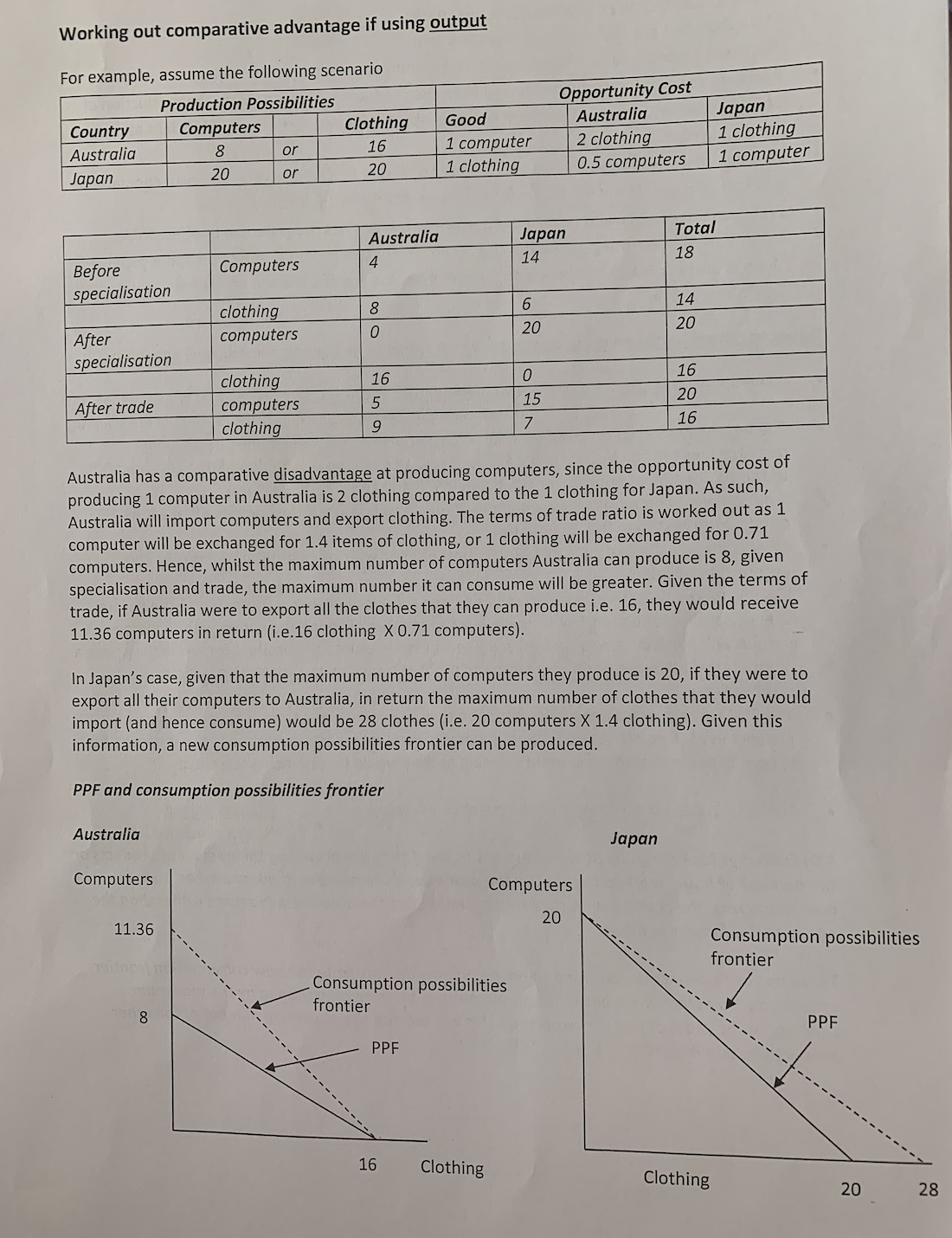
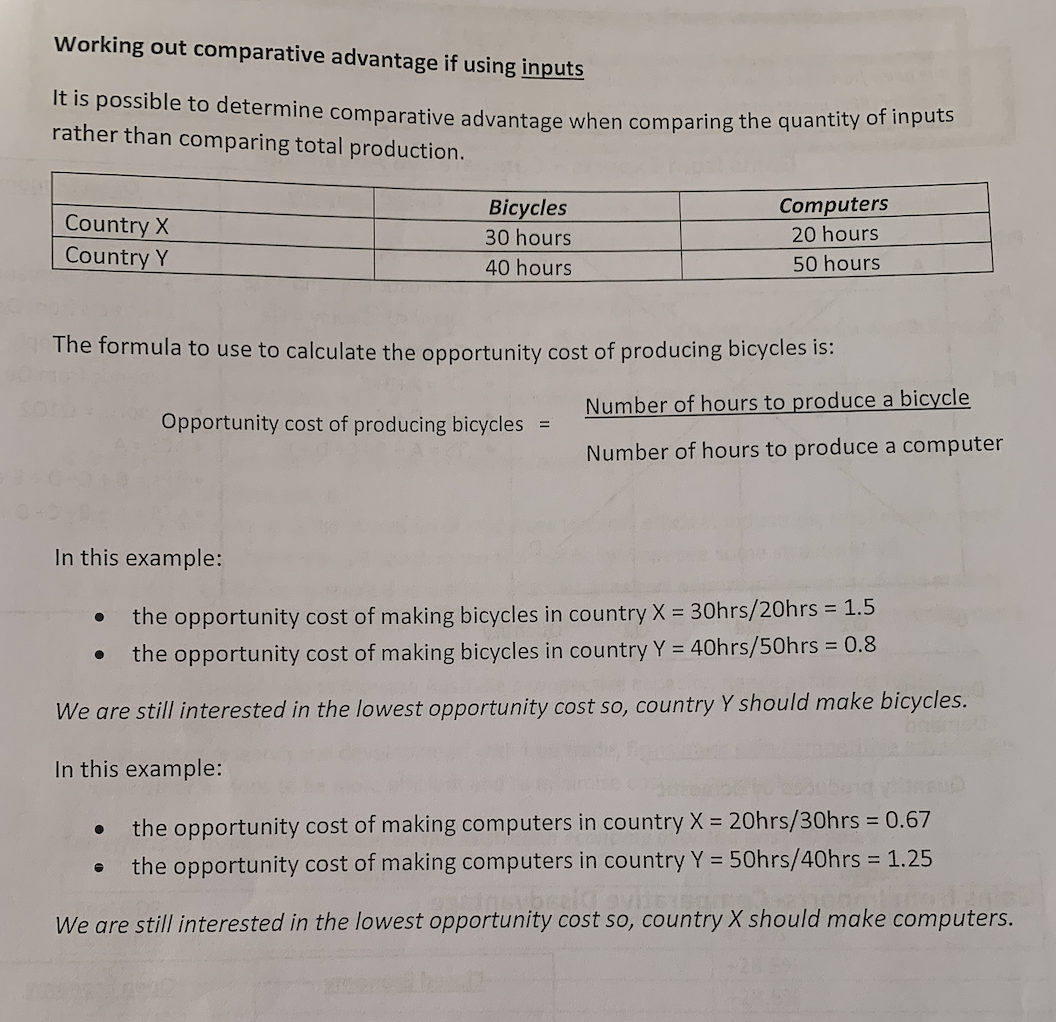
Opportunity cost equation
Opportunity cost= (max number of products produced that were given up)/max number of products produced that we are gaining)
Things to remember when using opportunity cost ratios to determine comparative advantage
Before countries specialise, you need to decide how to split their resources between the two goods they can produce. (e.g. 50/50 or 30/70)
A nation has a comparative advantage in producing a product if they produce it at a lower opportunity cost than the other nation.
After trade, must make sure both countries are better off compared to before specialisation, but if we have less of the other product, the nation with the large surplus will partially specialise by placing most resources into the product they have the comparative advantage in and some into the product they have a comparative disadvantage.
For trade to benefit both countries the terms of trade (rate of exchange) must lies between the opportunity cost ratios of producing each product in each country. If it didn’t it would mean that whilst one nation is gaining from specialisation and trade, the other is losing as they would be sacrificing too much.
Terms of trade= number gained/number sacrificed
Working out comparative advantage if using outputs
Working out comparative advantage if using inputs
Gains from exports- comparative advantage
Gains from imports- comparative disadvantage
The benefits of trade liberalisation
Allows consumers to consume beyond their PPF, so standard of living improves for Australians as they have access to a greater quantity and higher quality goods and services.
Sees resources be diverted from inefficient industries to efficient ones, so optimal resource allocation occurs and productivity increases.
Increases competition for domestic producers, resulting in the prices of domestic and imported goods and services falling.
In the long term, with allocation of resources towards efficient industries, total employment in the country should rise, although short term we may see some structural unemployment.
Greater opportunity to develop economies of scale: as exports expand, the market for domestically produced goods and services increases; this in turn results in lower average costs of production which helps control cost push inflation.
Imports of capital help to increase Australia’s productive capacity, hence achieving future economic growth
Encourages research and development: with free trade, firms must gain competitive advantages over other nations to be more efficient and to minimise cost of production.
Definition of protection
Protection refers to any artificial advantage provided to a domestic producer over a foreign producer by the domestic government.
Definition of a tariff
Is an artificial advantage provided to a local producer by the domestic government. It is a tax placed upon imported products that compete with locally produced goods.
Definition of a subsidy
An artificial advantage provided to a local producer by the government, which takes the form of a grant used by firms to help absorb the costs of production allowing them to complete with the overseas producers.
Definition of a quota
A form of protection that places a restriction on the number of particular types of imports that are allowed in a country.
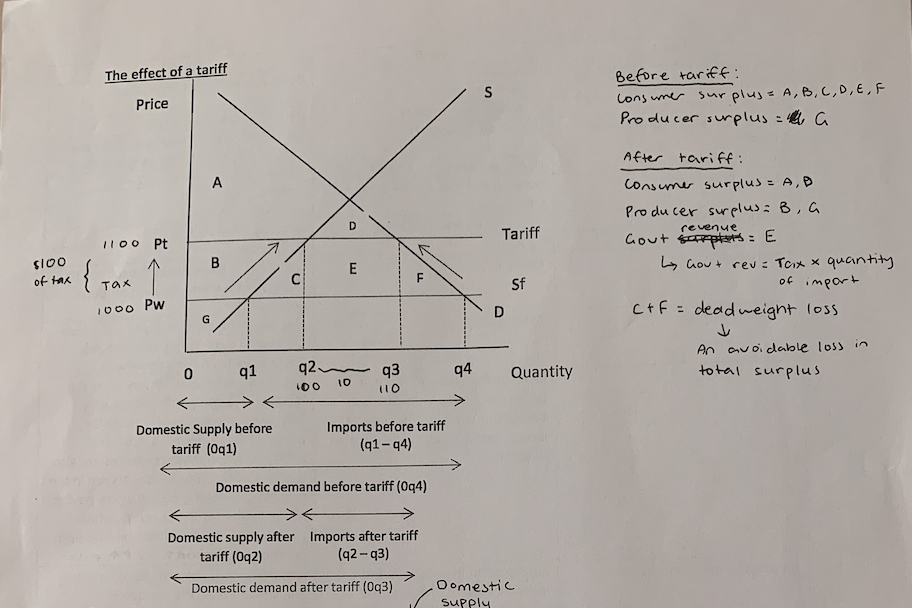
The impact of tariffs using the demand and supply model on trade, market efficiency and the macroeconomy
Domestic production in protected industries rise; employment in this industry rises (increased producer surplus)
Consumers pay more and have less choice (decrease consumer surplus)
Trade declines- exports also fall as inefficiencies creep in and retaliation makes us less internationally competitive.
Government revenue rises- although impact depends on demand for imports.
Resources allocated away from competitive, unprotected industries, towards non-competitive, protected industries. As protected industries consume more resources than they would have otherwise, this leads to higher factor (resource) costs for unprotected industries, reduced economic activity and factor (resource) growth generally. Producers in the unprotected industries lose as they are faced with higher costs of production.
Overall standard of living is lower and long term economic growth is stunted as the gains in producer surplus are outweighed by the loss in consumer surplus, hence total surplus decreases and a deadweight loss is created. Market efficiency is reduced.
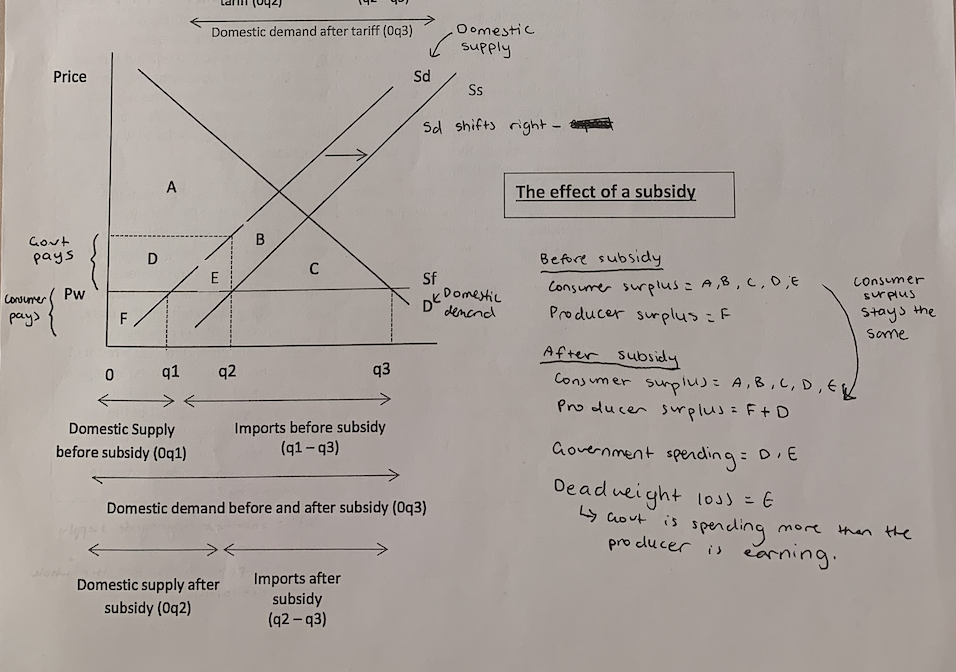
The impact of subsidies using the demand and supply model on trade, market efficiency and the macroeconomy
Consumers pay for subsidies indirectly through taxes.
Domestic firms in the protected industry expand causing unemployment to fall in that industry. This results in a transfer of income towards the protected firm and its workers.
Unlike a tariff, subsidy earns no tax revenue; this means that less money is available for the government to spend in other areas. Opportunity cost exists.
Foreign producers lose market share- meaning less foreign competition exists.
Whilst being preferable to a tariff, subsidies still result in a misallocation of resources like a tariff; factor costs rise, reducing growth potential in other competitive areas.
List the arguments for protection
Infant industry argument
The diversification argument
National defence argument
Anti-dumping argument
Favourable balance of trade argument
Increase domestic employment argument
Cheap foreign labour argument
Infant industry argument
Argued that infant industries need protection in their early years until they mature and can take advantage of economies of scale. It is argued that over time the infant industry will become more internationally competitive and develop a comparative advantage. The problem is that protection became more longer term than the original intention which was for it to be shorter term in nature. The infant industry becomes dependent on the protection and as such, the incentive to innovate and increase efficiency is removed.
The diversification argument
If a country completely applied the principle of comparative advantage, then it would specialise in a very narrow range of products. If there was a change in the prices of products from this industry, there would be a significant effect on the economy. The argument is that countries need to put protection on smaller industries that they don’t specialise in so that if there is a fall in the price of the countries main industry, the country would have other industries to fall back on. The industry with protection could eventually increase its efficiency and become competitive. This argument is weakened as there aren’t any countries that only have a comparative advantage in one or two industries and as world demand and technology changes over time, a countries comparative advantage also changes.
National defence argument
We need to protect those industries that are vital for defence. The problem is identifying which industries are ‘vital’; trade fosters international cooperation whilst protection reduces it.
Anti-dumping argument
It is argued that the foreign producer is engaging in unfair competition to drive out domestic producers by selling their products at a lower price in a foreign market tan in their home market. The overseas firm may be large enough to sustain short term losses by selling their prices at low prices and then increase its prices in the long run when there is less competition. Dumping may also occur when a firm has a large surplus they can’t sell in their own market or if their product has been banned for being injurious to health or illegal. The firm may sell their product to a overseas market at whatever price they can get. A difficulty with this argument is that it is hard to determine whether a firm/country is dumping, or it is just more efficient. The WTO helps countries make anti dumping cases. If dumping does cause harm to domestic producers, temporary protection may deter this.
Favourable balance of trade argument
Works on the belief that exports are good and imports are bad and similarly the goal is for a trade surplus rather than a trade deficit. In reality, protection may reduce imports, but exports will also fall as well because protection reduces the competitiveness of local firms, reality is imports benefits consumers and exports benefits producers.
Increase domestic employment argument
Argument is that imports employ foreign workers whereas domestic goods imply local employment. Employment in the protected industry may rise and employment in non protected industries will fall, as they face higher input costs so overall employment will decline.
Cheap foreign labour argument
This argument contends that Australian industries need to be protected from countries where wages are much lower. This argument could be turned around by saying that less economically developed countries need protection from countries like Australia because it has superior capital equipment and technology. Australian workers receive a higher wage because of their productivity. Countries that have an abundance of labour relative to other resources will have a comparative advantage in labour intensive goods. Countries like Australia should reap the benefits by importing these goods and services and producing those goods in which we are relatively more efficient.