Period 9 ID Terms
 Call Kai
 Learn
Learn Practice Test
 Spaced Repetition
 Match
Match Flashcards
 Knowt Play
1/17

There's no tags or description
Looks like no tags are added yet.
Name | Mastery | Learn | Test | Matching | Spaced | Call with Kai |
|---|
No analytics yet
Send a link to your students to track their progress
18 Terms
Moral Majority
A significant political movement in the 1980s led by Jerry Falwell and evangelical Christians, aiming to promote conservative values (opposed gay rights and feminism), influence national policy, and restore traditional family values in the United States. The movement fell apart in 1989 after conflict within the group, they received public backlash against what was viewed as harsh or unfair judgement.
Supply-side economics
Theory that stimulating economic growth in a county is best achieved by lowering taxes, decreasing regulation, and promoting free-market policies. Both Reagan and Trump used the theory to justify their economic policies, suggesting that benefits would "trickle down" to all income levels. However the national debt rose and the income gap increased.
PATCO
A labor organization representing air traffic controllers, known for a major strike in 1981, where workers were asking for a raise in pay and, decreased work week to 32 hours, and increased benefits. President Reagan then fired over 11,000 striking controllers, significantly impacting labor relations and government policies. Reagan’s popularity rose, business felt more able to firmly with unions, but it took almost a decade for the labor movement to recover from the impact of this event.
TEFRA (Tax Equity and Fiscal Responsibility Act)
Legislation passed in 1982 aimed at reducing the federal budget deficit by implementing tax reforms and cutting federal spending. This raised taxed by closing loopholes, tightening business deductions, and delaying some scheduled tax reductions. The act also put controls on Medicare as part of the goal of reducing the deficit. Reagan will be criticized for going back on his tax cuts promise and would regret singing it. He believed that congressional spending cuts would accompany the tax increases but that never happened.
AIDS (Acquired Immune Deficiency Syndrome)
The disease became public in the early 1980, which was spread through sexual contact, intravenous drug use, and blood transfusions. Lack of information and stigma led it to be called a “gay disease” which disproportionately affected the homosexual community. The lack of information about how to treat the disease led to division in America.
Iran-Contra Affair
A political scandal during the Reagan administration involving the secret sale of arms to Iran to encourage the release of hostages. The money was then use to fund Contra rebels in Nicaragua, which violated congressional prohibitions (Boland amendment). This scandal raised serious questions about executive power and accountability.
KAL 007
A commercial airplane that was shot down by the Soviet Union in 1983 after straying into restricted airspace, resulting in the deaths of all 269 passengers and crew on board including Congressmen Larry McDonald. This incident heightened tensions between the US and Soviets.
Contract with America
1994 congressional campaign for the Republican Party led by Newt Gingrich. It called for reduction of the size of the government, cutting taxes, and reducing welfare. The Republicans took both the house and the senate and pushed the Clinton administration more to the center.
START I (Strategic Arms Reduction Talks)
1991 treaty between the US and Soviet Union and resulted in both countries reducing their nuclear stockpiles by about 80%.
North America Free Treaty Agreement (NAFTA)
A trade agreement established in 1994 signed by Bill Clinton between the United States, Canada, and Mexico to eliminate trade barriers, increase economic cooperation among the three nations, and had little to no tariffs on goods. The agreement was seen as mainly positive however specific businesses were hurt by foreign competition. Areas in the automobile and textile factories often relocated to Mexico where labor costs were cheaper.
Immigration Reform and Control Act of 1986
Act passed in the Reagan administration that made it illegal to knowingly hire a worker who was in the US illegally.
Don’t Ask, Don’t Tell
A policy implemented in 1993 that allowed gay, lesbian, or bisexual individuals from serving in the US military as long as their sexuality was not publicly known. The act allowed the military to ban from service anyone who was openly homosexual.
DOMA (Defense of Marriage Act)
Signed by Bill Clinton in 1996, the act defined marriage federally as between a man and women. Meaning that states were not required to recognize same sex marriages, however it didn’t prevent it either.
Patient Protection and Affordable Care Act (Obamacare)
Signed by President Obama in 2010, the act brought forth a reorganization and expansion of those covered by government run health care (Medicare or Medicaid). The goal was to increase coverage and quality of healthcare while reducing costs. The act has been upheld as constitutional in 3 separate Supreme Court challenges.
“Star Wars” missile defense system (SDI)
A proposed missile defense initiative launched by President Reagan in 1984, aimed at intercepting and destroying incoming ballistic missiles using ground-based and space-based systems. The press dubbed it the "Star Wars" program and were critical of its feasibility and costs. Reagan hoped that it would replace MED (Mutual Assured Destruction) as a nuclear deterrent system.
ADA (Americans with Disabilities Act)
A 1990 act that prohibits discrimination against individuals with disabilities in all areas of public life, including jobs, schools, transportation, and all public and private places open to the general public.
Exxon Valdez
1989 oil spill off the coast of Alaska that released 11 million gallons of oil into the ecosystem doing significant damage. The Oil Pollution Act of 1990 was passed in response, which strengthened regulations and responses, and increased the liability and financial responsibility of oil companies for future spills.
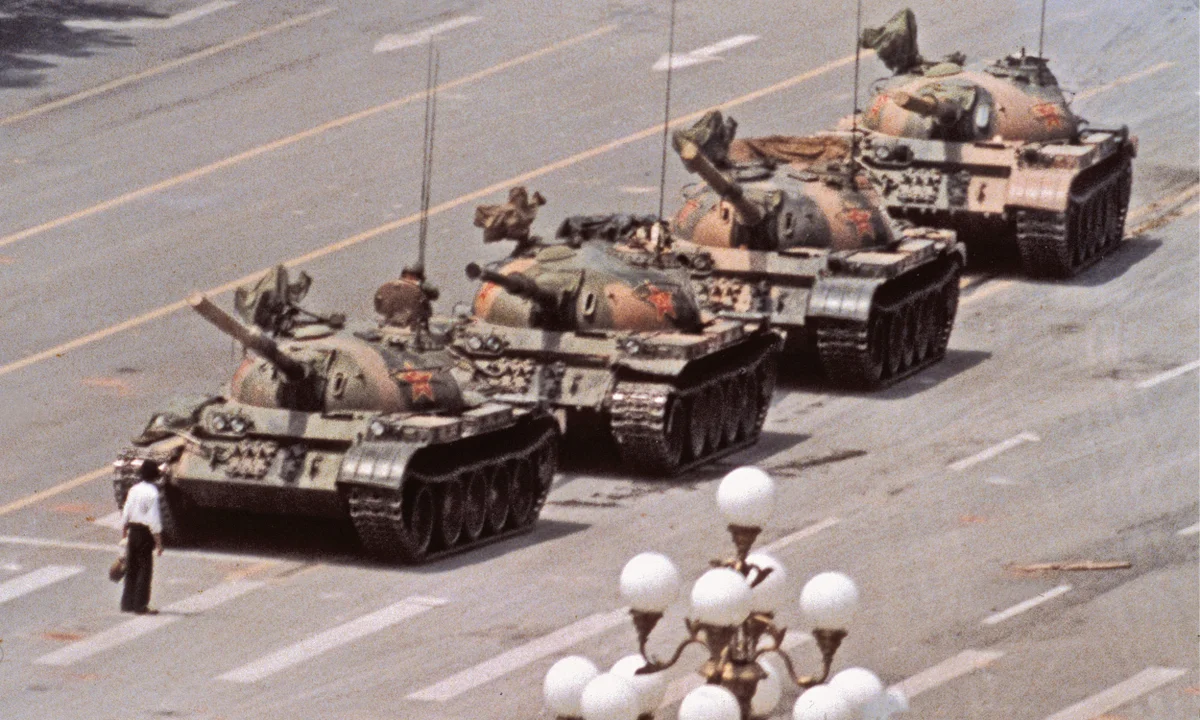
Tienanmen Square
1989 student and intellectual led protest in China, inspired by movements in the Soviet Union. President George H.W. Bush condemned the violence. The US imposed sanctions, suspended military sales, and froze high-level exchanges with China. The iconic photo of the man in front of the tank comes from this.