CPrac E - Gravimetric analysis and enthalpy
 Call Kai
 Learn
Learn Practice Test
 Spaced Repetition
 Match
Match Flashcards
 Knowt Play
1/11

There's no tags or description
Looks like no tags are added yet.
Name | Mastery | Learn | Test | Matching | Spaced | Call with Kai |
|---|
No analytics yet
Send a link to your students to track their progress
12 Terms
Loss in mass after heating =… (for hydrated sample AND compound undergoing thermal decomp)
Loss in mass after heating = mass of water of crystallisation (for hydrated sample without undergoing thermal decomposition)
Loss in mass after heating = mass of gases produced (for compound undergoing thermal decomposition)
Describe general heating of compound
Using a balance, weigh a clean and dry boiling tube.
Add a given mass of solid (about 5 g) into the tube and reweigh.
Heat the tube gently and then strongly to decompose the salt.
Hold the boiling tube at 45 angle to the flame to ensure even heating of the salt, and to allow CO2 and water vapour given off to escape from the tube
Cool the tube before reweighing to find the mass of the tube and residue.
Repeat the heating, cooling and reweighing processes until constant mass is achieved where consecutive mass difference is less than 0.050 g
Investigate how the solubility of calcium hydroxide in water depends on the temperature of the solvent
Measure 100 cm3 of deionised water using a measuring cylinder into a clean and dry conical flask
Place the conical flask in a thermostatically controlled water bath maintained at 10 °C and use a thermometer to monitor the temperature of the solution inside the conical flask
Weigh accurately about 5.00 g of solid Ca(OH)2
Once the temperature inside the conical flask reaches 10 °C, transfer the contents from weighing bottle into the conical flask
Using a glass rod, stir the mixture
Then leave the mixture to stand over a period of 30 min for equilibrium to be established
Weigh a dry evaporating dish
Quickly filter the reaction mixture and collect the filtrate.
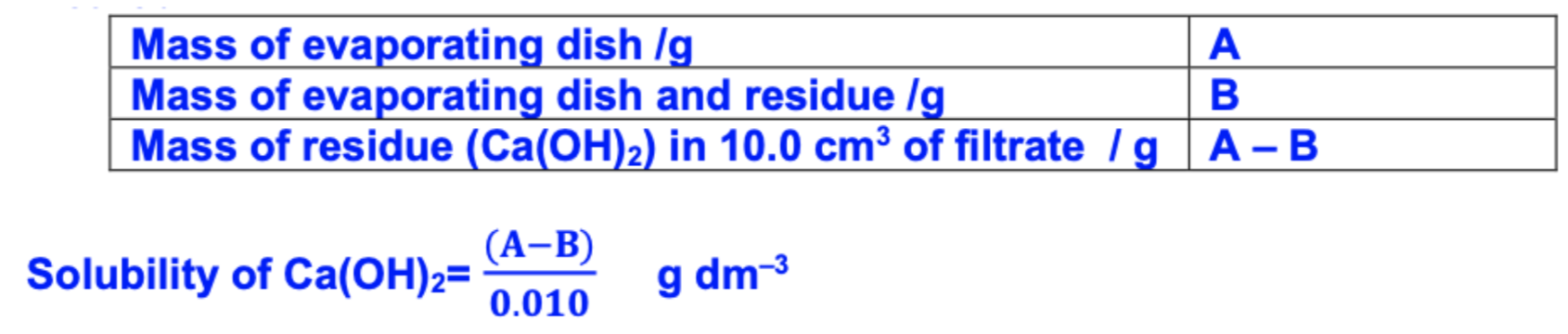
Pipette 10.0 cm3 of the filtrate into the evaporating dish and evaporate it to dryness.
Cool, weigh and record the mass of the dish with the residue
Repeat steps 1 to 9 four more times at temperatures of 20 ºC, 30 ºC, 40 ºC, 50 ºC
Investigate how the solubility of calcium hydroxide in water depends on the temperature of the solvent TABLE
Why must the tube be heated gently first
To remove water of crystallisation present in the solid as water droplets. Sudden release of water due to rapid heating can cause the substance to splatter, which is dangerous and leads to inaccurate results. Strong heating may also cause sudden thermal expansion which will crack the tube.
Why must the tube be cooled before reweighed
To avoid fluctuation in the mass readings for hot substances caused by the air convection above the solid and to increase accuracy of weighing results
Why must we heat to constant mass
To ensure complete decomposition of the solid and ensure all water of crystallization has been removed, leaving behind a pure,anhydrous form of the substance for accurate mass determination.
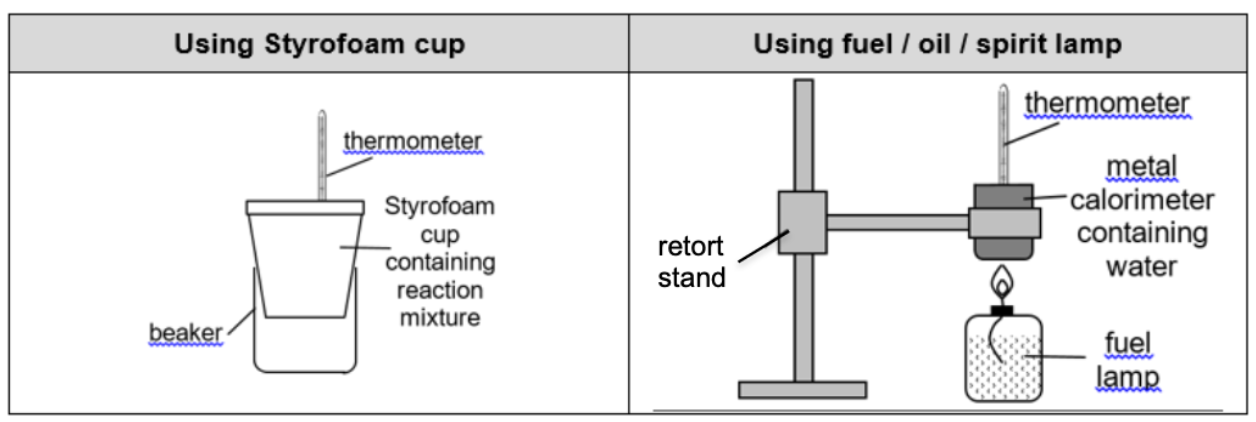
Draw styrofoam cup and fuel lamp
Temp, mass reading, measuring cylinder units
Temperature: 1dp
Mass reading: 3dp
Measuring cylinder: cm3 to nearest whole number
Include STATE symbols
Weighted average initial temperature formula

General: (Determine enthalpy change of reaction)
Use a measuring cylinder to transfer an appropriate volume of limiting reagent (at least 20 cm3) into a polystyrene cup
Measure and record the initial temperature with a thermometer
Use another measuring cylinder to measure an appropriate volume of the second solution and record its initial temperature
Add the second solution into the polystyrene cup
Stir the mixture gently using the thermometer provided and record the highest / lowest temperature reached
Rinse and dry the polystyrene cup
Repeat the experiment using a different set of volumes of reagents
Keep total volume of mixture (not more than 120 cm3) constant for the different experiments for simpler comparison
*Since total volume, m and c are the same for both experiments -> Heat change directly proportional to T
General: (Determine enthalpy change of combustion of fuel)
Use a measuring cylinder to introduce 100 cm3 into the copper calorimeter
Place the thermometer in the water and record its initial temperature
Place some XXX into the oil lamp (also known as spirit lamp)
Put a wick into it and weigh the oil lamp and its contents. Record the mass, m1
Place the oil lamp under the calorimeter and light up the oil lamp.
Stir the water gently with the thermometer
When the temperature of the water has increased by about 5 oC, extinguish the oil lamp.
Weigh the oil lamp and its contents immediately. Record the mass, m2.
Read and record the highest temperature of the water and calculate the T.
Calculate the mass of XXX used (m1 – m2)
Repeat the experiment to get reliable results