H6 Mortimer- Arthropods I, II + III. Chelicerates and Myriapods + Insect origins + Insect diversity: wings, larvae and pupae

0.0(0)
Studied by 0 people
call kaiCall Kai
learnLearn
examPractice Test
spaced repetitionSpaced Repetition
heart puzzleMatch
flashcardsFlashcards
GameKnowt Play
Card Sorting

1/9

encourage image

There's no tags or description

Looks like no tags are added yet.

Last updated 9:58 AM on 5/8/26
Name
Mastery
Learn
Test
Matching
Spaced
Call with Kai

No analytics yet

Send a link to your students to track their progress

10 Terms

1
New cards

describe the general features and subphyla of arthropods

  • arthropoda is a phylum in the ecdysozoa clade of bilaterian animals

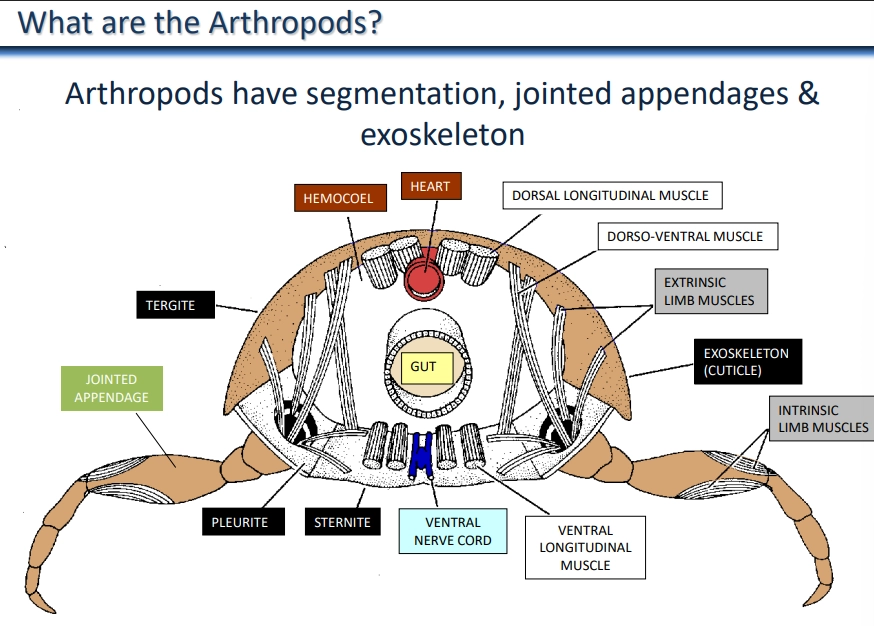
  • segmented, with articulate membranes (folded flexible regions) allow inter-segmental articulation

  • the ancestor had a series of similar segments (homonomous), but these are often now fused/lost/specialised (heteronomous) eg. head, thorax and abdomen regions grouped by tagmosis (independently evolved) and specialised

  • jointed, paired appendages with articles (like segments)- flexible cuticle at the joint with flexor + extensor and protractor + retractor muscles

  • exoskeleton/cuticle (tergite, sternite + pleurite) made from chitin polysaccharide with properties controlled by sclerotisation- tanning + cross-linking

  • growth is permitted by moulting (ecdysis)

  • dorsal + ventral longitudinal muscles, dorso-ventral muscles and extrinsic + intrinsic limb muscles

  • antennae with sensory functions

  • heart on the dorsal side with ostia and hemocel + ventral nerve cord

this can be split into four extant subphyla:

  • hexapoda (insects)

  • crustacea

  • myriapoda (millipedes + centipedes)

  • chelicerata (spiders + scorpions)

the trilobitomorpha is an extinct subphylum
<ul><li><p><span>arthropoda is a </span><strong>phylum </strong><span>in the </span><strong>ecdysozoa clade </strong><span>of </span><strong>bilaterian </strong><span>animals</span></p></li><li><p><strong><span>segmented</span></strong><span>, with </span><strong>articulate membranes </strong>(folded flexible regions) allow inter-segmental articulation</p></li><li><p>the ancestor had a series of similar segments (<strong>homonomous</strong>), but these are often now fused/lost/specialised (<strong>heteronomous</strong>) eg. head, thorax and abdomen regions grouped by <strong>tagmosis </strong>(independently evolved)<strong> </strong>and specialised</p></li><li><p><strong><span>jointed</span></strong><span>, paired appendages with </span><strong><span>articles </span></strong><span>(like segments)- flexible cuticle at the joint with</span><strong><span> flexor + extensor </span></strong><span>and </span><strong><span>protractor + retractor </span></strong><span>muscles</span></p></li><li><p><strong><span>exoskeleton/cuticle </span></strong><span>(tergite, sternite + pleurite) made from</span><strong><span> chitin </span></strong><span>polysaccharide with properties controlled by </span><strong><span>sclerotisation</span></strong><span>- tanning + cross-linking</span></p></li><li><p><span>growth is permitted by </span><strong><span>moulting </span></strong><span>(</span><strong><span>ecdysis</span></strong><span>)</span></p></li><li><p>dorsal + ventral longitudinal muscles, dorso-ventral muscles and extrinsic + intrinsic limb muscles</p></li><li><p><strong>antennae </strong>with sensory functions</p></li><li><p>heart on the dorsal side with ostia and hemocel + ventral nerve cord</p></li></ul><p></p><p>this can be split into four extant subphyla:</p><ul><li><p>hexapoda (insects)</p></li><li><p>crustacea</p></li><li><p>myriapoda (millipedes + centipedes)</p></li><li><p>chelicerata (spiders + scorpions)</p></li></ul><p>the trilobitomorpha is an extinct subphylum</p><p></p>
2
New cards

describe the hexapoda

  • hexapoda is a subphylum of the arthropoda phylum of bilaterian animals (ecdysozoa clade)

  • these are insects including bees, butterflies, moths, ants, wasps, and flies

  • almost exclusively terrestrial

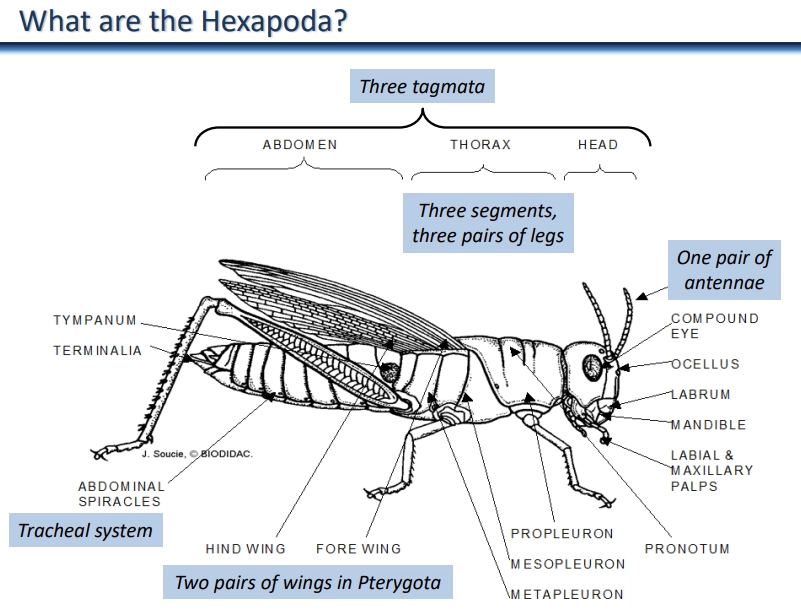
  • one pair of antennae

  • generally three segments from tagmosis: head, thorax (three segments + leg pairs) and abdomen

  • tracheal system has spiracles that can close (don’t need humidity)

  • they have waxy cuticles and hyperosmotic excreta

  • coevolved with flowering plants- phytophagous (plant eating) and pollinators

  • can be eusocial, with haplodiploidy

two classes:

  • the entognatha (concealed mouthparts)- no metamorphosis

  • the insecta/ectognatha (exposed mouthparts), two sublasses:

    • apterygota (wingless)- no metamorphosis

    • pterygota (two pairs of wings, may be reduced)- metamorphosis, four superorders:

      • paleoptera, polyneoptera, paraneoptera and holometabola (largest suborder)
<ul><li><p><strong>hexapoda</strong> is a <strong>subphylum</strong> of the <strong>arthropoda</strong> <strong>phylum </strong>of <strong>bilaterian </strong>animals (<strong>ecdysozoa clade</strong>)</p></li><li><p>these are insects including bees, butterflies, moths, ants, wasps, and flies</p></li><li><p>almost exclusively <strong>terrestrial</strong></p></li><li><p><strong>one pair of antennae</strong></p></li><li><p>generally three segments from tagmosis: head, thorax (three segments + leg pairs) and abdomen</p></li><li><p>tracheal system has <strong>spiracles </strong>that can close (don’t need humidity)</p></li><li><p>they have <strong>waxy cuticles </strong>and <strong>hyperosmotic excreta</strong></p></li><li><p>coevolved with flowering plants- phytophagous (plant eating) and pollinators</p></li><li><p>can be <strong>eusocial</strong>, with haplodiploidy</p></li></ul><p></p><p>two classes:</p><ul><li><p>the <strong>entognatha</strong> (concealed mouthparts)- no metamorphosis</p></li></ul><ul><li><p>the insecta/<strong>ectognatha </strong>(exposed mouthparts), two sublasses:</p><ul><li><p><strong>apterygota </strong>(wingless)- no metamorphosis</p></li><li><p><strong>pterygota </strong>(two pairs of wings, may be reduced)- metamorphosis, four superorders:</p><ul><li><p>paleoptera, polyneoptera, paraneoptera and holometabola (largest suborder)</p></li></ul></li></ul></li></ul><p></p>
3
New cards

describe the crustacea

  • crustacea is a subphylum (paraphyletic group, all pancrustacea but excluding hexapoda) of the arthropoda phylum of bilaterian animals (ecdysozoa clade)

  • this includes lobsters, crabs, crayfish, shrimp, krill, barnacles and woodlice- mainly marine, some freshwater or terrestrial

  • two pairs of antennae

  • direct (hatch with all segments + appendages) or indirect/metamorphosis (nauplius larval stage with just 3 head segments, moults add new segments) development

  • no general body plan, but at least two body segments from tagmosis

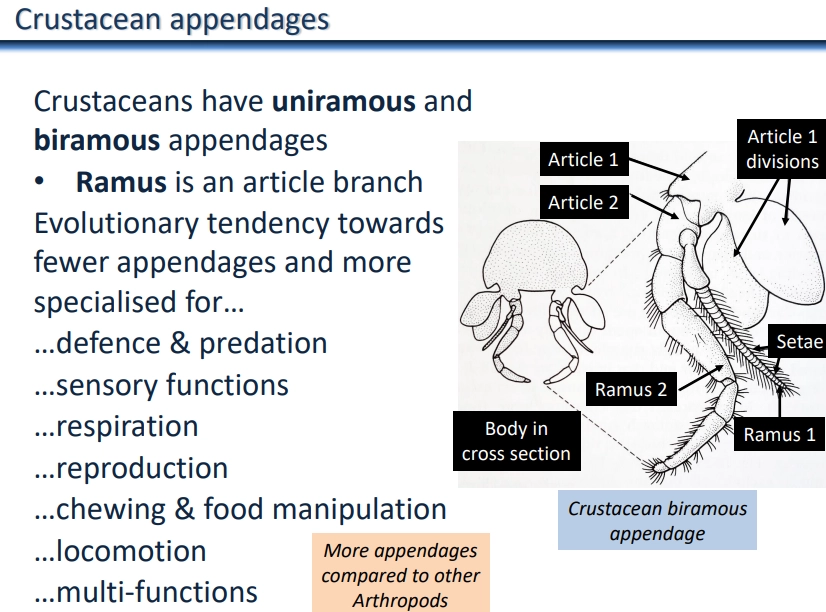
  • biramous or uniramous appendages (branching or no branching) can be specialised, e.g., as gills

  • largest class, malacostraca (crabs, krill…), have standardised tagmosis with a head, thorax and abdomen, and a gastric mill in their stomach
<ul><li><p><strong>crustacea </strong>is a <strong>subphylum</strong> (paraphyletic group, all pancrustacea but excluding hexapoda) of the <strong>arthropoda phylum</strong> of <strong>bilaterian </strong>animals (<strong>ecdysozoa</strong> <strong>clade</strong>)</p></li><li><p>this includes lobsters, crabs, crayfish, shrimp, krill, barnacles and woodlice- mainly marine, some freshwater or terrestrial</p></li><li><p><strong>two pairs of antennae</strong></p></li><li><p><strong>direct </strong>(hatch with all segments + appendages) or <strong>indirect/metamorphosis</strong> (nauplius larval stage with just 3 head segments, moults add new segments) <strong>development</strong></p></li><li><p>no general body plan, but at least two body segments from tagmosis</p></li><li><p><strong>biramous </strong>or <strong>uniramous </strong>appendages (branching or no branching) can be specialised, e.g., as gills</p></li></ul><p></p><ul><li><p>largest class, malacostraca (crabs, krill…), have standardised tagmosis with a head, thorax and abdomen, and a gastric mill in their stomach</p></li></ul><p></p>
4
New cards

describe the myriapoda

  • myriapoda is a subphylum of the arthropoda phylum of bilaterian animals (ecdysozoa clade)

  • this includes the centipedes and millipedes

  • head + trunk, single pair of antennae, open tracheae (need humidity)

  • centipedes have an odd number of leg pairs, poison claws on 1st trunk segment, defensive anal legs on the last segment, and are nocturnal, active hunters

  • millipedes have diplosegments (two pairs of appendages per segment), and mostly eat rotting vegetation and wood, + secrete noxious chemicals as a defence mechanism
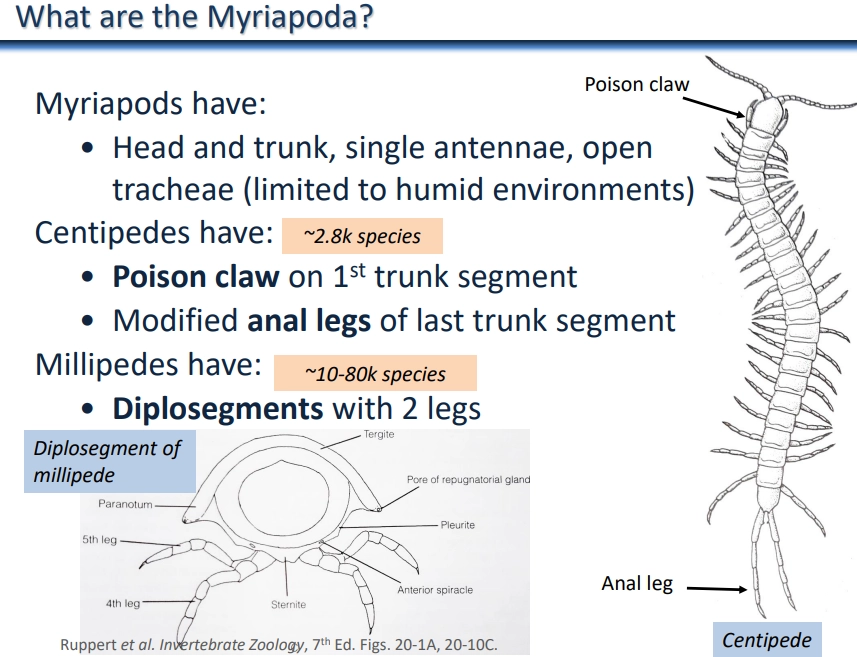
<ul><li><p><strong>myriapoda </strong>is a <strong>subphylum</strong> of the <strong>arthropoda phylum</strong> of <strong>bilaterian </strong>animals (<strong>ecdysozoa</strong> <strong>clade</strong>)</p></li><li><p>this includes the centipedes and millipedes</p></li><li><p>head + trunk, <strong>single pair of antennae</strong>, open tracheae (need humidity)</p></li><li><p><strong>centipedes </strong>have an odd number of leg pairs, poison claws on 1st trunk segment, defensive anal legs on the last segment, and are nocturnal, active hunters</p></li><li><p><strong>millipedes</strong> have <strong>diplosegments </strong>(two pairs of appendages per segment), and mostly eat rotting vegetation and wood, + secrete noxious chemicals as a defence mechanism</p></li></ul><p></p>
5
New cards

describe the chelicerata

  • chelicerata is a subphylum of the arthropoda phylum of bilaterian animals (ecdysozoa clade)

  • this includes 5 major subgroups, the ticks + mites, scorpions, spiders (together, the arachnids), horse shoe crabs + sea spiders

  • head and thorax region fused into a cephalothorax, + abdomen, 4 pairs of legs

  • compound eyes

  • no antennae (only arthropod group), but have chelicerae appendages (pincers) and pedipalps (non-locomotory appendages)

  • book lungs

  • carnivorous with liquid diet

  • no antagonistic muscles, use hydraulic pressure from hemocel to extend appendages and muscles to retract them

  • spiders produce silk, have poison glands and transfer sperm via pedipalps (almost exclusively predatory)
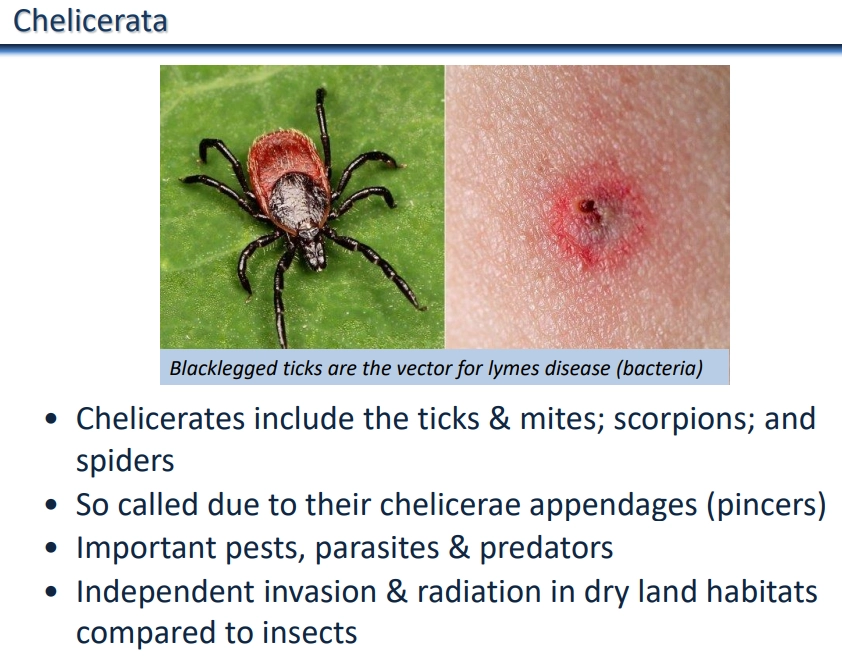
<ul><li><p><strong>chelicerata </strong>is a <strong>subphylum</strong> of the <strong>arthropoda phylum</strong> of <strong>bilaterian </strong>animals (<strong>ecdysozoa</strong> <strong>clade</strong>)</p></li><li><p>this includes 5 major subgroups, the ticks + mites, scorpions, spiders (together, the arachnids), horse shoe crabs + sea spiders</p></li><li><p>head and thorax region fused into a <strong>cephalothorax</strong>, <strong>+ abdomen</strong>, 4 pairs of legs</p></li><li><p>compound eyes</p></li><li><p><strong>no antennae</strong> (only arthropod group), but have <strong>chelicerae </strong>appendages (pincers) and <strong>pedipalps </strong>(non-locomotory appendages)</p></li><li><p>book lungs</p></li><li><p>carnivorous with liquid diet</p></li><li><p>no antagonistic muscles, use hydraulic pressure from hemocel to extend appendages and muscles to retract them</p></li></ul><p></p><ul><li><p>spiders produce silk, have poison glands and transfer sperm via pedipalps (almost exclusively predatory)</p></li></ul><p></p>
6
New cards

describe the trilobitomorpha

  • trilobitomorpha is an extinct subphylum of the arthropoda phylum of bilaterian animals (ecdysozoa clade)
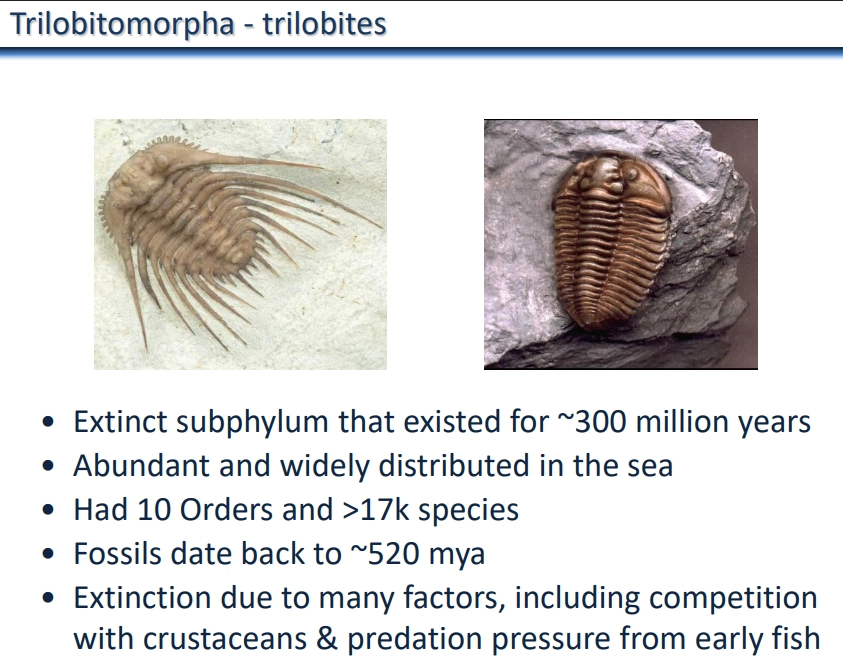
<ul><li><p><strong>trilobitomorpha </strong>is an <strong>extinct subphylum</strong> of the <strong>arthropoda phylum</strong> of <strong>bilaterian </strong>animals (<strong>ecdysozoa</strong> <strong>clade</strong>)</p></li></ul><p></p>
7
New cards

what is a wing and how did they evolve?

  • wings are though to have evolved once in the hexapoda/insects (ectognatha class), in the pterygota subclass

  • in many cases the one or both of the two pairs of wings have been lost, reduced or modified

  • powered flight, which evolved four times across history, actively generates lift (not gliding etc.), by the power stroke and the recovery stroke- wing changes angle so that the lift isn’t cancelled out

  • the top of the wing is the leading edge, and the veins of cuticle strengthen them

wings are not appendages, they evolved de novo, by two theories:

  • paranotal theory- wing develops from outgrowths of nota

  • endite-exite theory- wing develops from exites of primitive leg segments

they likely evolved from a gliding ancestor:

  • fixed angle, non-flapping wing generates lift for gliding

  • hinge, venation, muscle and higher respiration/metabolism needed to develop flapping flight

  • folding of wings in non-paleopterans opened up more habitats/niches

  • asynchronous muscle, which needs just a single nerve impulse, evolved independently multiple times to increase wing beat frequency + decrease body size
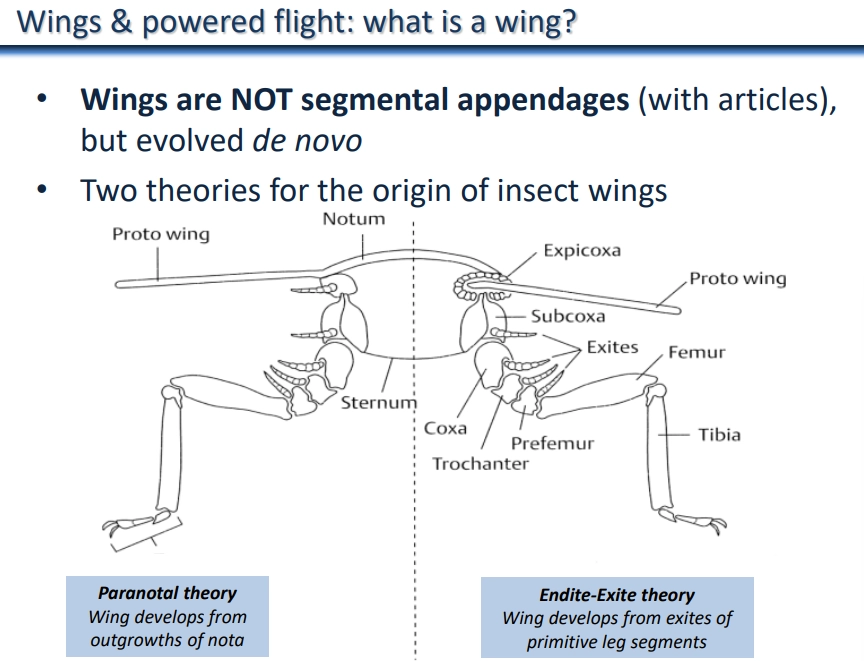
<ul><li><p>wings are though to have <strong>evolved once </strong>in the hexapoda/insects (ectognatha class), in the <strong>pterygota </strong>subclass</p></li><li><p>in many cases the one or both of the two pairs of wings have been lost, reduced or modified</p></li><li><p><strong>powered flight</strong>, which evolved four times across history, <strong>actively generates lift</strong> (not gliding etc.), by the power stroke and the recovery stroke- wing changes angle so that the lift isn’t cancelled out</p></li><li><p>the top of the wing is the leading edge, and the veins of cuticle strengthen them</p></li></ul><p>wings are <strong>not appendages</strong>, they evolved de novo, by two theories:</p><ul><li><p><strong>paranotal theory-</strong> wing develops from outgrowths of nota</p></li><li><p><strong>endite-exite theory-</strong> wing develops from exites of primitive leg segments</p></li></ul><p></p><p>they likely evolved from a <strong>gliding ancestor</strong>:</p><ul><li><p>fixed angle, <strong>non-flapping wing </strong>generates lift for gliding</p></li><li><p><strong>hinge, venation, muscle</strong> and higher <strong>respiration</strong>/metabolism needed to develop flapping flight</p></li><li><p><strong>folding </strong>of wings in non-paleopterans opened up more habitats/niches</p></li><li><p><strong>asynchronous muscle</strong>, which needs just a single nerve impulse, evolved independently multiple times to increase wing beat frequency + decrease body size</p></li></ul><p></p>
8
New cards

how are wings controlled?

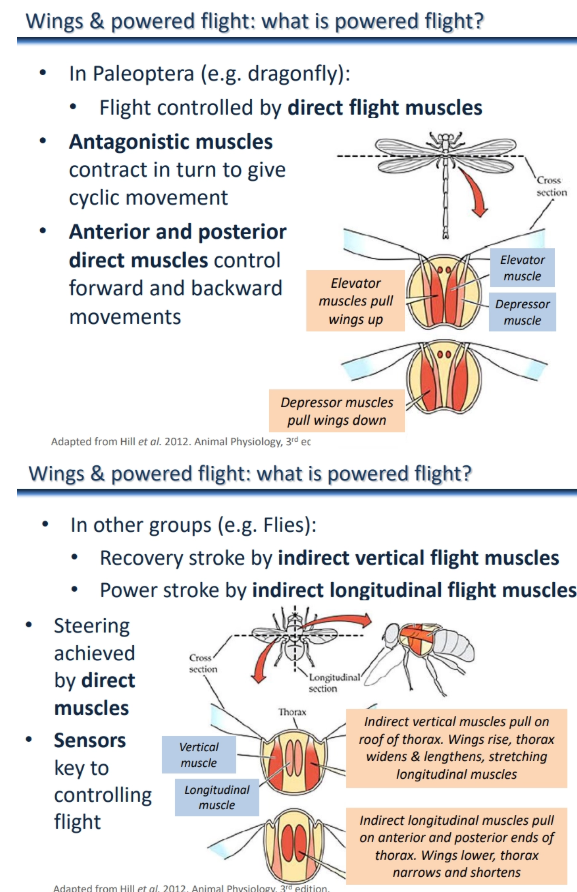
in paleoptera (eg. dragonflies):

  • controlled by antagonistic direct flight muscles

  • elevator vs depressor muscles contract in turn to cause cyclic wing movement

  • anterior vs posterior direct muscles control forward and backward movements

in other groups (eg. flies):

  • power stroke controlled by indirect vertical flight muscles, which pull on the roof of the thorax

  • recovery stroke controlled by indirect longitudinal flight muscles, which pull on the anterior and posterior ends of the thorax

  • direct muscles allow for steering

<p><strong>in paleoptera</strong> (eg. dragonflies):</p><ul><li><p>controlled by <strong>antagonistic direct flight muscles</strong></p></li><li><p><strong>elevator </strong>vs <strong>depressor </strong>muscles contract in turn to cause cyclic wing movement</p></li><li><p><strong>anterior </strong>vs <strong>posterior </strong>direct muscles control forward and backward movements</p></li></ul><p></p><p><strong>in other groups</strong> (eg. flies):</p><ul><li><p>power stroke controlled by <strong>indirect vertical flight muscles</strong>, which pull on the <strong>roof </strong>of the <strong>thorax</strong></p></li><li><p>recovery stroke controlled by<strong> indirect longitudinal flight muscles</strong>, which pull on the <strong>anterior </strong>and <strong>posterior ends </strong>of the <strong>thorax</strong></p></li><li><p><strong>direct</strong> muscles allow for <strong>steering</strong></p></li></ul><p></p>
9
New cards

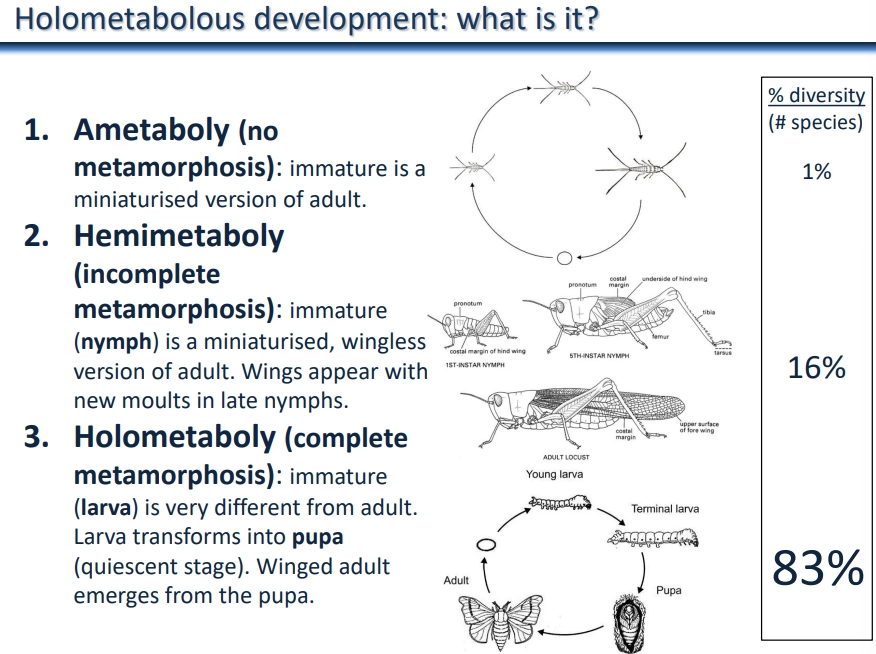
what are the different kinds of development to do with metamorphosis?

in hexapods
<p>in hexapods</p>
10
New cards

what is holometabolous development? what are the advantages of this?

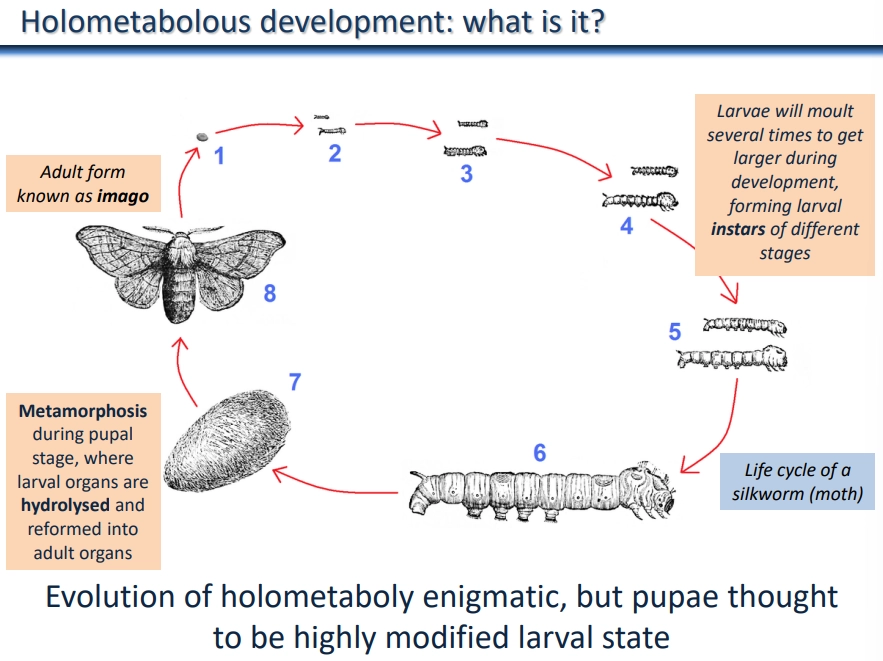
  • in holometaboly, the insect (hexapod) undergoes complete metamorphosis- this evolved only once

  • the immature larva enters a quiescent pupa stage, from which a very different winged adult then emerges from

  • the larva will moult very small amounts multiple times, mostly 5, to get larger (different stages = instars)

  • in the pupal stage, the larval organs are hydrolysed and reformed into adult organs from imaginal discs (clusters of embryonic reserve cells)

  • the imago is the final adult form

  • this process is hormonally controlled

  • this allows the larvae and adults to have ecologically different niches and specialisation, leading to resource partitioning and avoidance of competition between life stages

  • the speed of development can be controlled dependent on the amount of food eg. through diapause

  • it also allows for parasitoidism (longer-term than parasitism + causes death) by larva
<ul><li><p>in holometaboly, the insect (hexapod) undergoes<strong> complete metamorphosis</strong>- this evolved only once</p></li><li><p>the <strong>immature larva</strong> enters a <strong>quiescent pupa stage</strong>, from which a very different <strong>winged adult </strong>then emerges from</p></li><li><p>the larva will <strong>moult </strong>very small amounts <strong>multiple times</strong>, mostly 5, to get larger (different stages = <strong>instars</strong>)</p></li><li><p>in the pupal stage, the<strong> larval organs are hydrolysed</strong> and <strong>reformed </strong>into adult organs from <strong>imaginal discs </strong>(clusters of <strong>embryonic reserve cells</strong>)</p></li><li><p>the <strong>imago </strong>is the final adult form</p></li><li><p>this process is <strong>hormonally controlled</strong></p></li></ul><p></p><ul><li><p>this allows the larvae and adults to have<strong> ecologically different niches and specialisation</strong>, leading to <strong>resource partitioning </strong>and <strong>avoidance </strong>of <strong>competition </strong>between life stages</p></li><li><p>the<strong> speed of development can be controlled</strong> dependent on the amount of food eg. through <strong>diapause</strong></p></li><li><p>it also allows for <strong>parasitoidism </strong>(longer-term than parasitism + causes death) by larva</p></li></ul><p></p>