1a. intro to cog neuroscience
 Call Kai
 Learn
Learn Practice Test
 Spaced Repetition
 Match
Match Flashcards
 Knowt Play
1/16

There's no tags or description
Looks like no tags are added yet.
Name | Mastery | Learn | Test | Matching | Spaced | Call with Kai |
|---|
No analytics yet
Send a link to your students to track their progress
17 Terms
explain dualism/dual aspect theory
philosophical understanding that the mind and the body/physical brain are two different entities experiencing the same reality
which greek philosopher thought sensation and experiences came from the brain
hippocrates
which greek philosopher thought sensation and experiences came from the heart
aristotle
explain localised vs distributed function
localised = function comes from specialised regions
distributed = function comes from complex large-scale networks
what is phrenology and who founded it
Gall
states that the contours of our skull can give us information about the cognitive capacities of the individual i.e. their personality
certain bumps correlate to specific traits like morality or intellect
define functional specialisation
mental operations are specialised to specific regions / different regions of the brain serve different functions
give one benefit to phrenology
it allowed us to start describing the brain in terms of cortical areas and functional specialisation
founded the idea that different cortexes cover different functions
give one difference between functional specialisation and phrenology
phrenology thinks each area of the brain has one function, but functional specialisation says an area can be responsible for many functions
explain aggregate field theory
came about as a response to the localisation of function theory becoming popular
says there is not one single area responsible for a function
evidence from testing on animals found that removing parts of the brain didn’t stop levels of functioning - showing how there must be multiple areas involved
what is ablation
a research method where parts of an animal’s brain is removed to see how it impacts their function
what made the theory of localisation come back into circulation
work done on Broca and Wernicke’s areas (only in left hemisphere)
broca = speech production
wernicke = language comprehension
how did cognitive psychology emerge
behaviour was treated as a measurable output of internal processing, which allowed us to connect cognitive constructs to neural measurements
explain Ebbinghaus’ work on measuring memory:
argued internal processes can be quantified. his work gave proof that cognition can be quantified if we are systematic enough
explain behaviourism and what they think of cognitive psychology
focussed on what our behaviour tells us about humans, so thinks cognitive psychology is pointless because they are looking at complex unobservable phenomena
explain how single cell recording works
uses a microelectrode to measure the activity of singular neurons
supports the idea that we have specialised neurons for specialised tasks i.e. vision
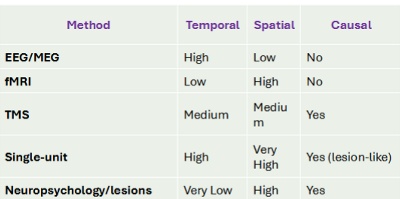
state the temporal, spatial resolutions and causal relationsips of EEG, fMRI, TMS, single-cell, and lesions:
explain power analysis
a calculation used to work out how many participants you will need for a study to detect a meaningful effect