3.4.2 Perfect competition
 Call Kai
 Learn
Learn Practice Test
 Spaced Repetition
 Match
Match Flashcards
 Knowt Play
1/6

There's no tags or description
Looks like no tags are added yet.
Name | Mastery | Learn | Test | Matching | Spaced | Call with Kai |
|---|
No analytics yet
Send a link to your students to track their progress
7 Terms
What is perfect competition?
A market where there is a high degree of competition - closest example is agriculture, but in reality, no market is perfectly competitive
PED of goods are infinite, as they are perfectly elastic
In recent years, the internet has also made some markets close to perfectly competitive - increased price transparency, lower barriers to entry, increased homogeneous goods, etc.
Characteristics of perfect competition
Many buyers and sellers
This means that no one firm or customer can influence the market
Any one firm has insignificant market share
So many firms that firm concentration ratio is so small and insignificant
No barriers to entry or exit
Therefore, when a firm is making profits anyone can enter the market to make the same product, or when a firm is making a loss they can stop production and just leave
Perfect knowledge/information
If a firm is making profits, other firms will know and will attract them to join the market - this competes away any profits
All firms also have the same costs, as production techniques are the same - any new technology will be copied
If a firm tries to raise prices above market price, consumers will be aware and switch producers and still buy the same good for a lower price, leading to no sales
Homogeneous goods
All firms sell the exact same product (e.g. tomatoes, eggs) - therefore, if a firm raises their price, consumers will buy the same good from elsewhere for a lower price
Therefore, firms in perfect competition are ultimately price takers
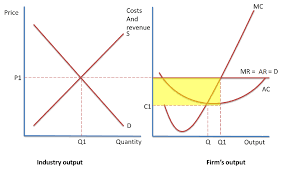
Short run profit maximisation (supernormal profits)
Firms look to short run profit maximise, so will produce at MC=MR - therefore, they can make supernormal profits in the short run (AR>AC)
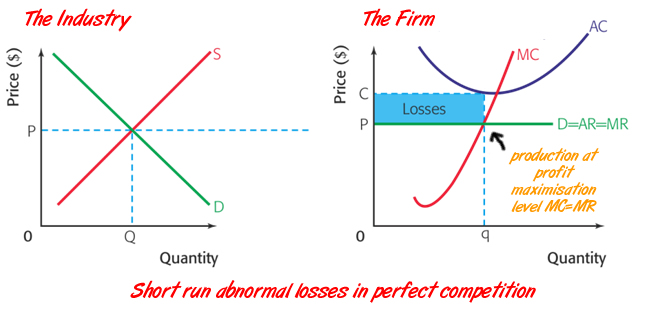
Short run profit maximisation (loss)
When short run profit maximising (MR=MC), firms can also make an economic loss (AR<AC)
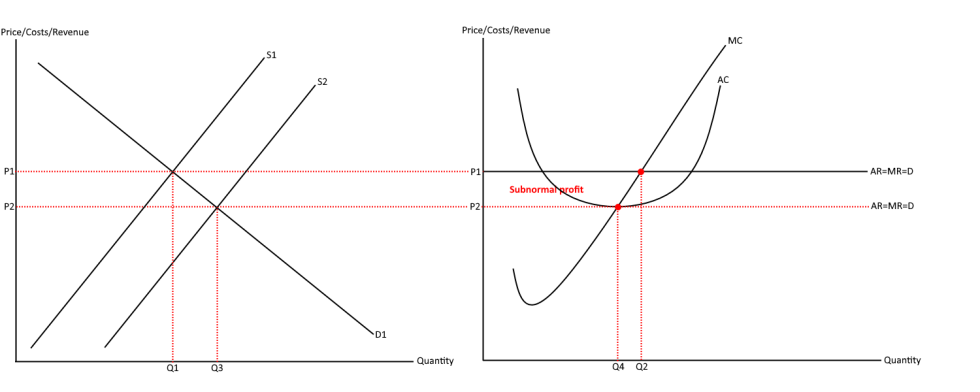
Long run profit maximisation (supernormal to normal profits)
In the long run, firms in perfect competition can only make normal profits - due to perfect knowledge and no barriers to entry, new firms are encourage to join the market due to supernormal profits
This increases supply from S1 to S2 in the industry, leading to fall in price from P1 to P2, producing at P/AR=AC (productive and allocative efficiency)
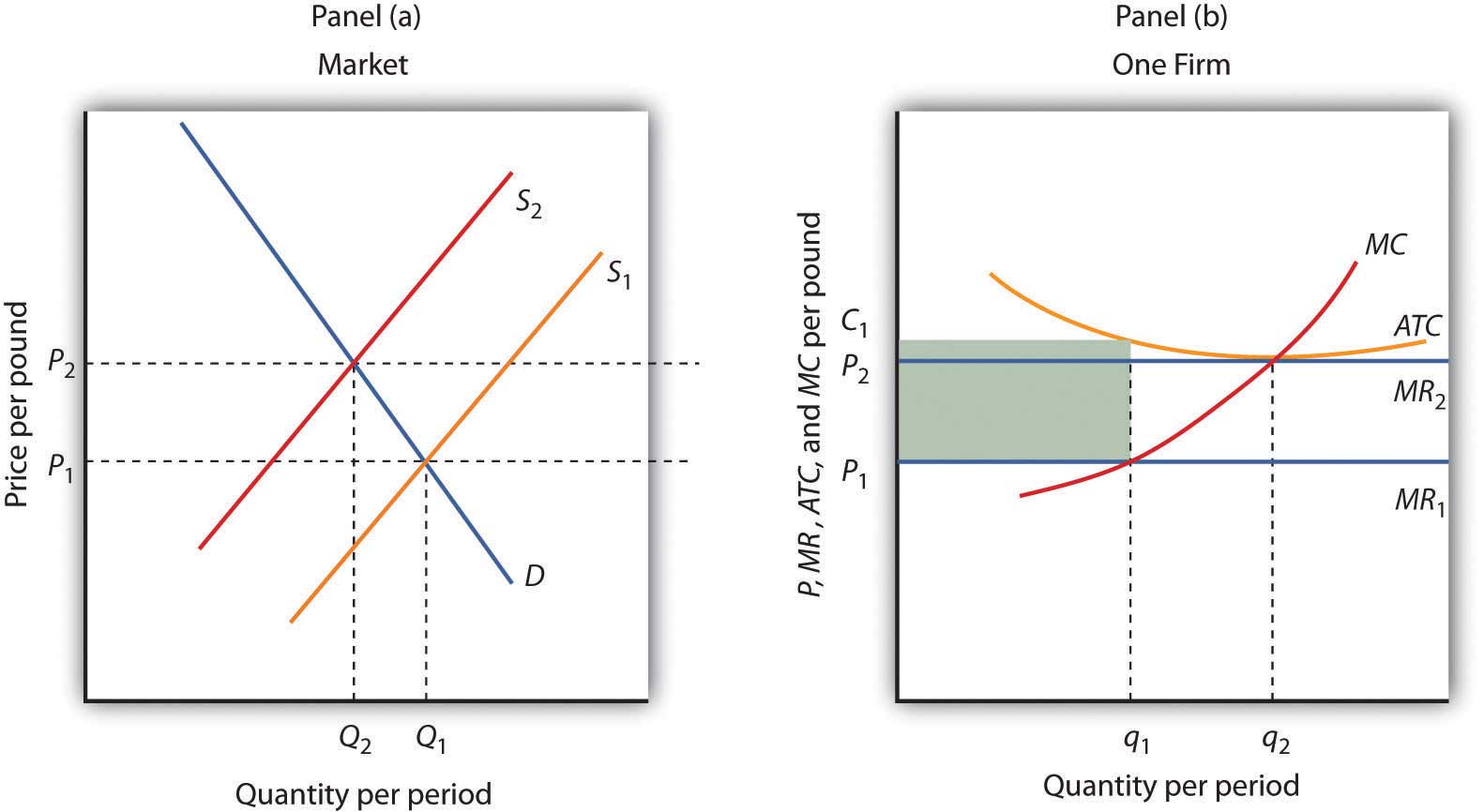
Long run profit maximisation (loss to normal profits)
In the long run, firms making a loss will just leave the industry due to low barriers to entry - this decreases supply from S1 to S2, increasing prices from P1 to P2, as firms can increase prices due to less competition, producing at P/AR=AC (productive and allocative efficiency)
Efficiencies in perfect competition
Always productively efficient (MC=AC) and allocative efficient (P=MC) in the long run
Has X-efficiencies, as competition keeps costs low, hence prices are low - however, firms do not benefit from economies of scale, which means costs are higher than they could be
However, no dynamic efficiency in the long run due to no supernormal profits for research and development, lack of financing - any new inventions will also be adopted by other firms (may be some dynamic efficiency in the short run, but usually unsuccessful)