Human Geography
 Call Kai
 Learn
Learn Practice Test
 Spaced Repetition
 Match
Match Flashcards
 Knowt Play
1/84

Earn XP
Description and Tags
Spring 2026
Name | Mastery | Learn | Test | Matching | Spaced | Call with Kai |
|---|
No analytics yet
Send a link to your students to track their progress
85 Terms
Toponym
The name given to a place on Earth
Site
Psychical characteristics of a place (ex: climate, vegetation and wildlife, natural resources)
Situation
The location of a place relative to other places, network (links between places)
5 points to define human geography
uses scientific process/method, to look at landscape/surface of the earth, and identify patterns, the processes that created these patterns, and their impacts
Formal region
An area within which most people share one or more distinctive characteristics
Functional region
An area organized around a node or focal point
Vernacular region
An area that people believe exists as part of their cultural identity
Globalization
Actions or processes that involve the entire world and result in making something worldwide
in scope
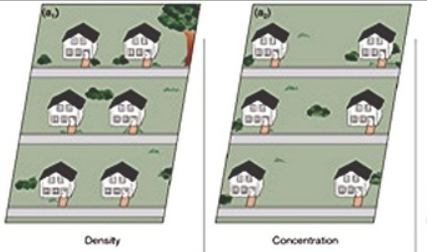
Density
The frequency with which something occurs in space, number of people divided by size of the space
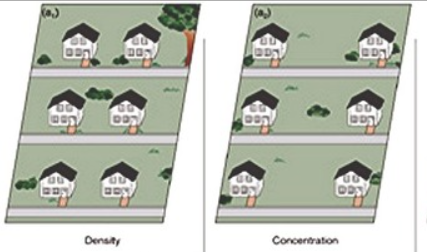
Concentration
The extent of a feature's spread over space (clustered or dispersed)
Pattern
The geometric arrangement of objects in space
Uneven development
The increasing gap in economic conditions between regions in the core and periphery
Hierarchical diffusion
spread of an idea from persons or nodes of authority or power to other persons or places
Contagious diffusion
rapid, widespread diffusion of a characteristic throughout the population
Stimulus diffusion
The spread of an underlying principle
Distance decay
The diminishing in importance and eventual disappearance of a phenomenon with increasing
distance from its origin
What 4 regions contain 2/3 of the world’s population?
Europe, Southeast Asia, East Asia (China), South Asia (India)
Ecumene
the area of Earth occupied by permanent human settlement
Which environmental condition is most likely to discourage human settlement?
Areas too dry, too cold, or too mountainous
Which characteristics encourage human settlement?
Temperate/moderate temperatures, fertile soil (arable), low-lying coastal areas
Agricultural density
Number of farmers per unit of arable land, indicator of economic growth and economic difference between countries (developed countries have lower ag density than developing)
4 types of distortion that can happen with projection
Shape, Distance (between two points), relative size (Greenland looking big), direction (from one place to another)
Latitude and Longitude
Lat: vertical, North/South, parallels Long: horizontal, East/West, meridians
Hearth
node/place from which an innovation originates
Diffusion
Process of a spread of a feature or trend from one place to another over time
Environmental possibilism
Belief that the psychical environment may limit some human actions BUT people have the ability to adjust to their environment, NOT determinism
Human-Environment (school)
Studies the impact humans have on the environment and vice versa
Area Studies (school)
Encylocpedic memorizing locations and maps, what classically think of geography
Spatial Interaction (school)
Study the movement of things, people, cultures, practices, and goods around the planet and it’s impacts
Absolute VS Relative locations
Absolute: precise, coordinate systems, addresses, place names
Relative: colloquial, situational, landmarks to give directions
Which of the following countries is in Stage 4 of the demographic transition model?
Denmark
In which stage of demographic transition do birth rates decline?
Stage 3
What is a key characteristic of Stage 1 of the demographic transition?
High birth and death rates
Demographic Transition 1
Deaths and births relatively the same, very low growth
Demographic Transition 2
Births begin to outweigh deaths, High growth, transition from 1 to 2 usually sparked by the Industrial Revolution
Demographic Transition 3
High population but slowing growth, more education and access to healthcare
Demographic Transition 4
Low growth, few births and deaths outweigh births, aging populations and declining populations
Historically what advancement typically moved a country from Stage 1 to Stage 2 of the demographic
transition?
Industrial revolution
What is an example of physiological density?
Number of people per square kilometer of arable land
Why does Egypt have a high physiological density?
Most of the population lives in a small area near the Nile, because a large portion of the land is not arable
What is the main reason for the high crude death rate (CDR) in developed countries like Denmark?
Aging population
What type of country has the highest CBR? And what can bring it down?
Developing countries, goes down with educating women and access to healthcare/birth control
What demographic issue is caused by cultural preferences for sons in countries like China and India?
Gender imbalance
Dependency ratio
Ratio of the elderly plus young under 15 over the working age population
Which population pyramid shape is typical for a country in Stage 2 of the demographic transition?
Triangle with a wide base (
Malthusian Theory
Population growth will outpace food production (overestimated pop growth and underestimates ag tech and economic growth)
What region is experiencing most rapid population growth today?
Africa
What health challenges are typical in Stage 4 of the epidemiologic transition?
Obesity and sedentary lifestyle diseases
4 Stages of epidemiologic transition
What does infant mortality rate (IMR) measure?
Deaths of infants under 1 year per 1,000 live births
What is the primary cause of low life expectancy in sub-Saharan Africa?
Lack of access to medical facilities
What does the demographic winter predict?
around 2100 global population will peak and after that it will start to collapse around the world
What does the NRI (Natural Rate of Increase) also called the natural increase rate (NIR) measure?
CBR minus CDR and adjusted to reflect a percentage, increase of pop without accounting for migration
Which population density measure helps geographers understand food availability?
Physiological density
Physiological density
Urban density
Migration
A permanent move to a new location
Difference between emigration and immigration?
Em: moving FROM/OUT a country
Im: moving TO/IN a country
Net migration
The difference between the number of immigrants and emigrants
According to Ravenstein's laws, most migrants:
Move a short distance and remain in the same country
Which country has RECENTLY been the greatest source of immigrants in the US
Mexico
Where is the largest flow of immigration from?
Latin America to North America
What was one of the primary reasons for migration to the United States in the 19th and
early 20th centuries?
Search for economic opportunities
What is the migration of people from rural areas to urban areas primarily caused by?
Economic opportunities
The Trail of Tears is an example of what?
Forced migration
Which country has HISTORICALLY been the largest source of immigrants to
the United States?
Germany
In recent years a major cause of forced political migration is:
Armed conflict
Intervening obstacle
A challenge that hinders migration
Brain drain
the migration of highly skilled individuals from one country to another
Chain migration
Migration of people to a location where relatives or members of the same nationality previously migrated, based on social ties
Step migration
follows a path of a series of steps toward a final destination, based on logistical considerations
Counter urbanization
Movement from urban to rural areas
What is one of the most common environmental push factors of migration?
Water related disasters
Asylum seeker
A person who has migrated in the hope of being recognized as a refugee
Remittance
Money migrants send back to their home countries
Why do many countries implement quotas on immigration?
To control the number of people moving into the country
What was the primary reason for migration from Mexico to the U.S. in recent decades?
Economic opportunities
Why has female migration increased in recent years?
More job opportunities for women in host countries
Refugee
Someone forced to migrate due to conflict, violence, or persecution
Which of the following continents has the highest number of emigrants?
Asia