essay 16 - characteristics of the cavity as a dentin wound: status of the dental pulp, smear layer, medicatio cavi dentis - medicaments and properties (pharmacodynamics)
 Call Kai
 Learn
Learn Practice Test
 Spaced Repetition
 Match
Match Flashcards
 Knowt Play
1/15

There's no tags or description
Looks like no tags are added yet.
Name | Mastery | Learn | Test | Matching | Spaced | Call with Kai |
|---|
No analytics yet
Send a link to your students to track their progress
16 Terms
describe the characteristics of the cavity as a dentin wound
a prepared cavity is considered a wound to the dentin as it involves the mechanical removal of tooth tissue
This ‘wound’ affects the odontoblastic processes in the dentinal tubules and may result in pulp inflammation is not properly managed
The dentin-pulp complex should be protected during and after cavity preparation to prevent irreversible pulp damage
describe the status of the dental pulp
the pulp is highly vascular and innervated. It responds to injury with inflammation and if the injury is significant or prolonged, necrosis may occur
Remaining dentin thickness is critical: thinner the remaining dentin, the greater the risk to pulp vitality
describe the smear layer
it is a microscopic debris layer created during tooth preparation, composed of hydroxyapatite, denatured collagen and cutting debris
It partially blocks the dentinal tubules, which can be beneficial (reducing sensitivity), but also harbours bacteria and reduces bond strength
Its removal or modification is important in adhesive procedures as it can impede bonding
what does medicatio cavi dentis (cavity medication) involve?
it involves disinfecting and protecting the cavity prior to restoration. This application of medicaments before restoration of a cavity. Although not a part of tooth preparation itself, cavity medication plays a key role in adapting the cavity for restoration, especially in:
— deep cavities
— situations with minimal remaining dentin
— cases where thermal, mechanical or chemical irritation could occur
what is the goal of medicatio cavi dentis (cavity medication)?
to protect the pulp
to promote pulpal healing
to reduce bacterial load
to create a suitable biological environment for restoration
what are the types of cavity medicaments used?
liners
bases
describe liners
thin coatings (aqueous or volatile suspensions) applied to dentin to:
— Stimulate the pulp to protect itself. (e.g produce reparative dentin)
— form a barrier agent against irritants (thermal, chemical, bacterial)
— offer electrical insulation
examples:
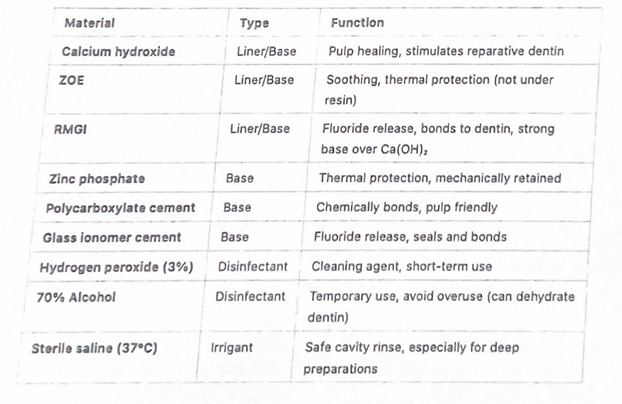
calcium hydroxide - stimulates reparative dentin, antibacterial and anti inflammatory
Zinc oxide suspensions - soothing effect on pulp, bacteriostatic (stops bacteria multiplying), NOT used under resin
For composite restorations, a liner (often RMGI) may also:
reduce gap formation at root margins
minimise microleakage and recurrent caries (release fluoride)
serve as a stress breaker
what are liners and what do they help with?
thin coatings (aqueous or volatile suspensions) applied to dentin to:
— Stimulate the pulp to protect itself (e.g producing reparative dentin)
— form a barrier agent irritants (thermal, chemical, bacterial)
— offer electrical insulation
what may a liner also help with in composite restorations?
reduce gap formation at root margins
minimise microleakage and recurrent caries (release fluoride)
serve as a stress breaker
give examples of liners and their purpose
calcium hydroxide - stimulates reparative dentin, antibacterial and anti inflammatory
Zinc oxide suspensions - soothing effect on pulp, bacteriostatic, NOT used under resin
describe bases
thicker materials placed under permanent restorations to protect the pulp against:
— condensation forces
— thermal changes
— chemical irritation
examples:
— zinc phosphate
— zinc oxide-eugenol (ZOE)
— calcium hydroxide (in thicker, settable form)
— polycarboxylate cement
— glass ionomer cement (GIC) and RMGI - most commonly used
Bases also help build bulk between pulp and final restoration (ideally -2mm of dentin + liner/base)
what are bases and what do they protect the pulp from?
thicker materials placed under permanent restorations to protect the pulp against:
— condensation forces
— thermal changes
— chemical irritation
Bases also help build bulk between pulp and final restoration (ideally -2mm of dentin + liner/base)
examples of bases
examples:
— zinc phosphate
— zinc oxide-eugenol (ZOE)
— calcium hydroxide (in thicker, settable form)
— polycarboxylate cement
— glass ionomer cement (GIC) and RMGI - most commonly used
what does the cleaning and disinfection prior to medication consist of?
gross debris is removed during cavity prep, but fine debris may remain.
Irrigation and cleaning protocol:
warm water, 3% hydrogen peroxide, or 70% alcohol for short-term disinfection
gently dry with air (avoid desiccating the dentin - means: drying the dentin too much)
clean residual debris using explorer or cotton pellet
perform final visual inspection of cavity
what are the requirements of disinfectant agents?
must be effective
must maintain disinfection over time
must not harm the pulp
Warm sterile distilled water or saline (37 degrees Celsius) - especially useful in deep preparations