13.3 Three Oligopoly Models
 Call Kai
 Learn
Learn Practice Test
 Spaced Repetition
 Match
Match Flashcards
 Knowt Play
1/41

There's no tags or description
Looks like no tags are added yet.
Name | Mastery | Learn | Test | Matching | Spaced | Call with Kai |
|---|
No analytics yet
Send a link to your students to track their progress
42 Terms
Why can’t oligopoly be explained with one model?
Because oligopolies are extremely diverse and firms are mutually interdependent.
What are the three oligopoly pricing models?
Kinked-demand curve, collusive pricing, and price leadership.
What does “mutual interdependence” mean?
Each firm’s profit depends on how rivals react to its decisions.
What does the kinked-demand curve explain?
Why oligopoly prices are sticky (don’t change much).
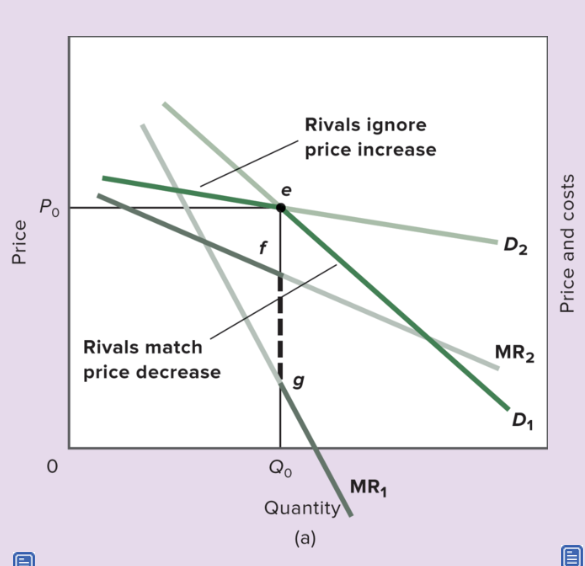
What happens if a firm raises price in a kinked-demand model?
Rivals ignore the increase → firm loses many customers → demand is elastic above P₀.
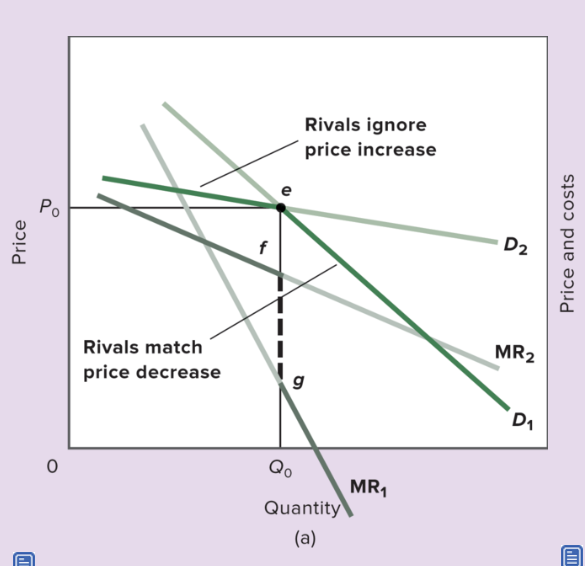
What happens if a firm cuts price in a kinked-demand model?
Rivals match the cut → firm gains few customers → demand is inelastic below P₀.
Why is there a kink in the demand curve?
Because rivals ignore price increases but match price cuts.
Why does MR have a vertical gap?
Because demand has two different slopes above and below the kink.
Why are prices sticky in oligopoly?
Small cost changes don’t shift MC enough to escape the MR gap, so price stays at P₀.
What is a major criticism of the kinked-demand model?
It doesn’t explain how the original price P₀ was chosen.
When does kinked-demand fail?
During inflation or recession, when firms frequently change prices.
What is collusion?
Firms agreeing to fix prices, divide markets, or restrict competition.
What is a cartel?
A formal collusive agreement on price and output.
What is the goal of collusion?
To act like a monopoly and maximize joint profit.
Why do identical firms with identical costs want the same price?
Because they all maximize profit at the same MR = MC point.
What happens if one firm cheats and lowers price?
It steals customers → rivals retaliate → profits fall → possible price war.
Why is collusion illegal in the U.S.?
It raises prices, reduces competition, and harms consumers.
What is OPEC?
A major international oil cartel that controls supply to influence prices.
How does OPEC raise oil prices?
By restricting output.
What is covert collusion?
Secret price-fixing or coordination without formal agreements.
Why do cost and demand differences hurt collusion?
Firms want different profit-maximizing prices.
How does the number of firms affect collusion?
More firms → harder to agree.
Why is cheating a threat to collusion?
Firms can secretly cut prices to steal customers.
Why does recession break collusion?
Firms cut prices to survive when demand falls.
How does potential entry weaken collusion?
High profits attract new competitors.
What legal barrier prevents collusion?
Antitrust laws.
What is price leadership?
One dominant firm sets price; others follow.
Why is price leadership not illegal?
There is no explicit agreement — firms just follow the leader.
Why are price changes infrequent under price leadership?
Leaders avoid risks of rivals not following.
What is limit pricing?
Setting price low enough to discourage new entrants.
What causes breakdowns in price leadership?
Firms undercutting each other → price wars.
What is a price war?
Repeated price cuts as firms try to maintain market share.
How do price wars end?
Firms lose money → leader raises price → others follow.
Kinked Demand Curve
Oligopoly firms think rivals will IGNORE price increases but MATCH price cuts.
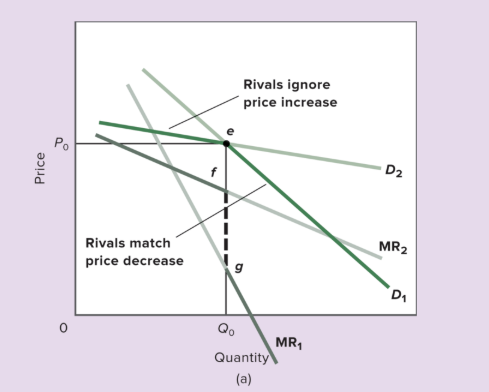
Graph A —> Kinked Demand Curve
Graph (a) has two demand curves and two MR curves because the firm faces two different reactions from rivals.
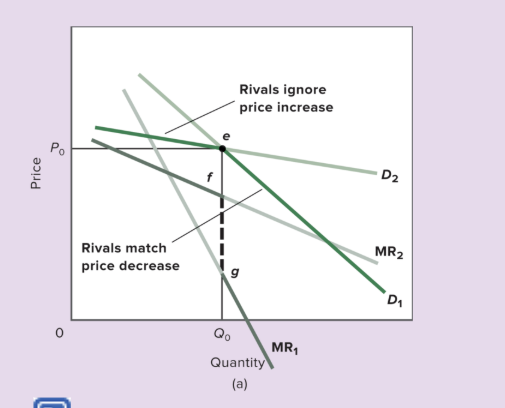
The top, flatter demand curve = rivals IGNORE price increases
Label: D₂
If Arch raises price, rivals keep their prices the same
Arch loses MANY customers
Demand is very elastic (flat)
This is why the top part of the graph is flatter.
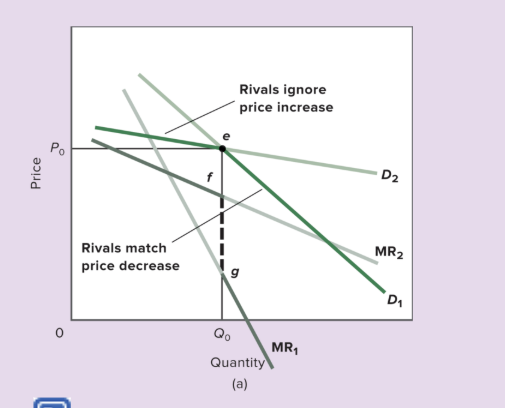
The bottom, steeper demand curve = rivals MATCH price cuts
Label: D₁
If Arch cuts price, rivals also cut
Arch gains almost NO customers
Demand is very inelastic (steep)
This is why the bottom part of the graph is steep.
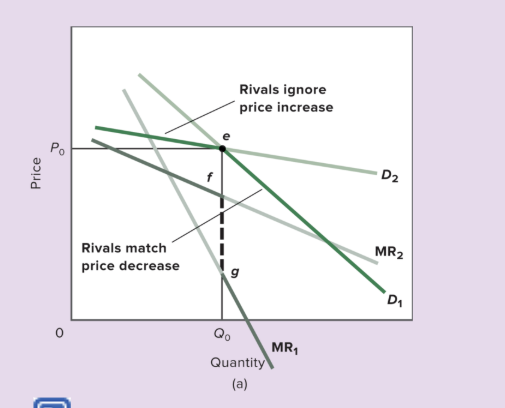
These two pieces meet at point e → the KINK
Point e is the current price P₀ and quantity Q₀.
Above P₀ → elastic
Below P₀ → inelastic
This sudden change in slope creates the kink.
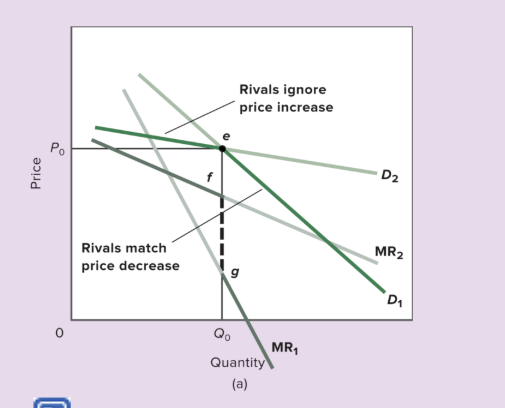
Why are there two MR curves?
Because each demand curve has its own MR curve:
MR₂ goes with the flat demand curve (rivals ignore price increases)
MR₁ goes with the steep demand curve (rivals match price cuts)
These two MR curves do not meet smoothly, so there is a vertical gap between them.
That vertical gap is the dashed line between f and g.
Graph B —> price is sticky
As long as MC crosses MR inside the vertical gap, the firm keeps the same price and quantity.
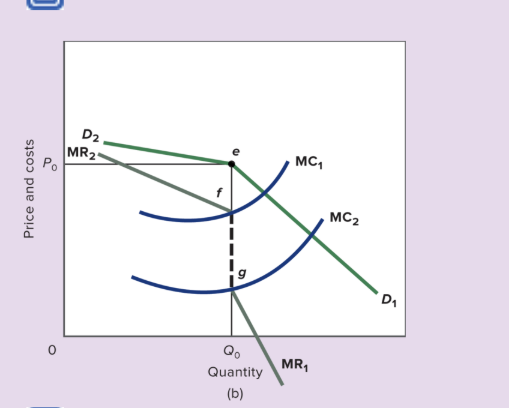
Graph B
In oligopoly, price stays the same even when costs change.
Vertical MR GAP: f —> g
Because:
MR₂ comes from the flat demand curve
MR₁ comes from the steep demand curve
They don’t meet smoothly
→ So there’s a vertical jump between them.
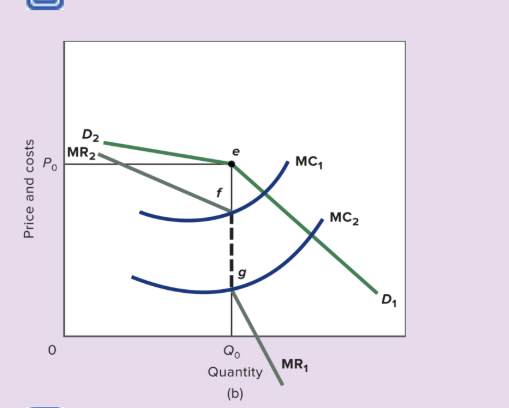
IFTH: Why MC₁ and MC₂ don’t change price
Both MC curves hit the MR gap between f and g.
When MC intersects MR anywhere inside that vertical gap, the firm chooses the SAME:
Quantity = Q₀
Price = P₀
So even if costs go up (MC₂) or down (MC₁):
👉 Price stays at P₀
👉 Output stays at Q₀
This is why oligopoly prices are “sticky.”