Other Analogies & Concepts AP Chemistry
 Call Kai
 Learn
Learn Practice Test
 Spaced Repetition
 Match
Match Flashcards
 Knowt Play
1/15

There's no tags or description
Looks like no tags are added yet.
Name | Mastery | Learn | Test | Matching | Spaced | Call with Kai |
|---|
No analytics yet
Send a link to your students to track their progress
16 Terms
Aufbau Principle
Start at lowest energy level
Hund’s Rule
One in each orbital before pairing
Pauli Exclusion Principle
2 electrons per orbital, electrons must have opposite signs
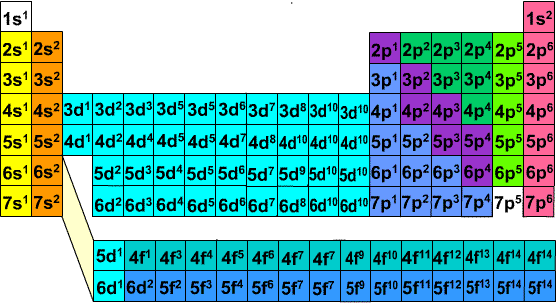
Electron Configuration
1s22s22p63s23p64s23d104p65s24d105p66s24f145d106p67s25f146d107p6
Periodic Trends
Atomic Radius: size of an atom (Increases left and down)
Electronegativity: ability to attract an electron (Increases right and up)
Ionization Energy: energy to remove an electron (Increases right and up)
Dipole Moment
Arrow that points towards the more polar side of a molecule (depends on electronegativity and molecular shape)
Electronegativity Difference
Non-Polar: <0.4
Polar: >0.4 & <1.7
Ionic: >1.7
Are Cations or Anions larger in a particle diagram?
Anions, b/c they have more electrons
Properties of Ionic Structures (Salts)
Crystal lattice, hard & brittle, high melting & boiling points, can undergo dissolution, solid at room temperature, good insulators as solid, can only become conductor when dissolved or melted
Dissociation
When water dissolves a salt into two aqueous solutions
Properties of Covalent Bonds
Low melting & boiling points, can be any state of matter, are not conductors, soft solids
Sea of Electrons & Delocalized Electrons
Lattice structures have a sea of electrons around all nuclei, to which we can’t tell which electrons belong to which atoms
Properties of Metallic Bonds
Luster, Malleable, Ductile, conductors, creates oxides, can lose electrons to form cations
Substitutional vs Interstitial Alloys
Substitutional: Atoms in a pure metal are replaced by metals of a similar size
Interstitial: Small atoms are shoved into the spaces between the molecule corners (often non-metals)
Bond Strength
Stability: Strength of the bond via electrons
Bond Length: Distance between the nucleus of the atoms
Bond Energy: Energy required to break the bond,
Solubility Rules
ALWAYS Soluble: SNAP (Sodium, Nitrate, Ammonium, Potassium) + Group 1A (Alkali Metals)