Investments BFC3241
 Call Kai
 Learn
Learn Practice Test
 Spaced Repetition
 Match
Match Flashcards
 Knowt Play
1/275

There's no tags or description
Looks like no tags are added yet.
Name | Mastery | Learn | Test | Matching | Spaced | Call with Kai |
|---|
No analytics yet
Send a link to your students to track their progress
276 Terms
What is a centralized limit order book?
An organized record of outstanding orders to buy and sell securities in equity markets.
What role do exchanges play in trading?
Exchanges provide the electronic platform for matching buy and sell orders.
invest only in bills and one risky portfolio, this becomes
CML / Sharpe ratio comparison.
What is the function of brokers in trading?
Brokers connect to trading platforms and execute trades on behalf of their clients.
What do clearing houses do?
They maintain records of securities' owners and manage processes like dividend payments and voting.
What are market orders?
Requests to buy or sell stocks immediately at the best available price, guaranteeing execution but not the price.
What are limit orders?
Requests to buy or sell stocks at a specific price, guaranteeing the price but not the execution.
What is a stop loss order?
An order created to limit losses on an existing position, typically executed as a market order.
What is a take profit order?
An order designed to lock in profits on an existing position, usually executed as a limit order.
What are electronic communication networks (ECNs)?
Systems that facilitate remote equity trading and enable new trading strategies like algorithmic and high-frequency trading.
What are transaction costs in trading?
Costs incurred while trading, including commission fees, bid-ask spreads, and price impacts from large trades.
Bid asked spread
The bid-ask spread is the difference between the lowest price a seller will accept (ask) and the highest price a buyer will offer (bid).
Formula: Bid-Ask Spread = Best Ask − Best Bid
Example:
Best Ask = $404.73
Best Bid = $404.65
Spread = $0.08
Why it's a cost:
When you buy → you pay the ASK (higher price)
When you sell → you receive the BID (lower price)
You always lose the spread on every trade — even if the price doesn't move at all
How do large investors minimize price impact?
They use algorithms to split large orders into smaller chunks and execute them over time, often in dark pools.
What does buying on margin mean?
Borrowing money from a broker to purchase securities, where margin is the percentage of trade value contributed by the investor.
What is the difference between initial margin and maintenance margin?
Initial margin reflects the initial investor equity value, while maintenance margin is the minimum equity value that must be maintained.
What happens if an investor's equity falls below the maintenance margin?
The investor receives a margin call, requiring them to add more funds or risk liquidation of their position.
How is the margin calculated?
Margin = Equity / Assets (Value of Stocks), where equity is the difference between assets and liabilities.
What is required for short sales?
Short sales require margin, where the proceeds from the sell trade are kept by the broker as a pledge.
How is margin calculated in short selling?
Margin = Equity / Liability (Value of Stocks).
What happens when the stock price increases after a short sale?
The margin can drop below the maintenance margin, potentially triggering a margin call.
How Does Buying on Margin Magnify Both Upside Potential and Downside Risk?
Buying on margin allows investors to control a larger position than their own capital allows by borrowing from their broker.
Upside: Returns are earned on the total position but measured against only the investor's own equity — amplifying percentage gains.
Downside: The loan remains fixed regardless of stock price movements — so all losses are absorbed by the investor's own equity, amplifying percentage losses equally.
Example:
Own $5,000, borrow $5,000 → control $10,000
Stock +10% → profit $1,000 → return on own capital = +20%
Stock -10% → loss $1,000 → return on own capital = -20%
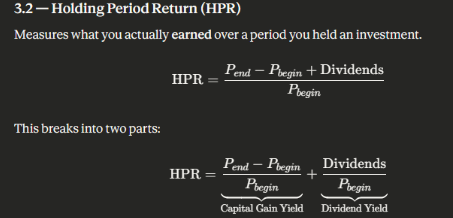
What is the holding period return (HPR)?
HPR measures historical/realized returns and is calculated as (Ending Price - Beginning Price + Dividends) / Beginning Price.
What is the geometric average return (GAR)?
GAR applies when returns are compounded over time, calculated using the formula (1 + HPR)^1/n -1
What is the arithmetic average return (AAR)?
AAR calculates returns without compounding and is used when not reinvesting.
How is portfolio HPR calculated?
Portfolio HPR is calculated by taking the HPR of each security, multiplying it by its weight in the portfolio, and summing the products.
What is realized risk measured as?
Realized risk is measured as the standard deviation of past returns.
What does the expected return formula use?
Expected return uses future returns and their probabilities.
What is Value-at-Risk (VaR)?
VaR measures the potential loss in value of an asset or portfolio at a given confidence level.
How is tail risk different from standard deviation?
Tail risk focuses on the risk of extreme losses, while standard deviation measures overall return dispersion.
What is the significance of normal distribution in finance?
Stock returns are approximately normally distributed, where the expected return is the mean and risk is measured by standard deviation.
What does a margin call signify?
A margin call indicates that the equity in the account has fallen below the maintenance margin requirement.
What are the two main types of assets discussed in Portfolio Theory?
Risk-Free Assets and Risky Assets.
What is the significance of the Capital Allocation Line (CAL)?
It represents the risk-return trade-off of portfolios that combine risk-free and risky assets.
What does research indicate about most investors' risk preferences?
Most investors are risk averse.
What do indifference curves represent in investment choices?
They demonstrate the trade-off between risk and return for an investor.
What does a higher indifference curve indicate?
It represents higher utility for the investor.
What is the optimal portfolio determined by?
The tangency between the highest indifference curve and the CAL.
What does covariance measure in portfolio management?
The co-movement of two variables.
How is correlation defined in relation to covariance?
Correlation is a standardized covariance that is easier to interpret.
What is market risk?
A common source of risk for all stocks, also known as systematic risk.
What is firm-specific risk?
Risk specific to a firm, also known as idiosyncratic risk, which is unrelated to general economic conditions.
What are the benefits of diversification?
Diversification benefits arise from non-perfect correlation between asset returns, reducing overall portfolio risk.
What is the efficient frontier?
The upper part of the mean-variance opportunity set (MVOP) that consists of asset combinations that are better than any other combinations.
What is the Capital Market Line (CML)?
A line that represents portfolios that optimally combine risk-free and risky assets, showing the highest expected return per unit of risk.
What does the slope of the CML represent?
The highest Sharpe ratio, indicating the maximum excess return per unit of undiversifiable risk taken by an investor.
What is the significance of the tangency point on the efficient frontier?
It represents the market portfolio (MVP) where the highest utility is achieved for investors.
What is the Capital Asset Pricing Model (CAPM)?
A model that describes the relationship between risk and expected return, indicating what required rate of return any security should have.
What are the main assumptions of the CAPM?
1. Investors are rational, mean-variance optimizers. 2. Single period planning horizon. 3. Price takers. 4. All assets are publicly traded. 5. Common risk-free borrowing and lending rate. 6. No taxes or transaction costs. 7. Homogeneous expectations.
What does beta measure in the context of CAPM?
Beta measures the sensitivity of an asset's returns to the returns of the market portfolio.
What happens if there are violations of homogeneous expectations in CAPM?
Disagreement on the market portfolio leads to undefined market portfolios and meaningless beta, causing CAPM to break down.
What is the significance of the market portfolio in CAPM?
All investors are assumed to hold the market portfolio, which includes all assets in the investable universe.
What do all investors being homogeneous mean-variance optimizers imply?
They have identical efficient frontiers and invest along the Capital Market Line (CML), choosing the same weights for each risky asset in the tangent portfolio M.
What does the Securities Market Line (SML) represent?
The SML represents the relationship between the expected return of a security and its systematic risk as measured by beta.
How does the Capital Market Line (CML) differ from the SML?
The CML plots total risk (standard deviation) against expected return, while the SML plots only undiversifiable risk (beta) against expected return.
What is alpha in the context of CAPM?
Alpha is the difference between the expected return of a security and the return predicted by the CAPM, indicating under- or over-pricing.
What is the main purpose of equity analysis?
To evaluate the fair value of a firm and identify overvalued or undervalued securities.
What is the Discounted Cash Flow (DCF) approach?
A valuation method that estimates the value of an investment based on its expected future cash flows, discounted back to their present value.
What are the three main DCF models used in practice?
1. Dividend Discount Model (DDM) 2. Free Cash Flow to Firm (FCFF) model 3. Free Cash Flow to Equity (FCFE) model.
What is the Dividend Discount Model (DDM)?
A method to calculate the intrinsic value of a stock based on the present value of expected future dividends.
What does it mean if the intrinsic value is greater than the market value?
It indicates that the stock is underpriced and may be a good buying opportunity.
What is the purpose of using multiples in equity valuation?
To allow quick comparisons between similar firms based on key performance ratios.
How does multiples analysis differ from DCF analysis?
Multiples analysis is relative and does not determine whether a stock is mispriced, while DCF provides an absolute valuation.
What is the Gordon growth model?
A specific type of DDM that assumes dividends will grow at a constant rate indefinitely.
What does a higher retention ratio (b) imply for a firm's growth opportunities?
It allows the firm to reinvest earnings, potentially increasing its value.
What is the Present Value of Growth Opportunities (PVGO)?
PVGO is calculated based on changes in firm value when adjusting the payout policy.
What is the implication of high growth companies regarding dividends?
High growth companies typically pay lower dividends as they reinvest for growth.
What is the significance of the marginal projects having ROE equal to k?
It indicates that these projects do not add value beyond the cost of capital.
What are the two free cash flow models used when companies do not pay dividends?
Free Cash Flow to Firm (FCFF) model and Free Cash Flow to Equity (FCFE) model.
What does the Free Cash Flow to Firm (FCFF) model calculate?
It discounts future cash flows available to all capital providers (debt and equity) plus a terminal value.
What is the Free Cash Flow to Equity (FCFE) model used for?
It discounts future cash flows available to equity holders plus a terminal value.
What does the terminal value represent in valuation?
The terminal value represents the present value of future free cash flows for the remainder of the firm's life beyond the forecast period.
What are price multiples in equity valuation?
Ratios of key firm performance outcomes used to compare similar firms, such as competitors in the same industry.
What is the P/E ratio and how is it calculated?
The P/E ratio is calculated as price-per-share divided by earnings-per-share.
What factors influence the P/E ratio?
The required rate of return (k) and expected growth in dividends (g).
How can analysts estimate the 'fair' price of a stock using P/E ratios?
By multiplying a target P/E ratio by the firm's earnings.
What is a challenge when selecting peer firms for P/E ratio calculations?
It may be difficult to identify direct peers.
How is the target forward P/E determined?
By averaging the forward P/Es of selected peer firms or using the industry average.
What is the purpose of multiplying the target forward P/E by the one-year-ahead earnings forecast?
To obtain the 'fair' stock price.
What is the significance of the P/B ratio in valuation?
P/B ratio is calculated as price-per-share / book-value-per-share.
What is the price-to-cash-flow (P/CF) ratio used for?
It is used because cash flows are less subject to accounting manipulation.
When is the price-to-sales (P/S) ratio particularly useful?
For firms with low or negative earnings in early growth stages.
What should be considered when using multiples for valuation?
Potential accounting manipulations and the reliability of the denominator.
What is the underlying assumption of multiple analysis?
Similar assets should be sold at similar prices per amount of generated profits.
What are the pros of using multiples compared to DCF analysis?
It requires less information and helps to choose the best investment among comparable alternatives.
What is a limitation of using price multiples in valuation?
It cannot determine whether a stock is mispriced (under- or over-valued).
What is the significance of consistency in calculations when using multiples?
It ensures comparability, whether using per-share vs. aggregate values or forward vs. trailing multiples.
What is the primary goal of equity analysts?
To determine if the stocks they research are fairly priced.
What types of analysts work for brokerage houses?
Sell-side analysts.
What is the role of sell-side analysts?
They provide recommendations to individual investors and produce research reports for firms of interest.
What types of analysts work for investment funds?
Buy-side analysts.
What is the role of buy-side analysts?
They make recommendations to fund managers on which stocks to buy or sell, consistent with the fund's investment objectives.
What macroeconomic factors do equity analysts consider?
Exchange rates, inflation, interest rates, employment, and overall economic growth (GDP).
What are some tools used in equity analysis?
Portfolio Theory, Asset Pricing Models, and various Equity Analysis techniques.
What are business cycles?
Fluctuations in economic activity characterized by periods of economic expansion and contraction.
What are leading indicators?
Indicators that change prior to the change in the business cycle, such as claims for unemployment insurance and new housing units.
What are coincident indicators?
Indicators that change simultaneously with the business cycle, such as industrial production and manufacturing sales.
What are lagging indicators?
Indicators that change after the business cycle has changed, such as average duration of unemployment and outstanding commercial loans.
Which industries are considered cyclical?
Industries that are sensitive to business cycles, such as technology, materials, energy, and industrial sectors.
What are noncyclical (defensive) industries?
Industries that are less sensitive to business cycles, such as health care and fast-moving consumer goods (FMCG).
What does the threat of entry depend on?
The height of entry barriers and the expected reaction from incumbents in the industry.