4.3 Genetic diversity can arise as a result of mutation or during meiosis
 Call Kai
 Learn
Learn Practice Test
 Spaced Repetition
 Match
Match Flashcards
 Knowt Play
1/29

There's no tags or description
Looks like no tags are added yet.
Name | Mastery | Learn | Test | Matching | Spaced | Call with Kai |
|---|
No analytics yet
Send a link to your students to track their progress
30 Terms
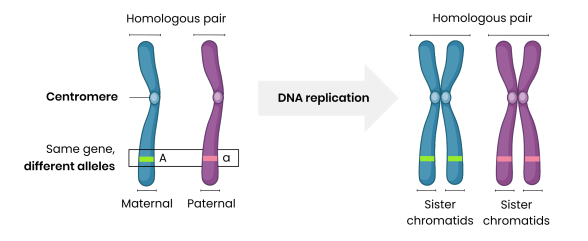
What three features define homologous chromosomes?
Same length.
Same genes at the same loci.
May have different alleles.
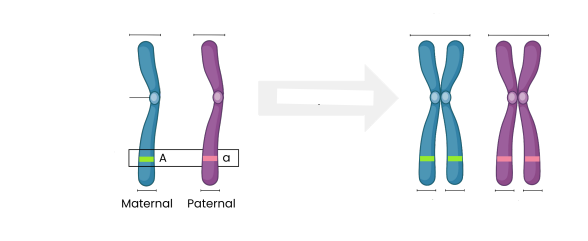
Label the diagram showing features of homologous chromosomes.
What is a diploid cell, and how is it represented symbolically?
A diploid cell has two complete sets of chromosomes.
It is represented as 2n.
What is a haploid cell, and how is it represented symbolically?
A haploid cell has a single set of unpaired chromosomes.
It is represented as n.
What happens during interphase before meiosis begins?
DNA replicates semi-conservatively, leading to 2 identical sister chromatids joined by a centromere.
What separates during Meiosis I (the first nuclear division)?
Meiosis I separates homologous chromosomes.
What three events occur during Meiosis I involving homologous chromosomes?
Chromosomes arrange into homologous pairs.
Crossing over occurs between homologous chromosomes.
Independent segregation of homologous chromosomes takes place.
What separates during Meiosis II (the second nuclear division)?
Meiosis II separates chromatids.
What are the three outcomes of meiosis, assuming a diploid parent cell?
Four daughter cells are produced.
The daughter cells are genetically varied.
The daughter cells are normally haploid.
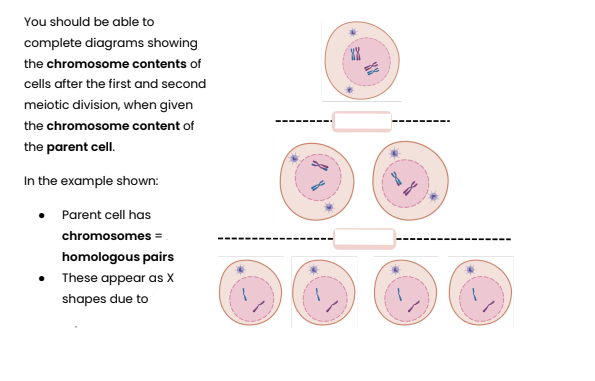
Label a diagram to show the chromosome content of cells during meiosis.
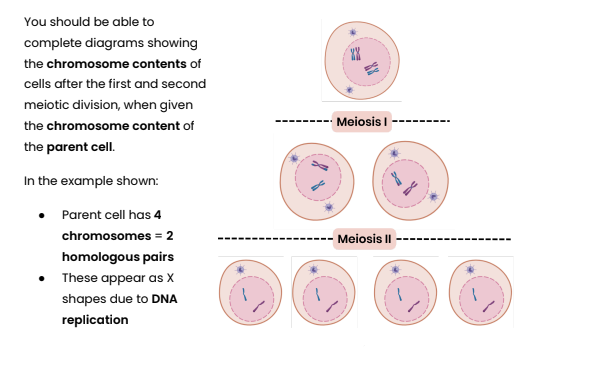
Why is the number of chromosomes halved during meiosis?
As Meiosis I separates homologous chromosomes. (the first division).
During crossing over, what structure do homologous pairs of chromosomes form?
Homologous pairs associate to form a bivalent.
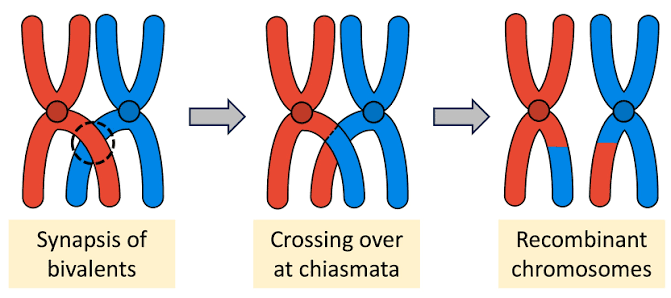
During crossing over, what is the name of the point of contact between non-sister chromatids?
Chiasmata form at the point of contact between non-sister chromatids.
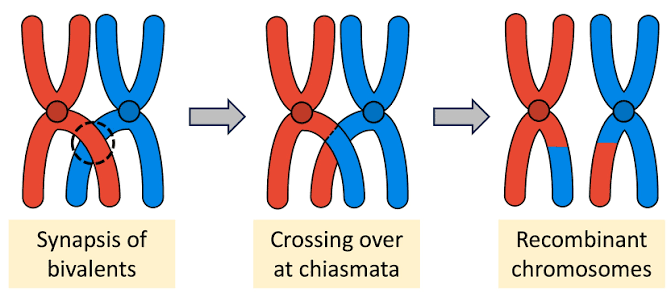
During crossing over, what is exchanged between non-sister chromatids, and what does this create?
Alleles or equal lengths of non-sister chromatids are exchanged between chromosomes.
This creates new combinations of maternal and paternal alleles on chromosomes.
During independent segregation, how do homologous pairs align at the equator?
During independent segregation, homologous pairs align randomly at the equator.
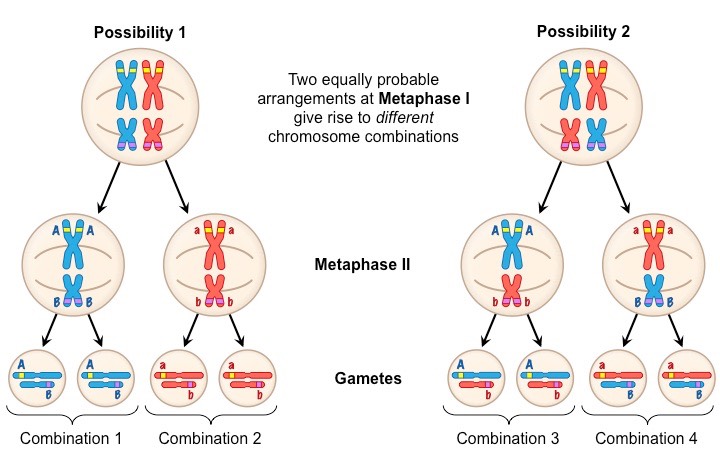
What is the consequence of the random alignment of homologous pairs during independent segregation?
It is random which chromosome from each homologous pair goes into each daughter cell.
This creates different combinations of maternal and paternal chromosomes in daughter cells.
Other than mutation and meiosis, what process increases genetic variation within a species?
Random fertilisation or fusion of gametes.
This creates new allele combinations and new combinations of maternal and paternal chromosomes.
How does the number of daughter cells produced differ between mitosis and meiosis, and why?
Mitosis produces 2 daughter cells, whereas meiosis produces 4 daughter cells.
This is because there is 1 division in mitosis but 2 divisions in meiosis.
How does the change in chromosome number differ between mitosis and meiosis?
Mitosis maintains the chromosome number (for example, diploid to diploid or haploid to haploid).
Meiosis halves the chromosome number (for example, diploid to haploid).
This is because homologous chromosomes separate in meiosis but not in mitosis.
How does the genetic variation of daughter cells differ between mitosis and meiosis, and why?
Mitosis produces genetically identical daughter cells, whereas meiosis produces genetically varied daughter cells.
This is because crossing over and independent segregation occur in meiosis but not in mitosis.
How does meiosis create haploid gametes, and why is this important for maintaining chromosome number between generations?
Two divisions create haploid gametes, halving the number of chromosomes.
The diploid number is restored at fertilisation, so the chromosome number is maintained between generations.
What two processes during meiosis create genetic variation?
Independent segregation.
Crossing over.
How can you recognise where mitosis occurs in a life cycle based on chromosome number changes?
Mitosis occurs between stages where the chromosome number is maintained.
For example, diploid (2n) to diploid (2n), or haploid (n) to haploid (n).
How can you recognise where meiosis occurs in a life cycle based on chromosome number changes?
Meiosis occurs between stages where the chromosome number halves.
For example, diploid (2n) to haploid (n).
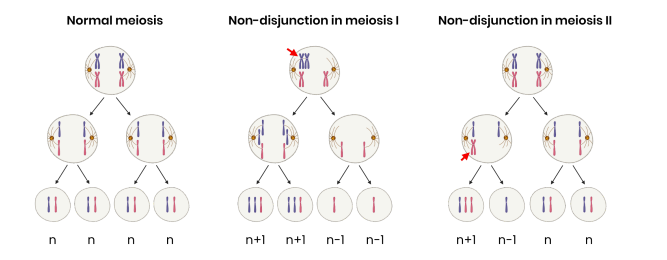
How do mutations in the number of chromosomes arise spontaneously during meiosis?
Arise spontaneously by chromosome non-disjunction during meiosis.
During non-disjunction, which structures fail to separate, and what causes them to be pulled to the same pole?
Homologous chromosomes (in Meiosis I) or sister chromatids (in Meiosis II) fail to separate during meiotic division.
Both are pulled to one pole by spindle fibres.
What are the two possible chromosome numbers in gametes resulting from non-disjunction?
Some gametes have an extra copy (n+1) of a particular chromosome.
Others have none (n-1) of that particular chromosome.
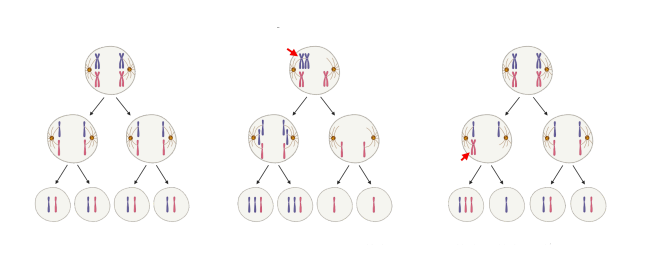
Label a diagram showing the outcomes of chromosome non-disjunction during meiosis.
How can you calculate the number of possible combinations of chromosomes in daughter cells following meiosis?
Use the formula 2ⁿ, where n = the number of pairs of homologous chromosomes (half the diploid number).
How can you calculate the number of possible combinations of chromosomes following random fertilisation of two gametes?
Use the formula (2ⁿ)², where n = the number of pairs of homologous chromosomes (half the diploid number).