Anatomy Final: NEW UNIT
 Call Kai
 Learn
Learn Practice Test
 Spaced Repetition
 Match
Match Flashcards
 Knowt Play
1/169

There's no tags or description
Looks like no tags are added yet.
Name | Mastery | Learn | Test | Matching | Spaced | Call with Kai |
|---|
No analytics yet
Send a link to your students to track their progress
170 Terms
How much water does our body contain (Total Body Water)
Infant, young adult, and obese and elderly
Infant: 65-75%
Young Adult: 55-60%
Obese and Elderly: 40-50%
Math: Your Total Body Water Content
70 kg X 55% = about 40L
Where is this 40L of water distributed in your body
Intracellular: 65% (40L X 0.65)= 26L
Extracellular: 35% (40L X 0.35)= 14L
Extracellular: 35% (40L X 0.35)= 14L. where does it go
25% Interstitial Water (between cells) (40L X 0.25)= 10L
8%Water in blood and Lymph (40L X 0.08)= 3.2L
2%Trancellular water (endoplymph, joints, cerebral spinal
fluid, pericardial and pleural fluids) (40L X 0.02)= 0.8L
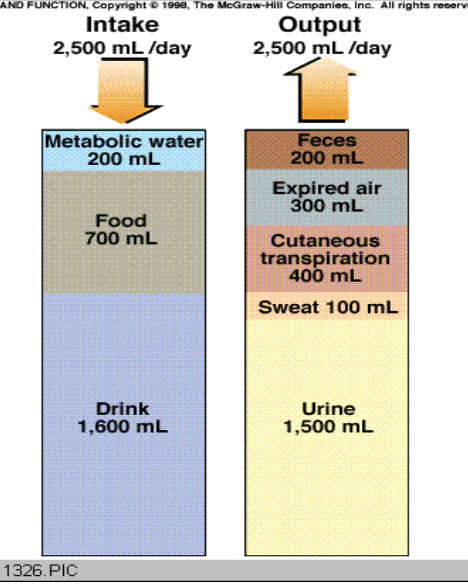
What are the Sources of the 2.5 L/day water you normally receive
Preformed (2.3 L/day) =Drinks and Food
Metabolic water (0.2 L/day) = Aerobic Respiration
how much water do we normally receive in a day
2.5 L/day
HOW MUCH WATER EXITS BODY: Urine
1.5 L/day
HOW MUCH WATER EXITS BODY: Transpiration
0.4L/day
HOW MUCH WATER EXITS BODY: Sweat
0.1 L/day
HOW MUCH WATER EXITS BODY: Breathing
0.3 L/day
HOW MUCH WATER EXITS BODY: Feces & diarrhea
0.3 L/day or 10L/day
HOW MUCH WATER EXITS BODY: vomiting
0-10 L/day
Insensible Water Loss:
Not obvious or conscious loss
Obligatory Water Loss:
Totally unavoidable loss
How can water loss (dehydration) become very severe very fast: Diarrhea or Vomiting
Water AND IONS can be lost
How can water loss (dehydration) become very severe very fast: Sweating on a hot dry day
up to 5 L/day or more lost
How can water loss (dehydration) become very severe very fast: Breathing rate and water loss when you are on top of Pike’s Peak CO
up to a 1.5 L/day
WATER Homeostasis is one of the most important types of balance we must maintain. Each Day
2,500 ml IN/2,500 ml OUT
HOW IS WATER BALANCE ACCOMPLISHED
Digestion steps: oral (buccal) cavity
food Olfaction (smell), GUSTATION (taste), ingestion, and mastication
Digestion all starts with smell (olfaction) and taste (gustation)!
• If food does not smell or taste “good” we don’t eat (malnutrition)
• Enzyme co-factors: Lithium(Li+) and Zinc (Zn++)
4 types of tongue taste bud: front-back/Left-right
1-Sweet-energy (front left)
2-Salt-sodium
3-Sour-acidic
4-Bitter-alkaline/poison
Unami is the fifth “taste” (back, Right)
what makes soy sauce taste good
Unami
Palatability and ingestion
Flavor-Aroma-Texture
the palatability of a food declines as its ingestion proceeds
Mastication:
We use teeth, tongue, lips and cheeks to begin the mechanical aspects of the digestive process
Palatability
the fact or quality of being acceptable or agreeable to the taste
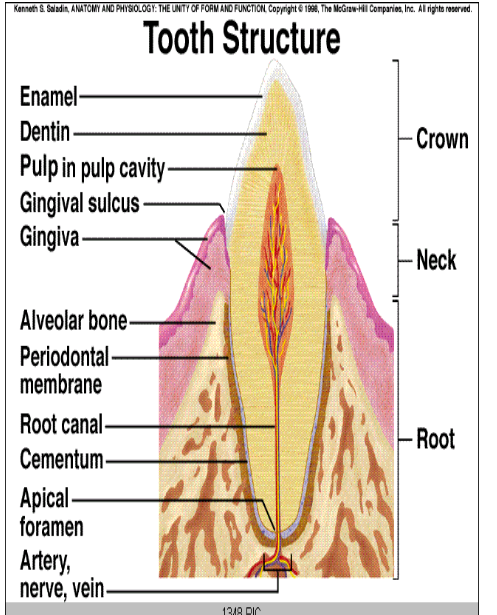
The Parts of a Tooth
• Enamel (white outside)
• Dentin (yellow inside)
• Pulp Cavity (hollowed-out spaces inside your tooth)
• Root Canal (nerves)
• Alveolar Bone
• Occlusion:
• Occlusal Surface:
• Cusps:
what are milk/Deciduous teeth and how many do we normally have
The first set of teeth we have as kids usually have 20
secondary or permanent teeth and how many do we have and when do we get them
after age 6
our second (permanent) set of teeth we usually have 32
Each Quadrant has how many teeth
8
32/4=8
Each Quadrant has 8 teeth: what are they and how many
• 2 incisors-cut
• 1 canine-hold
• 2 premolars-sheer
• 2 molars-grind
• 1 ‘Wisdom’ tooth- later adulthood
incisors
cut
canine
hold
Wisdom’ tooth
later adulthood
molars
-grind
premolars
-sheer
1X4 quadrants=
4wisdom teeth to pull out right?) Last to erupt
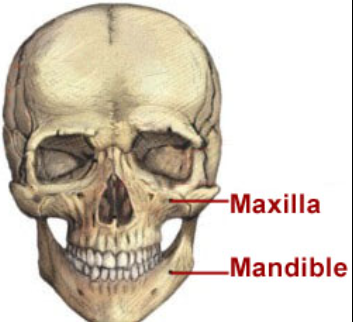
mouth bones
Maxilla and Mandible
Infants: 20 Deciduous Teeth
As the permanent teeth erupt, they push the deciduous teeth out of their sockets! “Teething”
Plaque:
a sticky deposit on teeth in which bacteria proliferate.
– Calculus or Tartar
– Flossing and brushing
Caries:
decay and crumbling of a tooth or bone
– Digestive enzymes and acids
– Grinding Out and Fillings as a solution
Root Canal Therapy:
– Pulp replacement
– Infection removed
Gingivitis can lead to
Peridontal Disease
Periodontal Disease
also called gum disease, is a serious gum infection that damages the soft tissue around teeth.
Gingivitis
a common and mild form of gum disease,
how much saliva do we produce in a day
1.5 L/day
We produce saliva for 3 reasons: what are they
1) Lubrication/moisture of food during mastication
2) Mix enzymes for digesting bacteria, starch and lipids
3) Addition of NaCO3- for control of acidity/tooth decay
Lingual Lipase is active in what
stomach
what is Lysozyme
dog saliva
innate immunity, providing protection against bacteria, viruses, and fungi
we don’t have it
Enzymes active only at what PH: in saliva
7
Lingual (mouth) amylase
begins the digestion of carbohydrates
Electrolytes: In saliva
K+, Cl-, NaCO3- (Sodium Carbonate)
Proteins: in saliva
Mucin and IgA
Mucin
protect and lubricate epithelial cell surfaces.
IgA
to rank the level of similarity between two structures and to allow structure classification when many proteins are being analyzed.
what is the main content in saliva
water
Parotid
(20%): Serous
Sublingual
(5%): Mucous
Submandibular
(70%): Mixed
• Minor glands (5%)
Deglutination
the tongue presses a food bolus against the palate,
through the fauces,
into the pharynx,
past the epiglottis and into the
esophagus.
Then peristaltic waves of smooth muscle squeeze it into
the stomach as the cardiac sphincter relaxes.
bolus
a small rounded mass of a substance, especially of chewed food at the moment of swallowing
Deglutination: Activity coordinated by swallowing center of
medulla: 22 muscles
Three Stages to Swallowing:
1) Buccal
2) Pharyngeal
3) Esophageal
Three Stages to Swallowing:
• 1) Buccal > 2) Pharyngeal > 3) Esophageal
(birds play everyday)
Entry into esophagus (skeletal then smooth muscle) creates a peristaltic wave in the muscularis externa that generates propulsion by shortening and narrowing the tube right-behind the bolus!
Enteric Nervous System allows for conduction of depolarization along smooth muscle cells resulting in a wave of contraction!
Finally: Lower esophageal sphincter must relax (dilate) before bolus can pass through the cardiac orifice into the stomach!
Gastro Esophageal Reflux Disease (GERD)
a common condition in which the stomach contents move up into the esophagus. Reflux becomes a disease when it causes frequent or severe symptoms or injury. Reflux may damage the esophagus, pharynx or respiratory tract.
“Purple Pill called Prilosec”
Stomach Provides for
Mixing, Acidification and Sterilization
where is the stomach located
inferior to the diaphragm and left lung
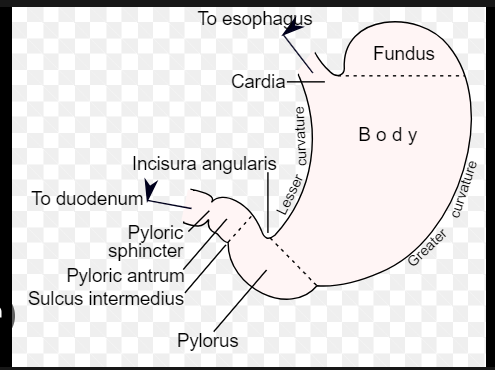
Pyloric Canal
the opening between the stomach and the duodenum.
Pyloric sphincter
a muscular valve that opens to allow food to pass from the stomach to the top of the small intestine.
Esophageal sphincter
prevents stomach acid from going up.
a high-pressure zone located where the esophagus meets the stomach and protects the esophagus from the reflux of gastric contents.
diaphragm
separates the thoracic cavity (lungs and heart) from the abdominal cavity (intestines, stomach, liver, etc.).
stomach: Fundic, Cardiac and Pyloric Regions and the “Body. Greater and Lesser Curvatures
the stomach converts ingested material into
Chyme
Chyme
the pulpy acidic fluid which passes from the stomach to the small intestine, consisting of gastric juices and partly digested food
Gas and the cause of indigestion
Eating too much, eating too fast, or eating during stressful situations. Eating foods that your body has a hard time digesting (food intolerance) Smoking or using other tobacco products
what are the four layers of the stomach out to in
serosa
muscularis externa
submucosa
mucosa
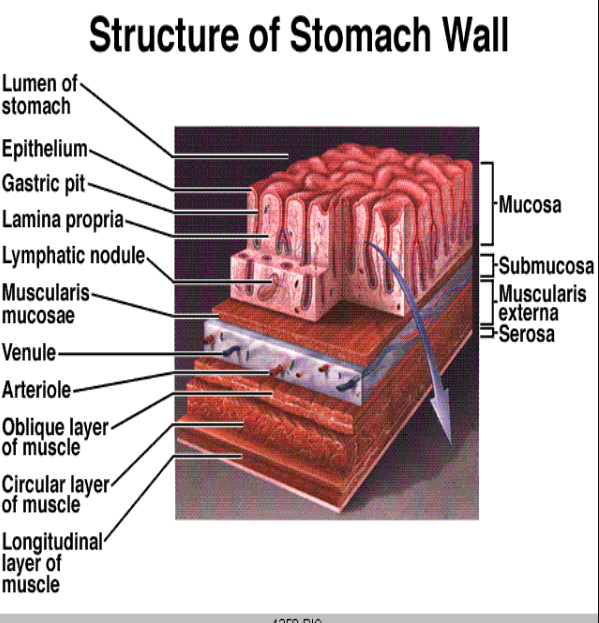
layer of protective ______- coats and protects all underlying simple columnar epithelial cells from acids!
glycocalyx
what is the stomach tissue type
simple columnar epithelial
Stomach: (Blood) Entry and exit
Enters via: gastric branch of celiac trunk artery
Exits via: hepatic portal vein for cleaning of blood toxins in liver
Stomach: (Hormones)
Gastrin: output hormone to blood
CCK, GIP and Secretin: Input hormones from blood
Stomach: (Information) Enters two ways
– Vagus Nerve: parasympathtic info to stomach
– Vagus Nerve also carries sensory info from stomach to brain
– Sympathetic fibers of celiac ganglion
Vagus Nerve:
parasympathetic info to stomach. also carries sensory info from stomach to brain
Gastrin:
output hormone to blood
CCK, GIP and Secretin:
Input hormones from blood
Stomach: (Lymphatics)
very important for fluid drainage/inflammation
What digestive materials are secreted by the stomach and how do we protect ourselves against them?
acids, pepsin and huge amounts of mucus
Stomach: Importance of mucus:
PROTECTION OF EPITHELIUM
Importance of stomach acid (3)
Antibacterial
Digestion
Nutrient availability
Problem with stomach acids: (2)
Potential self digestion: stomach, esophagus, duodenum
Potential enzyme de-activation due to pH
Importance of Pepsin
Break up proteins and Deactivate potential hazards
Potential to autodigest your own body
Solution: activation only in acidic pH
What happens to pepsin activity if “Tums” are taken
inhibit the proteolytic enzyme pepsin
Small Intestine: Three sections
Duodenum- neutralizes
Jejunum- digestion
Ileum- absorption
Duodenum
First 5% Section (12 fingers-12inches) from pyloric sphincter PAST sphincter of oddi: Goal-neutralize stomach acid
Jejunum-
”empty” Second 35% Section: Goal-enzymatic degradation and nutrient absorption
Ileum-
Third 60% Section: goal nutrient absorption before passage into cecum
Ileocecal Valve-
passage into Large Intestine
Key Intestinal Items from Outside->Inside
Serosa-
Longitudinal SCM
-Circular SMC-
Submucosa-
Mucosa-
Villi
and Lacteals-
Columnar epithelial tissue-
Microvilli-
BrushBorder
What are The three nutrient types
carbohydrate, proteins and lipids
Triglygerides are broken into ______ by the action of _____ prior to non-enzymatic absorption
free fatty acids
lipase
starch digestion
amylase