Chapter two: Systems for experiments
 Call Kai
 Learn
Learn Practice Test
 Spaced Repetition
 Match
Match Flashcards
 Knowt Play
1/9

There's no tags or description
Looks like no tags are added yet.
Name | Mastery | Learn | Test | Matching | Spaced | Call with Kai |
|---|
No analytics yet
Send a link to your students to track their progress
10 Terms
Give the three types of systems and their definitions.
Isolated - neither energy nor matter can be exchanged between system and surroundings.
Closed - only energy can be exchanged - n is constant
Open - both matter and energy can be exchanged
Define rigid, adiabatic, diathermal and isolating walls.
Rigid - volume/shape can’t be changed
Adiabatic - prevent thermal interaction. Only way to do work on the system is via adiabatic changes.
Diathermal - allow thermal interaction.
Isolating - no heat, work or matter allowed.
Define Thermodynamic equilibrium
Macroscopic properties aren’t changing wrt time. This means constant pressure, particle concentration and temperature.
At Thermodynamic equilibrium, the state is defined entirely by the state variables, not by the history of the system.
Difference between extensive and intensive variables
Extensive depends on size of the system (e.g. volume), intensive is independent of it (e.g. density).
Define reversible process, and state two conditions for a process to be reversible.
Reversible if and only if its direction can be reversed by a infinitesimal change in the conditions.
Process must be quasistatic and there must be no hysteresis.
Define quasistatic process
Every state through which the system passes may be considered an equilibrium state. Strictly, the process must be carried out infinitely slowly.
Define hysteresis
In a system with hysteresis, when a process is reversed it does not retrace its previous path but follows a different one (e.g. rubber band)
Define an irreversible process
Processes are irreversible when energy is permanently lost from the system due to dissipative forces such as friction.
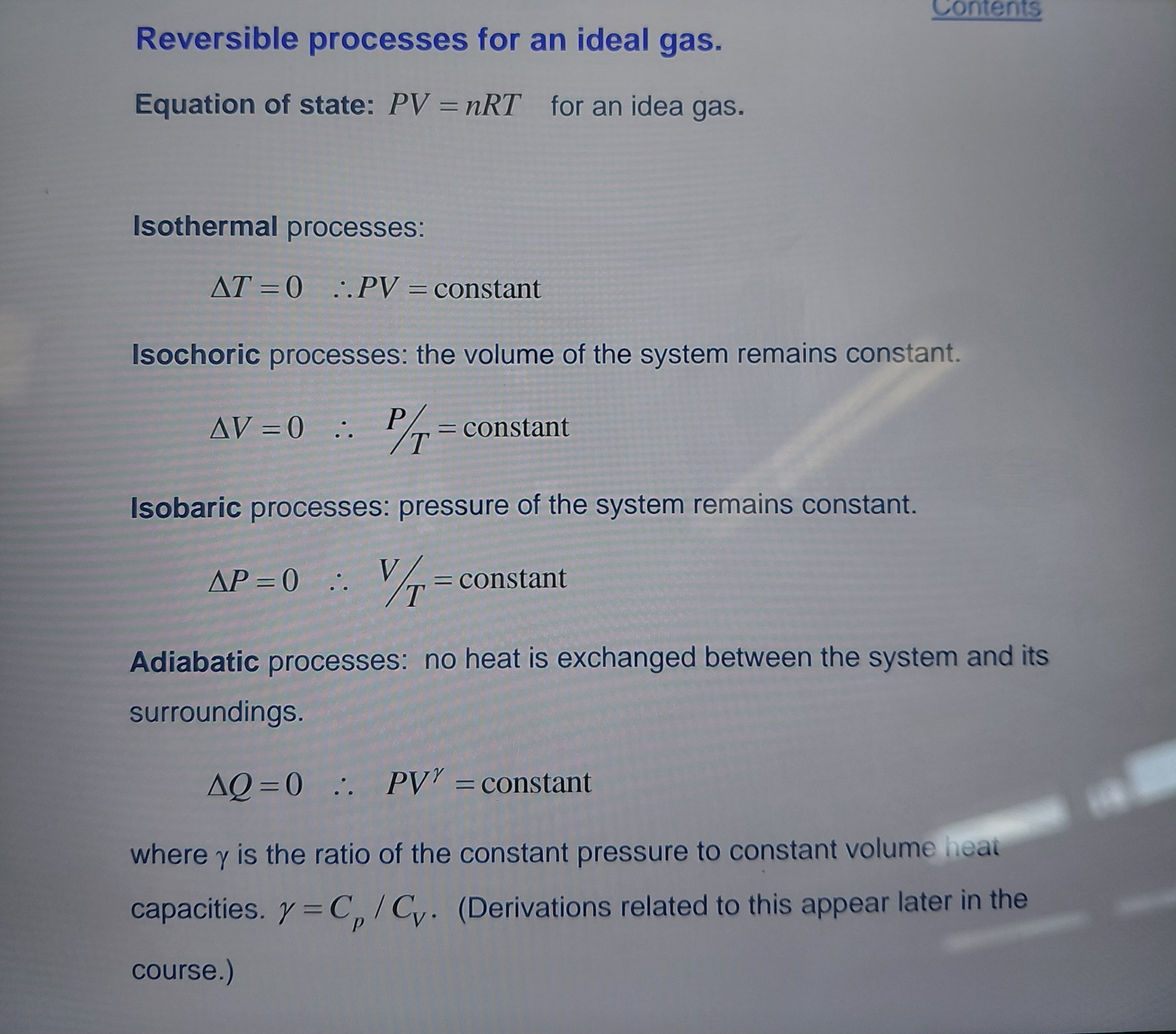
What are the conditions for different reversible processes for an ideal gas (isothermal, isochoric, isobaric, adiabatic)