Music Cog Final
 Call Kai
 Learn
Learn Practice Test
 Spaced Repetition
 Match
Match Flashcards
 Knowt Play
1/229

There's no tags or description
Looks like no tags are added yet.
Name | Mastery | Learn | Test | Matching | Spaced | Call with Kai |
|---|
No analytics yet
Send a link to your students to track their progress
230 Terms
serial ratios
relationships between adjacent notes
can be broken down by durations
Simplest is a 1:1
isochronous ratio
1:1 ratio of time spans between two tones
Rhythmic temporal window
200- 1000ms
Cerebellum function
musical timing- ABSOLUTE timing not relative
balance and coordination
basal ganglia function
neural entrainment- internal brain oscillations sync to external stimulus
movement
Parkinson's disease disrupts the basal ganglia, leading to impaired motor behaviour
supplementary motor area
active during rhythm perception- even without any intention to move, suggests a deep link between rhythm and movement
left temporal lobe
important for rhythm perception
Patients who had portions of their left temporal lobes removed showed difficulty discriminating short rhythmic time intervals
categorical perception
tendency to treat ranges of values along a physical continuum as if they are the same until they get to a limit where the perception completely changes- how we perceive musical rhythm
Rhythm
variations in duration
ALL sounds have rhythm
tempo
the ABSOLUTE speed/ rate that music is going to
Get tempo from averaging inter-onset intervals across a performance
doesn't need any reference to any other musical structure
beat
not the same as tempo
pulse we naturally synchronize to
Preferred is around 120 bpm
beat remains constant in a song
we cave have beat without having notes per measure (meter)
meter
A repeating pattern of strong and weak beats that provides us with the underlying framework for rhythm
Must have rhythm and beat to have meter
spontaneous tempo
People have a naturally occurring preferred tapping rate
older adults tend to SLOWER tempos
simple rhythm
fewer notes which don't align with primary beat
tapping in /4 grouping
complex rhythm
Individual tones can group into higher-level patterns
ideal grouping less clear-> more ambiguous
Continuum of musical time- class example
similar to Shepard tone- beat is continuously rising
in this example beat is getting faster while it's not actually moving
RHYTHM gets faster, but the metrical structure is the same
Timing and expressivity
X axis: expressivity (human -> robot)
Y axis: emotionality (0.0-0.7)
emotionality peaks at high human expression (125%-100%)
Like an actor bringing a script to life, a musician brings sheet music to life (with upper boundaries- may lose essense of piece with too much emotional expression)
singings involves:
phonation, respiration, articulation
social psychology continuum
Socio-biology Discursive
Genetic material Group processes
Epigenetic material
<------------------------------------------------------>
Perception of what is constant and dissonant has changed throughout history
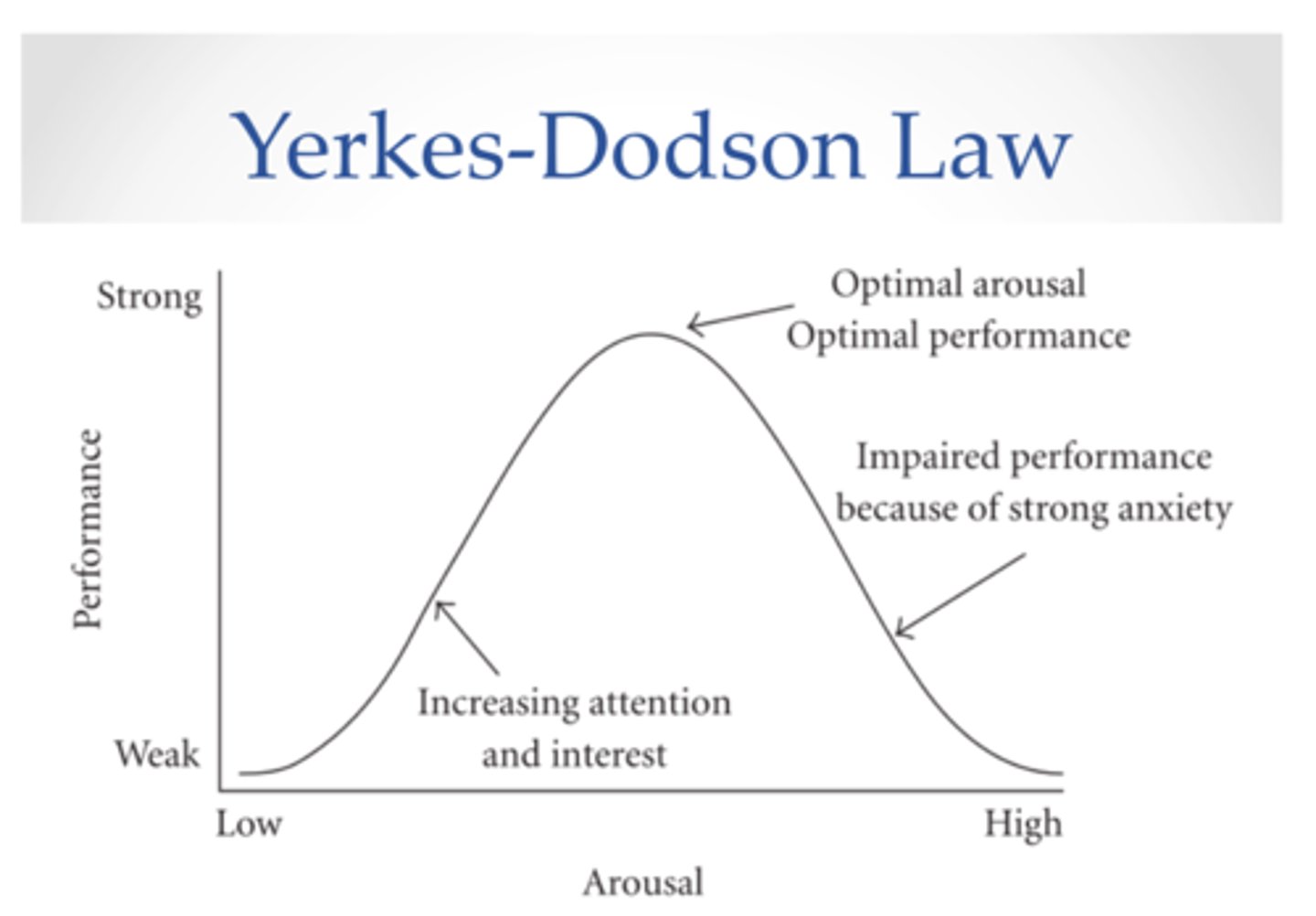
Yerkes- Dodson Law
X- axis: amount of arousal aka anxiety (low<-----> high)
Y-axis: performance quality (poor<------> good)
bell shaped curve
too low- lackluster
too high- performance anxiety
social facilitation
can be positive or negative
Observation may improve the performance of the practiced task
Basic tasks- when we are watched, we do better
aka social inhibition
if it's a new task we perform worse when watched
This is worsened with evaluation rather than mere presence
trait anxiety
personality-based tendency towards anxiety
state anxiety
temporarily induced by situaiton
distraction theory
intrusive thoughts shift one's attention to task-irrelevant aspects
(such as what the audience may be thinking) and leaving limited
attentional and working memory needed for optimal execution of the task
explicit monitoring theory
when performing you begin to overthink actions you don't typically think about
these implicit practives becomes explicit with nerves
how to improve performance anxiety
exposure therapy- fake audience and fake judges
performers engaging with an engaged supportive audience can actually HELP performers
effects of performers
Beatle mania or beaver mania
seeing celebrities and fainting/ hyperventilating
Why expressive timing exists
To communicate musical structure
As a metaphor for physical motion
To convey emotion
Phrase-final lengthening:
Performers slow down near the end of a musical phrase (analogous to pausing at the end of a spoken clause).
Phrase-initial acceleration
Performers speed up at the beginning of a phrase.
Melody lead
In simultaneous notes, melody notes are played slightly before accompanying notes to make the melody stand out perceptually
syncopation
when onsets align with weak beats while strong beats are silent — does not necessarily disrupt the underlying beat
meter and rhythm don't align
aspects of transformational leadership
charisma
inspirational motivation
intellectual stimulation
lack of connection harms product!!
chameleon effect
gestures affect performers-> timing of group (obviously)
Chameleon: the shape of the conductor's mouth can impact the singer's shape of mouth!!
Face of conductors can impact the expression of the choir
The conductor's gestures effect on audience
gestures conductors using the audience's perception of sound, independent of the actual sound of the players
prioritized integrative attending
the acts of attending to the self and others
matters
less about if you're right, more about being aware of what others are doing
may have different ways of playing when wanting to blend in vs. stand out
- when projecting: louder, higher overtones
- when blending in: quieter and less high overtones
3 paradoxes in group music
Leadership vs. democracy
- Tension between the two
- May not want to have a leader yet a leader emerges
Playing 'second fiddle'
- Secondary supporting role
Confrontation vs. compromise
- Must have consistent negotiation
Music affecting consumer behaviour- wine example
A store selling wine played German or French music
led to an increase in sales for respective wines
Music affecting consumer behaviour-cafeteria example
played pop, classical, and easy listening music in a cafeteria
Evaluation of dining for condition:
pop: upbeat and fun
classical: sophisticated
easy listening: cheap and down market
Music affecting consumer behaviour- bites per minute example
The speed at which people eat depends on
no music= baseline
slow music= 19% more bpm
fast music: 36% more bpm
Music affecting consumer behavior- florist behavior
Customer's in the florists shop spent more money buying when love songs play in the background compared to pop or no music
gender roles in music
flute as being seen for women vs. drums for men
Some stereotypes date back centuries
In 18th century Germany it was acceptable for higher class women to play lute, harp, piano, and violin
Western school age children see flutes, violins, and clarinets as appropriate for girls and drums, trumpets, and guitars for boys
asking about musical groups
asking for personal favorite, societal favorite, and recent listening
Female responses;
Personal favorite: 2male: 1 female
Societal favorite: 7:1
Male responses:
Personal favorite: 7:1
Societal favorite: 9:1
People anticipate a greater predominance of male preference in others as opposed to themselves
prosocial benefits of music
bouncing experiment (insync or asynch)
Exp 1: interpersonal movement
Exp 2: do effects transfer?
Exp 3: Interaction type
mozart effect
now discounted belief that listening to Mozart can make your baby smarter
what IS true: doing something you enjoy before an exam can help you do better
impact of visual info when choosing competition winners
When asked which musician won the competition
conditions: only choose sound, video, or video and sound
The guessers were best at choosing in conditions with video only
Mechanisms Explaining Music's Effect on Consumer Behavior
Arousal: Faster or louder music heightens physiological arousal, speeding up automatic behaviors like eating, walking, and talking.
Entrainment: Consumers synchronize to the pulse of background music, setting their behavioral tempo. Slower tempos encourage lingering (beneficial in high-end retail or restaurants); faster tempos suit quick-turnaround environments like fast food.
Priming: Music activates thoughts, associations, and cultural connotations that guide purchasing decisions — such as associating French accordion music with French wine. Related to this is musical fit — when music shares connotations with a product, it makes those attributes more salient and memorable.
cognitivist view of musical meaning
music expresses emotions listeners comprehend
emotivist view of musical meaning
music induces emotions in listeners
four types of musical meaning
associative meaning
iconic meaning
contextual meaning
semantic meaning
associative meaning
sound and image association can be built
This is where the meaning of sound is derived
E.g., associating a willow tree with someone weeping (posture like someone sulking)
Emergent meaning
Darling They're Playing our Tune
iconic meaning
This associative meaning can be so strong that the IMAGE can represent the SOUND
e.g. a mounty or maple syrup can represent Canada
Anthems- represent countries
Even without lyrics clearly represents country
Nothing CLEARLY Canadian about actual notes just relies on association
contextual meaning
meaning only makes sense within a context and may not be understoof without all the different elements
focus becomes clearer over time
example: piece of music that wasn't very harmonious or nice sounding got low ratings- given that it got dedicated to the victims of Hiroshima- the music is rated a lot higher
semantic meaning
non word passages of music can communicate ideas similar to how speech can
example: when played a sound and asked if it represents needle or river (reality vs illlusion etc.) people are basically unanimous
happens through semantic priming
semantic priming
You get a prime and a target
Prime: last night man cut his finger and went to hospital where he saw a
"nurse" or "potato"
Slower to say word "potato"
N400 response- neural indicator of semantic mismatch
Negative neural response
Also happens in musical information
Primed with language and also music
cross-cultural semantic meaning of music
Given musical sample:
Let people choose which word was associated with music
33 sound examples
3 word choices for each
Compared German to Mafa individuals (unfamiliar with Western musical culture)
Percent of choices for intended target words vs. unrelated target words
For German- lots of choices for the intended
For Mafa individuals- LOTS fewer choices for the intended word target (around chance)
For Mafa individuals- when they didn't get intended one Mafa individual have lots of agreement for which category they're choosing. Music can have meaning even if not the intended meaning by composer
Isomorphism
Susan Langer
meaning is derived from musical structure and extramusical structure (noises outside of music)
e.g. having a song with screaming and crying
Ocean example
music can express something nonmusical when the form of a musical event matches the form of something outside the music, such as an emotion, a story, a dance, or a scene in nature.
Cognitivism
Peter Kivy
Our ability to enjoy music is a direct function of our ability to understand it
For example a picture of a person climbing a mountain
Without other context can't tell if they're falling/ climbing
Need full context for message
Kivy and Langer both from field of philosophy not a scientific perspective
Ocean example
Intentionality
Leonard Meyer
Interested in Gestalt grouping principles He defines 'musical meaning' as follows: 'one musical event meaning because it points to and makes us expect another musical event'
Looks at TYPES of meaning
hypothetical: what we're expecting from music
evident: only comes after hearing whole piece and understanding how the pieces work together
determinate: relationship between hypothetical and evident
Evident meaning example:
man gets asked what restaurant you went to? Says what's the name of the red flower? Other man says rose? Man turns to his wife, Rose to say which restaurant?
Unexpected
more bucket example
ITPRA
David Huron
imagination, tension, prediction, reaction, appraisal
more bucket example
dog example of ITPRA
Dog video playing fetch
Imagination: dog imagines possibilities for future stimulus before seeing the ball
Tension: right before ball is thrown dog's muscles become tense and attention is very focused in preparation for anticipated event
Prediction: dog predicts WHEN the react as the person starts to throw the ball
Reaction: dog reacts to the stimulus- starts to run
Appraisal: dog judges (appraises) outcome of expectation when he sees the ball
If person didn't throw the ball vs. if they did was the reaction correct
Constrictive valence
when there is a disagreement between prediction and appraisal
program music
music that is intended to evoke images or convey the impression of events.
pure music
Also called absolute music. Music that has no referential or emotional meaning for listener
emergent meaning
Meaning may not be present till we get a certain amount
e.g. C-A can be C-A-T or C-A-B
Like Meyers intentionality theories
As well as Huron's ITPRA
Meaning is from FULL CONTEXT of all notes (for musical context)
composition of rhythm across cultures
Result: specific properties of language play a role in the music created
English: stress-timed language- spaced between syllables are more variable
French: syllable-timed language- more equal space between syllables
In music:
English- bigger pattern differences
French- 1:1 pattern differences each time
English composers (stress timed)have more rhythmic variability than French composers (syllable timed)
Huron: replicated but found a smaller effects
Used less specific criteria for composers
Used American composers and was the same as English composers
German and Austrian composers were also the same
Difference between rhythmic patterns of English and French composers
aesthetic perspectice
music exists solely to be beautiful
- some disagree with this view as much music is designed to counteract beauty
self referential
the music's meaning extends solely to itself and nothing else
frequencies humans can hear
20-20,000HZ
presbycusis
hearing loss associated with aging
specifically a loss of sensitivity to high frequency
critical band
refers to a range of frequencies that evoke a similar response in the auditory system
consonance
combinations of notes that sound harmonious and pleasant
dissonance
combinations on notes that clash and sound unsettling
this is maximal when there are overtones that fir within the same critical band while not being identical in frequency
critical band: range of frequencies which evoke a similar response in the auditory system
amplitude
corresponds with loudness
perceived loudness is based on intensity
music induced hearing loss
aka noise induced hearing loss
permissible exposure limit is max of 90dB over an 8 hours period
young people who use personal listening devices shows signs of irreeversiblie hearing loss
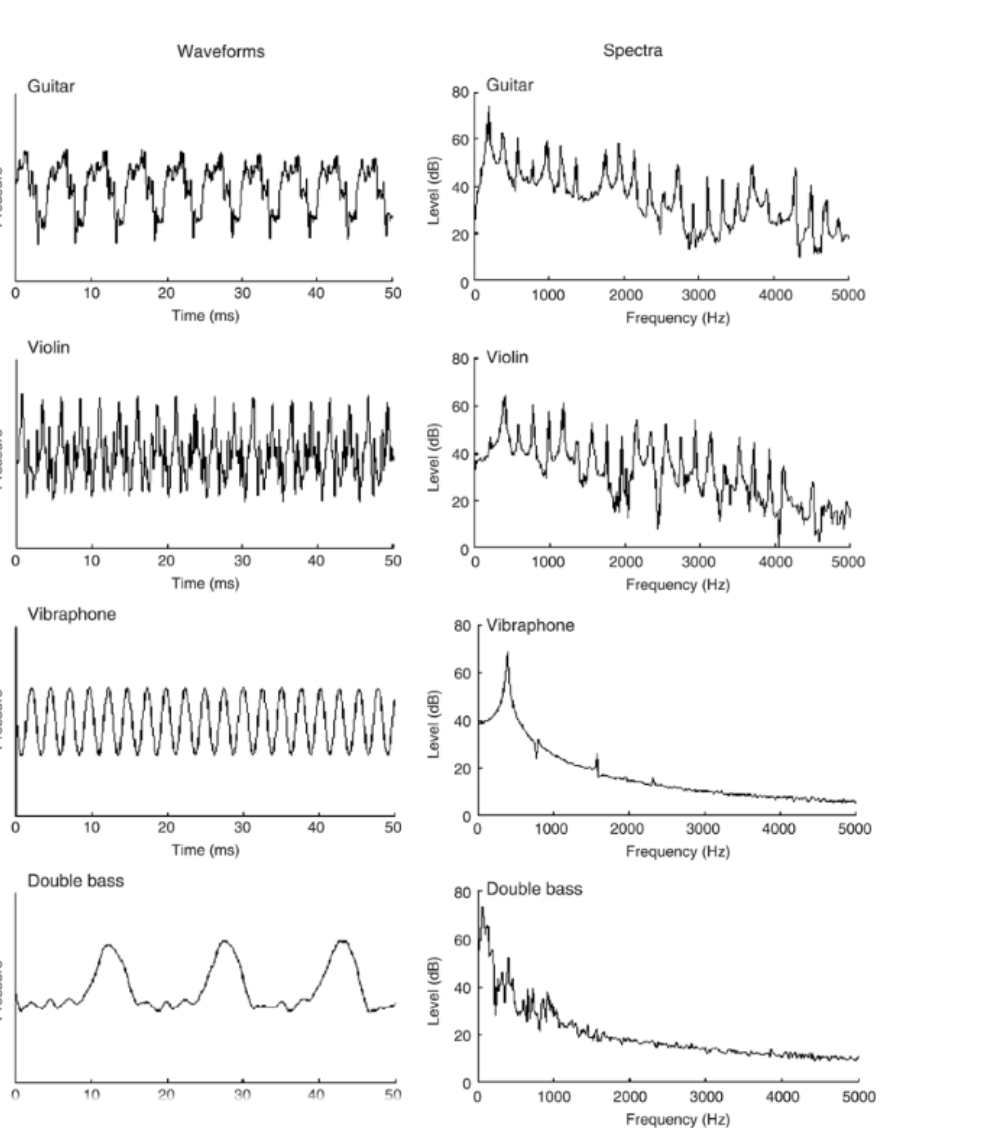
timbre
aspect of sound that distinguishes different voices or instruments even when they play the same note at the same volume
frequency relationships
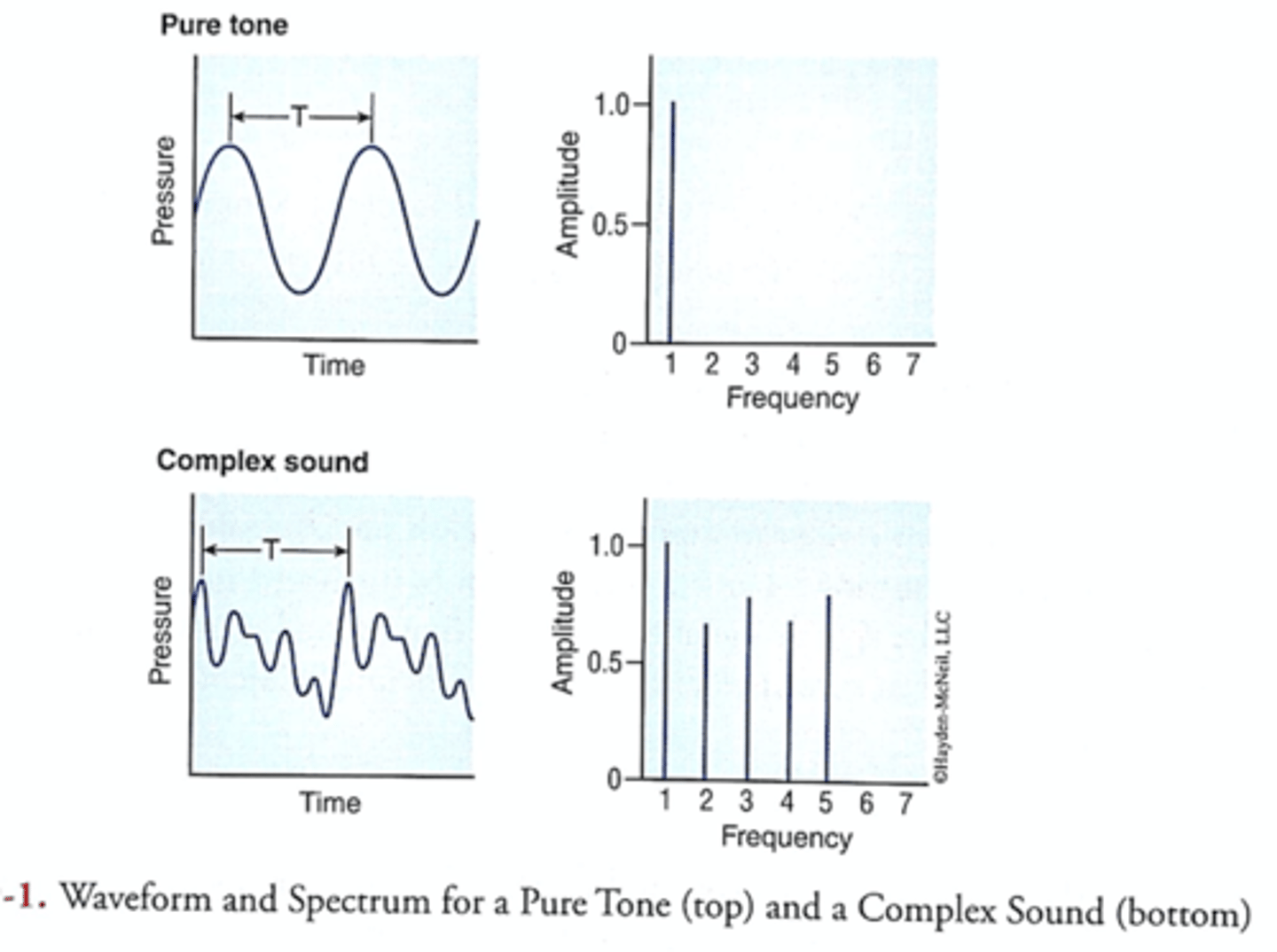
each tone produced by most instruments make up not only the fundamental frequency but also its overtones series
characteristics can be seen in waveforms
Indexicality
a thing that represents a thing e.g a footprint represents a foot was there
musical sounds directly point to, indicate, or are physically connected to specific contexts, emotions, or social meanings, rather than just symbolizing them
affordance
the actionable possibilities that the environment and the individual provides
how the brain organizes sound
proximity: groups sounds coming from the same source (pitch)
similarity: similar sounds come from the same source (timbre)
closure: brain fills in gaps to estimate where sounds are going
symmetry
common fate: a sound coming from x direction will continue to come fron x direction
past experience: what brain know about the world and sound
marimba illusion
video and audio rearranged
video with long movement and video with short movement
asked to estimate auditory lengths and ignore the gesture
video with the long movement - audio perceived as longer
McGurk Effect
Seeing someone's lip movements changes what syllable we hear them say
Gesture looks like it caused the sound so brain fuses the two into a unified experience
e.g. with the video can hear 'ga, ga, da, da, ba, ba'
with eyes closed only; 'ba, ba, ba'!
sensory integration!
- hearing only 'ba'
- but we see lips go from saying 'ba' -> 'ga'
- sensory integration leads to hearing 'da, da'
musical theatres sensory integration
We see lip movements on screen and hear sounds from speakers (Not coming from same place)
- brain fuses stimuli together leading to the assumption that info is coming from lips
Causality and Sound Type
Looking at video of a marimba hit and hearing either the marimba, a piano, a horn, clarinet, voice, or white noise
looked at visual influence of a long or short marimba hit on the auditory perception
- very clear that voice, white noise etc. don't fit with the video- so almost no influence of long- short hit on perception of sound length
- not as clear with piano- short or long marimba hit impacted auditory perception of this sound
Long/ short visual condition affects participants long/short answers based on logicality of matching sound to gesture
limits in how much our brain will pair sounds and sources (lack or pairing but success b/c brain is correct)
audio- visual integration
for a spatial task, the visual system dominates
- needs 30 frames in a second on TV to convince brain of movement
for a temporal task, the auditory dominates
- needs 44000 samples per second to convince brain of sound!
flat tone
sustained period of sound/ sharp increase and decay (not natural)
natural tone
tone with gradual increase and natural decay
sounds of musical instruments vs. tone beeps
musical instruments: more gradual increase and decrease of sound, more variance in the sound experience for the same note- not 'perfect', include overtones of fundmantal note
beeps: are pure tones, always the exact same
issue with some auditory perception studies
around 90% use simplistic sounds: beeps, clicks etc.
less than 10% use percussive sounds
Only 10% of actual everyday sounds are simplistic!!
temporal order judgment task
way of looking at strength of binding across modalities
for piano and guitar there is no benefit of congruity and no unity assumption
- same integration of piano/piano and piano/guitar
speech is special
- unity assumption for female voice/ face and male voice/ face
piano and guitar very similar amplitude envelopes
amplitude envelopes
amount of energy over time
- energy decay over time vs. no change in energy (pure tone)
which type of gestures by a musician affects the audience the most
gestures outside of what's explicitly needed to make music
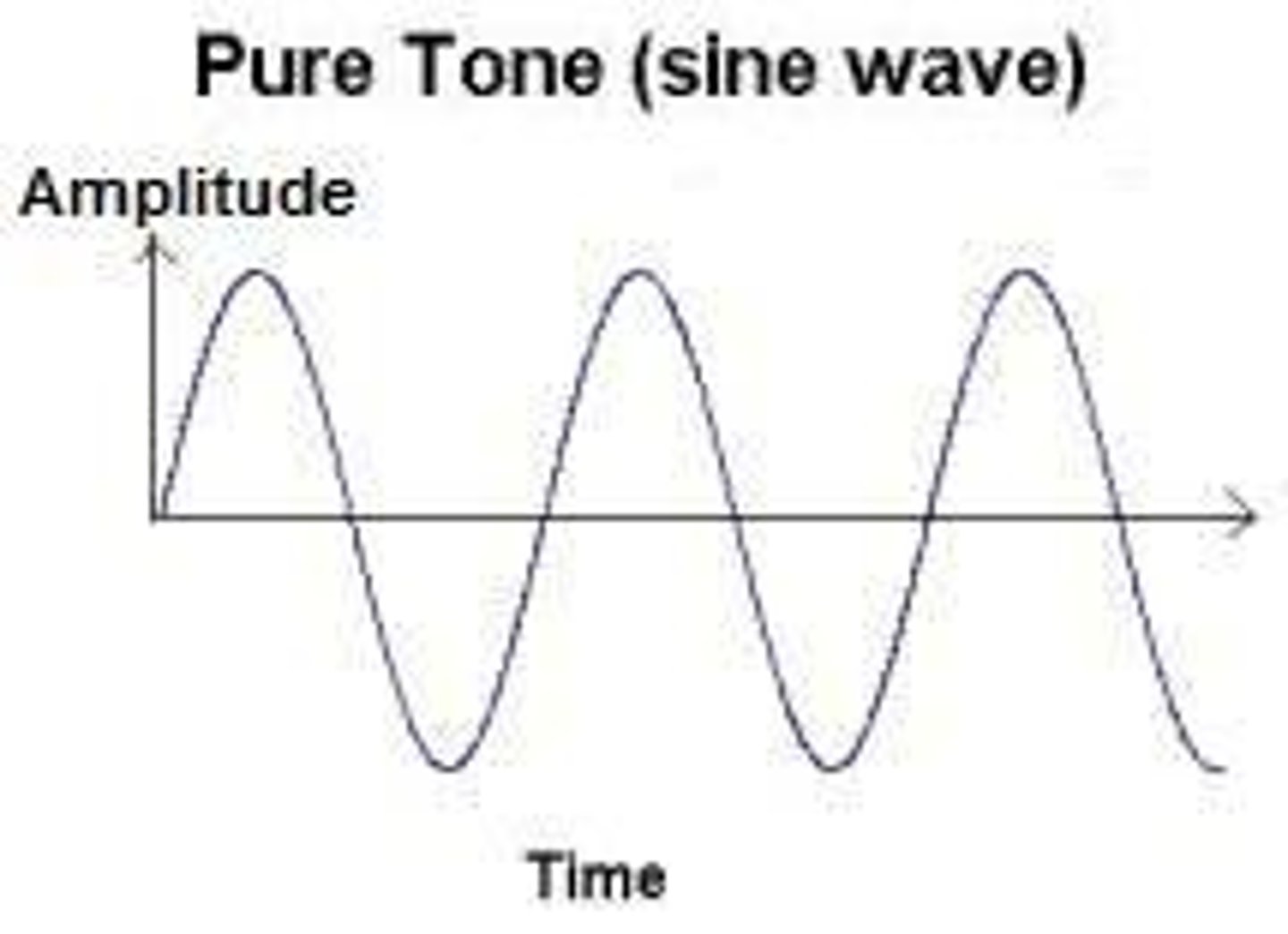
waveform in music
amplitude over time
hard to tell what comes from what- doesn't capture everything
blind to spectral info
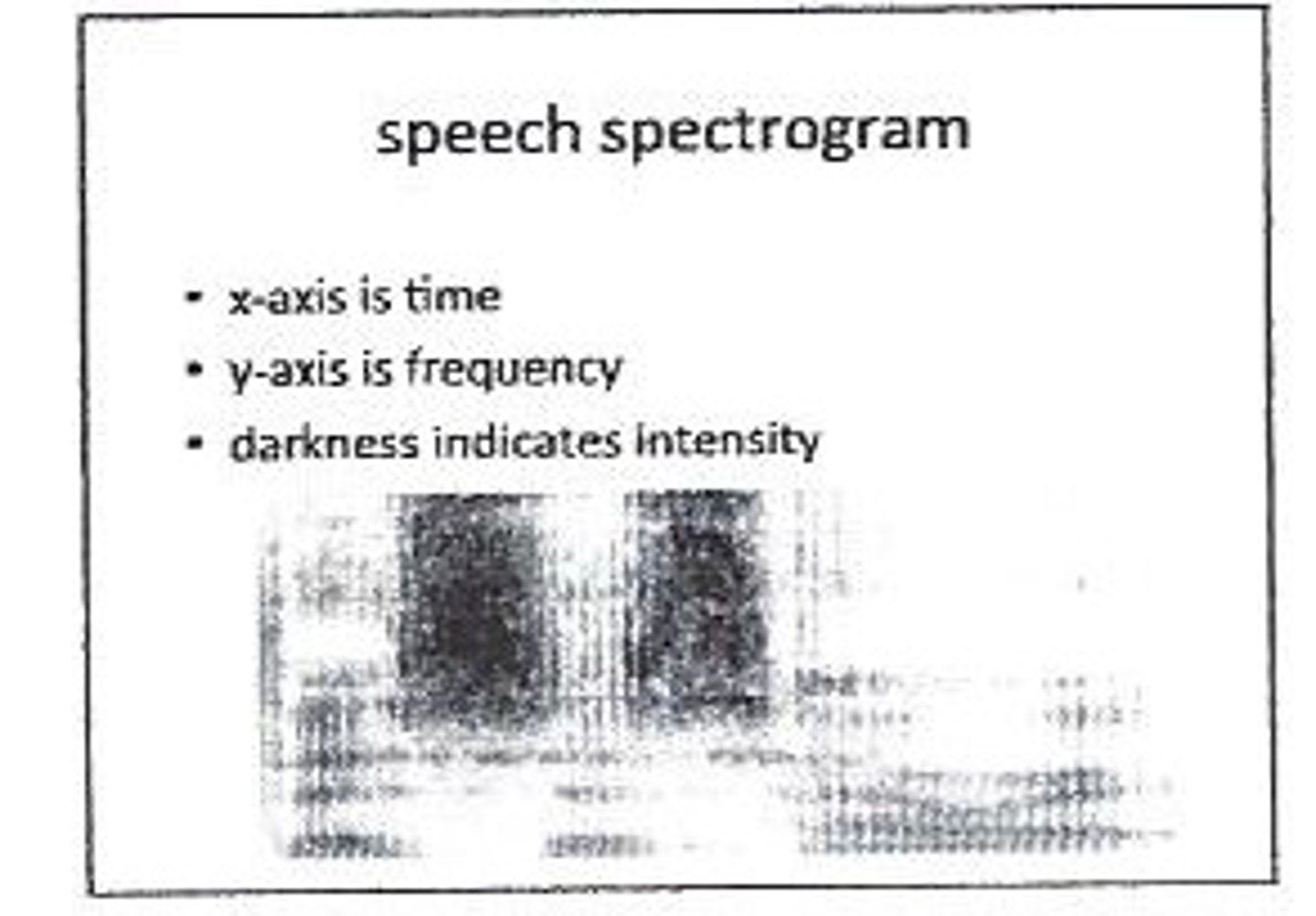
sonogram
frequency over time ( best representation)
power spectrum
amplitude over frequency
special interval
twice the frequency of the lower note- or all the integer multiples of the fundamental
overtones of 100Hz
200Hz, 300Hz, 400Hz, 500Hz, etc.
octaves of 100Hz
200Hz, 400Hz, 800Hz, 1600Hz
doubling the frequencies
overtone series
complex tone: all overtones together
brain binds these together- one sound not separate