3.3.3.3 ozone depletion
 Call Kai
 Learn
Learn Practice Test
 Spaced Repetition
 Match
Match Flashcards
 Knowt Play
1/12

There's no tags or description
Looks like no tags are added yet.
Name | Mastery | Learn | Test | Matching | Spaced | Call with Kai |
|---|
No analytics yet
Send a link to your students to track their progress
13 Terms
what are chlorofluorocarbons (CFCs)?
halogenoalkanes donating both chlorine + fluorine atoms but no hydrogen eg CCl₃F, trichlorofluoromethane
what were CFCs used for?
the short chain ones are gases + were used, eg in refrigerators
longer chains are used for dry cleaning + as degreasing solvents
under normal conditions, CFC gases are very _____
unreactive
but if CFC gases are unreactive, then why are they a problem?
they eventually end up in the atmosphere, where they are decomposed to give chlorine free radicals
what is ozone?
a molecule made from three oxygen atoms, O₃
why is the ozone layer important?
it absorbs the harmful UV radiation from the Sun that causes skin cancer by damaging DNA in skin cells
what do chlorine radicals do?
they decompose ozone in the stratosphere, causing a hole in the earth’s ozone layer
describe the steps to how chlorine radicals decompose ozone + give equations for each step
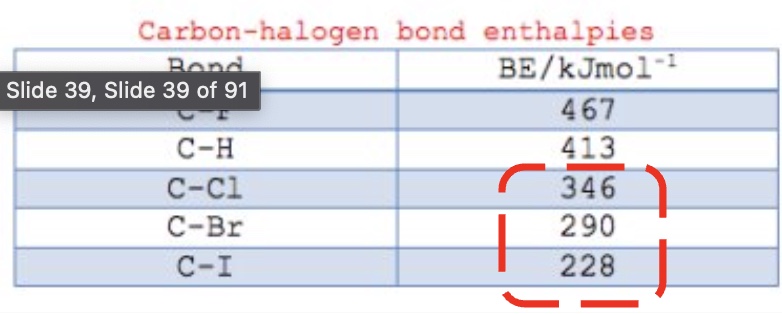
the C-Cl bond breaks in the presence of UV radiation to produce Cl•
R-Cl → R• + Cl•
these Cl• then decompose ozone in the stratosphere
Cl• + O₃ → ClO• + O₂
the resulting free radicals, ClO•, attack more ozone molecules + regenerate Cl•
ClO• + O₃ → 2O₂ + Cl•
what can we say the Cl• acts as in this process + why?
it acts as a catalyst in the breakdown of ozone to oxygen as it is not destroyed + is regenerated
give the overall equation to show the ozone breakdown
2O₃ → 3O₂
what has research by chemists provided evidence for?
for legislation to ban the use of CFCs as solvents + refrigerants in order to prevent the further breakdown of earth’s ozone layer
what alternatives to CFCs have chemists developed?
safer alternative chlorine-free compounds such as 1,1,1,2-tetrafluoroethane, which is used primarily in refrigeration + conditioning
why are chlorine free compounds safer?
they contain only C-H and C-F bonds + which therefore do not produce any chlorine radicals → these C-H and C-F bonds are stronger