Passé composé indicatif
 Call Kai
 Learn
 Practice Test
 Spaced Repetition
 Match
 Flashcards
 Knowt Play
1/6

Earn XP
Description and Tags
7 Terms
When do you use the passé composé?
Completed past actions: J'ai mangé.
Specific events: Elle est arrivée hier.
A sequence of completed actions: Je suis rentré et j'ai dormi.
How do you form the passé composé?
Present tense of avoir or être + past participle.
J'ai parlé.
Nous avons fini.
Elle est partie.
Most verbs use avoir.
Certain movement/change-of-state verbs and all reflexive verbs use être.
What are the Dr Mrs Vandertramp verbs (verbs that use être)?
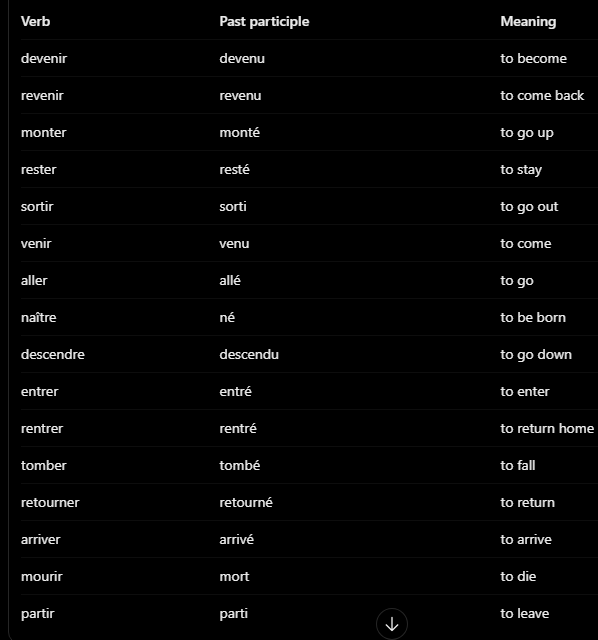
What are the regular past participle endings?
-er → -é: parler → parlé
-ir → -i: finir → fini
-re → -u: vendre → vendu
What are the most important irregular past participles?
être → été
avoir → eu
faire → fait
prendre → pris
mettre → mis
voir → vu
boire → bu
lire → lu
écrire → écrit
dire → dit
ouvrir → ouvert
offrir → offert
venir → venu
tenir → tenu
pouvoir → pu
vouloir → voulu
devoir → dû
savoir → su
recevoir → reçu
naître → né
mourir → mort
What are the agreement rules?
Changing the ending of the past participle to match the relevant person or thing. With être, the past participle usually agrees with the subject in gender and number.

When does the past participle agree in the passé composé?
With être: usually agrees with the subject.
With avoir: usually doesn't agree with the subject.
With avoir, it agrees with a direct object placed before the verb.
Examples: Elle est partie. / Les lettres que j'ai écrites.