Physiology lecture 28

0.0(0)
Studied by 0 people
call kaiCall Kai
learnLearn
examPractice Test
spaced repetitionSpaced Repetition
heart puzzleMatch
flashcardsFlashcards
GameKnowt Play
Card Sorting

1/22

flashcard set

Earn XP

Description and Tags

Pancreas and bile

Last updated 8:51 AM on 5/1/26
Name
Mastery
Learn
Test
Matching
Spaced
Call with Kai

No analytics yet

Send a link to your students to track their progress

23 Terms

1
New cards

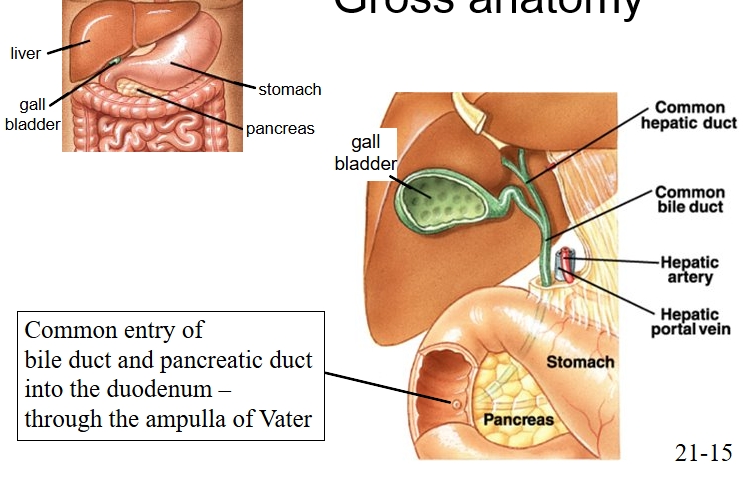
gross anatomy of GI system

2
New cards

Gross anatomy​ in liver

knowt flashcard image
3
New cards

Pancreatic exocrine secretion​ to know

  • Functions​

  • Mechanisms of secretion​

  • Control

4
New cards

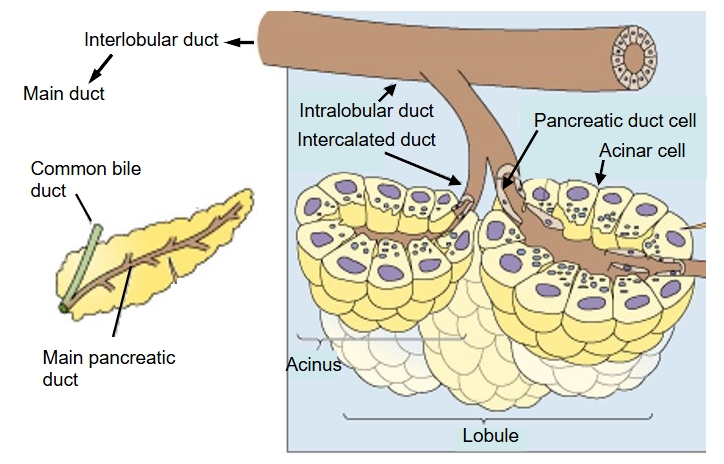
Organisation of Pancreas​

knowt flashcard image
5
New cards

Pancreatic juice​

  • Enzymes​ - Digestion, Pancreas is key organ for digestion​, Acinar cells​

​Fluid & electrolyte (HCO3-)​

  • Wash out enzymes​

  • Alkaline (~pH 8) to neutralise gastric acid in duodenum​

  • pH optimum for intestinal digestion​

  • Primary secretion from acinar cells ​

  • Modified to HCO3- rich juice by duct cells​

  • Around 1.5 litres per day

6
New cards

Pancreatic enzymes​

  • Amylolytic (carbohydrate digestion)​ - Amylase​

  • Proteolytic (protein digestion)​ - Trypsin, chymotrypsin, elastase​

  • Lipolytic (fat digestion)​ - Lipase, phospholipase​

  • Nucleolytic (nucleic acid digestion)​ - DNAse, RNAse​

​Mostly inactive precursors (zymogens) - to prevent autodigestion

7
New cards

enzymes in small I lumen from pancreas

trypsinogen also secreted from pancreatic duct with an anti enzyme to prevent ductal damage

This allows other enzymes to be digested
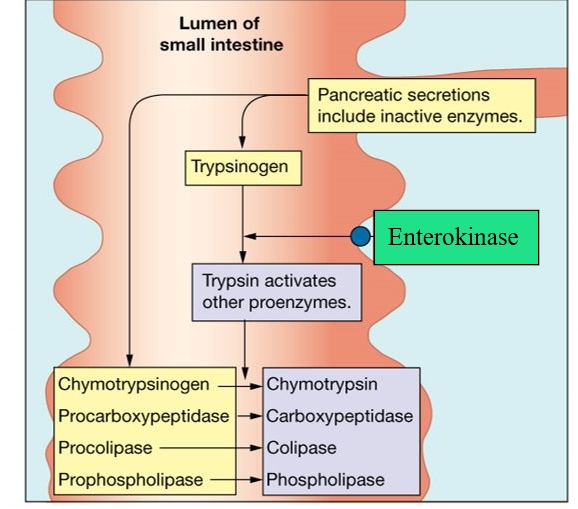
<p>trypsinogen also secreted from pancreatic duct with an anti enzyme to prevent ductal damage</p><p>This allows other enzymes to be digested </p>
8
New cards

Pancreatic proteases​

  • Secreted as zymogens​

  • Activation by enterokinase in the intestine​

  • Trypsin can auto-activate​

  • so trypsin Inhibitor​ also secreted

  • Many different proteases​

  • Endo- and exopeptidases​

  • Amino acid specificity​

  • Protein digestion completed by intestinal peptidases​ - Brush-border membrane and cytosolic

9
New cards

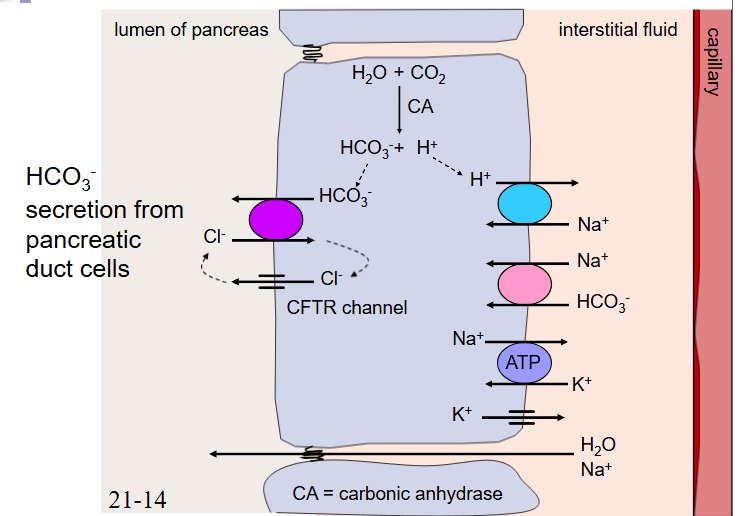
Pancreatic HCO3- secretion​

  • Acinar cell primary secretion ​- Isotonic NaCl secretion​

  • Duct HCO3- secretion​

  • Isotonic via apical Cl-/HCO3- exchange & CFTR Cl- channels​

  • Cystic fibrosis​

  • Absence of CFTR channels​

  • Lack of fluid secretion​

  • Lack of washout of enzymes​

  • Damage to pancreas​

  • Poor nutrition

<ul><li><p class="Paragraph WhiteSpaceCollapse SCXP217031388 BCX8" style="text-align: left;"><span style="line-height: 0px;">Acinar cell primary secretion ​- Isotonic NaCl secretion​</span></p></li></ul><ul><li><p class="Paragraph WhiteSpaceCollapse SCXP253380680 BCX8" style="text-align: left;"><span style="line-height: 0px;"><strong>Duct HCO</strong></span><span style="background-color: inherit; line-height: 0px;"><strong>3-</strong></span><span style="line-height: 0px;"><strong> secretion​</strong></span></p></li><li><p class="Paragraph WhiteSpaceCollapse SCXP253380680 BCX8" style="text-align: left;"><span style="line-height: 0px;">Isotonic via apical Cl</span><span style="background-color: inherit; line-height: 0px;">-</span><span style="line-height: 0px;">/HCO</span><span style="background-color: inherit; line-height: 0px;">3-</span><span style="line-height: 0px;"> exchange &amp; CFTR Cl</span><span style="background-color: inherit; line-height: 0px;">-</span><span style="line-height: 0px;"> channels​</span></p></li></ul><p class="Paragraph WhiteSpaceCollapse SCXP253380680 BCX8" style="text-align: left;"><span style="line-height: 0px;">​</span></p><ul><li><p class="Paragraph WhiteSpaceCollapse SCXP253380680 BCX8" style="text-align: left;"><span style="line-height: 0px;"><strong>Cystic fibrosis​</strong></span></p></li><li><p class="Paragraph WhiteSpaceCollapse SCXP253380680 BCX8" style="text-align: left;"><span style="line-height: 0px;">Absence of CFTR channels​</span></p></li><li><p class="Paragraph WhiteSpaceCollapse SCXP253380680 BCX8" style="text-align: left;"><span style="line-height: 0px;">Lack of fluid secretion​</span></p></li><li><p class="Paragraph WhiteSpaceCollapse SCXP253380680 BCX8" style="text-align: left;"><span style="line-height: 0px;">Lack of washout of enzymes​</span></p></li><li><p class="Paragraph WhiteSpaceCollapse SCXP253380680 BCX8" style="text-align: left;"><span style="line-height: 0px;">Damage to pancreas​</span></p></li><li><p class="Paragraph WhiteSpaceCollapse SCXP253380680 BCX8" style="text-align: left;"><span style="line-height: 0px;">Poor nutrition</span></p></li></ul><p></p>
10
New cards

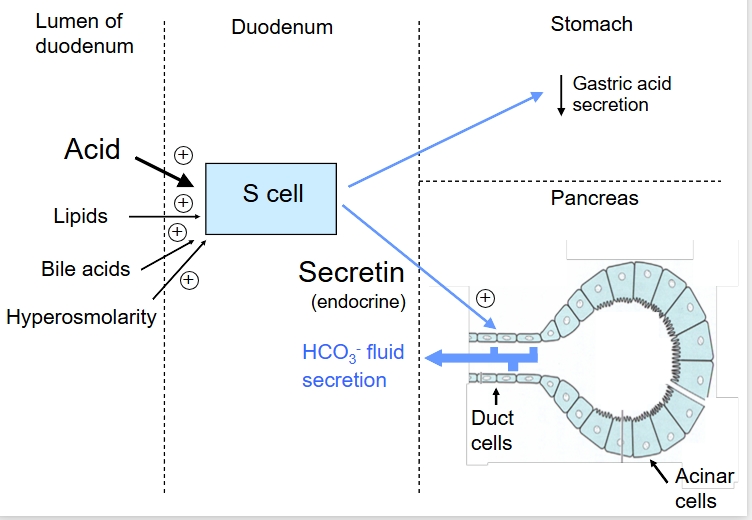
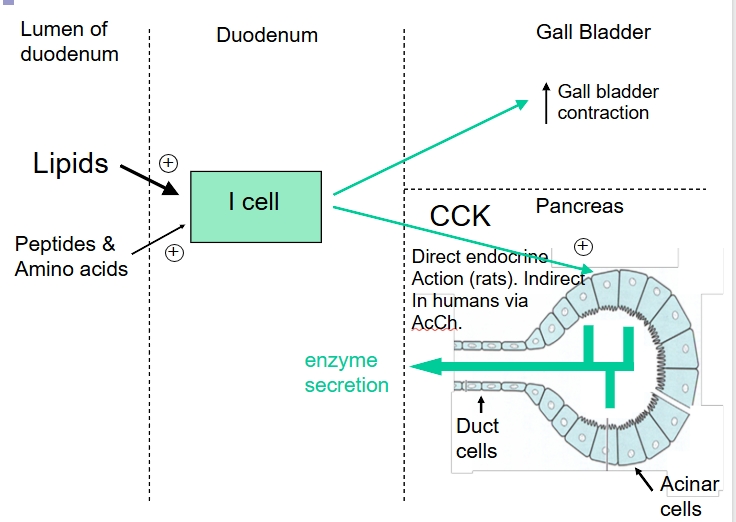
Pancreatic secretion - control​

  • Secretin​

  • Duodenal S cells​

  • Release stimulated by acid​

  • Increases HCO3- rich secretion​

  • Cholecystokinin-Pancreozymin (CCK)​

  • Duodenal I cells​

  • Release stimulated by fat and protein​

  • Stimulates gall bladder contraction​

  • Stimulates pancreatic enzyme secretion

  • Neural: Vagus ​

  • Stimulates both acinar cells and duct cells

11
New cards

S cells

knowt flashcard image
12
New cards

I cells

knowt flashcard image
13
New cards

bile functions

  • Elimination of waste products​

  • Cholesterol​

  • Bile pigments (e.g. bilirubin)​

  • Minerals​

  • Lipophilic drugs and metabolites​

  • Heavy metals​

  • Promotion of lipid digestion and absorption

14
New cards

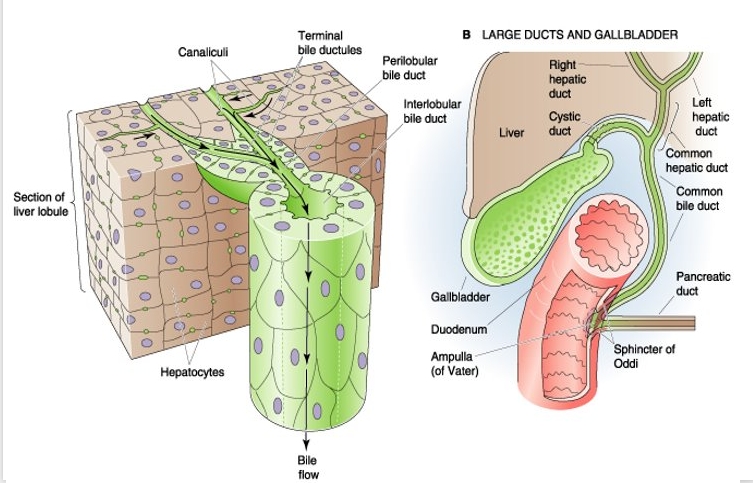
Structure of biliary tree​

knowt flashcard image
15
New cards

Bile ​

  • Hepatocytes secrete bile into canaliculi​

  • Bile ducts secrete HCO3- rich fluid (like pancreas)​

  • Bile enters duodenum by common bile duct​

  • Between meals approximately 50% bile stored and concentrated in gall bladder

16
New cards

Bile ​components

  • Biliary lipids​

  • Bile acids (67%)​

  • Phospholipids (22%)​

  • lecithins​

  • Cholesterol (4%)​

  • Bile pigments​

  • Bilirubin (0.3%) ​

  • Jaundice ​

  • Bile acids keep cholesterol in solution

17
New cards

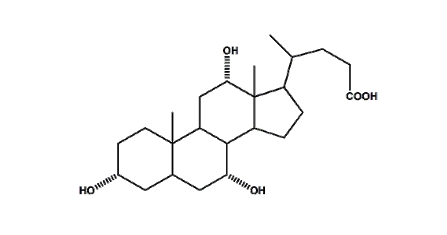
Bile acids (salts)​

  • Primary​

  • Liver synthesis from cholesterol​

  • e.g. cholic acid (cholate)

  • Secondary​

  • Modification by intestinal bacteria (dehydroxylation)​

  • e.g. deoxycholate​

  • Conjugation​

  • To amino acids (glycine or taurine)​

  • Increases solubility​

  • e.g taurocholate ​

  • Enterohepatic circulation​

  • Recycling of bile acids through intestine and liver
<ul><li><p class="Paragraph WhiteSpaceCollapse SCXP168543445 BCX8" style="text-align: left;"><span style="line-height: 0px;"><strong>Primary​</strong></span></p></li><li><p class="Paragraph WhiteSpaceCollapse SCXP168543445 BCX8" style="text-align: left;"><span style="line-height: 0px;">Liver synthesis from cholesterol​</span></p></li><li><p class="Paragraph WhiteSpaceCollapse SCXP168543445 BCX8" style="text-align: left;"><span style="line-height: 0px;">e.g. cholic acid (cholate)</span></p></li></ul><ul><li><p class="Paragraph WhiteSpaceCollapse SCXP75479692 BCX8" style="text-align: left;"><span style="line-height: 0px;"><strong>Secondary​</strong></span></p></li><li><p class="Paragraph WhiteSpaceCollapse SCXP75479692 BCX8" style="text-align: left;"><span style="line-height: 0px;">Modification by intestinal bacteria (dehydroxylation)​</span></p></li><li><p class="Paragraph WhiteSpaceCollapse SCXP75479692 BCX8" style="text-align: left;"><span style="line-height: 0px;">e.g. deoxycholate​</span></p></li><li><p class="Paragraph WhiteSpaceCollapse SCXP75479692 BCX8" style="text-align: left;"><span style="line-height: 0px;"><strong>Conjugation​</strong></span></p></li><li><p class="Paragraph WhiteSpaceCollapse SCXP75479692 BCX8" style="text-align: left;"><span style="line-height: 0px;">To amino acids (glycine or taurine)​</span></p></li><li><p class="Paragraph WhiteSpaceCollapse SCXP75479692 BCX8" style="text-align: left;"><span style="line-height: 0px;">Increases solubility​</span></p></li><li><p class="Paragraph WhiteSpaceCollapse SCXP75479692 BCX8" style="text-align: left;"><span style="line-height: 0px;">e.g taurocholate ​</span></p></li><li><p class="Paragraph WhiteSpaceCollapse SCXP75479692 BCX8" style="text-align: left;"><span style="line-height: 0px;"><strong>Enterohepatic circulation​</strong></span></p></li><li><p class="Paragraph WhiteSpaceCollapse SCXP75479692 BCX8" style="text-align: left;"><span style="line-height: 0px;">Recycling of bile acids through intestine and liver</span></p></li></ul><p></p>
18
New cards

Enterohepatic circulation of bile acids​

  • Synthesis of primary bile acids in liver​

  • 0.6g synthesised/ day​

  • Conjugated​

  • Secretion into duodenum in bile​

  • 12-36g/ day secreted​

  • Involved in lipid digestion/absorption​

  • Reabsorption in terminal ileum​

  • 0.6g lost to faeces (cholesterol excretion)​

  • Recirculation through hepatic portal vein to liver​

  • 3g pool in portal blood​ - very efficient

  • Taken up by liver and secreted into bile​

  • Can be recycled <12 times/ day

19
New cards

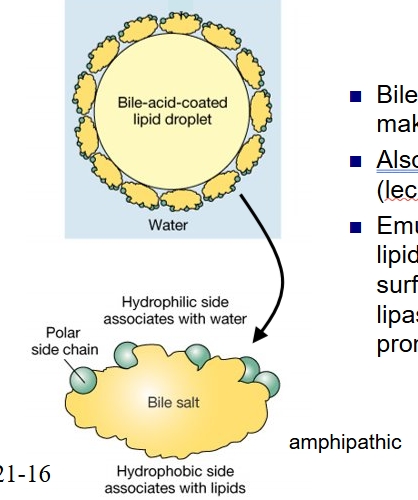
emulsification

  • Bile salts coat lipids to make emulsions

  • Also phospholipids (lecithins) and cholesterol​

  • Emulsification of dietary lipids increases the surface area exposed to lipases and therefore promotes digestion

allows for more efficient action of lipase
<ul><li><p class="Paragraph WhiteSpaceCollapse SCXP15761754 BCX8" style="text-align: left;"><span style="line-height: 0px;">Bile salts coat lipids to make <strong>emulsions</strong>​</span></p></li><li><p class="Paragraph WhiteSpaceCollapse SCXP15761754 BCX8" style="text-align: left;"><span style="line-height: 0px;">Also phospholipids (lecithins) and cholesterol​</span></p></li><li><p class="Paragraph WhiteSpaceCollapse SCXP15761754 BCX8" style="text-align: left;"><span style="line-height: 0px;">Emulsification of dietary lipids increases the surface area exposed to lipases and therefore promotes digestion</span></p></li></ul><p>allows for more efficient action of lipase </p>
20
New cards

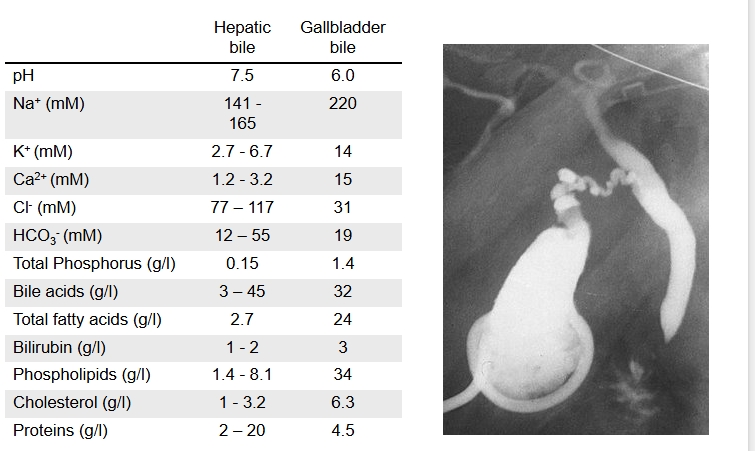
Function of gall bladder​

  • Concentrates bile (< x 20)​

  • Absorbs electrolytes and water​

  • Isotonic​

  • Na+ with bile salts​

  • ~0.9l bile secreted by liver but only ~0.5l added to duodenum (mixture of dilute and concentrated bile).
<ul><li><p class="Paragraph WhiteSpaceCollapse SCXP93967038 BCX8" style="text-align: left;"><span style="line-height: 0px;">Concentrates bile (&lt; x 20)​</span></p></li><li><p class="Paragraph WhiteSpaceCollapse SCXP93967038 BCX8" style="text-align: left;"><span style="line-height: 0px;">Absorbs electrolytes and water​</span></p></li><li><p class="Paragraph WhiteSpaceCollapse SCXP93967038 BCX8" style="text-align: left;"><span style="line-height: 0px;">Isotonic​</span></p></li><li><p class="Paragraph WhiteSpaceCollapse SCXP93967038 BCX8" style="text-align: left;"><span style="line-height: 0px;">Na</span><span style="background-color: inherit; line-height: 0px;">+</span><span style="line-height: 0px;"> with bile salts​</span></p></li><li><p class="Paragraph WhiteSpaceCollapse SCXP93967038 BCX8" style="text-align: left;"><span style="line-height: 0px;">~0.9l bile secreted by liver but only ~0.5l added to duodenum (mixture of dilute and concentrated bile).</span></p></li></ul><p></p>
21
New cards

Control of biliary secretion​

  • Bile acid-dependent​

  • Bile acid concentration in plasma​

  • Ductal

  • Secretin​

  • Gall bladder contraction​

  • Cholecystokinin (CCK)​

  • Vagal nerves (ACh)​

  • integrated with pancreatic enzyme secretion

22
New cards

Gallstones – a failure to keep cholesterol in solution​

  • Cholesterol

  • 80%​

  • Super-saturated with cholesterol​

  • High ratio of cholesterol to bile salts/lecithin​

  • High fat diet, females

  • Or

  • Pigment

  • Conjugation compromised – free bilirubin​

  • Stasis – sluggish flow of bile

<ul><li><p class="Paragraph WhiteSpaceCollapse SCXP67072702 BCX8" style="text-align: left;"><span style="line-height: 0px;"><strong>Cholesterol </strong>​</span></p></li><li><p class="Paragraph WhiteSpaceCollapse SCXP67072702 BCX8" style="text-align: left;"><span style="line-height: 0px;">80%​</span></p></li><li><p class="Paragraph WhiteSpaceCollapse SCXP67072702 BCX8" style="text-align: left;"><span style="line-height: 0px;">Super-saturated with cholesterol​</span></p></li><li><p class="Paragraph WhiteSpaceCollapse SCXP67072702 BCX8" style="text-align: left;"><span style="line-height: 0px;">High ratio of cholesterol to bile salts/lecithin​</span></p></li><li><p class="Paragraph WhiteSpaceCollapse SCXP67072702 BCX8" style="text-align: left;"><span style="line-height: 0px;">High fat diet, females</span></p></li><li><p class="Paragraph WhiteSpaceCollapse SCXP67072702 BCX8" style="text-align: left;">Or</p></li><li><p class="Paragraph WhiteSpaceCollapse SCXP67072702 BCX8" style="text-align: left;"><span style="line-height: 0px;"><strong>Pigment</strong>​</span></p></li><li><p class="Paragraph WhiteSpaceCollapse SCXP216639114 BCX8" style="text-align: left;"><span style="line-height: 0px;">Conjugation compromised – free bilirubin​</span></p></li><li><p class="Paragraph WhiteSpaceCollapse SCXP216639114 BCX8" style="text-align: left;"><span style="line-height: 0px;">Stasis – sluggish flow of bile</span></p></li></ul><p></p>
23
New cards

LOs

  • List the functions of pancreatic exocrine secretions​

  • Describe the mechanisms of pancreatic exocrine secretion​

  • Give an account of the control of pancreatic exocrine secretions​

  • Explain the functions of bile and the gall bladder​

  • Give an account of the control of gall bladder contraction