Chapter 4 - inorganic chemistry and the periodic table
 Call Kai
 Learn
Learn Practice Test
 Spaced Repetition
 Match
Match Flashcards
 Knowt Play
1/97

Earn XP
Description and Tags
98 Terms
What are the group 2 elements called?
The alkali earth metals
What is the oxidation states of group 2 elements (and what charge are their ions)
2+
Are group 2 elements oxidising or reducing agents?
They are reducing agents like all metals and they give up both of their s subshell electrons to form 2+ ions
List some of the properties of group 2 metals
They tend to be harder and denser than group 1
They have higher meting points as they loose two electrons which gives stronger metallic bonding
Their surface is covered in a layer of oxide as they react with the oxygen in the air
Give some of the uses of Be and Mg
Be - hard metal used in many alloys
Mg- used to make low density alloys for cars
Give a property of Ba
Ba- a very reactive metal that must be kept stored in oil like the alkali metals
Do melting and boiling points generally increase or decrease down group 2?
They decrease down Group 2 as atomic size increases, weakening the metallic bonding
What happens to ionisation energy going down group 2?
Ionisation energy decreases
Why does ionisation energy change the way it does going down group 2?
It decreases because although the nuclear charge increases (because there are more protons), factors such as an increased shielding effect and a larger distance (because of an extra shell) between the outermost electrons and nucleus outweigh the attraction of the higher nuclear charge.
How and why does reactivity change going down group 2?
It increases because most elements react by loosing their outer 2 electrons and so if their ionisation energies are higher it is harder to react to lose these electrons
Write a half equation for the reaction of calcium with oxygen
Ca —> Ca2+ + 2e-
What happens in the reactions of group 2 and oxygen?
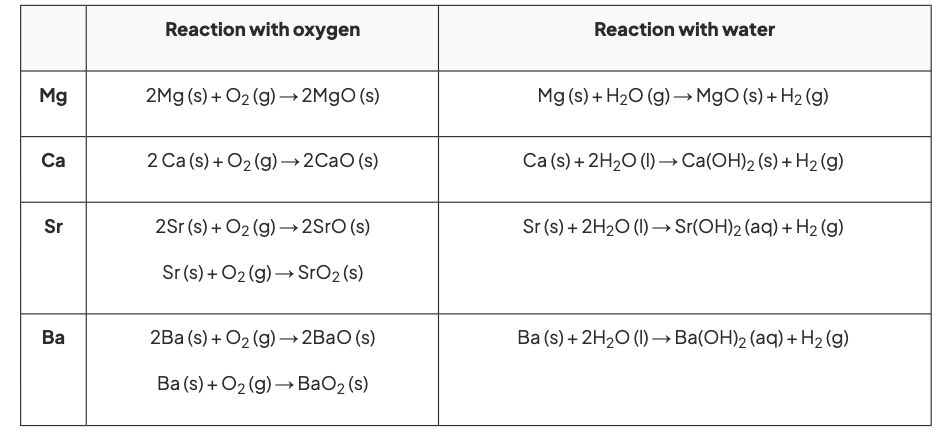
The group 2 metals( except beryllium) burn with oxygen to form solid white oxides. This gets more reactive going down the group which is why barium is stored in oil because it reacts very easily with oxygen in air.
How are Sr and Ba reaction with oxygen different to the other group 2 elements?
They could form an oxide or a peroxide (BaO2)
Write the equation for the reaction of oxygen and magnesium
2Mg(s) + O2 (g) —> 2MgO(s)
What happens in the reactions of group 2 with water?
With water the group 2 metals (excluding beryllium) produce metal hydroxides and hydrogen
Write the equation for the reaction of magnesium in cold water
Mg (s) + 2H2O (l) → Mg(OH)2 (aq) + H2 (g)
What is the issue with the reaction between magnesium and cold water?
It is very slow (it also only produces a very weak alkaline as magnesium hydroxide is onlly slightly soluble). This can be overcome by reacting it in heated steam where it reacts much more vigorously to make magnesium oxide and hydrogen gas.
Mg (s) + H2O (g) → MgO (s) + H2 (g)
Write the equations for the reactions between group 2 and O2 and H2O
Oxygen- M (s) +O2 (g) —> 2MO (s)
Water - M (s) + 2H2O (l) —> M(OH)2 (aq) + H2 (g)
What does the reaction between group 2 and chlorine produce?
Solid white metal chlorides
Write the equation for the reaction between calcium and chloride
Ca(s) + Cl2(g) ➔ CaCl2(s)
List the group 2 oxides
BeO,MgO, CaO, SrO and BaO. They are all white solids.
Are the group 2 oxides acidic or basic?
All Group 2 oxides are basic, except for BeO which is amphoteric (it can act both as an acid and base).
What it happens in the reaction between group 2 oxides and water?
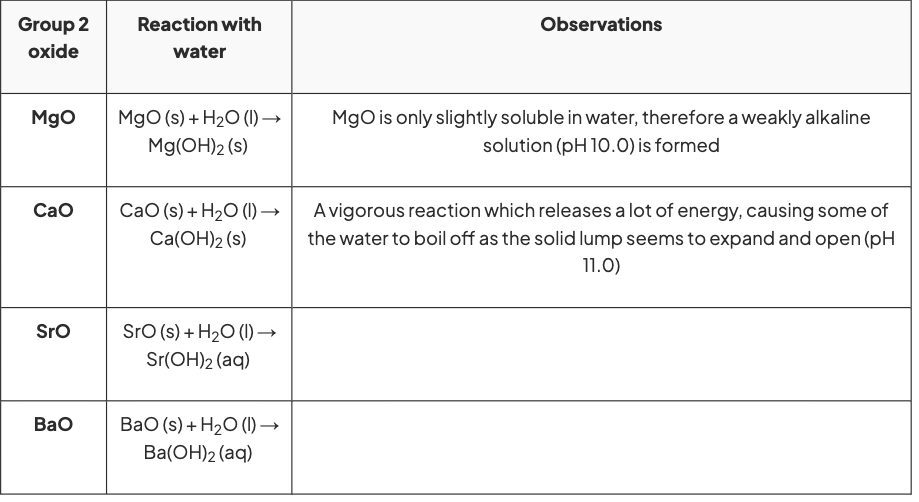
Group 2 oxides react water to form alkaline solutions which get more alkaline going down the group.
They all form hydroxides when added to water (except Beryllium oxide which doesn’t react with water. Also Beryllium hydroxide in insoluble)
Also MgO only reatcs very slowly and it’s hydroxide isn’t very soluble
oxide + water → hydroxide
(calcium hydroxide, when in solution, is also called limewater)
Write the reaction between calcium oxide and water
CaO(s) + H2O(l) → Ca(OH)2(aq)
What do group 2 oxides form when they react with acids?
oxide + dilute hydrochloric acid → chloride + water
oxide + dilute sulfuric acid → sulfate + water
What happens when the group 2 oxides react with sulfuric acid?
The insoluble sulfates form at the surface of the oxide, which means that the solid oxide beneath it can’t react with the acid
This can be prevented to an extent by using the oxide in powder form and stirring, in which case neutralisation can take place
This neutralisation will also happen with hydrochloric reaction
Write the reaction between barium oxide and hydrochloric acid
BaO(s) + 2HCl(l) → BaCl2(aq) + H2O(l)
What do the group 2 hydroxides form when they react with dilute HCl
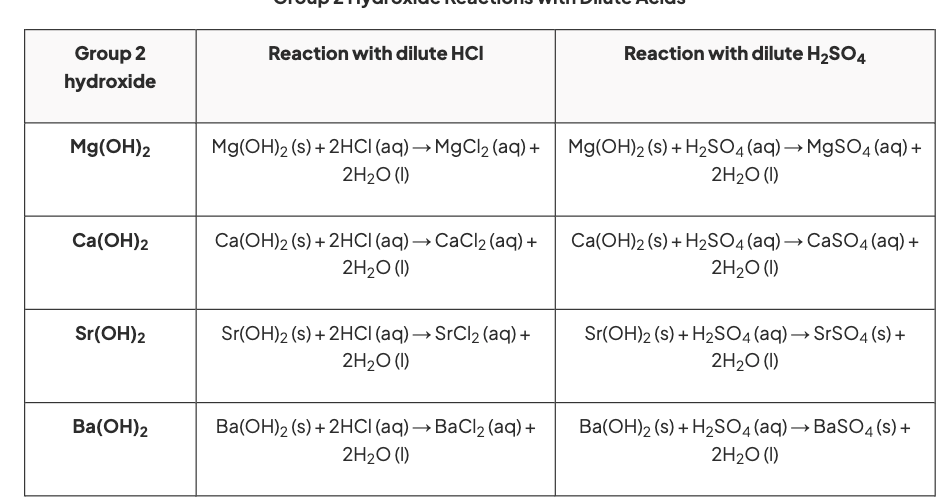
The Group 2 metal hydroxides form colourless solutions of metal salts when they react with a dilute acid
hydroxide + dilute hydrochloric acid → chloride + water
Write the reaction between Mg(OH)2 and HCl
Mg(OH)2 (s) + 2HCl (aq) → MgCl2 (aq) + 2H2O (l)
What do the group 2 hydroxides form when they react with dilute H2SO4
The Group 2 metal hydroxides form colourless solutions of metal salts when they react with a dilute acid
hydroxide + dilute sulfuric acid → sulfate + water
Write the reaction between Mg(OH)2 and H2SO4
Mg(OH)2 (s) + H2SO4 (aq) → MgSO4 (aq) + 2H2O (l)
Write the general reaction between hydroxides and HCl and H2SO4
hydrochloric acid - M(OH)2(s) + 2HCl(aq) ➔ MCl2(aq) + 2H2O(l)
sulfuric acid - M(OH)2 (s) + H2SO4 (aq) → MSO4 (aq) + 2H2O (l)
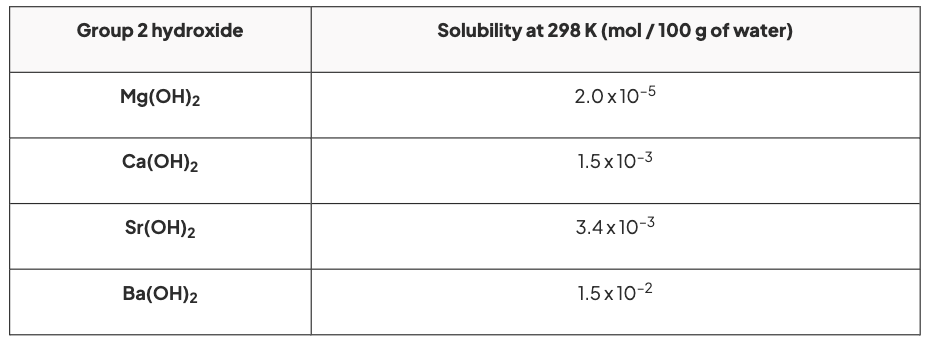
How does the solubility of the hydroxides change down the group?
It increases
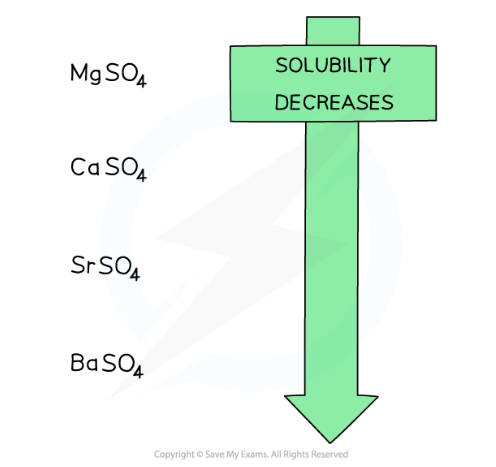
How does the solubility of the sulfates change down the group?
The solubility decreases (barium sulfate is an insoluble white precipitate)
Do the products formed in the reaction between group 2 oxides and water get more or less alkaline down the group?
They become more alkaline going down the group because the hydroxides produced in the reaction become more soluble going down. This means that as the hydroxides dissolve in water to form OH- ions, as the solubility increases the concentration of these hydroxide ions increases which increases the pH of the solution. Therefore going down the group the alkalinity of the solution formed increases when Group 2 oxides react with water.
Write the equation for how the hydroxides dissolve in water
X(OH)2 (aq) → X(aq) + 2OH- (aq)
(Where X is the Group 2 element)
What is limewater?
Limewater is a solution of calcium hydroxide that form calcium carbonate with carbon dioxide is added to it to form a white precipitate
Ca(OH)2(aq) + CO2(g) → CaCO3(aq) + H2O(l)
Are group 1 hydroxides more or less soluble than group 2 hydroxides?
Group 1 hydroxides are more soluble than group 2 hydroxides
What is thermal decomposition?
Thermal decomposition is the breakdown of a compound into two or more different substances using heat
What is thermal stability?
Thermal stability is a compound's resistance to decomposition when heated. The more thermally stable a substance is the more heat it will take to break it down. Thermal stability increases down a group.
Why does thermal stability increase down a group?
Because the large negative carbonate and nitrate ions can be made unstable by the presence of a positively charged ion (e.g. Mg2+). The cation polarises the anion which distorts it, the greater the distortion the less stable the compound. Large cations cause less distortion then small cations as they have a lower charge density. So the further down the group, the larger the cations, the lower the charge density so the less distortion caused and the more stable the carbonate/nitrate compound.
Are group 1 or 2 compounds more thermally stable?
Group 1 compounds are more stable then group 2 compounds. The greater the charge on the cation the greater the distortion so the less stable the compound becomes. Group 2 have a 2+ charge compared to group 1s 1+ charge.
How thermally stable are group 1 carbonates?
They are generally thermally stable (you can’t heat them enough with a bunsen burner to make them decompose - they do decompose at higher temperatures and the decomposition temperatures increase going down the group). However, Li2CO3 does decompose to form Li2O (s) + CO2 (g)
What are the decomposition products of Group 1 nitrates, and how does their decomposition change down the group?
Generally the group 1 nitrates decompose to form the nitrite and oxygen (e.g. 2KNO3 (s) —> 2KNO2 (s) + O2 (g) ).
Lithium nitrate however will decompose more fully to produce nitrogen dioxide (a brown toxic gas) and oxygen (4LiNO3 (s) —> 2Li2O (s) + 4NO2 (g) + O2 (g)).
All the nitrates from sodium to caesium decompose in the same way (to form nitrites) , the only difference being how hot they have to be to undergo the reaction. Down Group 1, the decomposition gets more difficult, and you have to use higher temperatures
What are the decomposition products of Group 2 carbonates, and how does their decomposition change down the group?
The Group 2 carbonates decompose when they are heated to form the metal oxide and give off carbon dioxide gas. CaCO3(s) ➔ CaO(s) + CO2(g)
What are the decomposition products of Group 2 nitrates, and how does their decomposition change down the group?
The Group 2 nitrates break decomposed when they are heated to form the metal oxide, oxygen gas and nitrogen dioxide gas
2Ca(NO3)2(s) ➔ 2CaO(s) + 4NO2(g) + O2(g)
More heat is needed to do this going down the group.
How can the thermal stability of carbonates and nitrates be tested?
Group 2 carbonates - Measure the time taken to produce enough CO2 gas to turn limewater cloudy.
Group 1 nitrates - Measure the time taken to produce enough O2 gas to relight a glowing splint.
Group 2 nitrates - In a fume cupboard ( because No2 is toxic) , measure the time taken to produce brown NO2 gas.
What test can be done to identify metal ion?
A flame test. Each metal ion produces a different colour if heated in a flame.
How do you carry out a flame test?
Clean a platinum or nichrome wire by dipping it in concentrated acid and then by heating it in a hot Bunsen flame. (this avoids contamination from other ions)
Dip the wire into the compound
Hold the wire in a hot flame and observe the colour produced.
How does a flame test work?
In a flame test the heat causes the electron to move to a higher energy level
The electron is unstable at this energy level so falls back down
As it drops back down from the higher to a lower energy level, energy is emitted in the form of visible light energy with the wavelength of the observed light
What colour are the flames for the group 1 ions?
Li - Scarlet Red
Na- Yellow
K- Lilac
Rb- Red
Cs- Blue
What colours are the flames for the group 2 ions?
Mg- No flame colour
Ca- Brick red
Sr-Crimson
Ba- Apple green
Why does Mg2+ not have an obseravable colour?
Because the energy it emits is outside the visible spectrum.
What are the group 7 elements called?
The halogens
What are some of the uses of halogens?
Halogens are used in water purification (chlorine), as bleaching agents (chlorine), as flame-retardants and fire extinguishers (bromine), and as antiseptic and disinfectant agents (iodine).
What does diatomic mean?
Diatomic molecules are covalently bonded pairs of the same atom. All of the halogens are diatomic (e.g. F2)
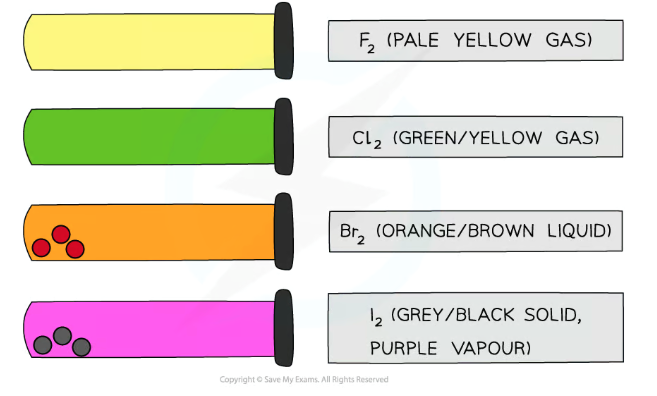
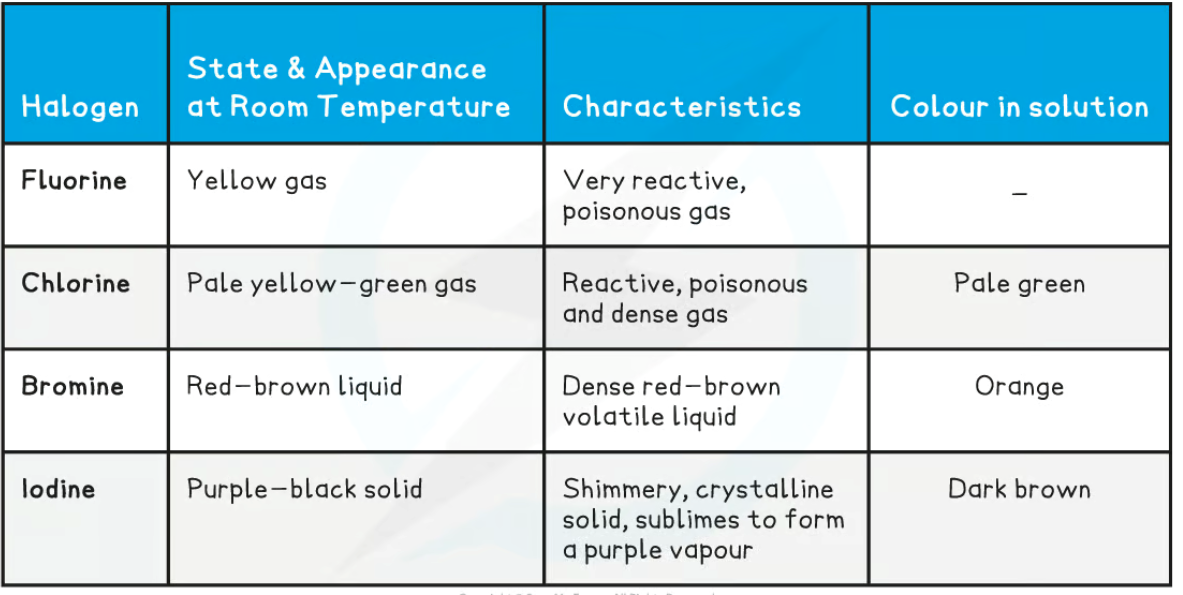
What are the colours of the halogens?
F2 is a pale yellow gas
Cl2 is a green /yellow gas
Br2 is a orange / brown liquid
I2 is a grey/black solid or a purple vapour
(they each have distinct colours which get darker going down the group)
What is volatility?
Volatility is how easily a substance can evaporate. ( a volatile substance will have a low boiling point)
How do the melting and boiling points (and volatility) change down group 7?
Going down group 7 the melting and boiling points increases so the volatility decreases.
Explain the trend in melting and boiling points
As the halogens are diatomic, they contain weak London forces between their molecules. The more electrons there are in a molecule, the greater the London forces (ie. bigger molecules have stronger London forces) so therefore going down the group it becomes more difficult to separate the molecules and the melting and boiling points increase.
What is electronegativity?
The electronegativity of an atom refers to how strongly it attracts electrons towards itself in a covalent bond.
State and explain the trend in electronegativity in the halogens
Electronegativity decreases down the group. This is because the atomic radii of the elements increases so the outer shells are further from the nucleus so an incoming charge will experience more shielding from the electrostatic attraction so the halogens ability to accept an electron decreases.
What charge ions do group 7 usually form?
1- (they act as oxidising agents in these reaction)
State and explain the trend in reactivity for group 7
Reactivity decreases down group 7 because the larger ions find it more difficult to attract incoming electrons.
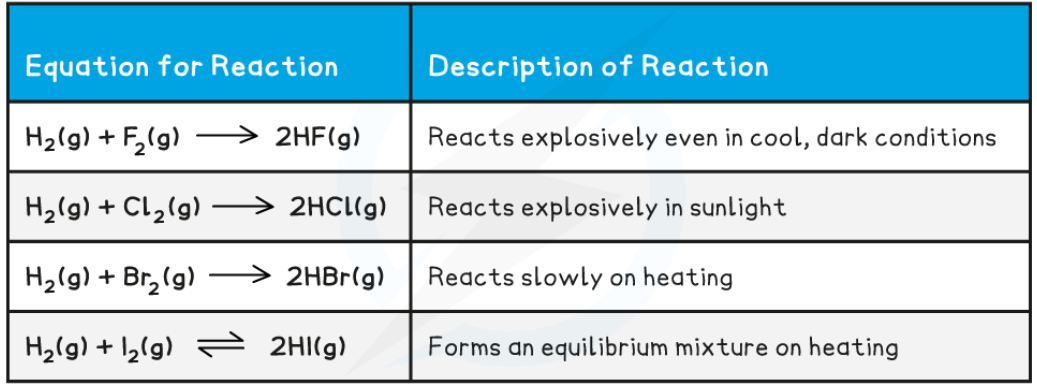
How can we demonstrate the change in reactivity of the halogens?
By looking by at the reactions with hydrogen gas. This test shows the reaction becoming less vigorous down the group.
List characteristics of the halogens
When does a halogen displacement reaction take place?
When a more reactive halogen displaces a less reactive halide ion form its aqueous solution. These are redox reactions (the more reactive halogen is reduced (gains electrons) the less reactive halide ion is oxidised (loses electrons)). The products from this are most often identified by colour but these can be very faint in water so an immiscible organic solvent is sometimes used instead to make the result clearer.
What colours do the halogens form in an aqueous solution and an organic solvent?
Halogen | Colour in aqueous solution | Colour in organic solvent (e.g., cyclohexane) |
|---|---|---|
Chlorine (Cl2) | Very pale green (often appears colourless) | Colourless |
Bromine (Br2) | Orange (can appear yellow if very dilute) | Orange |
Iodine (I2) | Brown | Purple / Violet |
What happens in the reaction between Chlorine and Bromide ions?
Chlorine is more reactive than bromine so, chlorine will displace bromide ions
The ionic equation is:
Cl2 (aq) + 2Br⁻ (aq) → 2Cl- (aq) + Br2 (aq)
Observations:
In aqueous solution: The colourless solution turns orange
With an organic solvent: The organic layer turns orange
Redox analysis:
Reduction: Chlorine's oxidation state changes from 0 to -1
Oxidation: Bromine's oxidation state changes from -1 to 0
What happens in the reaction between Chlorine and Iodide ions?
Chlorine is more reactive than iodine so, chlorine will displace iodide ions
The ionic equation is:
Cl2 (aq) + 2I- (aq) → 2Cl- (aq) + I2 (aq)
Observations:
In aqueous solution: The colourless solution turns brown
With an organic solvent: The organic layer turns purple / violet
Redox analysis:
Reduction: Chlorine's oxidation state changes from 0 to -1
Oxidation: Iodine's oxidation state changes from -1 to 0
What happens in the reaction between Bromine and Iodide ions?
Bromine is more reactive than iodine so, bromine will displace iodide ions
The ionic equation is:
Br2 (aq) + 2I- (aq) → 2Br- (aq) + I2 (aq)
Observations:
In aqueous solution: The orange solution turns brown
With an organic solvent: The organic layer turns purple / violet
Redox analysis:
Reduction: Bromine's oxidation state changes from 0 to -1
Oxidation: Iodine's oxidation state changes from -1 to 0
Can there be a reaction between bromine water and chloride ions?
No, a less reactive halogen cannot displace a more reactive halide ion.
Br2 (aq) + 2Cl- (aq) → No Reaction (The solution would simply remain orange.)
What type of reaction is halogen/halide displacement? (reduction, oxidation, redox, disproportionation)
It is a redox reaction where the halogen is reduced and the halide oxidised
What do the halogens form when they react with group 1 and 2 metals?
They form the corresponding halide salts. (e.g 2Na(s) + F2(g) ➔ 2NaF(s)). In all reactions in this category, the halogen acts as an oxidising agent.
Write an equation for the reaction between sodium and fluorine
2Na(s) + F2(g) ➔ 2NaF(s)
In this reaction:
Sodium is oxidised: Na ➔ Na+ + e- (oxidation state changes from 0 to +1).
Fluorine is reduced: F2 + 2e- ➔ 2F- (oxidation state changes from 0 to -1).
(Group 1 metals react with halogens in a 2:1 ratio)
Write an equation for the reaction between magnesium and chlorine.
Mg(s) + Cl2(g) ➔ MgCl2(s)
In this reaction:
Magnesium is oxidised: Mg ➔ Mg2+ + 2e- (oxidation state changes from 0 to +2).
Chlorine is reduced: Cl2 + 2e- ➔ 2Cl- (oxidation state changes from 0 to -1).
(Group 2 metals react with halogens in a 1:1 ratio)
Describe the reactions between iron and Cl,Br and I
Chlorine and bromine can oxidise iron(II) to iron(III)
Cl2 (g) + 2Fe2+ (aq) → 2Cl- (aq) + 2Fe3+ (aq)
Br2 (g) + 2Fe2+ (aq) → 2Br- (aq) + 2Fe3+ (aq)
However, iodine is not a strong enough oxidising agent to oxidise iron(II) to iron(III)
Iodine is actually oxidised from iodide ions to iodine by iron(III)
2I- (aq) + 2Fe3+ (aq) → I2 (aq) + 2Fe2+ (aq)
What is a disproportionation reaction?
A reaction in which the same species is both oxidised and reduced. An example of this is the reaction of chlorine with a dilute alkali.
How do halogens react with cold dilute alkali solutions?
Through a disproportionation reaction where the halogen is both oxidised and reduced.
E.g. X2 + 2NaOH —> NaOx +NaX +H2O
Describe the reaction between chlorine and cold alkali (15oC)
Cl2 (aq) + 2NaOH (aq) —> NaClO (aq) +NaCl (aq) +H2O (l)
In this reaction the chlorine is simultaneously reduced and oxidised.
NaClO (aq) is bleach which is very useful in many different areas.
Describe the reaction between chlorine and hot alkali (70 oC)
3Cl2 (aq) + 6NaOH(aq) —> 5NaCl(aq) +NaClO3 (aq) + 3H2O(l)
Once again the Cl is both oxidised and reduced.
Why does chlorines reactions with hot and cold alkali have different products?
Because of the thermal instability of chlorate (1) ion (ClO-).
The reaction with cold alkali produces the chlorate(I) ion
However, when the solution is heated, the chlorate(I) ion has sufficient energy to undergo a further disproportionation reaction
It breaks down to form the more thermally stable chlorate(V) ion (ClO3-) and chloride ions (Cl-):
3ClO- (aq) → 2Cl- (aq) + ClO3- (aq)
Therefore, the "hot alkali" reaction is simply the "cold alkali" reaction followed by this second disproportionation step
Why is the reaction between chlorine and water useful?
Because it can be used to clean up water and make it drinkable.
This is another example of a disproportionation reaction.
Cl2 (aq) +H2O(l) —> HCL (aq) + HClO(aq)
Chloric(I) acid (HClO) sterilises water by killing bacteria
Chloric acid can further dissociate in water to form ClO-(aq):
HClO (aq) → H+ (aq) + ClO- (aq)
ClO-(aq) also acts as a sterilising agent cleaning the water
How does the reducing power of the halides change going down the group?
The reducing power decreases because the attraction between the halides nucleus and the outer electrons decreases due to shielding.
What is the general formula of the reaction of the halides with concentrated sulfuric acid?
The general reaction of the halide ions with concentrated sulfuric acid is:
H2SO4(aq) + X-(aq) → HX(g) + HSO4-(aq)
This reaction produces toxic gases so must be done in a fume cupboard
What happens when chloride ions react with concentrated H₂SO₄?
KCl + H₂SO₄ → KHSO₄ + HCl
Steamy white fumes of HCl can be seen
This is not a redox reaction
The reaction stops here because the Cl is too weak a reducing agent to reduce the sulfuric acid.
What happens when bromide ions react with concentrated H₂SO₄?
1st step: KBr + H₂SO₄ → KHSO₄ + HBr (HBr can be seen as white steamy fumes)
2nd step: The concentrated sulfuric acid oxidises HBr which decomposes into bromine and hydrogen gas and sulfuric acid itself is reduced to sulfur dioxide gas:
2HBr (g) + H2SO4 (aq) → Br2 (g) + SO2 (g) + 2H2O (l)
The bromine is seen as a reddish-brown gas
What happens when iodine reacts with concentrated H₂SO₄?
The reaction of sodium iodide and concentrated sulfuric acid is:
H2SO4 (aq) + NaI (s) → HI (g) + NaHSO4 (s)
Hydrogen iodide decomposes the easiest
Sulfuric acid oxidises the hydrogen iodide to several extents:
The concentrated sulfuric acid oxidises HI and is itself reduced to sulfur dioxide gas:
2HI (g) + H2SO4 (aq) → I2 (g) + SO2 (g) + 2H2O (l)
Iodine is seen as a violet/purple vapour
The concentrated sulfuric acid oxidises HI and is itself reduced to sulfur:
6HI (g) + H2SO4 (aq) → 3I2 (g) + S (s) + 4H2O (l)
Sulfur is seen as a yellow solid
The concentrated sulfuric acid oxidises HI and is itself reduced to hydrogen sulfide:
8HI (g) + H2SO4 (aq) → 4I2 (g) + H2S (s) + 4H2O (l)
Hydrogen sulfide has a strong smell of bad eggs
HI is such a strong reducing agent that it can reduce sulfur dioxide, SO2, further to hydrogen sulfide, H2S
SO₂ (g) + 2HI (g) → H2S (g) + I2 (s) + H2O (l)
Sulfur is reduced from +4 in SO₂ to –2 in H2S, a gain of 6 electrons:
This demonstrates reduction
The iodide ion is oxidised to iodine (I2), seen as purple vapour
The bad egg smell of H2S confirms the presence of this gas
This final step highlights the maximum reducing power of iodide ions, not seen with Cl⁻ or Br⁻
Give a summary of the halide reactions with sulfuric acid.
Halide ion | Reaction with conc H2SO4 | Observations |
|---|---|---|
Cl- (aq) | H2SO4 (l) + NaCl (s) → HCl (g) + NaHSO4 (s) | Misty fumes of HCl gas |
Br- (aq) | H2SO4 (l) + NaBr (s) → HBr (g) + NaHSO4 (s) H2SO4 (l) + 2HBr (g) → Br2 (g) + SO2 (g) + 2H2O (l) | Misty fumes of HBr gas Chocking gas of SO2 and reddish brown gas of Br2 |
I- (aq) | H2SO4 (l) + NaI (s) → HI (g) + NaHSO4 (s) H2SO4 (l) + 2HI (g) → I2 (s) + SO2 (g) + 2H2O (l) H2SO4 (l) + 6HI (g) → 3I2 (s) + S (s) + 4H2O (l) H2SO4 (l) + 8HI (g) → 4I2 (s) + H2S (g) + 4H2O (l) | Misty fumes of HI gas Chocking gas of SO2 and purple vapour of I2 Yellow solid of S (s) Strong, bad egg smell of H2S (g) |
How can you test for halide ions?
By dissolving the solution in nitric acid and then adding a silver nitrate solution followed by ammonia solution.
The halide ions will react with the silver nitrate solution as follows:
AgNO3 (aq) + X- (aq) → AgX (s) + NO3- (aq)
Ag+ (aq) + X- (aq) → AgX (s)
If the unknown solution contains halide ions, then a precipitate of the silver halide will be formed
What would the results be in the halide test if it was positive?
Halide ion | Colour of Silver Halide Solution | Effect of adding dil. NH3 | Effect of adding conc. NH3 |
|---|---|---|---|
Cl- (aq) | White | Dissolves | Dissolves |
Br- (aq) | Cream | Insoluble | Dissolves |
I- (aq) | Pale yellow | Insoluble | Insoluble |
What is formed when a halogen reacts with hydrogen?
A hydrogen halide (e.g. HCl). These are colourless gases that can dissolve in water and moisture in the air to produce steamy fumes of acidic gas that turns damp blue litmus paper red.
What forms when a hydrogen halide reacts with ammonia?
Ammonuim halides (e.g. NH4Cl ) which are white fumes
Can hydrogen halides react with water?
Yes. For example, hydrogen chloride also dissolves in water to form hydrochloric acid HCl (g) → H+ (aq) + Cl- (aq)
How can you test for carbonates (CO32-)?
Using dilute hydrochloric acid. The carbonates will fizz as they give off CO2. You can test for carbon dioxide by by bubbling the gas through limewater and seeing if it goes cloudy.
How can you test for hydrogencarbonates (HCO3-)?
Using dilute hydrochloric acid. The hydrogencarbonates will fizz as they give off CO2. You can test for carbon dioxide by by bubbling the gas through limewater and seeing if it goes cloudy.
How can you test for sulfates?
Add dilute HCl and then barium chloride solution (BaCl2). If a white precipitate forms the original compound contained a sulfate.
How would you test for ammonium compounds?
As ammonia gas is alkaline you can use a damp piece of red itmus paper. If there is ammonia it will turn blue. This can be used to test for ammonium ions. If you add sodium hydroxide to the substance and then test the products for ammonia gas you can see if there is an ammonium ion.