Behavioral Medicine Lecture 19
 Call Kai
 Learn
Learn Practice Test
 Spaced Repetition
 Match
Match Flashcards
 Knowt Play
1/41

There's no tags or description
Looks like no tags are added yet.
Name | Mastery | Learn | Test | Matching | Spaced | Call with Kai |
|---|
No analytics yet
Send a link to your students to track their progress
42 Terms
BPS Model of Challenge & Threat
Focuses on acute stress responses in active performance situations
Considers the ratio of perceived task demands to per levied coping results
Emphasizes motivational orientation over valance
Posits two types of acute stress responses
Threat
Demands > resources
We are telling our bodies we cannot cope with the situation
Social threat responses are built on systems originally in place to deal with physical threats
Centers blood in the core & releases chemicals to help minimize damage to the body
Challenge
Resources > demands
Appraisals let the body know that we can successfully cope with situational demands
Increases blood flow (& O2) to the periphery: major muscle groups in the brain
MORE blood to the brain
Associated with improved cognitive performance and beneficial health outcomes
Don’t see the negative downstream consequences as you would under a threat
BPS Model of Challenge & Threat
Motivated Performance Situation → task engagement → evaluation of coping resources vs task demands
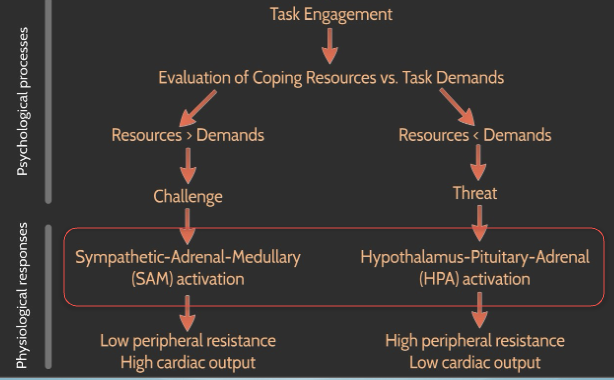
Resources > Demands
Challenge
Sympathetic-Adrenal-Medullary (SAM) activation
Low peripheral resistance, high cardiac output
Body relaxes, allows oxygenated blood to flow properly
Resources < Demands
Threat
Hypothalamus-Pituitary-Adrenal (HPA) activation
High peripheral resistance, low cardiac output
KNOW
The difference between threat vs challenge mindset
Peripheral difference
Cardiac output
Challenge state
Approach oriented: body is preparing to meet the demands of the situation
Activated by the Sympathetic-Adrenal-Medullary (SAM) axis activation which causes:
Adrenaline release
Blood vessels remain open, not constricted = increased blood flow to major muscle groups & brain = increased cardiac efficiency
Enhanced performance
Threat state
Avoidance oriented
SAM activation + Hypothalamic-pituitary-adrenal (HPA) axis activation
Release of cortisol
Blood vessels constricted
Decreased cardiac efficiency
Worsened performance
Release of stress hormones
Brain is not getting the blood it needs
Process Model of Emotion Regulation
Affective responses (including stress responses) can be regulated at various points in the emotional experience
Situation selection and modification → attentional deployment → cognitive change or reappraisal → emotion is experienced → response modulation
(cont)
Appraisals of bodily signs of stress are typically negative
“Nervous energy” or “butterflies in my stomach”
Appraisal of stress can also be good
“Amped up” or “bursting with excitement”
Interventions that alter appraisals of stress such that coping resources are elevated relative to task demands can elicit more adaptive stress responses
Is “calming down” the best strategy??
Not necessarily!
It DEPENDS on which stress state you are in.
It is better to be in a challenge state than to be relaxed!
Threat < Relaxed < Challenge
Arousal Reapprasial
Acts at the appraisal stage of the emotional experience to change downstream biological, cognitive, and performance outcomes
Signs of stress arousal - racing hearts & sweaty palms - are not longer seen as negative, but rather as adaptive coping tools = stress is positive!
Doesn’t seek to eliminate stress completely; sympathetic activation is needed when demands are high
91% of people believe that relaxation is the best way to maximize your performance
BUT Excited > Relaxed > Anxious
Stress Reappraisal
Teach people about the benefits of stress
Signs of stress no longer appraised as detrimental, but instead as adaptive coping tools:
“Oh no I’m freaking out!” → “Yeah, my body is harnessing its resources”
*video on slides
Had people talk about themselves while giving them nonverbal cues
Studies on stress reappraisal
1) Dr. Jamieson’s studies on the GRE in the classroom and the real world
2) Dr. Jamieson and Dr Hangen’s reappraisal in a community college math class
3) Dr. Hangen’s research on risk taking & challenge vs. threat tasks
4) Dr Jamieson’s study on threat reappraisal stereotype threat
Study 1: Stress reappraisal & the GRE
Goal: to see efficacity of arousal reappraisal outside of the lab
Participants:
60 undergraduate students (31/, 29f) who were planning to take the GRE
Method
Time 1: students provided a saliva sample when they arrived
Told that they would be taking a practice GRE test in the lab as advertised
Randomly assigned to one of two conditions
Control: no further instruction
Reappraisal: received reappraisal instructions
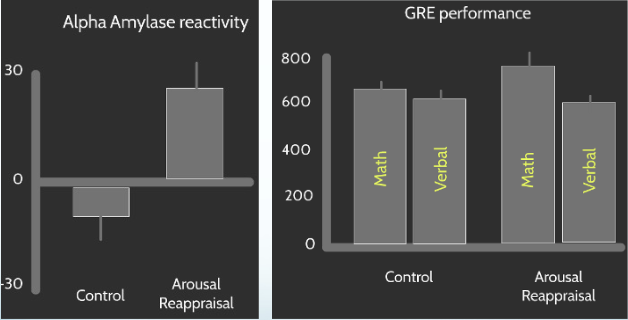
Second saliva sample: target being measured was salivary alpha amylase which is proxy for SNS arousal
Completed practice GRE quantitative & verbal (old scoring system)
(cont)
Time 2: 1-3 months after the lab study pps completed the GRE in the “real world”
Pps reported back to the lab with a copy of their real GRE scores
Completed post-test questionnaires
Amount of stress experienced during the testing session
Whether pps believed stress helped or hurt performance
Feelings of anxiety prior to & during the testing
How confident pps felt during testing
Results: Effects in the lab
Encouraging participants to reappraise stress arousal as a coping tool elicited an increase in sympathetic activation and improved performance on the math section
Much more amylase production
Study 2: reappraisal in the classroom
N = 93 students in a community college math course
2 Conditions:
Stress reappraisal: stress can help you
Placebo: Ignore stress (people think this is good advice)
Materials 5-8 minute readings (journal summaries) with comprehension questions
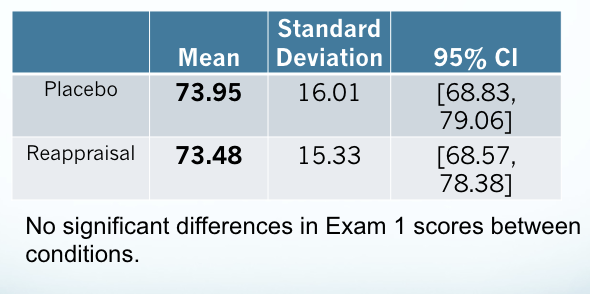
Exam 1 (pre-intervention)
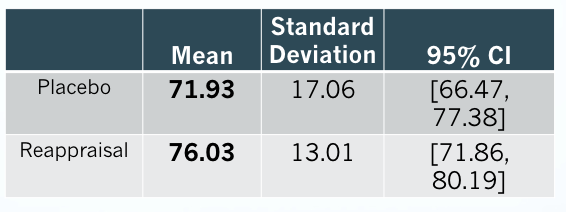
Exam 2 (post intervention)
Significant improvement in the reappraisal group
How did the reappraisal materials impact exam performance?
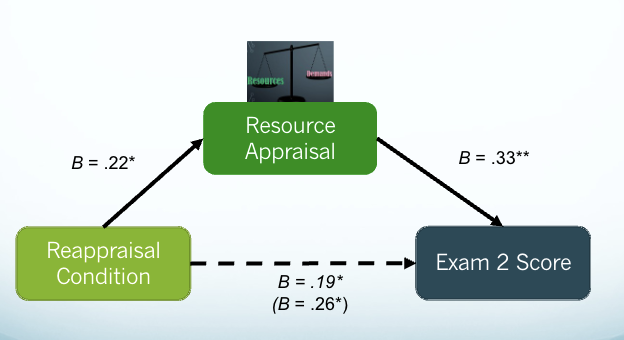
Reappraisal condition → resource appraisal → exam 2 score
It is a partial mediation
KNOW
The manner in which the exam 2 scores were increased
Explain this model
It is a partial mediation
What does it explain
Study 3: Competition, threat, and risk taking
Competition
Challenge state → more risk taking
Threat state → more cautious
Sensors - Autonomic sensors:
Impedance cardiography (ICG)
Electrocardiography (ECG)
Blood pressure (BP)
Autonomic measures
PEP (pre-ejaculation period) = SNS arousal (contractile force of heart)
CO (cardiac output) = cardiac efficiency; blood ejected per minute
TPR (total peripheral resistance) = blood pressure
Determining stress state
-
Challenge state
Improved cardiac efficiency
Peripheral vasculature not constricted
Low PEP
High CO
Low TPR
Threat state
Decreased cardiac efficiency
Peripheral vasculature constricted
Low PEP
Low CO (or no change)
High TPR
Results
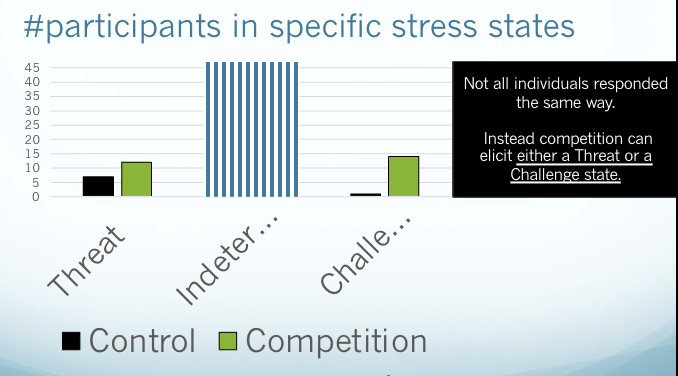
There was a challenge state, and threat state, and an indeterminate state
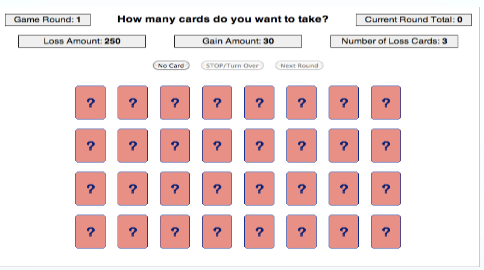
Risk-Taking measure: Columbia Card Task
You flip over cards, some can give you points some can lose you points
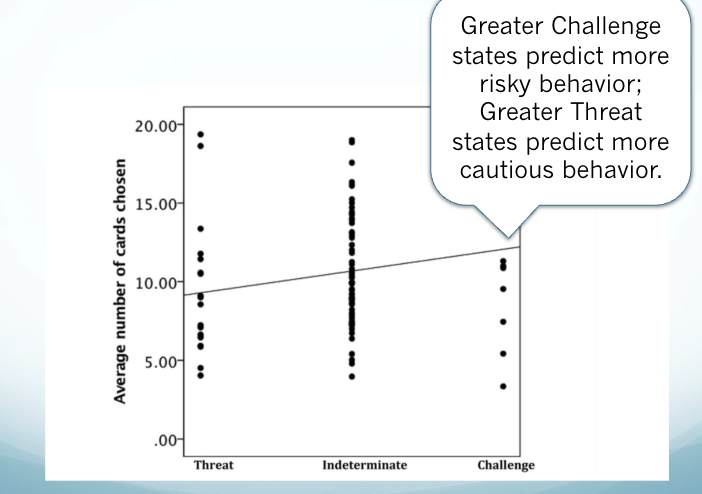
Results
Greater Challenges states predict more risky behavior;
Greater Threat states predict more cautious behavior
Stereotype threat
fear of confirming a negative group stereotype. Often the anxiety over the negative stereotype results in reduced performance
E.g. women & math
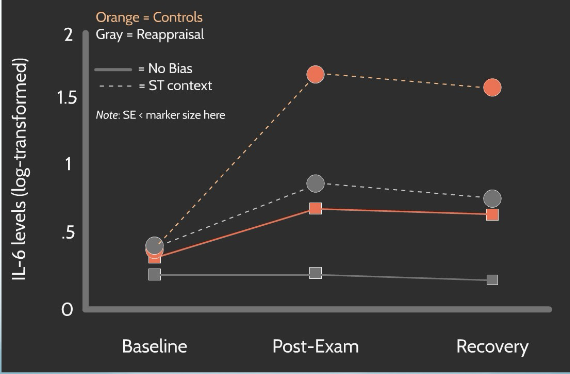
Arousal reappraisal & stereotype threat
Examined effects of arousal reappraisal on math performance and inflammatory cytokines (IL 6) on a stereotype threat environment
Female participants were told that they would be completing
a) gender biased math test or b) an Unbiased math test
For both conditions, there was a control group and an arousal reappraisal group
DVs: performance on math test & levels of IL 6
Levels of IL 6
Higher numbers mean worse outcomes
When stereotype threat is activated, you see huge levels of IL 6 activation
Final take-aways
There are different TYPES of acute stress responses
Challenge stress states are healthy and helpful
By changing the way you THINK about stress, you can change the way your BODY reacts in stressful situations (stress reappraisal)
Instead of trying to relax, next time you notice signs of stress (pounding heart, rapid breathing) remember the benefits of stress and embrace it!
*video on slides
She always treated stress as the enemy, but she realized that she was wrong
People who experienced high stress and believed that stress was harmful had a much higher risk of dying
But people who had high stress but didn’t view stress as harmful had the lowest risk of death amongst all groups
Many people died from the belief that stress is bad for you
(Cont)
Talked about stress studies
What if instead of viewing the symptoms of stress as bad, what if they viewed it as helpful
Example: breathing fast is just getting more oxygen to your brain
Oxytocin
Stress makes you social
Stress release oxytocin (the cuddle hormone), motivates you to seek support
Morbidity
Every major stressful experience increased the risk of dying by 30%
People who spent time caring for others had no risk of dying, caring created resilience