Digestive System: Key Processes, Structures, and Enzymes
 Call Kai
 Learn
Learn Practice Test
 Spaced Repetition
 Match
Match Flashcards
 Knowt Play
1/96

There's no tags or description
Looks like no tags are added yet.
Name | Mastery | Learn | Test | Matching | Spaced | Call with Kai |
|---|
No analytics yet
Send a link to your students to track their progress
97 Terms
Digestion
The breaking down of larger food molecules into smaller molecules.
Absorption
The passage of smaller molecules into the blood and lymph.
Digestive System
The collective organs that perform digestion and absorption.
Ingestion
The first of six basic processes: taking food in.
Secretion
The release of water, acid, buffers, and enzymes into the lumen of the GI tract.
Mixing and Propulsion
The movement of food through the digestive tract.
Mechanical Digestion
Movements of the gastrointestinal tract that physically break down food to aid chemical digestion.
Chemical Digestion
A series of catabolic (hydrolysis) reactions that break down carbohydrates, lipids, and proteins into smaller usable molecules.
Defecation
The elimination of feces from the GI tract.
Alimentary Canal
The continuous tube extending from the mouth to the anus.
Accessory Structures
Organs that aid in digestion but are not part of the GI tract, including teeth, tongue, salivary glands, liver, gallbladder, and pancreas.
Mucosa
The inner lining of the tract supplied with blood vessels, nerve fibers, and endocrine cells.
Submucosa
Connective tissue just below the mucosa containing blood vessels and nerves.
Muscularis
Contains two muscle layers important for peristalsis and mechanical breakdown.
Serosa
The outermost covering composed of visceral peritoneum.
Mesentery
A large double fold of peritoneal tissue that anchors the digestive tract to the posterior abdominal wall.
Mastication
The act of chewing.
Hard Palate
The anterior roof of the mouth.
Soft Palate
The posterior roof of the mouth.
Cheeks
The lateral walls of the oral cavity.
Uvula
A muscular flap that closes off the nasal cavity during swallowing.
Deciduous Teeth
Baby or milk teeth, totaling 20.
Permanent Teeth
Adult teeth, totaling 32.
Crown
The visible upper portion of a tooth made of calcium phosphate.
Enamel
The very hard substance covering the crown.
Dentin
The bulk of the tooth, similar to bone but without cells.
Gingiva
The gums.
Salivary Amylase
An alkaline secretion in saliva that digests starch.
Deglutition
The act of swallowing.
Bolus
The ball of food formed for swallowing.
Epiglottis
The flap covering the opening to the windpipe during swallowing.
Cardiac Sphincter
The valve connecting the esophagus to the stomach.
Pyloric Sphincter
The valve connecting the stomach to the small intestine.
Rugae
Folds in the stomach that disappear when it is distended with food.
Chyme
The semi-fluid mixture of food and gastric juices.
Pepsinogen
The inactive form of pepsin that begins protein digestion.
Parietal Cells
Stomach cells that secrete hydrochloric acid (HCl) and intrinsic factor.
Intrinsic Factor
A substance essential for the absorption of vitamin B12.
Gastrin
A hormone that stimulates gastric glands to produce gastric juice.
Duodenum
The first 10 inches of the small intestine; receives chyme, bile, and pancreatic juice.
Jejunum
The 8-foot middle section where bulk chemical digestion and absorption occur.
Ileum
The final 12-foot section ending at the ileocecal valve.
Villi
Finger-like projections that increase the surface area for absorption 600 times.
Lacteal
A lymph vessel in the villi that absorbs fatty acids.
Bile
Produced by the liver and stored in the gallbladder; acts as an emulsifier.
Emulsification
The process of breaking fat into tiny droplets to increase surface area for enzymes.
Secretin
A hormone that stimulates the pancreas to release bicarbonate to neutralize chyme.
Cholecystokinin (CCK)
A hormone that triggers the release of bile and pancreatic enzymes.
Bilirubin
A breakdown product of hemoglobin that gives bile and feces color.
Cecum
The first part of the large intestine where the appendix is located.
Colon
The largest part of the large intestine, divided into ascending, transverse, descending, and sigmoid sections.
Feces
The solid waste of the large intestine composed of undigested fiber and bacteria.
Vitamin K
A vitamin synthesized by bacteria in the large intestine.
First steps of digestion in the mouth
Digestion begins with ingestion (taking in food) and mastication (chewing) to divide food into smaller pieces.
Mouth's contribution to chemical digestion
Salivary glands secrete saliva containing salivary amylase, an enzyme that initiates the breakdown of carbohydrates (starch).
Ball of chewed food before swallowing
It is called a bolus.
How body prevents food from entering nose or windpipe
The uvula closes off the nasal cavity, and the epiglottis covers the opening to the windpipe during swallowing (deglutition).
Food movement from mouth to stomach
The esophagus uses peristalsis—involuntary muscular contractions—to push the bolus down the 10-inch tube.
Valve controlling entry of food into stomach
The cardiac sphincter.
Primary function of stomach's mechanical action
The stomach's three muscle layers mix and churn food until it becomes a semi-fluid mixture called chyme.
Enzyme that begins protein digestion in stomach
Pepsinogen is released by chief cells and activated into pepsin by hydrochloric acid (HCl) to digest proteins.
Importance of Hydrochloric Acid (HCl)
Secreted by parietal cells, it kills bacteria, unfolds proteins, and activates pepsinogen.
Hormone triggering release of gastric juices
Gastrin is released into the bloodstream when solid food enters the stomach, stimulating gastric glands.
Where bulk of chemical digestion and nutrient absorption occurs
In the small intestine, specifically the duodenum (first 10 inches) and jejunum (8 feet).
Role of liver and gallbladder
The liver produces bile (stored in the gallbladder), which performs emulsification to break large fat globules into tiny droplets for better enzyme access.
How pancreas assists in small intestine
It secretes pancreatic juice containing enzymes like trypsin and lipase, and sodium bicarbonate to neutralize the acidic chyme.
How surface area is increased for absorption
Finger-like projections called villi increase the surface area 600 times.
Specialized vessel that absorbs fatty acids
The lacteal (a lymph vessel) located within the villi.
Main function of large intestine (colon)
It reabsorbs large quantities of water and electrolytes and stores waste; no digestion of food occurs here.
Beneficial role of bacteria in colon
They synthesize Vitamin K and certain B vitamins, which are absorbed into the bloodstream.
What gives feces its color
Bilirubin, a byproduct of the breakdown of hemoglobin.
How waste is removed from the body
Solid waste (feces) is regulated by the rectum and eliminated through the anus during defecation.
degluttition
swallowing
cardiac sphincter
opening from the esophagus to the stomach
pyloric sphincter
Controls passage of food from stomach to small intestine
ileocecal valve
prevents food from moving back into the small intestine once it has entered the large intestine
decidous teeth
baby teeth (20)
permanent teeth
adult teeth 32
Incisors
front teeth
Premolars
The teeth immediately behind the canines; used in chewing, grinding, and shearing food. The bicuspid teeth
Molars
Back teeth that grind food
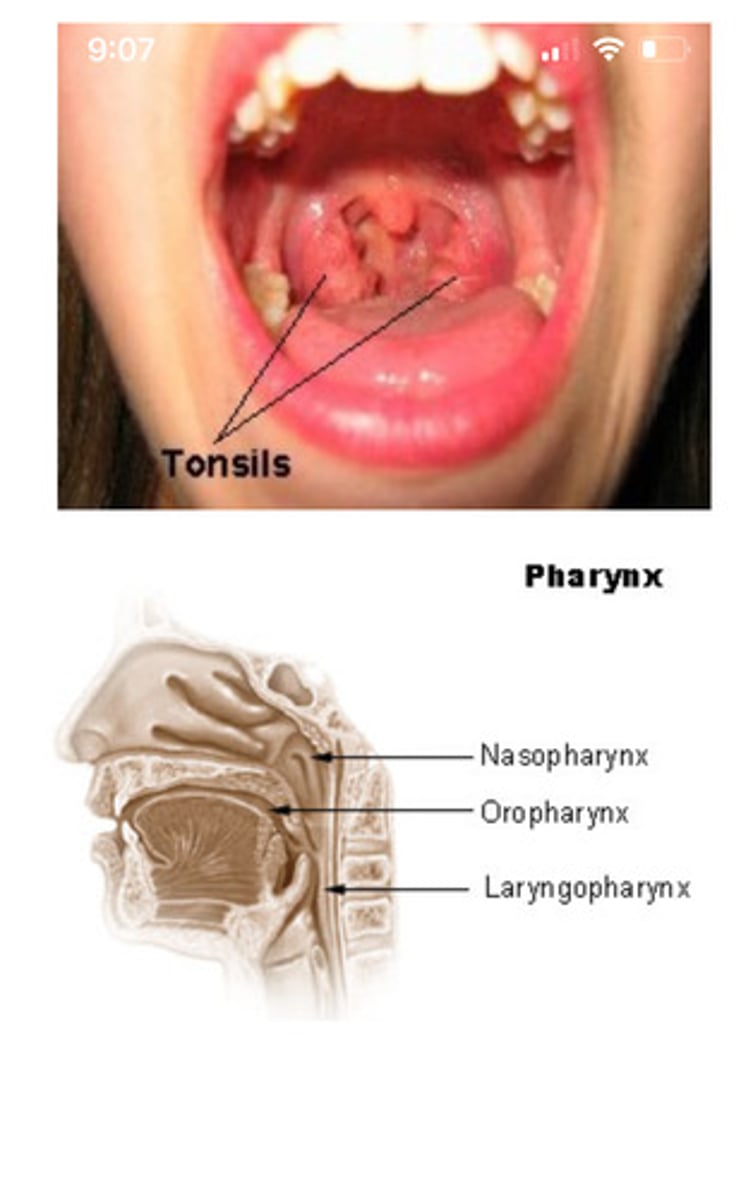
Pharynx
throat; passageway for food to the esophagus and air to the larynx
Pharynx divisions
nasopharynx- behind the nose
oropharynx- behind the mouth
laryngopharynx- hyoid bone to esophagus
Tonsils
masses of lymphatic tissue in the back of the oropharynx
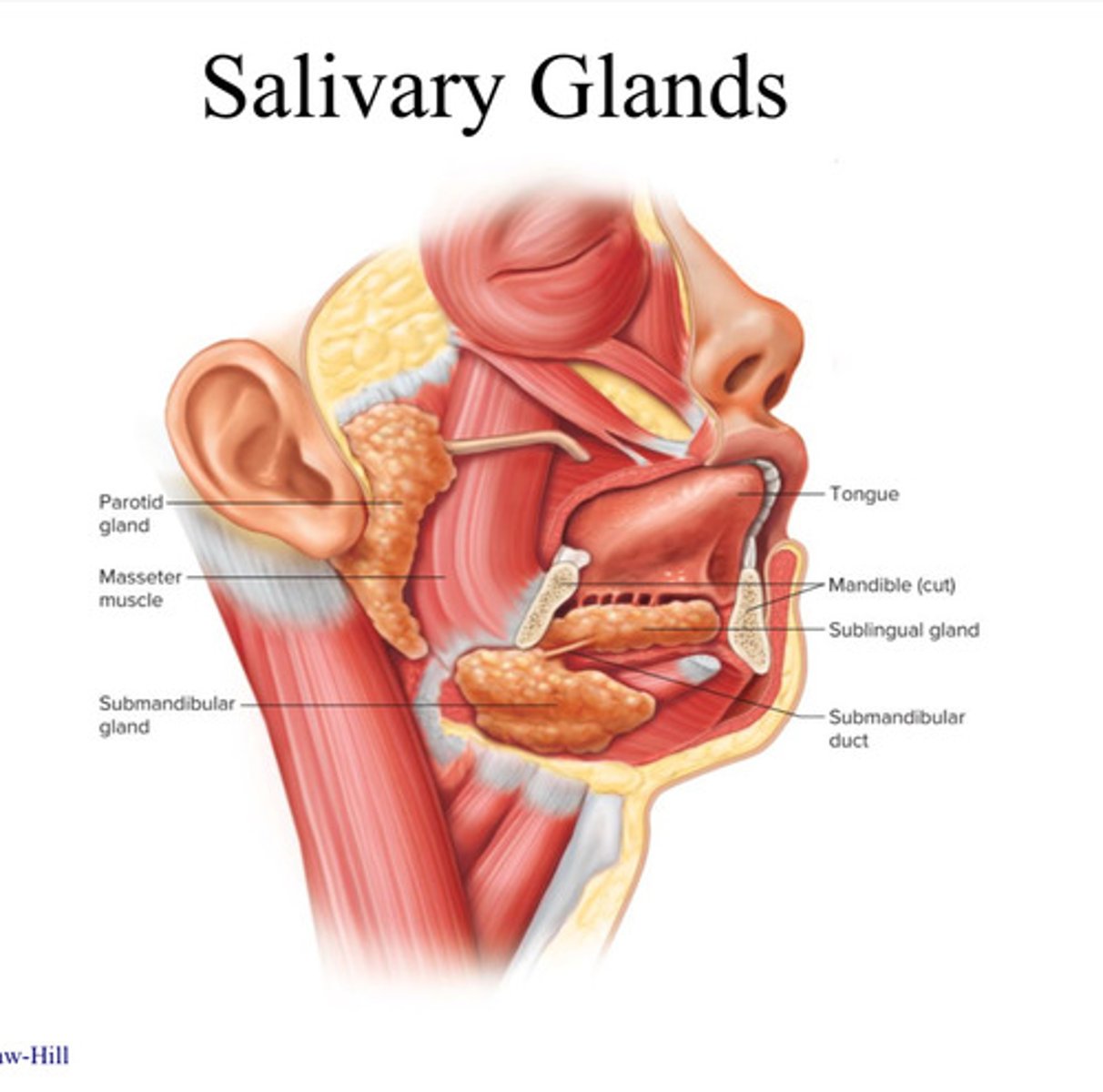
Salivary glands
parotid, sublingual, and submandibular glands
small intestine function
Absorbs most nutrients; Main absorption organ of the digestive tract
Small intestine enzymes
Lactase, Maltase, & Sucrose
Lipase
Bicarbonate ions
Peptidase
Stomach secretions/enzymes
HCI- acid that breaks down proteins
Pespin- proteins
Intristic factor- binds to b12, protect
Bicarbonate ions
make pancreatic juice alkaline; buffer stomach acid
pancreas function
regulates blood sugar (insulin & glucagon)
Secretes pancreatic juice which breaks down all categories of food
produces digestive enzymes for fats, carbs, and proteins
Pancreas secretions
amylase- carbs
trypsin- proteins
lipase- lipids
bicarbonate ions- neutralizes
large intestine (colon)
Absorbs water and forms feces
Liver
produces bile
Bile
A substance produced by the liver that breaks up fat particles
tooth pulp
consists of nerves, blood vessels, and loose connective tissue
CCK (cholecystokinin)
released by small intestine- stimulates gallbladder, pancreatic juices
Secretin
A hormone secreted by the small intestine (duodenum) in response to low pH (e.g., from stomach acid). It promotes the release of bicarbonate from the pancreas to act as a buffer.