D2.1 Cell and Nuclear Division
 Call Kai
 Learn
Learn Practice Test
 Spaced Repetition
 Match
Match Flashcards
 Knowt Play
1/113

There's no tags or description
Looks like no tags are added yet.
Name | Mastery | Learn | Test | Matching | Spaced | Call with Kai |
|---|
No analytics yet
Send a link to your students to track their progress
114 Terms
Asexual reproduction
A= no Asexual= nonsexual reproduction Produces offspring that are all genetically identical to the parent
How are sperm and egg involved in asexual reproduction?
they are NOT because it is asexual repoduction.
Sexual reproduction
Produces offspring that are genetic variation within a species
difference in Asexual reproduction offspring vs sexual reproduction offspring
asexual- offspring are all genetically identical to the parent
sexual- offspring are genetically unique
Binary fission and mitosis
Cell division mechanisms in which the parent cell divides to form two identical daughter cells mitosis= same ex: when you get a papercut you cant tell which cells are dividing because they all look the same
Meiosis
Form of cell division in which a cell divides its genetic material between four daughter cells during gamete formation
Cell cycle
The events that take place in a cell leading to its division that produces two daughter cells
3 phases of cell cycle big picture
interphase, mitosis, cytokinesis
Cell proliferation
Proliferation= growth Process in multicellular organisms by which a cell grows and divides to produce 2 daughter cells
3 things Cell proliferation occurs for
Organism growth, replacement of dead cells, tissue repair
Organism growth
When plants and animals age, most also grow in size. Cell proliferation creates the cells necessary to add more mass to the body
Organism growth in animals: what are the 2 phases before reaching adult size
Most animals have an embryonic and juvenile phase of growth before reaching an adult size
Embryonic cell proliferation
It is rapid and the number of cells increases, but the size of the individual cells get smaller. All the cytoplasm and nutrients are supposed by the original egg cell. Egg cells are very large
Whats the lifespan of red blood cells? and why should i know this
Life span is 120 days. it is importanr because of such a short life span you have to keep replacing your bloodcells throughout your life
Where are red blood cells produced?
It is hematopoietic stem cell found in the bone marrow
what is an erythrocyte?
scientific name for red blood cell ery backwards sounds like red cyte means cell
Whats another name for red blood cell?
erythrocyte
What are the 2 steps of an erythrocryte life cycle?
1. stem cell commits to becoming a red blood cell and becomes an erythroblast
2. erythroblast becomes erythrocyte and enters the bloodstream
b=blast c=cyte b comes beofre c in alphabet
Juvenile growth
Cells continue to proliferate, often with "spurts" of growth
Organism growth in plants
There is no limit in growth in plants. They can grow through out the lifespan. plants= evergreen evergreen= forever growth
3 steps of Plants cell proliferation
Root apical meristem creates the cells for lengthening the roots
Shoot apical meristem creates the cells for elongating the stem, creating leave and forming flowers.
Lateral meristem widens the stem, adding thickness.
goes from the bottom of the plant to the stem and then the sides
Replacement of cells that divide naturally
When cells die more cells sr eproduced to replace them ex:papercut
Red blood cells
They live for about 120 days and must be replaced throughout an animals life. Hematopoietic stem cells are located in the hematopoietic shell cell niche found in bone marrow.
Skin cells
Skin cells are replaced throughout an animals life.
3 steps for replacement of skin cells
1. new skin cells are created in the basal (sounds like basement means bottom) layer of the epidermis-skin you see
2. new skin cells mature and push old cells to the surface
3. mature cells deteriorate and dead cells arrive at the top and flake off at the surface
what do skin cells produce as they move towards the skin surface?
cells produce keratin
What is keratin?what does it do?
keratin is a protein that cuases cells to toughen and dryout
How is keratin produced?
keratin is produced by skin cells that are moving towards the surface
Tissue repair processes and reasoning
During healing of an injured tissue, cell proliferation occurs to replace damaged cells. This repair is especially important for skin and blood vessels, which protect and bring oxygen and nutrients to other cells in the body. It calls helps replace blood lost through bleeding. In certain organism, it can replace entire limbs or tails.
Tissue repair is triggered by what 2 cells
Basal cells in the epidermis
Multi potent stem cells in the hair follicle
Cytokinesis
cyto=cytoplasm divison of cytoplasm and organelles into 2 daughter cells
Cytokinesis in plant cells
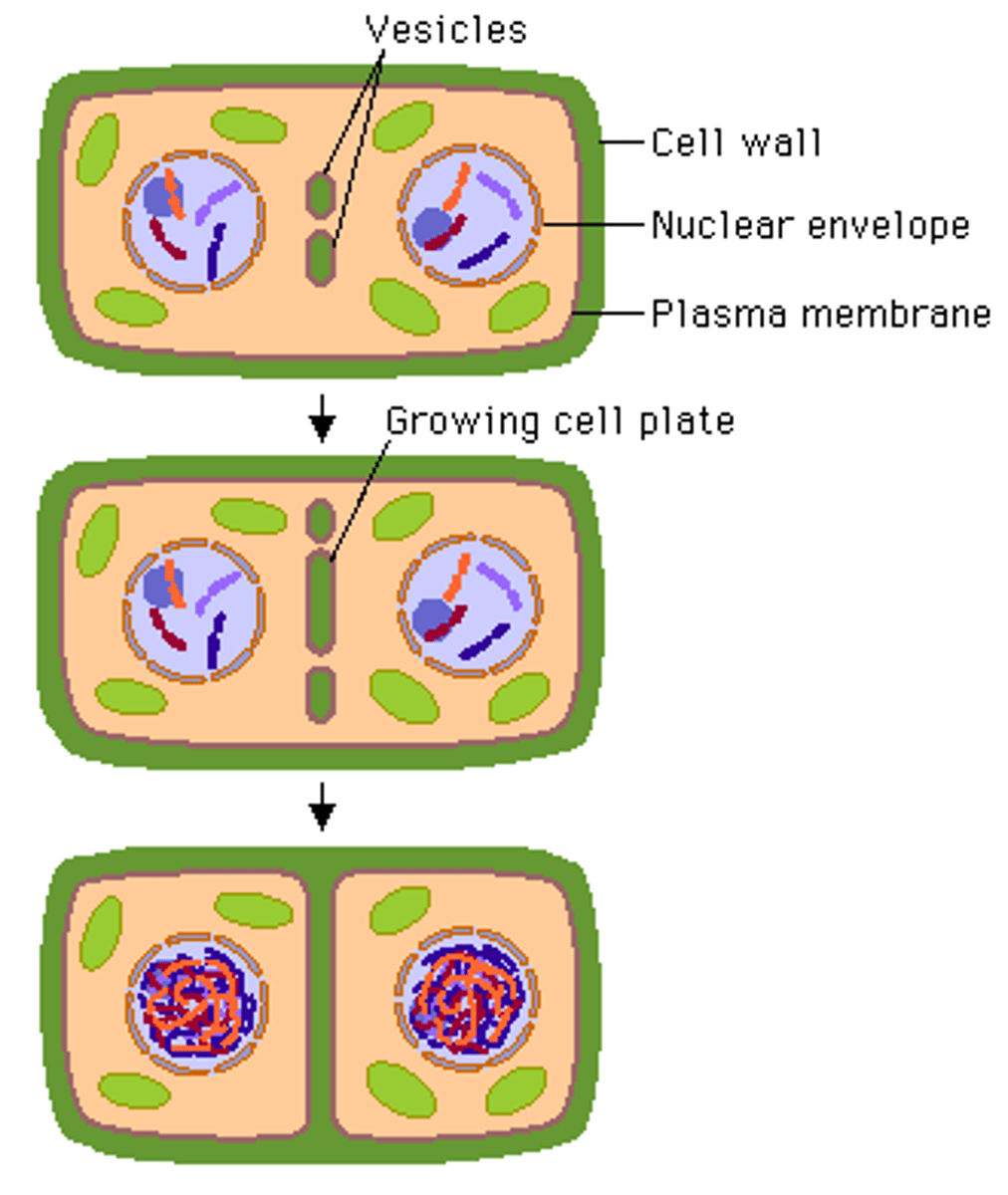
1. Golgi buds off viscose that move toward the cell equator
2. The vesicles fuse together to create a disc shaped structure called the "cell plate". The cell plate extends until it reaches and fuses with the sides of the parent cell, thereby completely separating the 2 new daughter cells
3. Both daughter cells then release cellulose by exocytosis into the space between the 2 membranes. The cellulose builds the cell wall of each daughter cell.
2 steps Cytokinesis in animal cells
1. Contractile proteins called actin and myosin form rings at the equator of the cell. These proteins contract pulled the cell membrane inward to form a cleavage furrow
2. The cell membrane cleavage furrow pinches in until the cells split into 2 daughter cells
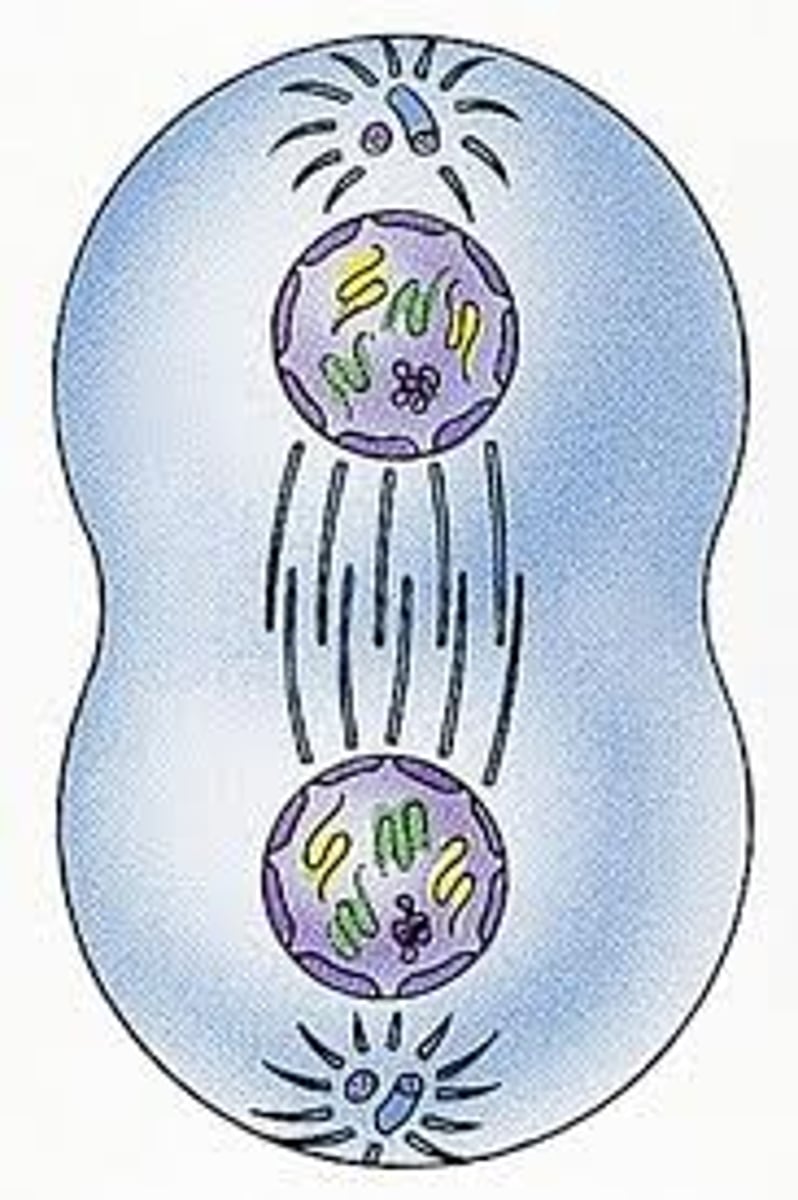
draw the difference between plant and animal cells cytokinesis
see slide 21 of slide deck
Equal cytokinesis
The cytoplasm and rganells are equally partitioned between the daughter cells to form 2 equal size cells
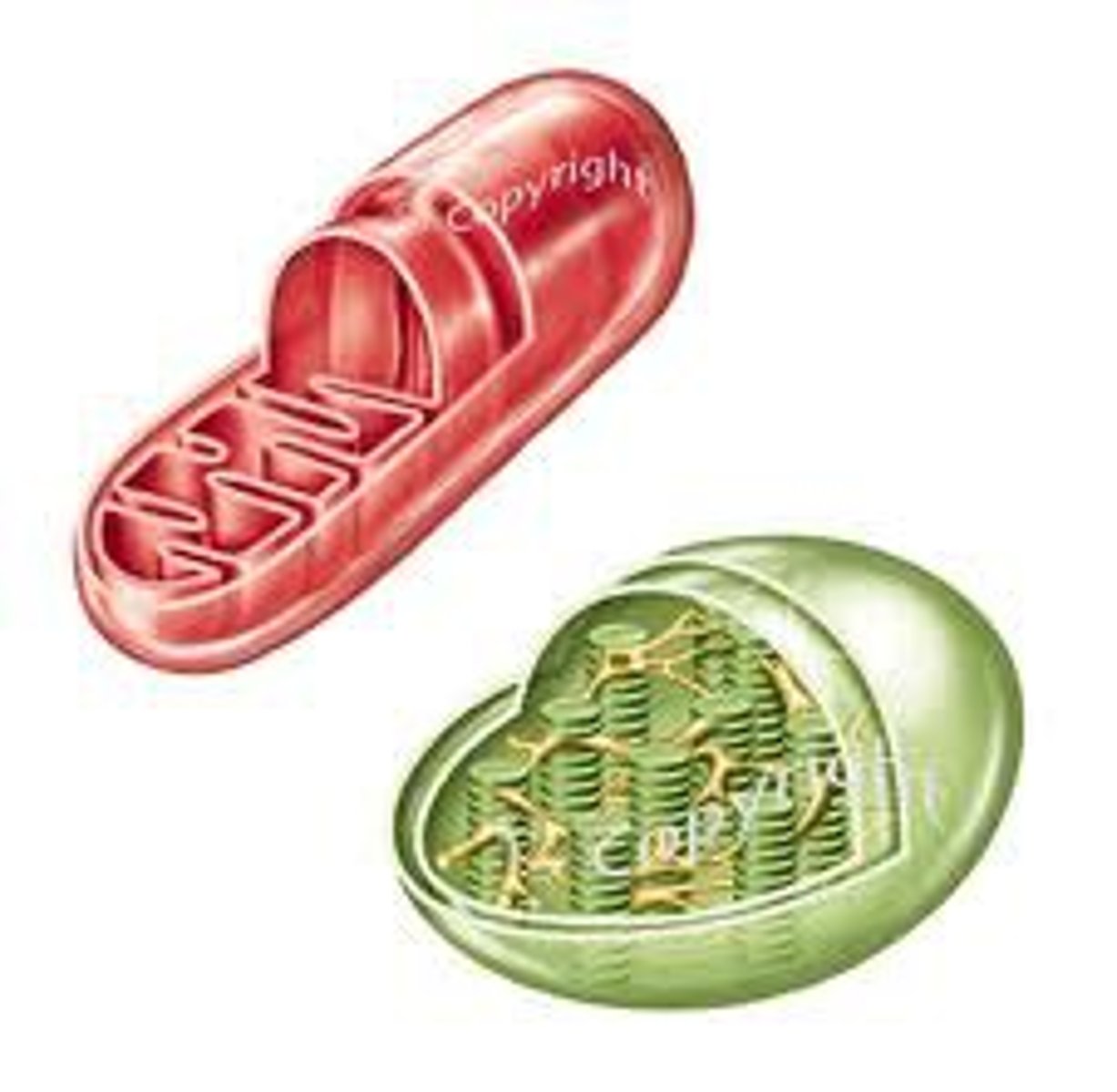
What 2 organelles undergo their own divison
mitochrondria and chloroplast
Unequal cytokinesis yeast budding
Yeast budding is asymmetric division mechanism used by most yeast to reproduce asexually.
Unequal cytokinesis oogenesis
Production of an egg cell. Cytoplasm is divided unevenly during cytokinesis to produces 1 large egg cell and 3 small polar bodies. Single egg contains the cytoplasm of all 4 daughter cells
oo means eggs it looks like 2 eggs
Mitosis
Single nuclear division that results in 2 indentical nuclei
Meiosis
Includes 2 nuclear divisions and results in 4 genetically diverse daughter cells with half as many chromosomes as the parent cell
what are the 2 major steps of eukaryotic cell division?
1. divison of the NUCLEUS by mitosis or by meiosis
2. division of the CYTOPLASM by cytokinesis
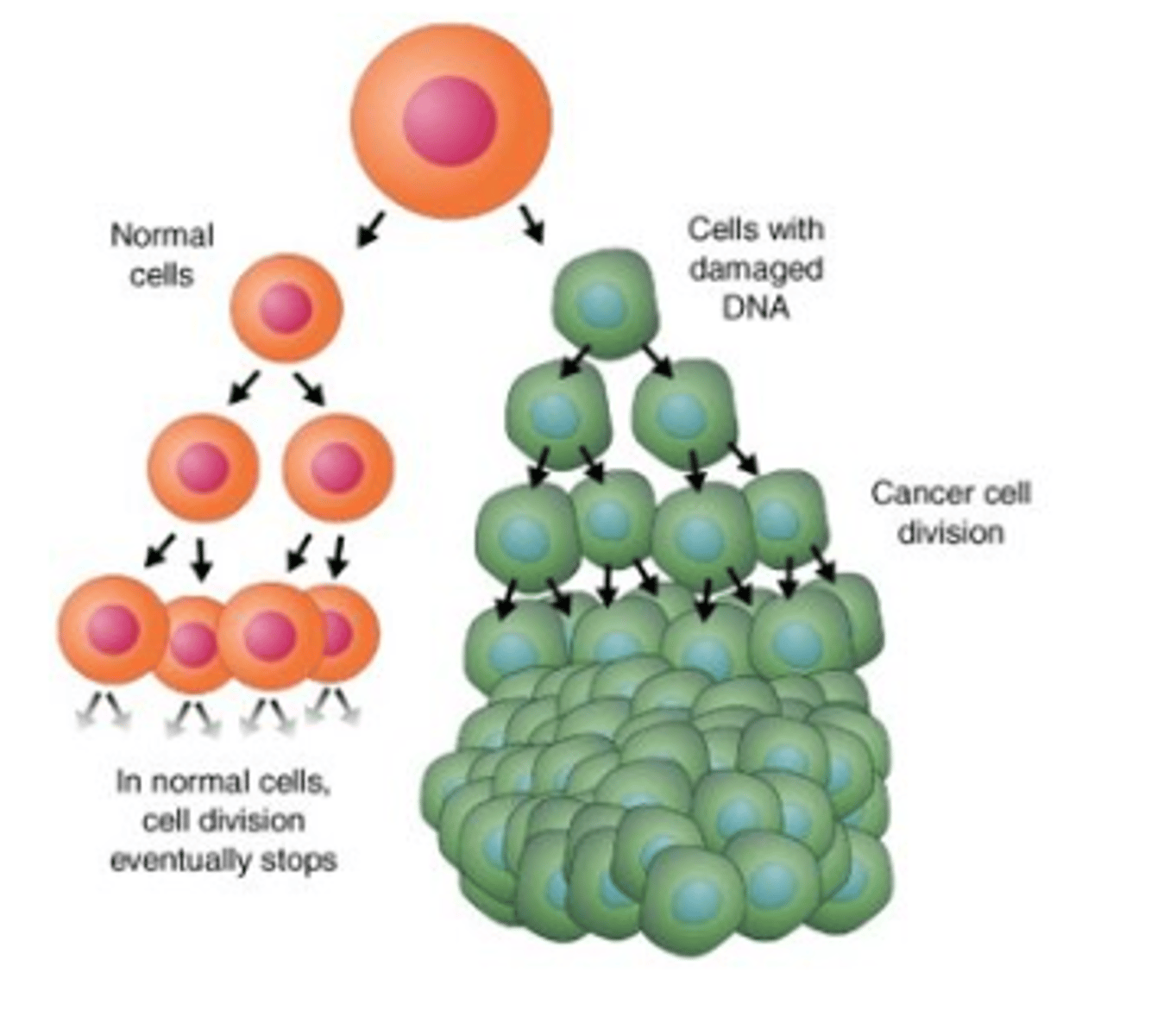
What does cancer result from?
it results from mitosis occuring when it shouldnt
What is progression through mitorsis regulated by
by cyclins cyclins= cycle like the cell cycle
2 main phases of the cell cycle (mitosis
1. interphase (inter=between) period between cell divisions
2. cell division (mitosis+cytoplasm)
what is mitosis division of?
mn alphabetical mitosis and nucleus
3 stages of interphase
G1, S, G2
Define what happens in the 3 stages of interphase
in G1 g= growth cell growth
S phase- synthesis of dna
G2- cell growth
list 2 things G1 vs G2
G1 is regular cell growth, G2 is preparation for mitosis
S phase is before g2 and after g1
What is G0
it is non dividing cells
What kind of cells are in G0?List 3 examples
cells that enter a non dividing state and perform a differentatied rule
1. differetiated bone cells
2. skeletal muscle cells
3. neurons
How do we ensure proper progression through the cell cycle?
eurkaryotic cells have 3 checkpoints cells checks for errors before proceeding to the next stage
List the 3 cell cycle checkpoints
it is G1, G2, M
what happens when there is a probelm detected at G1 checkpoint?
cell cycle cannot proceed to the S phase
What heppns when there is a problem at the G2 checkpoint
Cell cycle cannot proceed to Mitosis
What happens when theres a problem at the M checkpoint?
cell cycle cannot proceed to G1
What are the 4 phase of cell cycle in order
G1, S, G2, M, G1
4 ways a cell grows in size during interphase
1. synthesising proteins
2. doubling the amount of dna
3. increase the volume of cytoplasm
4. increase the amount of organelles
What is chromatin
it is a condensed - closely packed structure made up of dna rna and proteins wrapped around the dna
What is the form of dna during G1
most of the dna is in chromatin form not tightly coiled
What are cyclins?
they are protein molecules that regulate phases of mitosis.
What happens at the end of G1?
the cell checks that it has grown to an adequate size and checks for Dna damage.
What happens at the M checkpoint?
it determines where all the sister chromatids are correctly attched to the spindle microtubules
What is happening during the G1 phase of interphase?
During the G1 phase proteins are being made. The cell is also performing cellular respiration to produce ATP that the cell needs to function.
What happens in the G2 phase of interphase?
The cell prepares to divide by obtaining nutrients to replenish energy, synthesize proteins needed for division, taking apart the cytoskeleton that is holding organelles in place, and growing in size by increasing cytoplasm volume
What is cyclin-dependent kinases? (CDKs) What happens if there is a low concentration of cyclin?
It is an enzyme that is turned on by cyclins. They do the work of moving the cell throught he cell cyclin. If there is a low concetration. of cyclin, the Cdk will not be acitve and the cell cycle will freeze.
What are the 4 types of cyclins? where are they located?
D, E, A, and B
Cyclin B is at the end of G2
Cyclin D is at the beggining of G1
Cyclin E is at the end of G1
Cyclin A is at S phase
What do the each of the 4 cyclins do?
Cyclin D (G1) starts in early G1 and helps the cell move from G1 to S phase.
Cyclin E (late G1/S) prepares the cell for DNA replication.
Cyclin A (S/G2) starts DNA replication, makes sure DNA is copied once, and later helps trigger mitosis.
Cyclin B (M phase) helps form the mitotic spindle. Must break down for anaphase to begin.
What do motor proteins within the kinetochores do?
They pull the chromosomes toward the poles
What is a chomosome?
it is a molecule of dna supercoiled aorund a nucleosome-forming packaging histone proteins.
What are genes?
Genes are sections of DNA of the chromosome that can contain thousands of genes. Each gene storees genetic info that codes for a trait.
What are homolougous chromosomes?
they are a pair of chomosomes, one inherited from the mother and one from the father. They have same size, same centromere location and same genes in the same order.
What are variation within a single gene called?
They are called alleles
What are the 4 major phases of mitosis?
Prophase, Metaphase, Anaphase, Telophase (PMAT)
What happens in prophase?
repplicated dna condense to become chromosome
Centrioles move to opposite poles
Spindle formed by microtubules
Nuclear membrane breaks apart
What happens in metaphase?
chromosomes lining up in the middle
What happens in anaphase?
the sister chromatids are seperated and they move to opposite poles of the cell.
What happens in telophase?
The nuclear membrane starts to reform around each set of daughter chromosomes. Dna uncoils to become chromatin. The spindle fibers break down and dissabear.
Interphase under the microscope
nuclei are rounded or oval. Dna is in chromatin form, chromosomes are not present. Microtubles are distributed around the nucleus
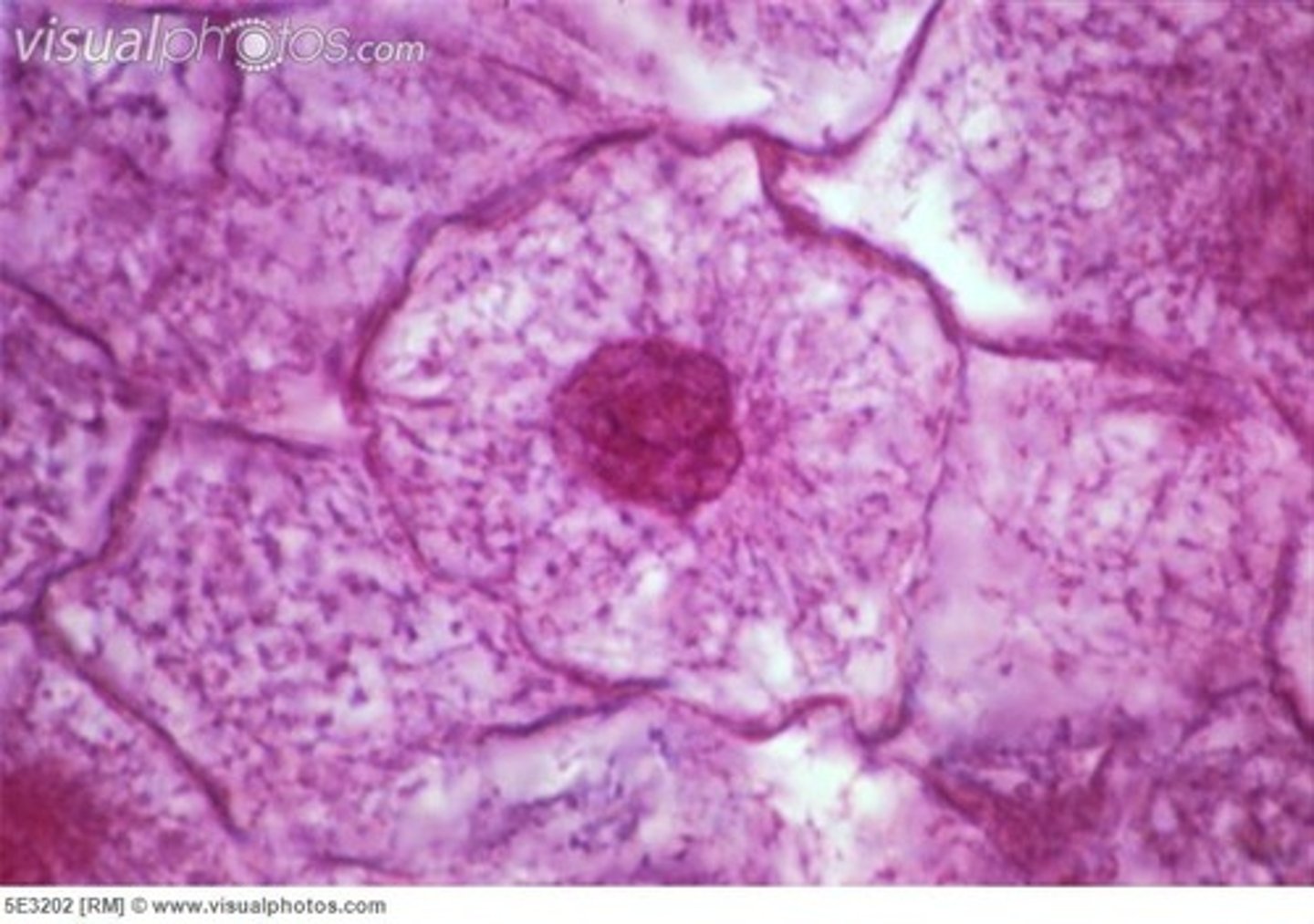
Early prophase under the microscope
nuclei is rounded or oval and dna starts to condense into loose chromosomes. microtubles start come near nucleus. nuclear membrane still intact
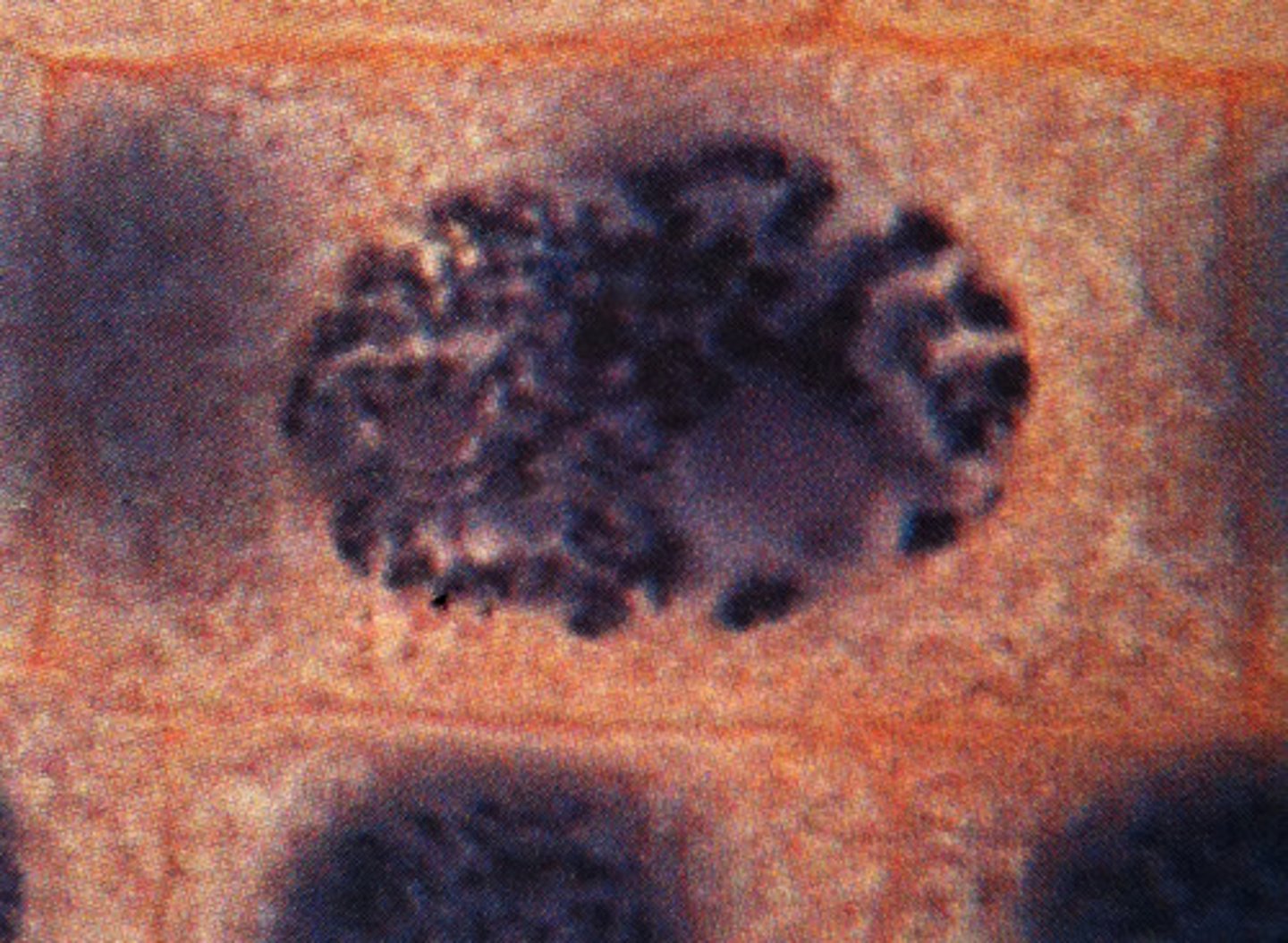
Late prophase (prometaphas) under microscope
nuclear membrane has broken down and more condensed than in early prophase. Microtubules attach to chromosomes and the mitotic apparatus takes shape but not completely spindle shaped.
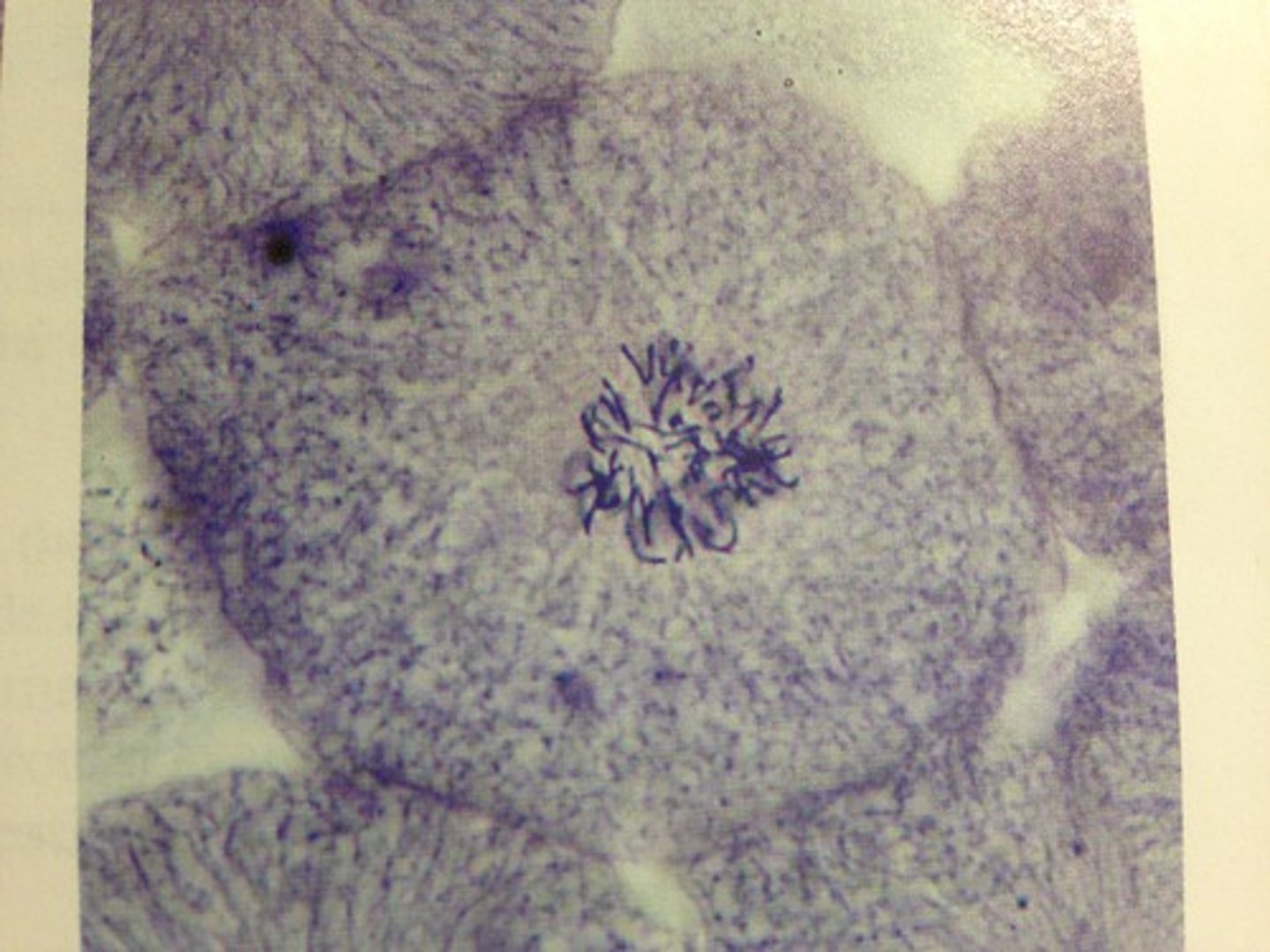
Metaphase under microscope
chromosomes form a condensed bar shape mass across the center of the cell. Microtuosued form a spindle shape. Chromosomes are completely aligned and the mitotic apparatus is highly condensed.
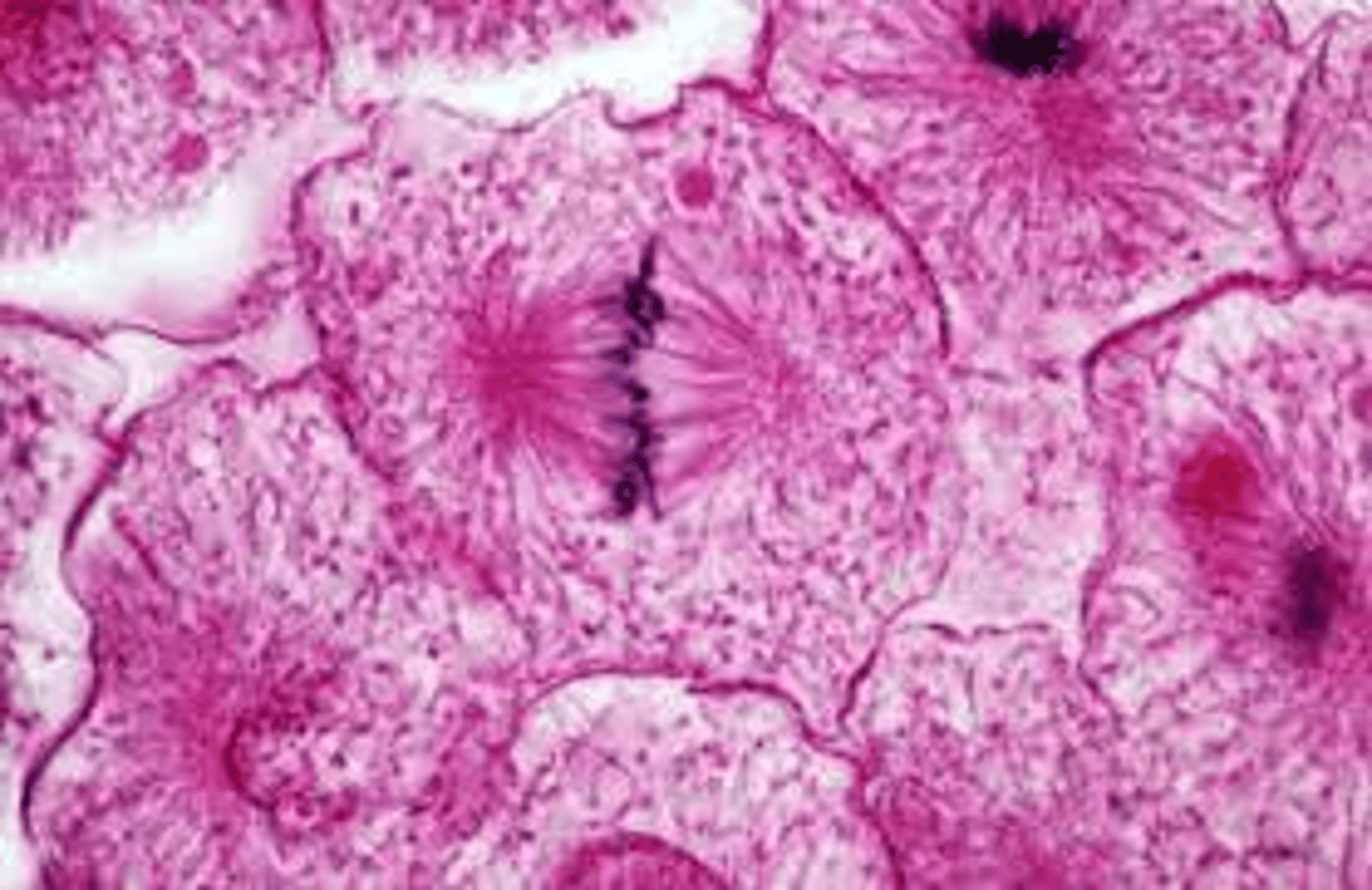
Anaphase under microscope
chromosomes seperate into 2 clusters at the poles of the cell. trailing chromosomes arms point back to center in some examples. Microtubles still kinda form a spindle but much more irregular.
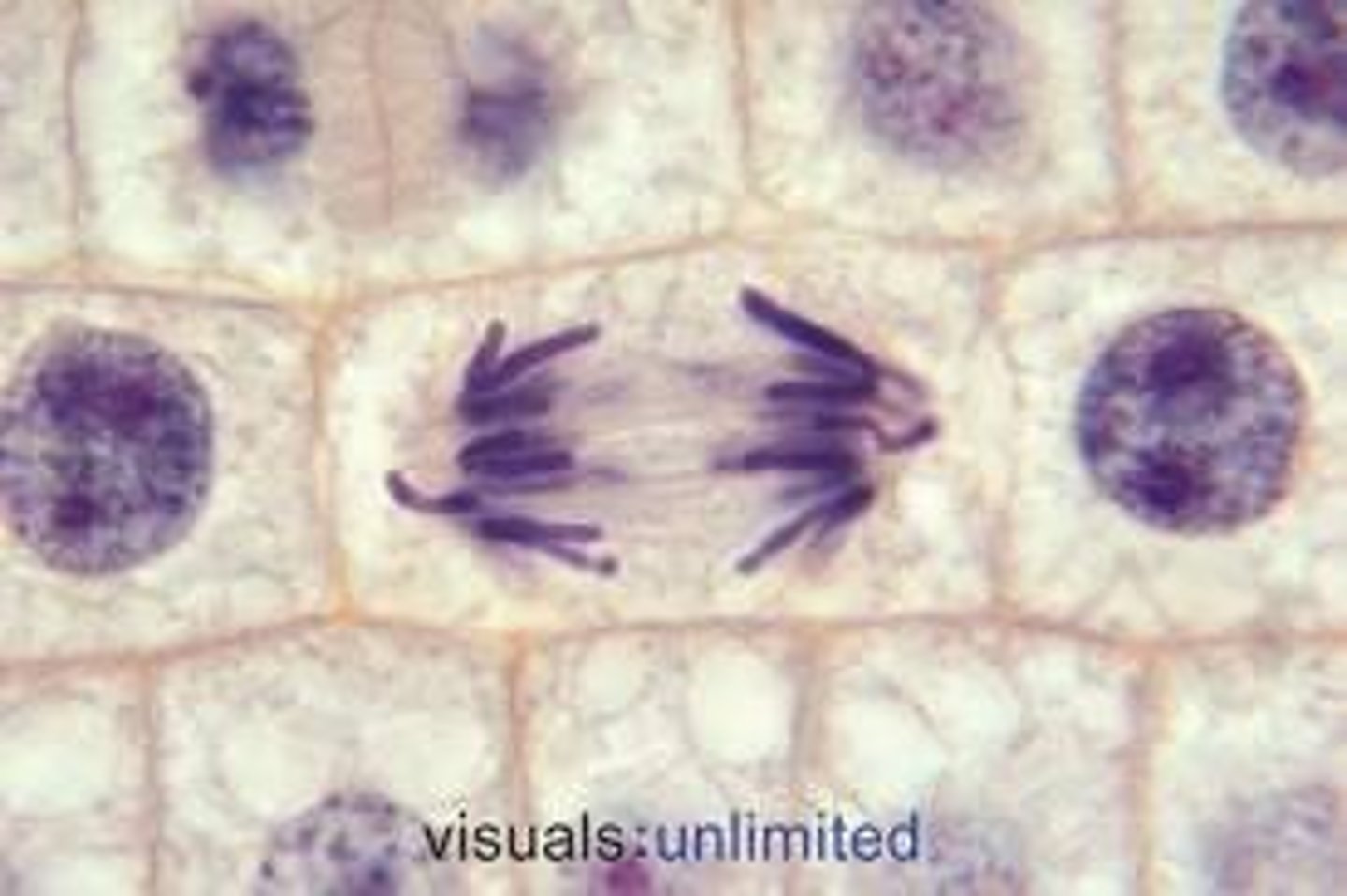
telophase under microscope
nucei may start to be seen as they reform but are found in pairs that are smaller than they were in interphase. They may be round or irregular. Microtubles are seen in a dense bundle usually along the midbody of the cell. animal cells take on a cumbell shape as cytokinesis occur simultaneouly.
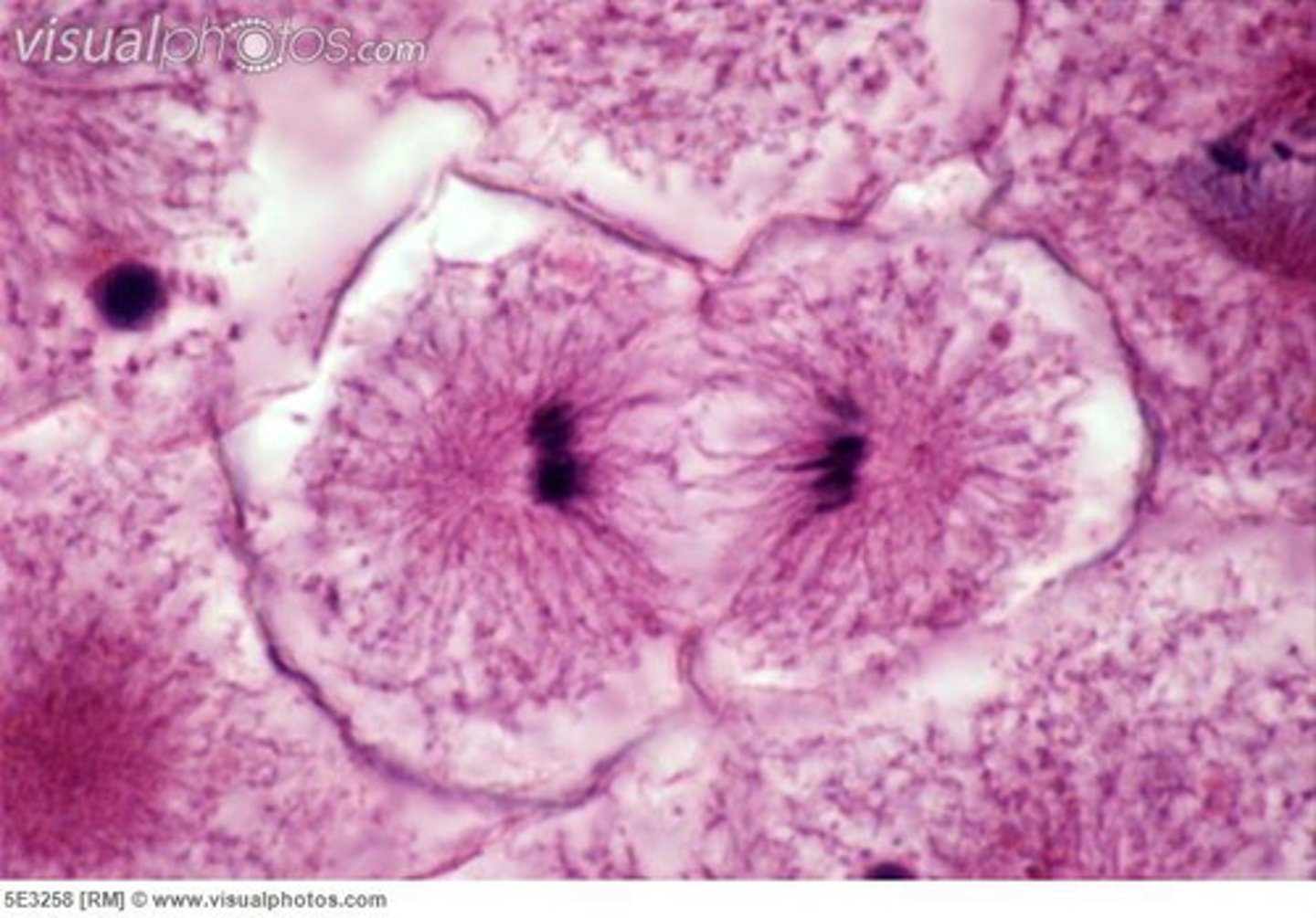
why do tumor initiation begin
they begin from random error in dna replication or a mutagen
What is a mutagen?
it is anything that permanently changes genetic material. ex: radiation, chemicals, infections agents.
What are the 2 major classes of genes that control the cell cycle?
1. proto-oncogenes- they code for proteins that make the cell cycle go such as genes that code for cyclin
2. Tumor Suppressor Genes- they code for proteins that make the cell cycle stop
How can proto-oncogenes cause cancer?
When they mutate, it becomes a cancer causing allele called an oncogene. oncogenes are permanently activated even when they are not supposed to be. when this happens the cell grows out of control, leading to cancer.
proto-oncogene vs oncogene
when proto-oncogene is active, a protein will be make causing cell to divide. When not activated the cell will not make the protein and the cell will not divide
vs
an oncogene is constantly making the protein causing the cell to divide even if it should not be dividing
What is tumor supressor gene and what happens when they are mutated?
they are normal genes that slow down cell divison, repair dna mistakes, or tell cells when to die. when they are mutated they dont work properly and cells can grow out of control, which can lead to cancer.
4 steps of cancer development
1. initiation- normal cell is turned into cancerous cell as result of mutations of genes that regulate the cell cycle
2. promotion- the initated cell divides, giving rise to large number of daughter cells containing mutations
3. progression- the cancerous cells often become aneuploid (have wrong number of chromosomes) and begin to invade surrounding tissues
4. Metastasis- cancer cells break away from where they were first formed (primary tumor) travel through blook or lymph system to form new tumors in othe rparts of body
why do we need to find out mitotic index?
to figure out if someone has cancer or not
Why do elephants have a lower rate of cancer?
They have a “zombie gene” that causes cell apoptosis, so cells die before they can become cancerous
what is a benign tumor
the cells in the tumor adhere to each other and remain in a single mass. Do not cause cancer
What is a malignant tumor?
the cells in the tumor can detach and invade neighboring tissues, lymph vessels or blood vessels. cause cancer
What is the type of cell divition that meiosis goes through?
It happens in the process of gametogenesis which is two round of division, forming 4 new haploid gametes. It is known as the reduction division because it reduces the number of chromosomes in the daughter cells by half compared to the starting cell.
What are the phases of meiosis
Cell division occurs twice during meiosis. in eachround of division, cells go through 4 stages: prophase, metaphase, anaphase, telophase
interphase in meiosis
creates proteins and dna and then dna replicates which creates 2 strands held together at the centromere. and the cell prepares for meiosis
prophase I in meiosis
chromosomes condence, pairup and exchange dna by crossing over
Metaphase I in meiosis
homologous pairs line up along the metaphase place
Anaphase I in meiosis
homolougous chromosomes seperate and move the opposite poles