correlations
 Call Kai
 Learn
Learn Practice Test
 Spaced Repetition
 Match
Match Flashcards
 Knowt Play
1/14

There's no tags or description
Looks like no tags are added yet.
Name | Mastery | Learn | Test | Matching | Spaced | Call with Kai |
|---|
No analytics yet
Send a link to your students to track their progress
15 Terms
What is a correlational technique?
A non-experimental method used to measure the strength + direction between two co-variables.
What are co-variables?
The 2 variables being measured in a correlational study.
How do correlational studies differ from experiments?
Correlations measure relationships between co-variables, whereas experiments test cause + effect between IV & DV.
Why are correlational studies useful?
Identify rships that can be further investigated (don’t show cause effect but show association between v’s).
Types of correlation?
+ve correlation - as 1 variable increases the other does too. E.g; height + shoe size.
-ve correlation - as 1 variable increases, the other decreases. E.g; schl absences + GCSE grades.
0 correlation - no correlation between co-variables. E.g; rainfall in Wales + no. Of ppl who’ve read Lord of Rings.
Correlational coefficient: What is a correlational coefficient?
A numerical measure of the strength + direction/nature (+ve/-ve) of a correlation.
What is the range of a correlation coefficient?
-1.0 → +1.0
-1.0 = perfect -ve correlation.
+1.0 = perfect +ve correlation.
The closer the no. Is to +1 or -1 the stronger the correlation.
What does a coefficient close to 0 represent?
A weak or no correlation.
Scattergrams: What is a scattergram?
A graph showing the rship between 2 co-variables using plotted points.
Shows direction + strength of correlation.
What does an upward trend on a scattergram show?
+ve correlation.
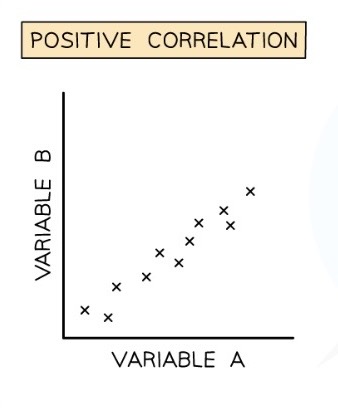
What does a downward trend on a scattergram show?
-ve correlation.
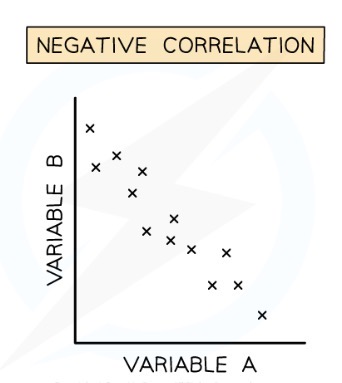
What does no clear pattern on a scattergram show?
0 correlation.
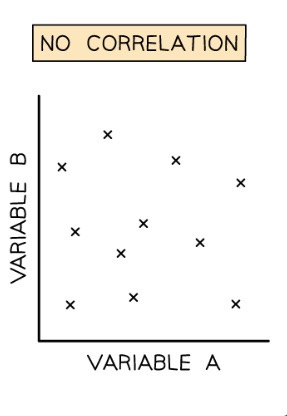
Application: Give a real-world example of correlation leading to further research?
The rship between cigarette smoking + lung cancer (+ve correlation found initially → cause effect rship discovered).
What are the strengths of correlational techniques?
Useful for preliminary research - measures rship between co-variables → helps identify patterns + generate testable hypotheses → useful starting point for further investigation.
Ethical + practical - variables=measured not manipulated, useful when experiments would be unethical → reduces ethical concerns.
Can use secondary data - alleviates concern over informed consent as info alrdy in public domain (e.g; gov statistics) → access to large data sets.
What are the weaknesses of correlational techniques?
Cannot establish cause + effect - only shows association between co-variables; could be due to 3rd variable problem → reduces validity of conclusions.
Limited to linear rships - mainly detects linear rships, may fail to identify curvilinear ships (e.g; temp + aggression) → can oversimplify rships between v’s.