Ch 3: Random Variables and Probability Distributions
 Call Kai
 Learn
Learn Practice Test
 Spaced Repetition
 Match
Match Flashcards
 Knowt Play
1/12

There's no tags or description
Looks like no tags are added yet.
Name | Mastery | Learn | Test | Matching | Spaced | Call with Kai |
|---|
No analytics yet
Send a link to your students to track their progress
13 Terms
Random Variable
A function that associates a real numbers with outcomes in sample space
Probability Distribution Criteria (PDF)
f(x) is postive
Adding all outcomes’ probabilities = 1
P(X = x) = f(x)
What does P(X=x) imply?
f(x). For example, P(X=3) will tell you the probability outcome of 3.
PDF notation
f(x)
Cumulative Distribution Function (CDF)
Looks for a range of values leading up to a certain value
PDF vs. CDF
-PDF: Looking for an exact value of X
-CDF: Looking for a range of values less than or equal to a certain value
Joint Probability Distribution Criteria
f(x, y) is positive for all (x,y)
Adding all f(x, y) = 1
P(X = x, Y = y) = f(x, y)
Marginal Distribution for X
-Integrate y out
-Use the bounds of y
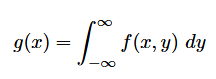
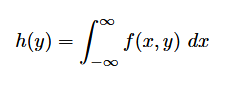
Marginal Distribution for Y
-Integrate y out
-Use the bounds of y
Which integral to do first for a Joint Probability Distribution?
The first integral should have bounds containing the other variable (so second integral can be constant)
Conditional Distribution
The given random variable goes at bottom

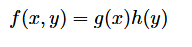
Statistical Independence
Conditional * condition = f(x, y)
Why are random variables and probability distributions important?
-allows us to use historical/previously known data to determine likelihood of random outcome
-can be used to describe data and infer how future ones will fare