soc 1010 exam 2
 Call Kai
 Learn
Learn Practice Test
 Spaced Repetition
 Match
Match Flashcards
 Knowt Play
1/134

There's no tags or description
Looks like no tags are added yet.
Name | Mastery | Learn | Test | Matching | Spaced | Call with Kai | Chat |
|---|
No analytics yet
Send a link to your students to track their progress
135 Terms
Culture
material objects, knowledge, beliefs, values, customs, and practices passed from, person to person, and from one generation to the next, in a society
Material Culture
tangible artifacts that people in a society produce, utilize, and share
Art, architecture, fashion, tech
Non-material Culture
abstract, intangible human creations that influence and affect people’s behavior
Socially constructed meanings, rules, and regulations, formal and informal
Cultural universals
phenomena found in every single culture; must somehow be functional (durkheim)
Pyramid of non material culture |
Pyramid of non material culture | Laws | |||||
mores/ folkways | ||||||
Norms | ||||||
Values | ||||||
Beliefs | ||||||
Language | ||||||
Symbols |
Language
complex set of symbols we use to think and express ourselves and others
Belief
statement about fact that may be incorrect
Values
widely shared ideas about what is appropriate or inappropriate in a society
Norms
shared expectations for behavior that are culturally specific and situationally specific
Mores
norms with a moral component - govern person and property
Folkways
the way of the folk - the way we do things
Laws
norms that have been legislated into code
Violation is met with sanctions
Sanctions
response to a norm violation (norms as a form of social control in the socialization process) - pushing them towards conforming
Paradoxes of Culture
We both create culture, and we are created by it
Culture is always changing yet it is your source of continuity with our past
Ideal Culture
beliefs, values, norms, practices that people in a society claim as their own
Real Culture
beliefs , values, norms, practices, that people in society actually hold
Trans-Valuation
When a particular phenomena in society that is viewed as negative comes over time to be viewed as positive or vice versa
Cultual Lag Time
when material culture and related nonmaterial culture changes
High culture
those activities, art forms, forms of entertainment, sports, foods, fashion that are assumed to appeal primarily to the upper class
Popular Culture
those activities, art forms, forms of entertainment, sports, foods, fashion that are assumed to appeal to the middle and working classes
Endogamy
marriage within one's own social class
Cultural Capitol Theory
created by Pierre bordieu: high culture is an exclusionary social class to ensure endogamy - gives you an advantage above others
Culture Shock
a feeling of disorientation experiences when a person finds them self in a cultural setting that is dramatically different from one's own
Ethnocentrism
the belief that one's own life and culture are superior than others and form a measure that other culture should be judged; most prevalent in countries w/ colonial history
Xenophobia
fear and hatred of foreigners and outsiders
Cultural Relativism
opposite of ethnocentrism; judging another culture based on its own beliefs, norms, and values
Dominant culture
represents ideas and practices of those in positions of power
Culture war
intense disagreement about core values and moral positions
Sub culture
large sub component of culture that share beliefs, practices, norms different from those of the larger society; ethnicity, activities, amish
Countercultures
subculture that champions values and lifestyles distincly opposed to those of dominant culture
Multiculturalism
large number of distinctive subcultures; the U.S. is an example b/c everyone is an immigrant
Structural Functionalism
culture enables people to meet their needs in society
culture is a tool kit for society
Conflict theory
culture is influenced and crafted by the socially powerful in order to control members of subordinate classes by influencing their thoughts and actions through effectively managing their impressions of social order
Why is the social class system self perpetuating?
b/c each different social class has its own distinctive “class-culture”
Symbolic interactionism
culture is emergent: created, maintained, and modified by people in their day-to-day lives through the shared meanings they experience during their interactions
Culture changes as our collectively shared meaning of social phenomena change
Epistemology
our ways of knowing the world
Normative approach
worldview informed by legend, religions, superstition, common sense; custom habit, tradition, old wives tales, our friends relatives, peers, television, newspapers, the internet
Common sense observations - are not systematic and partially incorrect
Empirical approach
world view informed by science, that is: systematic observation, collection of data, and analysis to draw verifiable conclusions (positivist)
Explanatory research
attempts to explain cause-and-effect relationships. It must be quantitative (utilizing mathematics)
3 necessary prerequisites for cause-and effect:
correlation
ordering
Absence of “spurious” relationships
Correlation
variables must occur together more frequently than expected by chance
1.0 perfect correlation 0.0 no correlation
Perfect correlation
a one unit increase one dimension equals a one unit increase on the other dimension
Ordering
the independent variable must precede the dependent variable
Independent variable - the cause
Dependent variable - the effect
Absence of “spurious” relationships
A apparently causes C is correlated with B that causes C
Variable
a concept with measurable traits (height, weight)
Explanatory research is __________
“deductive”
Descriptive research is __________
“inductive”
The theory and research cycle
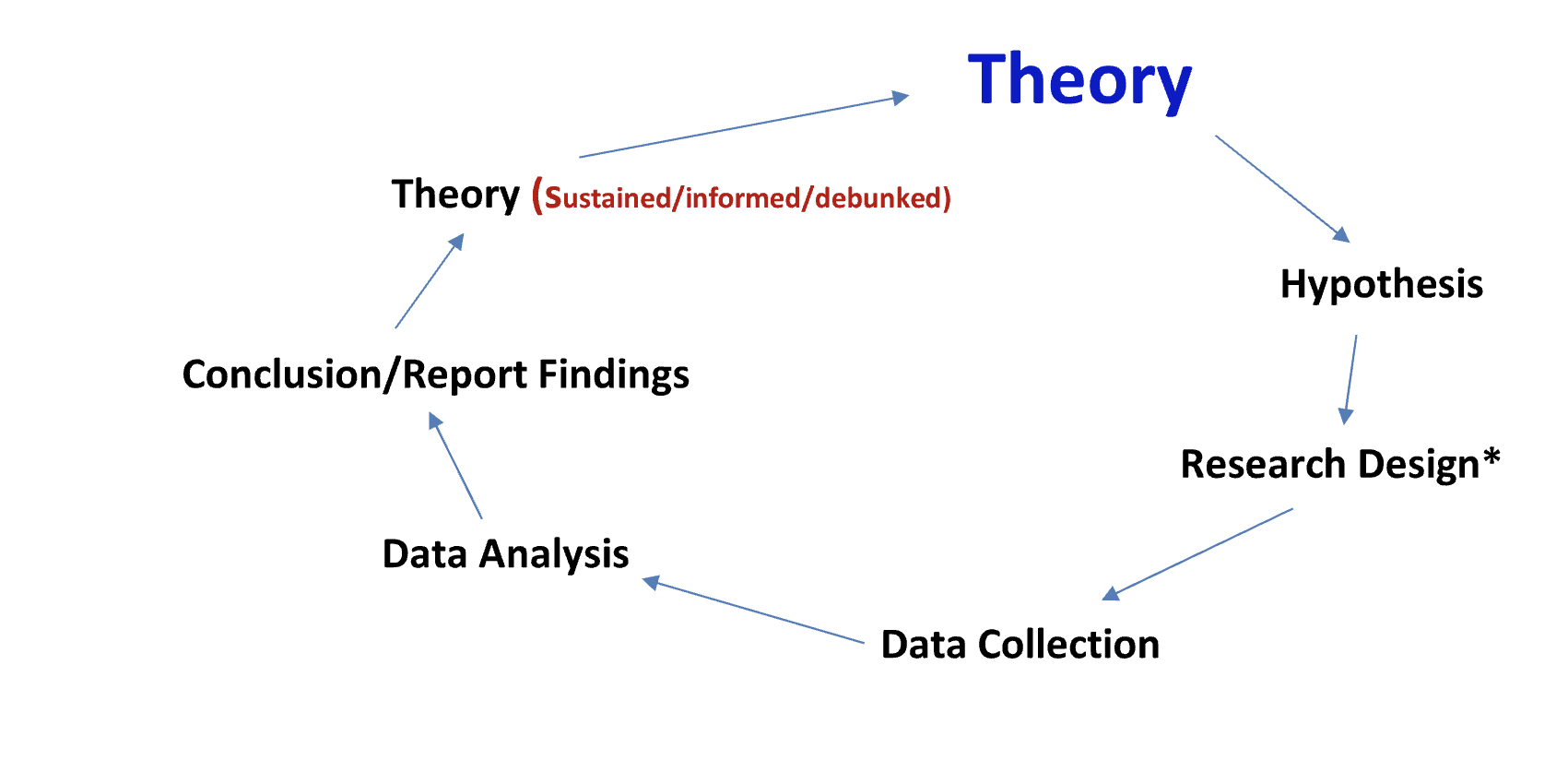
Hypothesis
statement about the relationship between variables that is to be investigated
Sample
a group within the population selected to represent the whole
Random sample
every member within the population has an equal chance of inclusion
Representative sample
shares the main characteristics of the larger population
Descriptive research
attempts to illuminate and sensitize us to typically obfuscated data… to “describe” hidden social worlds… particularly useful for initial discoveries about previously unknown social phenomena - called naturalistic research
Qualitative research
use words for interpretive description of social “reality”
employs open- ended inquiry allows us to discover the “world view” of those groups of interest to the researcher
Ethnography def.
long term research, qualitative, naturalistic, field research in which the researcher assumes a temporary membership role within the population of interest; required participant observation
Ethnology
have to form a personal relationship with the people you are studying
Most qualitative research is “ethnography”
Originally developed by anthropologist to conduct a “complete observation”
Currently owned by sociology where we do “participant observation” to study hidden populations in urban settings
Hidden population
does not typically avail themselves to research
Ethics required the ethnographer to…?
identify themselves at the outset of any and every relationship that they have with others who might serve as potential “informants”
Hawthorne effect
people tend to behave differently when they know they are under observation
Laud humphreys and sociological ethics
Changed the landscape of sociological research forever
Studied tea room behavior (anonymous homosexual men having sex in public)
Went to a rest area in the area around tennessee, illinois, missouri
Took their license plates and identified them and send surveys
They never identified as gay, they were married some with kids and some in power
Had the #1 department of sociology but it got disbanded b/c of him
Now research must be pre approved by IRB - institutional review board
Socialization
a lifelong learning process that takes place during interaction during which we acquire the experience, knowledge, and skill sets to survive in our cultural setting and when we acquire your sense of self - goes on throughout ones life
the totality of one's beliefs and feelings about oneself constitutes their?
Self concept
We are a combination of our __________________
hereditary and environment
Charles Horton Cooley: looking glass theory
Look into the mirror and imagine the appearance and personality that you are think are going to appear to others
Present yourself to others
If others respond to us consistently to how we want them to respond it enhances our self concept. If they respond inconsistently, not like we want to, it diminishes our self concept.
Bateson defends Cooley and says -
-that there are 2 types of people one is inner directive and the other is other directive
inner directed def.
impervious to how others respond (not affected)
other directed def.
seeks approval and acceptance from others
Cooley and mead are contributors to what?
symbolic interactionism
Role taking
mentally assuming the role of another to better understand their world through their point of view
Preparatory stage
birth - beginning to talk, 0-2) - crudely imitate others around them
Significant other - those who we most wish to impress
play stage
(verbal skills, mead says ends at 6 but it never really does, pretending to be someone else) - begin to imitate a wide variety of people in a variety of circumstances
Game stage
(complex team sports, softball and later driving) - hone our imagination even further, reasonably predict what others and what you are going to do
Most in modern civilization are?
discontent and its not unusual
Book on sociology: civilization and its discontents
Civilization is how we acquired discontent
Freud says: culture inhibitions are instilled as a baby
It is because that we are inhibited that we exist
Erotic energy is what drives all human activity
Sublimating our erotic energy
Psyche/ ego
self
ID
pleasure principle, seeks immediate satisfaction
The superego is composed of inhibitions -
-equivalent of the conscious
Ego
component of the psyche that counterbalances the id and superego
Subjective component of yourself-
-makes you different
Objective component of yourself-
-makes you the same as others
Me
awareness of the generalized other - equivalent of the conscious
5 major agents of socialization
family, school, peers, mass media, and religion
Family
most important in every society, institution for making babies, places where children receive their primary form of socialization, perpetuates social inequality
School
formal socialization, teach technical skills in modern society, transmission of culture, social control, personal development, responsible to were you end up in society
Hidden curriculum - tedious busy work with virtually no reward
Peers
more important when away from your family, sense of belonging, downside they demand a high level of conformity,
Mass media
get your impressions from, most important for adults, influences your worldview, inform about events, entertainment,
Religion
morality, honesty, loyalty, belief systems, affects you even if you don’t practice
Erving goffman created this concept
Resocialization
voluntary resocialization
occurs by choice - drug user going to rehab
involuntary resocialization
may occur within a total institution
total institution individual
gives over all power in their lives to the institution (prison, military, mental hospital)
social structure
stable patterns of interaction and these define our roles and impose order on an otherwise chaotic social world allows us to interpret the reactions that we encounter (school, work)
have boundaries insiders and outsiders
social marginality
Being expected the full range of responsibilities but not being afforded the full range of privileges
status of being an insider and outsider in a group at once
status
socially defined position that as a specific set of privileges and responsibility - most basic component of social structure
master status
the status through which you define yourself and you wish others to define you as well
status set
all of the social statuses you occupy at once
achieved status
partially due to our own efforts
ascribed status
one that is put upon you at birth
role
specific set of behavioral expectations linked to a particular status
role set
describes various roles and relationships as a consequence of a person's societal status