chemistry - intermolecular forces and bonding
 Call Kai
 Learn
Learn Practice Test
 Spaced Repetition
 Match
Match Flashcards
 Knowt Play
1/18

There's no tags or description
Looks like no tags are added yet.
Name | Mastery | Learn | Test | Matching | Spaced | Call with Kai |
|---|
No analytics yet
Send a link to your students to track their progress
19 Terms
Intermolecular forces
bonding between molecules
Generally weak forces
Covalent bonds are an intermolecular force → occur inside the molecule and are much stronger
THREE TYPES
dipole-dipole
Hydrogen bonds
Dispersion forces
Electronegativity
tendency of an atom in a covalent bond to attract electrons
→ high core charge, few shells
Polarity
localised imbalances in electric charges within a molecule resulting in a negatively charged and positively charged end
Polarity - why do molecules bond together
chlorine atone is more electronegative
Chlorine atoms → attracts bonding electrons more than the hydrogen atom
Polarized bonds
covalent bonds between atoms of different electronegativity have polarised bonds
Atoms in polarised bonds have partial charge
Covalent bond ← partial charge, ionic bond ← full charge
The greater the difference in Electronegativity → more polar the bond
Polar covalent molecules - polarity of a molecule depends on
the polar bond that is contains
The way in which the bonds are orientation with respect to each other
→ eg: the shape of the molecule
Equal polarity & symmetrically arranged
if bonds have equal polarity (eg: O2) and are symmetrically arranged → their charge separations (electronegativites) will oppose each other & will effectively cancel each other out
→ molecule will be non-polar even though it had polar bonds
Bonds of different polarity or not symmetrically arranged
IF EITHER:
molecule contains bonds/different polarity
OR
its bonds are not symmetrically arranged
→ bonds wont cancel out → molecules are polar
When is a molecule polar
To be dipole, a molecule must:
Have polar bonds
Have asymmetrical charge distribution
Intermolecular forces - dipole and polar molecules
molecules with two charged ends (poles) = polar molecules or dipoles (two poles)
Di[oles arrange +ve to -ve charge → intermolecular attraction
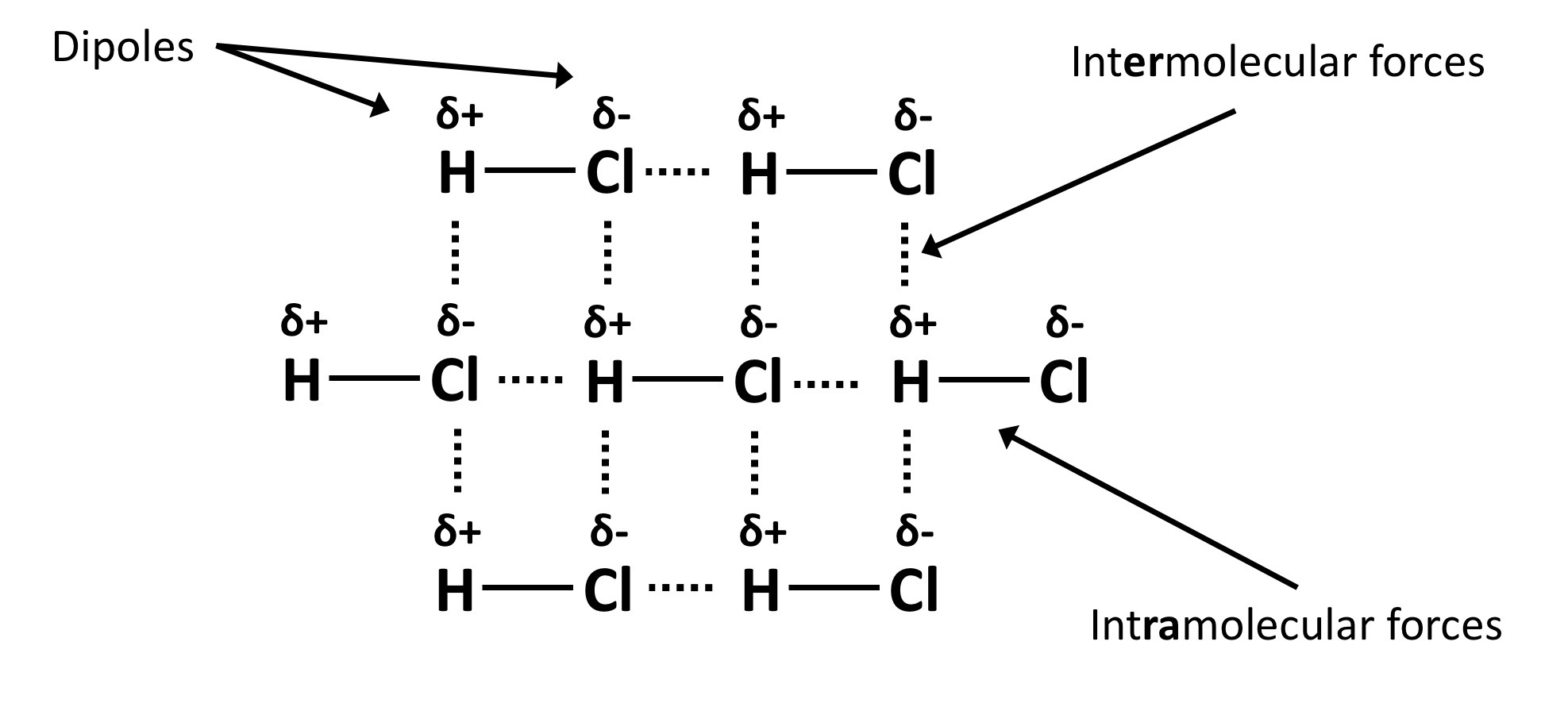
Intermolecular forces - dipole-dipole bonding
only occur between molecules that are polar
They are weak
→ when HCL melts → intermolecular forces hold it in liquid state → they’re lost in gaseous state
Intermolecular forces - hydrogen bonding
special type of dipole-dipole bonding
The strongest intermolecular force
Holds many biological molecules together
→ DNA and protein complexes
Hydrogen bonding cont.
occurs when H is bound to N,O or F
→ these are very electronegative atoms so H loses its valence electron and gains a large S+
→ they (N, O or F) have a free pair of electrons
Dispersion forces
Due to random movement of electrons at any instant, it’s possible for them to be unevenly distributed → temporary dipole (instantaneous dipole)
Instantaneous dipole → dissappears unless another atom happens to come close to the atom
→ if this happens → dipole will be induced in second atom
weak attraction between atoms are dispersions forces → are found between molecules
Relative bond strength
molecular substances may experience up to 4 types of interaction
→ all molecules - held together internally by covalent bonding
→ bcs this acts within a molecules → = intermolecular force
its a very strong force and considerably greater than any of the other forces that could be experienced
All molecules in liquid/solid states → also experience attraction to other molecules from dispersion forces. These are really weak forces that originate bcs of movement of electrons within molecule
Other forces that might be experienced= dipole-dipole & H bonding
→ these two are due to polarity existing within some molecules
Properties
Hydrogen > d-d > dispersion
stronger the bonding → higher the MP and BP → more energy needed to break bonds
Larger molecules → more IMB → higher MP/BP
→ consider type of intermolecular bonding and number of bonds
Types of covalent structures
covalent molecular structures - consist of molecules on their own. Low MP/BP. Covalent bonds btwn atoms within molecules = strong but intermolecular forces are weak
Covalent network strucutre - made from network of repeating lattices of covalently bonded atoms. High MP/BP and insoluble in water
Graphite
2D network lattice with layers of hexagonal rings
Within each layer, each C atom is bonded to three carbon atoms → leaving one electron per carbon atom not used in bonding
Electrons are delocalised across the layer
Each layer is only weakly linked to the next layer by London forces
Diamond
a 3D network lattice of tetrahedrons
Each carbon atom is bonded to four other carbon atoms