sl psych pt 2
 Call Kai
 Learn
Learn Practice Test
 Spaced Repetition
 Match
Match Flashcards
 Knowt Play
1/82

There's no tags or description
Looks like no tags are added yet.
Name | Mastery | Learn | Test | Matching | Spaced | Call with Kai |
|---|
No analytics yet
Send a link to your students to track their progress
83 Terms
Deindividuation
Loss of self awareness and individual identity (think of collective mind)
What Deindividuation does to our mind
It minimizes self awareness and concern for social evaluation, time distortion, it makes us more impulsive, we are guided by others, reduces memory
What type of behavior does deindividual lead to?
All of the above
Research in deindividuate subjects
No names, smocks or hoods sometimes. This would show results that people who were anonymous would chose the more negative outcome
ex: Zimbardo shock experiments, Halloween (2×2, being in group and being deindividuated more likely to get more candy
Is losing self awareness and self control bad?
No, think unity. (Study in the dark. Most people were more physical in the dark
Flow
Think of flow state, complete immersion, positive experience. Control without exerting control (automaticity)
Zen
Nothing definite is thought, planned, striven for, desired or expected which aims in no particular direction which is at the bottom of purposeless.
lazy and aimless
Is loss of self awareness good?
Depends on context
we tend to do what others do
Self as impulse vs self as institution
Is the self controller or controlled in “self controlled”, are we Dionysian or Apollonian. Different eras are different
Why give bias answer?
Cognitive mechanism: we don’t give negative feedback
Motivational: unconscious self protective mechanism, high self esteem
David dunning change of standards/construal
Participants were asked how important some standard were regarding friendship (i.e. fun, kind, loyal etc) and then were told that they were not that thing. Participants who scored standard high initially then hearing that they aren’t that standard would rate it lower.
Self serving bias experiment Ross
Married couples rated how they and their spouse took responsible for 20 household tasks. On average participants thought they handled 16 while partner only does 4
Self serving bias experiment employ and whitchurch
Morphing your face with an unattractive face and an attractive face. We often think we are more closer to the attractive face than unattractive
motivational explanation
Self esteem
What is our general attitude of ourself. Regard with respect
Sociometer hypothesis mark Leary
Our estimate of whether we are meeting societies standards and likely to be accepted.
Coping: terror management theory
Self esteem helps us with existential fears (ex: 9/11) helps us cope with anxiety and when we are reminded of our mortality we try to make us feel better
Self esteem brown and Dutton study
Regardless of high or low self esteem when receiving positive feedback we feel good, but when receiving negative feedback low self esteem has it worse than high
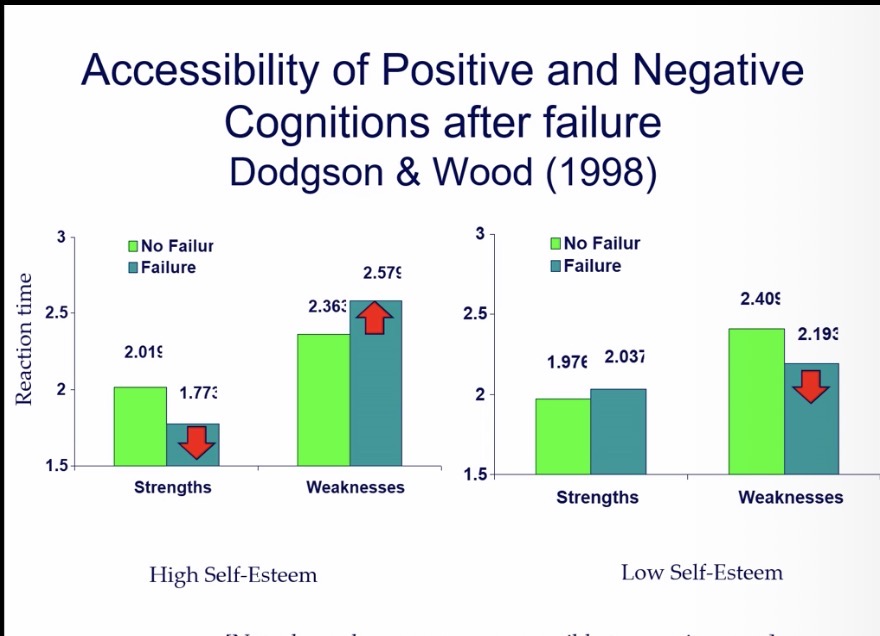
Accessibility of passivity and negative cognition after failure
For low self esteem people, when failed weakness become more accessible while people with high self esteem strength becomes more accessible when success.
Watching comedy after failure
People with high self esteem are more likely to want to watch comedy after failure than low self esteem
Helping after failure
High self esteem people would more likely help after failure than low self esteem
Gambling after failure
High self esteem more likely to keep gambling after failure than low
Threatened ego and aggression
People with high self esteem who are threatened are more likely to blast noise to other person than low self esteem
Does high self esteem lead to hurting or helping?
Both, depends on context and opportunities. Is high self esteem better? (Tank vs gage, we need to earn high self esteem not just give it out)
think of education and self esteem. If everyone gets a trophy nobody will put in effort
How do we know what kind of person we are?
We compare ourselves to others, we choose the standard. It allows us to learn about ourselves (hypothesis 5)
ex: If I got a 90 I compare myself with someone who got a 60, but also compare myself with someone who got 100
Social comparison theory
Upward comparison to someone better and downward comparison to someone worse
downward feels good upward feels worse. But upward is more informational
Basking in reflected glory study
We want our friends and connections to do well
think if ucla wins “we won” if ucla lose “they lose”
Self evaluation maintenance theory
Weak social ties: we are happier for stranger in a self relevant field. In non self field though we are happier for friend
Strong social ties: we are happier when friend does good in an activity that does not relate to us. But if it does relate to us we don’t like it
Self evaluation maintenance study
Participants gives clues to either friends or strangers
for friends if it’s just a game they give lots of clues if it pertains to our intelligence then not a lot of clues
Social feedback
Used to evaluate ourselves, prefer to hear positive
Self enhancement theory
Tell me im good no matter what, pushes positively, we want to be liked by others
Self verification theory
Tell me the truth, i want to believe what I think is the truth
want consistency even if its not 100% accurate
Test 1 for enhancement and verification (swann, et al)
5 qualities about self and how positive, then asked how much would we enjoy getting feedback on highest and lowest rated quality.
result: want more feedback on positive quality
enhancement
Test 2 for enhancement and verification (swann, et al)
asked if we prefer favorable or unfavorable feedback on worse or best attribute
We prefer favorable feedback for best attribute and unfavorable feedback for worst attribute
Verification
Test 3 for enhancement and verification (swann, et al)
How accurate was feedback that was given?
result: High self esteem believed favorable feedback more than unfavorable feedback. Low self esteem believed unfavorable feedback more than favorable feedback
Verification
Test 4 for enhancement and verification (swann, et al)
How good do you feel after getting the feedback?
result: high self esteem feels better when given favorable feedback but so does the low self esteem group
Enhancement
Why chose negative feedback
It helps us improve, want to feel authentic, we want to feel known by others
Social comparison: a barrier to happiness
Unhappy individuals are more affected by social comparison leading to increased negative emotions
Unhappy people look more at comparison while happy people look at themselves
How to enhacement well being by reducing social comparison
Set internal standards, practice gratitude, be kind to others, limit triggers, stay mindful
Prophecy failure
Marian Kerch believed that world is going to end on December 21, 1854.
nothing happened but she said that god saved the world due to their devotion
Cognitive dissonance reduction or rationalization
Cognitive consistency/balance theory
When one thing disturbs our balance we try to rationalize whether we change it positive or negative
Ex; i had a friend who was really nice and kind, but found out she was a cheater so it threw off my perspective. So I could either think that cheating isn’t that big of a deal or I could think that the friend is not good.
Rationalization
We do this everyday, it affects us by making us seem inathuentic and we do this because we need to feel consistent
hypothesis 5
Cognitive dissonance theory
Intrapersonal conflict. Two cognitions conflict causing dissonance
Main option to reduce this is change attitude or justify (we can change behavior as well but often can’t)
Study 1: insufficient justification
Dissonance, People do this boring experiment and after its over they are either given 20 dollars or 1 and ask to lie to other participants to say its fun
results: people who were paid 1 convinced themselves that the experiment is fun
Study 2: free choice
Dissonance, We needed to rank 8 appliances and after rating, we would then get the 4th ranked or the choice to pick either 4th or 5th ranked. Then they were asked to ranked again
result: when they had choice (4th and 5th) the one we chose would go up and the one we rejected would go down
No choice was similar to their first ranking
Study 3: effort = liking
Dissonance, Invited to join women discussion group
three groups: control, mild initiation and severe initiation (sexual and taboo)
Asked if they liked the later conversation
Results: people who were in the severe initiation were more committed to the discussion group (if I put in more effort it must be worth it)
Study 4: counter-attitudinal essays
Dissonant, they needed to write an essay on x or they have a choice to write on x or y. They measured initial attitudes and then measured a week later
results: free choice convinced themselves that they like the topic. They also misremember what they put down
Why misremembering attitude
To serve current goal, attitudes aren’t stored with tags
ex: if I paid for college I want to believe the class expanded my thinking even if it doesn’t
Process of cognitive dissonance
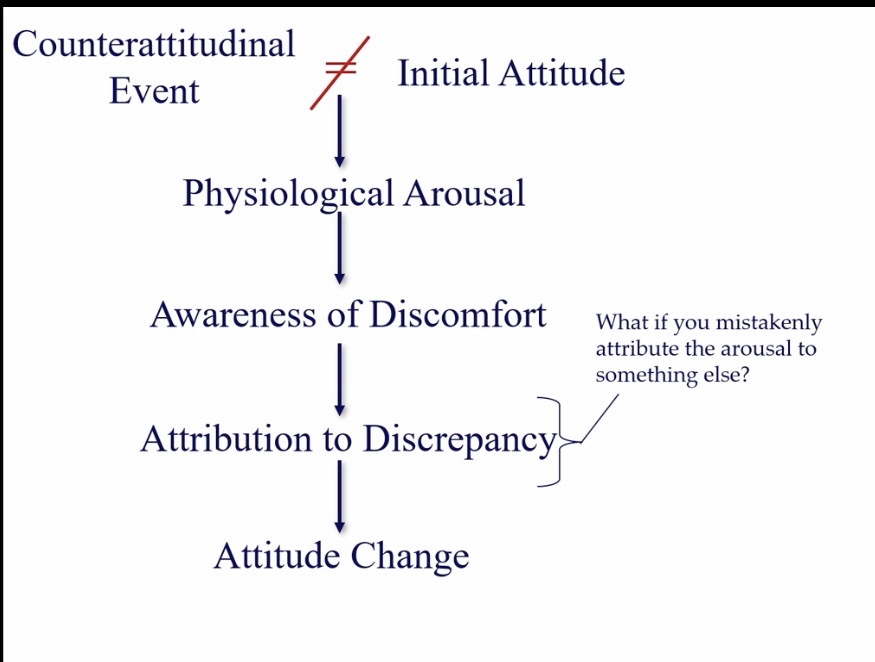
Misattribution of dissonance arousal
Given a pill (placebo) either an arousal pill or a relaxation pill or none at all. Then asked to write a counter-attitudinal essay
result: if you freely chosen the essay you will change your attitude when you take a relaxation pill or no pill at all, but if you take an arousal pill your attitude will not change
Could blame arousal pill on what they are thinking on not them so they don’t change
Can’t blame it on relaxation because it’s suppose to relax you
Study amnesia and cognitive dissonance
Is cognitive dissonance conscious?
Compared amnesiacs and healthy controls and used the same 8 appliance free choice study
results: the same thing happened to amnesiacs to healthy controls, they don’t need to remember in order to have cognitive dissonance
Automatic
Study monkeys and kids
First round, Monkeys given choice of green or red M&M. Second round they got rejected color and new color M&M
results: more likely to chose the new color, but they don’t get this effect if they were given first round color. Needs to be free choice
Heider and simmel demo
Shapes going around a room and we try to make up a scenario
people with autism have trouble with this
we can also think of the IKEA AD
Invisible states and traits
If we predict traits → states → intention → behavior
we can predict broad to narrow but…We don’t do that we do this:
Behavior → intention → state → trait
Dispositional factor
Also called traits
Joe kicked Fido why was he angry? Use dispositional and situational factors
Dispositional: he has bad temper
Situational: Fido hit him
Situational factors
Context
Covariation model
3 factors: distinctiveness(across situations), consensus(across people), consistency(over time)
we often can’t do this due to not following people around and getting data
Joe kicked Fido why was he angry? Use covariation model
Distinctiveness: is joe mean to lots of people?
Consensus: is everyone mean to Fido?
Consistency: does joe always kick Fido?
Correspondent inference theory Ned jones
Attributions based on singular behavior,
Behavior = dispositions + situational factors
Situational constraints (correspondent inference theory)
We all share knowledges of social norms
Normative behavior (correspondence inference theory)
No disposition, inference should occur when social norms creates the behavior
Counter normative behavior (correspondent inference theory)
Correspondence between the behavior and ones internal dispositions
Mark punched bill because bill was sleeping with marks wife use correspondent inference theory
Behavior = punch
Situation = bill sleep with marks wife
Disposition = marks is not a hostile person situation calls for it
Mark punched bill because bill bump into mark on accident use correspondent inference theory
Behavior = mark punched bill
Situation = bill bumped into mark
Disposition = mark is aggressive in general
The Castro study
Either pro or anti Castro essay written by students and we are trying to find out whether the author is pro or anti Castro themselves. Subjects believed that essay is either freely chosen or required
results: freely choice makes them believe they are pro Castro and if they didn't have a choice it was reduced a little but they still think it represent them
Correspondence bias or fundamental attribution error
We overlook situation (situations are invisible), inaccurately theory of situational influence, salience (we only do this with other not ours), incomplete correction (automatic —> automatic → controlled), culture
Gilbert, Pelham, kurll
How anxious is this women everyday? See list of discussion topics
results: cog busy - they are similar, not busy - anxiety provoking is less
stereotype
beliefs that associate a group of people with certain traits. can be positive or negative
cognition/association
3 ways stereotypes can be wrong
overall generalization can be wrong, the generalization misapplied to individuals, we can misunderstand the cause of the true stereotype
prejudice
negative feelings/attitudes towards others because of their group behavior membership
affect
discrimination
negative behaviors towards others because of their group membership
behavior
implicit associations test
a test that makes you categorize white and positive connotations and black and negative connotation. we have to do it fast. it is to see what you automatically associate
results: 75% of people automatic white preference, shows discriminatory behavior
why do we stereotype cognitive accounts?
saves cognitive effort, reduces ambiguity
why do we stereotype motivational account
if they are ___, then I am better by comparison. stereotyping enhanced when threatened
stereotyping and cognitive effort macrea, Milne, and bodenhausen
adjectives about Julian, some are stereotypical and others don’t see label
50% traits fit label and 50% random trait
stereotype reduces ambiguity (kinda and Sherman Williams)
scenario: hit someone who annoyed them(ambiguous) , decked a neighbor who teased them (aggressive) and spanked a child(not aggressive). then was told it was either a housewife or a construction worker
results: aggressive and not aggressive was right but when it was ambiguous they rated constructive worker as more aggressive than housewife
motivational account of stereotyping (Spencer. fein, and frog)
when doing task, primed with Asian assistant or no Asian assistant. when completing words they checked how many stereotypical completions were made
results: when Asian assistant was there, a lot of stereotype completions more than white assistant, and more negative ones
stereotype threat
fear of doing a stereotype that was based on your group
ex: fear of dropping out of school and being labeled as a
Hispanic dropoutExperiment: primed stereotype behavior in one group which led them to not have working memory capacity
self fulfilling prophecies study Rosenthal and jacobsen
teachers were told that a test revealed late bloomers, measured IQ beginning and end of quarter
no such thing the results were: bloomers got a major IQ jump
self fulfilling prophecy
when an originally false social belief leads to its own fulfillment
maze full and maze bright rats
students were given “dull” or “bright” rats, we see that the ones labeled dull did much slower getting through the maze than the ones labeled bright. could be due to students not putting effort for the dull
snyder, tanke and berscheid study
men led to believe they were talking to either a ugly or pretty woman. if pretty they said she was more friendly than ugly one
they prob had been more friendlier to the pretty one
nonverbal communication
anything but words, appearance, facial expressions, tone of voice, gestures, posture