Chapter 9 - Transport in Plants
 Call Kai
 Learn
Learn Practice Test
 Spaced Repetition
 Match
Match Flashcards
 Knowt Play
1/26

There's no tags or description
Looks like no tags are added yet.
Name | Mastery | Learn | Test | Matching | Spaced | Call with Kai |
|---|
No analytics yet
Send a link to your students to track their progress
27 Terms
What is the need for transport systems in plants
Metabolic demands - Oxygen and glucose needs transportation as not all cells photosynthesise, hormones need transporting to different areas, mineral ions need to be transported to all cells
Size - Plants continue to grow throughout their lives and some can be giant so they need effective transport systems to move substances both up and down the plant
SA:V ratio - Although some parts of the plant have relatively high SA:V ratio, when all the parts of the plant are taken into account, they have a relatively low SA:V ratio meaning they can’t rely on diffusion alone to supply their cells
What are dicotyledonous plants (dicots)
These plants make seeds that contain cotyledons, organs that act as food stores for developing embryo plant and form the first leaves when the seed germinates
What are two different types of dicots
Herbaceous dicots - Soft tissues, relatively short life cycle
Woody (arborescent) dicots - Hard lignified tissues, long life cycle
What are the transport systems in dicotyledonous plants
Series of transport vessels running through stem, roots and leaves known as the vascular system.
In herbaceous dicots this is made of two types of transport vessels, xylem and phloem
Transport tissues are arranged into vascular bundles which can be seen in the transections
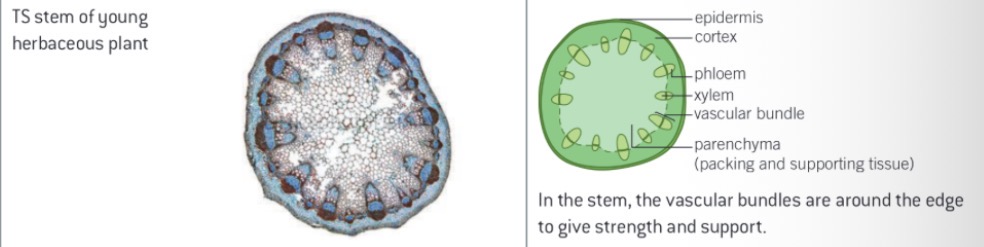
What does the transaction of a stem of a young herbaceous plant look like
The vascular bundles are around the edge to give strength and support
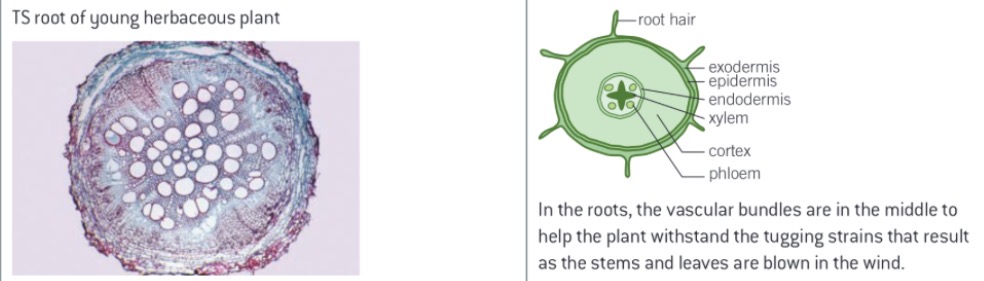
What does the transaction of a root of a young herbaceous plant look like
The vascular bundles are in the middle to help the plant withstand the tugging strains that result as the stems and leaves are blown in the wind
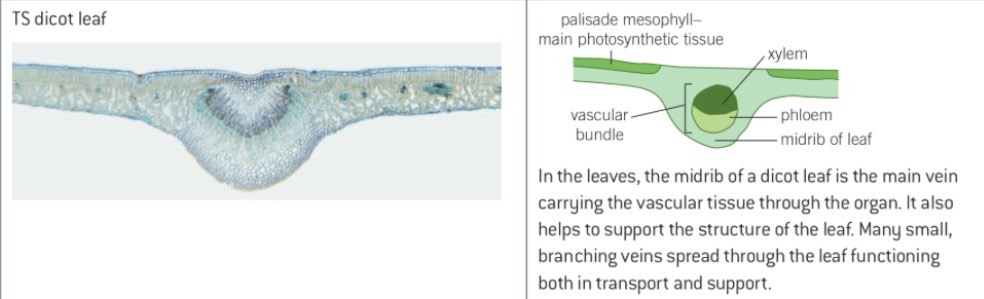
What does the transaction of a dicot leaf look like
The midrib of a dicot leaf is the main vein carrying the vascular tissue through the organ, it also helps to support the structure of the leaf.
There are also many small branching veins through the leaf which have a function in transport and support.
Describe the structure of the xylem tissue
Non-living tissue
One way transport upwards from the roots to the shoots/leaves
Long
Hollow
Made by several columns of cells fusing together end to end
Two other tissues associated with xylem:
Thick-walled parenchyma - packs around xylem vessels, storing food and containing tannin (bitter tasting chemical to protect from herbivores) deposits
Xylem fibres - Long cells with lignified secondary walls which provide mechanical strength but don’t transport water
How can lignin be laid down in the walls of xylem vessels
Rings
Spirals
Solid tubes with lots of small unlignified areas called bordered pits. These are areas where water leaves the xylem and moves into other cells of the plant
Describe the function of the xylem
Transport of water
Support the plant
Describe the structure of the phloem
Living tissue
Two way transport up and down the plant
Sieve tube elements (main transporting vessels)
Sieve tubes made of many cells joined end to end
Long
Hollow
Not lignified
Perforated sieve plates in between cells to allow contents to flow through
Mature phloem cells have no nucleus
Companion cells linked to sieve tubes made of elements
These cells are linked by plasmodesmata
Have supporting tissues: fibres, sclereids (cells with thick cell walls)
What happens when large pores appear in cell walls
Tonoplast, nucleus, other organelles break down and phloem becomes tube filled with phloem sap
What are plasmodesmata
Microscopic channels through the cellulose cell walls linking the cytoplasm of adjacent cells
Describe the functions of the phloem
Transports food in the form of organic solutes around the plant from the leaves where they’re made
Supplies cells with sugars and amino acids needed for cellular respiration and for synthesis of all other useful molecules
Companion cells maintain their nucleus and organelles so function as a life support system for sieve tubes made of cells
Describe how water plays a key role in plants
Turgor pressure - Provides a hydrostatic skeleton to support stems and leaves of plant as a result of osmosis
Turgor - Drives cell expansion enabling the plant roots to force their way through tarmac and concrete
Water loss - Helps to keep plants cool
Aqueous solutions - Helps to transport mineral ions and products of photosynthesis
Photosynthesis - It is a raw material for photosynthesis
How are root hair cells adapted
Microscopic size - Can easily penetrate soil particles
Large SA:V ratio
Thin surface layer
Water potential gradient is always maintained
How is the water potential gradient between soil and cell maintained
Concentration of solutes in cytoplasm of root hair cells is relatively high meaning low water potential in cell
Concentration of solutes in soil water is very low so there is high water potential in the soil water
As a result, water moves into root hair cells by osmosis
Describe the symplast pathway
Water moves through the symplast, a continuous cytoplasm of living plant cells connected via plasmodesmata
Root hair cell has higher water potential than the next cell along so as a result water moves from cell to cell by osmosis until the xylem is reached
As water leaves the root hair cell, its water potential falls again so this maintains a steep water potential gradient
Describe the apoplast pathway
Water moves through the apoplast, this is the cell walls and intracellular spaces
Water fills spaces between open network of fibres in cell wall
As water molecules move into the xylem, more water molecules are pulled through the apoplast behind them due to cohesive forces
This pull creates tension meaning there is continuous flow of water this way, offering essentially no resistance
How does water move into the xylem
Water will reach the endodermis, the layer of cells surrounding vascular tissue
Endodermis is noticeable in the roots because of the Casparian strip
Water in the apoplast water can’t go further so it is forced into the cytoplasm to join the symplast pathway
This diversion to the cytoplasm means that water must pass through selectively permeable surface membranes, so any potentially-toxic solutes in soil water can not reach living tissues as their are no carrier proteins to admit them
Water potential of xylem cells is lower than water potential of endodermis cells because endodermal cells move mineral ions into xylem by active transport
This means water moves into xylem very easily
When water is inside the vascular bundle it returns to the apoplast pathway to enter the xylem and move up
What is the Casparian strip
A band of waxy material called suberin which runs around each of the endodermal cells forming a waterproof layer
What is root pressure and how does it come about
Root pressure gives water a push up the xylem
The active pumping of mineral ions into the xylem produces movement of water by osmosis resulting in root pressure
What are some pieces of evidence for the role of active transport in root pressure
Some poisons affect mitochondria and prevent production of ATP. E.g. if cyanide is applied to root cells, no energy supply, root pressure disappears
Root pressure increases with temperature suggesting chemical reactions are involved
If levels of oxygen or respiratory substrates fall, root pressure falls
Xylem sap can exude from cut ends of stems. In the natural world, xylem sap is forced out of special pores at the ends of leaves in some conditions, e.g. at night when transpiration is low. This is guttation.
Describe transpiration and adaptations for this process
Lead surface covered with a waxy cuticle which makes them waterproof, preventing them from losing water rapidly
Carbon dioxide and oxygen move into and out of leaves down the concentration gradient via small pores called stomata
Stomata are opened and closed by guard cells to control the amount of water loss
How does the transpiration stream work
Water enters roots by osmosis and transported up the xylem to the leaves
It moves across membranes and throughout cell walls and intracellular spaces
The water vapour then moves out of the leaves via stomata
As water is lost by evaporation, water potential of the cell is lowered so that more water moves into the cell from adjacent cells by osmosis
Water exhibits capillary action moving it up the cell because of adhesion and cohesion
Water is continuously pulled up the xylem to replace the water that was lost by evaporation, this is the transpiration pull
Describe some pieces of evidence for the cohesion-tension theory
Changes in diameter of trees - When transpiration is at its peak, tension in xylem vessels is at its peak so tree shrinks in diameter. When transpiration is low at night, tension in xylem vessels is low so diameter of tree increases
When xylem vessel is broken - When vessel is broken, air is pulled into the xylem so water can’t be pulled up in a continuous stream as the cohesive forces have been broken
How are stomata opened and closed
Stomata are opened and closed by guard cells, this opening and closing is a turgor-driven process.
When turgor is low, asymmetric configuration of guard cell walls closes the pore
When environmental conditions are favourable, guard cells pump in solutes by active transport, increasing their turgor
Cellulose hoops prevent cells from swelling in width so they extend lengthways