finla bio revieew
 Call Kai
 Learn
Learn Practice Test
 Spaced Repetition
 Match
Match Flashcards
 Knowt Play
1/115

There's no tags or description
Looks like no tags are added yet.
Name | Mastery | Learn | Test | Matching | Spaced | Call with Kai |
|---|
No analytics yet
Send a link to your students to track their progress
116 Terms
Taxon
A group of organisms in a classification system. The basic taxon in the Linnaean System is the species, a group of organisms that can breed and make babies.
Classification
Organization according to shared characteristics.
Taxonomy
The science of naming and classifying organisms, gives scientists a way to refer to species and organize the diversity of living things. System called Linnaean System.
Binomial Nomenclature
Used in the Linnaen system that gives each species a two part scientific name in latin. (Genus, Species)
Genus
Includes one or more physically similar species that are thought to be closely related. Ex: Quercus includes 500 oak tree types
Species
Follows genus name, most specific taxon, always lower case.
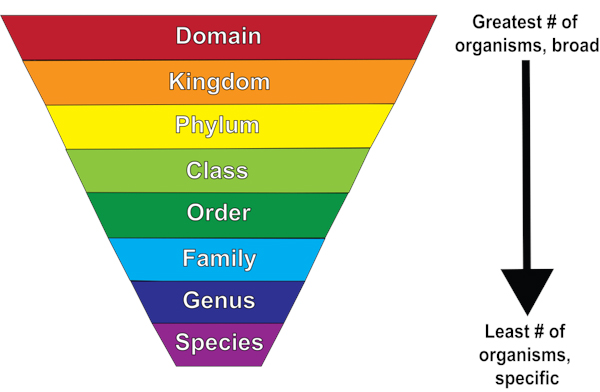
Eight Levels of Classification
Domain, Kingdom, Phylum, Class, Order, Family, Genus, Species
Modern Classification
Relies heavily on genetic similarities. Shown through Phylogeny and Cladistics. Ex: In 1866 only 2 classes, plantae and animalia, then single celled organisms came and became kingdom Monera.
Phylogeny
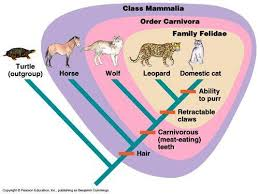
The evolutionary history for a group of species is called a phylogeny. Proposed evolution history of a species.
Cladistics
Classification based on common ancestry and evolutionary relationship. Goal is to place species in the order which they descended from a common ancestors
3 Domains
Domain Bacteria: Includes Prokaryotes, Kingdom Bacteria
Domain Archaea: Similar to eukaryotes, kingdom archaea.
Domain Eukarya: Includes all eukaryotes, Kingdom Protista, Plantae, Fungi, Animaliasss
Virus
Obligate intracellular parasites, goes from cell to cell, not all species are susceptible to the viruses, not all tissues are susceptible to the same virus.
Virus Structure
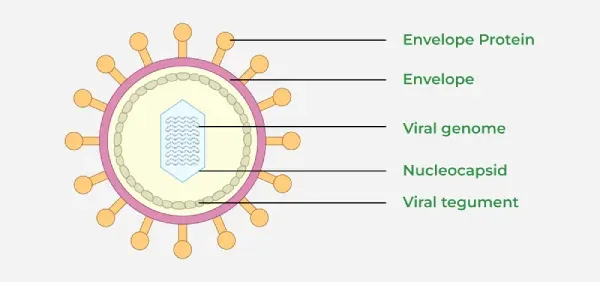
1) Genetic Material (DNA or RNA)
2) A Protein Shell = Capsid
3) Many have a lipid envelope.
Classification of Viruses
DNA Viruses Ex: Adenovirus, RNA Viruses Ex: Influenza, Bacteriophage.
Bacteriophage
Only infects bacteria and used in to treat bacterial diseases in humans when antibiotics dont work.
Viral Infection Cycle
1) Attaches to host cell.
2) Enters and the capsid falls apart.
3) Replication & gene expressions, releases copies of genome and sends info of what to copy, then gets uses ribosomes to create a capsid.
4) Assemble and leaves the cell to go infect another.
Steps: Attachment, Entry, Replication and Gene Expressions, Assembly, Release
Cytopathic Effects
Virus enters cell and makes all components to make more viruses, leads to cell dying and to creating more viruses
Vaccines
a new pathogen (thing that makes diseases) infects a person, introduces a new antigen (thing on viruses), for each new antigen, the immune system builds a specific antibody (senses antigen to fight viruses) .
It introduces the immune system to a pathogen before one occurs and preps the immune system for a future encounter.
Prokaryotes (Archaea and Bacteria)
Classified by their need of oxygen ( Obligate Aerobes ), are poisoned by oxygen (Obligated Anaerobes), can grow in areas with oxygen or no oxygen. Prokaryotes have similar structure and share similar processes Ex: Bacteria and Archaea. They reproduce asexually through binary fission and exchange genes in conjugation.
Prokaryote Structure that are similar.
Plasmid: a small piece of genetic material that can replicate separately form the prokaryote’s main chromosome.
Circular DNA and Ribosomes
Prokaryote Shapes
Classified by Shape:
Bacillus = Rod shaped, Coccus = Sphere, Spirilla = Spiral,
Classified by Arrangement:
Staph = Bunch of grapes, Strep = Chain
Archaea
Recently discovered, many of them live in extreme conditions and areas (Extremophiles), no obvious pathogens, found in almost every habitat.
Bacteria
It can make us sick by invading tissues and attacking cells or by making poisons that can be carried by blood to sites throughout the body. A toxin is a poison released by organism.
CAN BE DEALT WITH ANTIBIOTICS
Antibiotics
Chemicals that kill or slow the growth of bacteria, it stops bacteria from making cell walls.
Antibiotic Resistance in Bacteria
Resistance occurs after natural selection, where individuals who are more resistant survive and reproduce to make bacteria that can survive these antibiotics called Superbugs. Can cause overuse to favor the bacteria, underuse can cause them to become drug resistant, Misuse can cause them to become resistant to multiple antibiotics.
Protist
Single celled, most diverse kingdom, all a re eukaryotic, can be animal and fungus-like.
Fungi
No chlorophyll, heterotrophs, cell walls made of chitin (polysaccharide), decomposers, all are eukaryotic, most are multicellular, has no true roots.
Fungi Structure
1) Hyphae: Singular root of a fungi, cytoplasm can flow freely throughout it, surrounded by a plasma membrane and cell wall of chitin.
2) Mycelium: Is an underground network of hyphae.
3) Fruiting Body: Reproductive strucutre of a fungus that grows above ground. Ex: Mushrooms.
4) Spores: Things that is released from the fruiting body to spread.
Sac Fungi
Multicellular sac fungi, the sacs are called ascus that releases spores, morels, truffles, yeasts are single-celled sac fungi.
Bread Molds
Often found on spoiled food, spore producing structures are called Sporangia, at the tip of their hyphae.
Club Fungi
Their fruiting bodies look like clubs, releases their spores when someone strikes the mature fruiting body. Includes mushrooms, puffballs.
Mycorrhizal Relationship
Symbiosis/ mutualistic partnerships between fungi and the roots of certain plants. Fungus helps aids in nutrient and water absorption in exchange for carbohydrates (sugars) produced by the plant.
Incomplete Dominance
Heterozygous phenotype is somewhere between the two homozygous phenotypes. Neither of the alleles are dominant or recessive. Ex: Red Allele R + White Allele W RW = Pink color
Codominance
Alleles of a gene being expressed completely, where none is dominant or recessive. Both traits are fully and separately expressed. Ex: Red Allele + White Allele = Some red spots and some white spots.
Multiple Alleles
When there are more than 2 alleles possible for a specific trait. Ex: For blood, there’s A,O,B but a person can only inherit 2 of those, so there can be 2 versions of 1 gene but will result in only 1.
Polygenic Traits
Traits produced by two or more genes. Result from the interaction of 2 or more genes “Continuous Traits”. Ex: Human skin color trait is result of 4 genes interacting with eachother.
Epistasis
There can be a gene that can overshadow other genes which can affect the trait. Ex: Albinism, one gene will overshadow all the other genes that make you a different skin color and the albinism gene will make affect your trait and make your phenotype be all white.
Sex-linked Traits
XX genotype = Female, XY = Male. Females can only pass an X and male can pass X or Y. Y chromosome is responsible for male characteristics. In males there are no second copies of sex linked genes to mask the effects of another allele, which means they will express all their sex linked genes from the X chromosome given from the female. Females can be carriers of sex linked traits since they have both X chromosomes where one allele from 1 X chromosome could overshadow the other allele if it’s dominant. Ex: if female has hemophilia and ahs offspring as male, male will also have hemophilia.
Environment influencing phenotypes.
Phenotypes are just not everything, it gives a tendency for someone to be short or tall but it can also be affected by other means.
Ex: Temperature can affect offspring of turtles, Nutrients: if a bee gets royal jelly it can become a queen bee. (Continuous Traits: Can show wide range of results based on the genes and the environment)
Dominant vs Recessive Disorders
Recessive: 2 copies of the recessive allele must be present, often appear in offspring of parents who are both heterozygotes. Ex: Cystic fibrosis will occur when there are 2 recessive alleles (cc), and offspring that don’t have it Cc, will be a carrier.
Dominant: Shown when there’s 1 copy of the dominant disorder allele. Ex: Huntington’s disease will show when there’s 1 copy of the dominant allele.
Evolution
Slides: Change in allelic frequencies/ genetic makeup in a population over generations
Book: Process of biological change by which descendants come to differ from their ancestors.
Population
All the individuals of a species that live in an area. Some individuals had variations that were particularly well suited for their environment, but some weren’t. Darwin proposed that these adaptations arose over many generations.
Allelic Frequencies and Gene Pool
Allelic Frequencies: Refers to percentage of a specific allele in a population’s gene pool, which shows the preference of the animals to their surroundings and what alleles and traits are preferred in the area. Can change due to environment, mutation, natural selection, migration etc.
Gene Pool: Collection of all alleles in the whole population, which shows the allelic frequencies of a certain area.
Darwin’s Thinking
1) Overproduction leads to competition. (Based on the idea from Thomas Malthus) Ex: Too much ppl, not enough food which outpaces production and competition.
2) Variation exists within populations. Heritable differences or variations that exist within a population from other individuals in the group which is a basis for natural selection. Differences in genetic material of organisms whether inherited or resulting from a genetic mutation.
3) Adaptation allows for an organism to survive better in the environment and can lead to genetic change in a population over time. This also allows it to compete better against other individuals. Allows the ones with favored genetics to live longer and produce more offspring to share those adaptations.
4) Species have capacity for modifications. Artificial Selection where picking which traits are favorable and then breed those individuals to show those traits and trait must be heritable which makes it passed down through generations.
Natural selection mechanism is where each slight variation if useful, is preserved.
Darwin’s Voyage
1) Endemic but similar species: Species that live in a specific area but are similar to species elsewhere. Ex: Galapagos Islands animals are similar to mainland, but adapt differently to each island. Shows adaptation and variation due to environment.
2)Adaptation of similar species to different habits: Species adapt to different environment and causes them to develop different traits. Turtles with long necks live in tall plant areas, and shorter necks live in wet areas rich in moss and short plants.
4 Principles of Natural Selection.
Adaptation: Individuals possessing a favorable trait is more likely to survive and reproduce, and make them compete against others and the environment better, making more offspring inherit those traits.
Descent w/ Modification: Over generations, more individuals in the population will have the trait that benefits them the most.
Overproduction leads to competition: More offspring = more chance of survival, but increases competition due to which one having the more favorable trait and just the competition to gain food.
Variation exists in a population: The heritable differences or variations that exist in every population from other individuals in a group is the basis for natural selection.
Normal Distribution
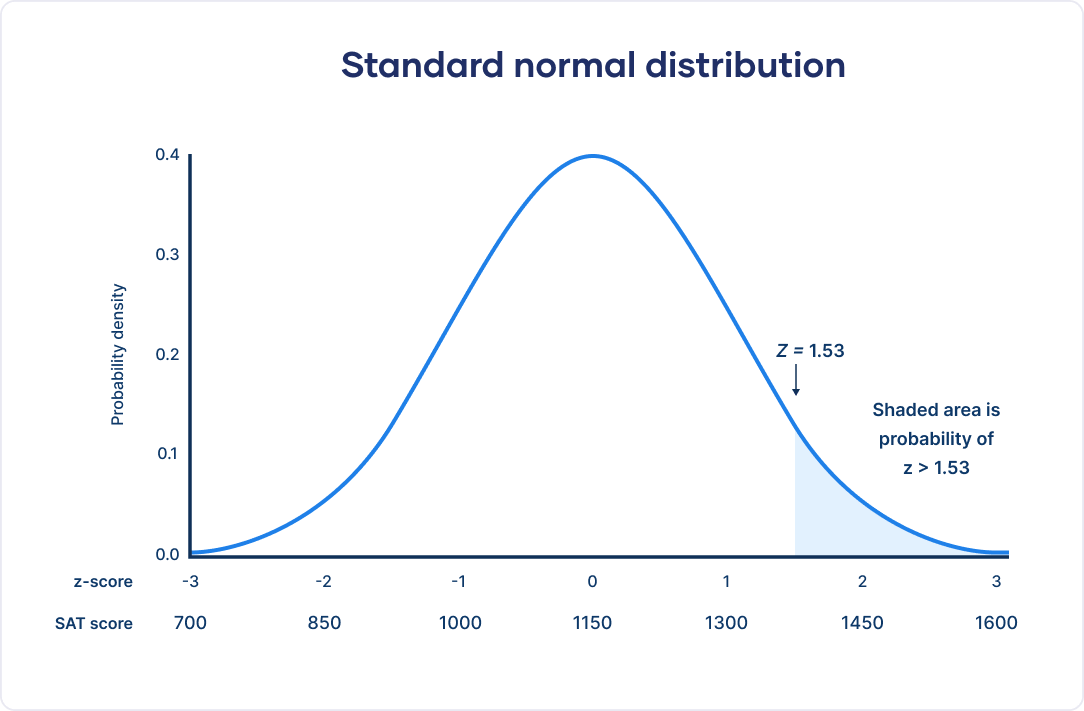
Frequency is highest near the mean value and decreases toward each extreme end of the range. For some traits, all phenotypes provide equal chance of survival, but Environmental changes can cause certain phenotypes to be advantage which can increase the allelic frequencies.
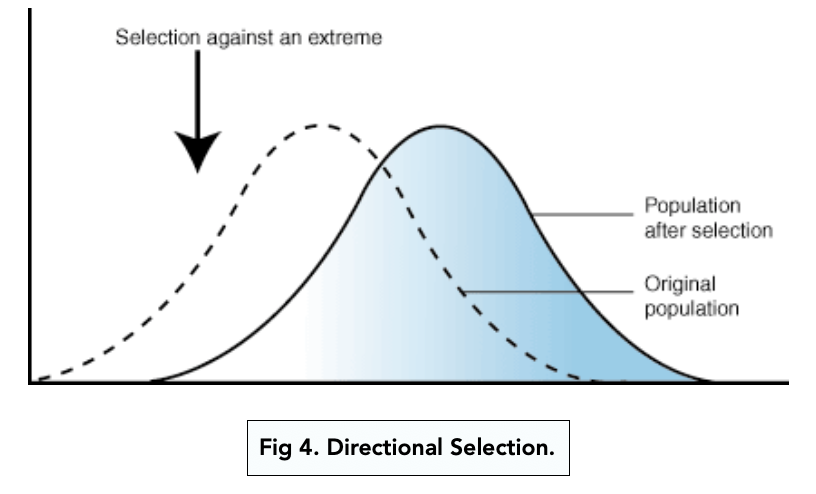
Directional Selection
Selection that favors phenotypes at one extreme of a trait’s range. Can cause a shift in a population phenotypic distribution. An extreme phenotype will soon become more common. Ex: Bacteria now that have a higher level of drug resistance is more abundant, before it wasn’t important so there was less allelic frequencies for drug resistance, but now it’s shifting to the extreme allele of having higher level of drug resistance.
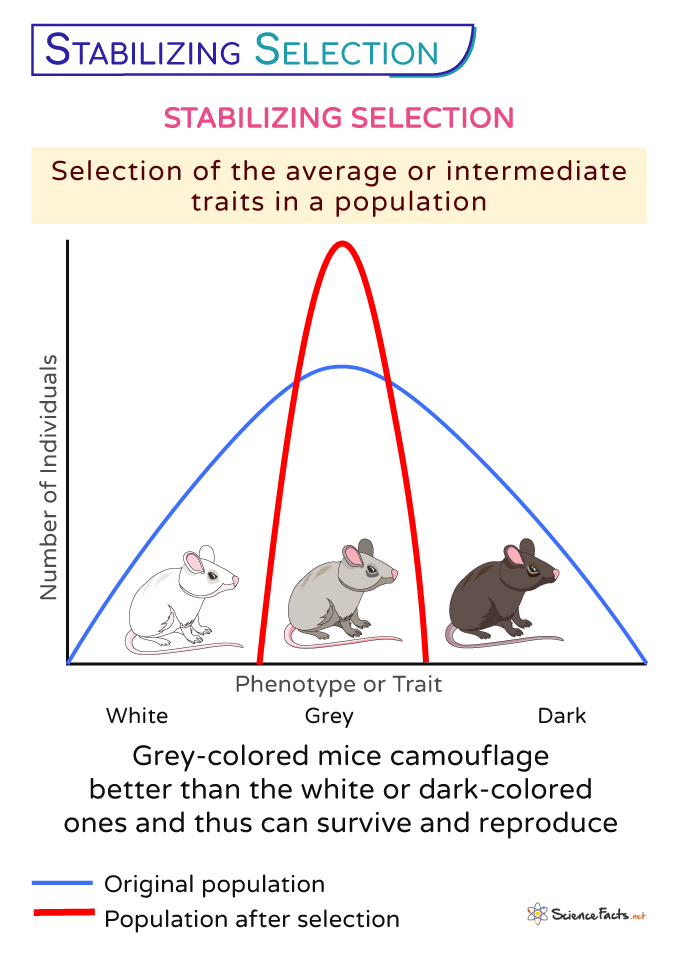
Stabilizing Selection
The intermediate phenotype is favored and becomes more common in the population, decreases the amount of extreme amount of phenotypes and doesn’t make the graph shift to 1 extreme phenotype. Unusually high allelic frequency in the mean. Ex: Grey mice camouflage better than white or black which makes them able to reproduce and make the allelic frequency close to the mean.
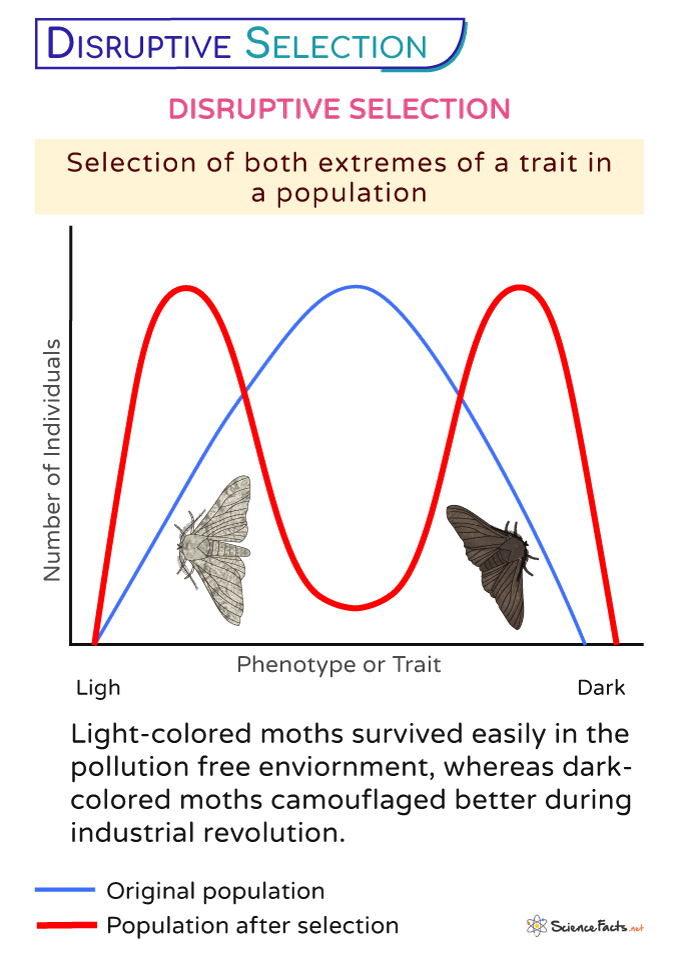
Disruptive Selection.
Occurs when both extreme phenotypes are favored, while individuals with intermediate phenotypes are selected against by something in nature. Occurs when both extreme phenotypes are favored by selection. Ex: Light colored moths and dark colored moths survive better than grey moths, so there is an abundance at the 2 extremes.
Process of Speciation
1) Populations are geographically isolated from each other ( can’t mate )
2) Mutation and natural selection may lead to differentiation.
3) Differences may lead to reproduction Isolation (Given the opportunity, they wont mate)
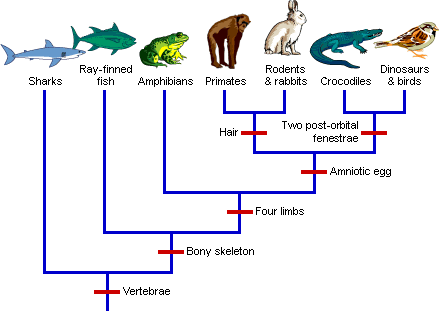
Phylogenetic Tree
Represents a proposed evolutionary history of a group of species
Why Cells Divide
To have a higher SA/V ratio to make them more efficient at importing and exporting materials.
Chromosome Composition
Chromatin, Chromatid, Centromere
Chromatin
DNA + Protein
Chromatid
One half of a duplicated chromosome.
Centromere
Sister chromatids held together the two sister chromatids, a region where the condense chromosome looks pinched.
Cell Cycles
Interphase: G1, S Phase and G2, Mitosis, Cytokinesis.
Interphase Phases
G1: Growth an organelle replication, S phase: Synthesis is replication of the DNA, G2: Preparation for division.
Mitosis Phases
Prophase, Metaphase, Anaphase, Telophase
Prophase
The nuclear envelope breaks down and centrioles and spindle fibers form, then chromosomes condense.
Metaphase
The chromosomes line in the middle of the cell, then the spindle fibers attach to centromeres.
Homologous chromosomes: They dont pair up with each other, but stay in a single line.
Anaphase
Sister chromatids of the duplicated chromosomes are separated.
Cytokinesis
Division of the whole cells, which produces two genetically identical daughter cells.
Traits
Distinguished characteristics that are inherited.
Genetics
Study of biological inheritance patterns and variation.
Genes
The genetic code that allows for people to see traits.
Allele
Any forms of a specific gene. Each gene, for homologous chromosomes, the alleles can be same or different. Ex: Mom’s Allele in Chr 15, Eye Color: Blue, Dad’s could be Brown.
Genotypes
Refers to the genetic makeup of a specific gene or a set of genes either being Heterozygous or Homogzygous.
Heterozygous
1 Dominant Allele and 1 recessive allele
Homozygous
either 2 Dominant Alleles or 2 Recessive Alleles
Phenotypes
Physical characteristics or traits of an individual.
Mendel’s Experiment
He used a purebred purple flower and a purebred white flowers and made them mate. If the flowers came out Purple, that means the dominant allele is the purple one. As he let them self pollinate, some came out white and purple, which meant that recessive alleles aren’t disappeared when joined with the dominant allele, but just hidden.
Mendel’s Law of Dominance
Some alleles are dominant and some are recessive.
Dominant: Always expressed no matter matched with recessive or not.
Recessive: Only expressed when there are 2 copies.
Mendel’s Law of Segregation
Each parent can only donate 1 copy of each gene to their offspring (1 Allele from the parent), the 2 copies (2 Alleles parents have) that come from the parent are separated during Meiosis 1 (Formation of Gametes) Each offspring will inherit two copies (2 Alleles total) of each gene (1 from each parent)
Somatic Cells
Are also called body cells and make up your body’s tissues and organs.
Gametes
Sex cells, Haploid, DNA in gametes are passed to your children. (Each gamete has 1 allele from their mom or dad)
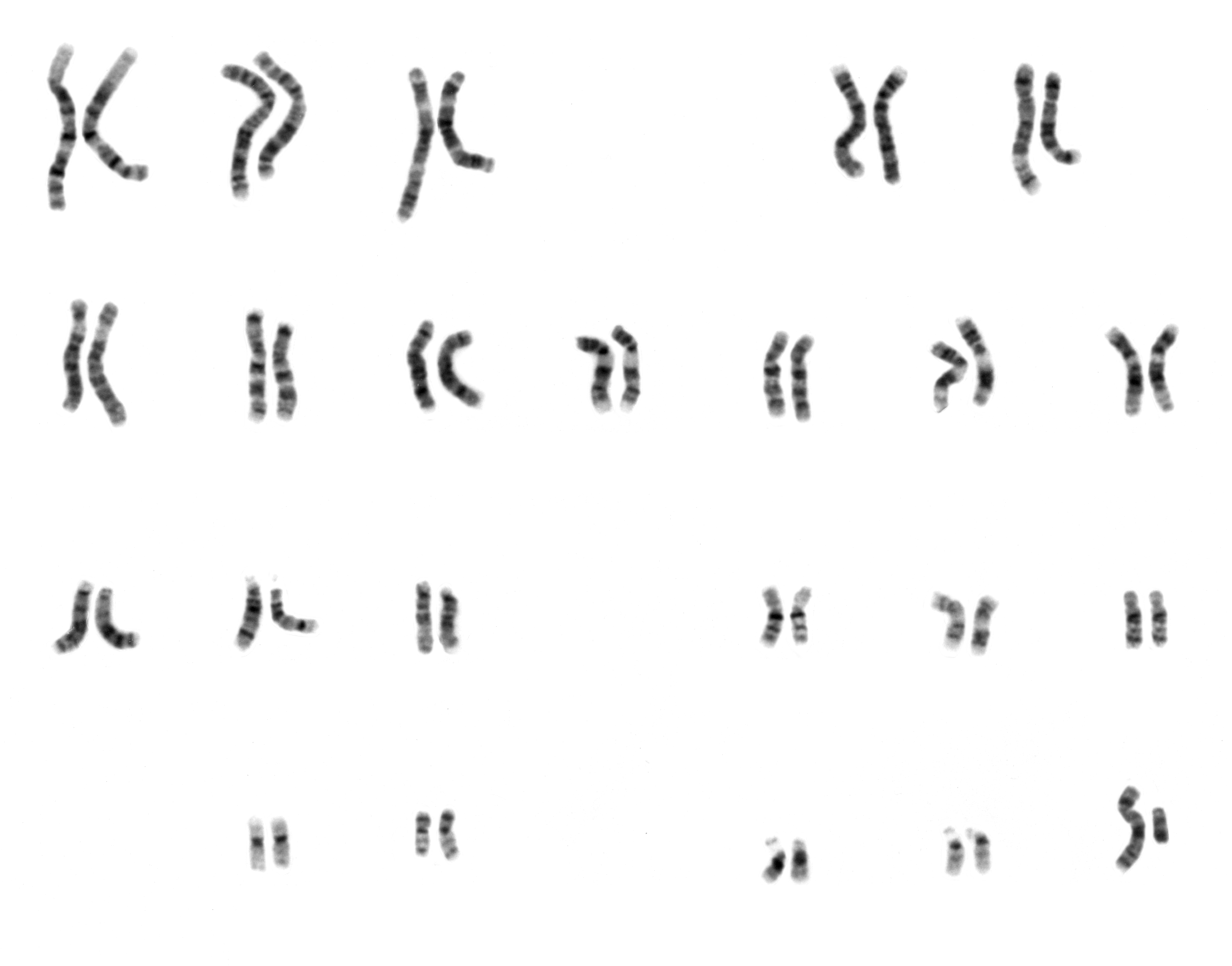
Karyotypes
Stains that organize the pairs of the homologous chromosomes.
Mitosis VS Meiosis
Mitosis: Produces genetically identical cells, happens all the time and is involved in asexual reproduction.
Meiosis: Produces unique cells, results in haploids and takes place at a certain time, and happens in sexual reproduction.
Homologous Chromosomes
Diploid, has 1 duplicated chromosomes from mom and 1 from dad. Genes for the same traits are all in the same location. Ex: Chromosome 6 = Eye Color (dad) Chromosome 6 = Eye Color (Mom)
Diploid
Has 2 copies of each chromosome: One chromosome from mom and one chromosome from dad.
Haploid
The cell has only 1 copy of each chromosome: One chromosome from dad, or one chromosome from mom.
Meiosis 1 Process
After duplicating during S phase, have 23 duplicated chromosomes of paternal and 23 duplicated chromosomes from maternal. Total 46 duplicated chromosomes.
Prophase: Nucleus envelope breaks and paternal and maternal chromosomes join to become a pair, lining up with the same genes and condensing.
Metaphase: They then move to the middle, spindle fibers and centrioles form. They are lined up randomly. Ex: 1st set of chromosomes; on the left side could be Mom’s chromosomes but for the 2nd set, the left side could be Dad’s chromosomes
Anaphase: The homologous chromosomes separate, and then each cell should have 23 duplicated chromosomes, mix of mom and dad (HAPLOID SINCE NOW CONTAINS ONLY 1 COPY OF CHROMOSOMES FROM EITHER DAD OR MOM Ex: Before: Cell would have alleles of mom AND dad for eye color, but now have only alleles from either mom OR dad.)
Meiosis 2 Process
Now, the new cells are duplicated already so no need to go through interphase or mitosis.
Prophase: Nuclear envelope/membrane breaks down, and spindle fibers and centrioles form.
Metaphase: Moves all the duplicated chromosomes to the middle. (23 Duplicated Chromosomes total)
Anaphase: Separates the sister chromatids, forming 2 more cells with each cell having 23 UNDUPLICATED chromosomes in each cell. (NOW THEY ARE COMPLETELY GENETICALLY UNIQUE AND ARE HAPLOID)
Law of Independent Assortment
The inheritance of one trait doesn’t affect the other. Alleles of different genes isolate independently during gamete formation Ex: The allele of your hair color wont affect your eye color".
IF BOTH ALLELES ARE ON THE SAME CHROMOSOME THIS LAW DONT WORK
Sexual Reproduction
Requires Meiosis (Separation of Diploids) and then Fertilization (Recombination)
Human Body Cells Have
1-22 Autosomes, X and Y chromosomes (23rd pair)
Dihybrid Cross
Inheritance of 2 traits at the same time, always go into a ratio of 9:3:3:1
plants
multicellular, eukaryotic, autotrophs, cell wall made of cellulose
seedless nonvascular plant
spores, tiny haploid, repoductive cells designed for dispersal. Produced by seedless plant. grow close to ground to absorb water and nutrient, rely on water for reproduction. Ex: mosses
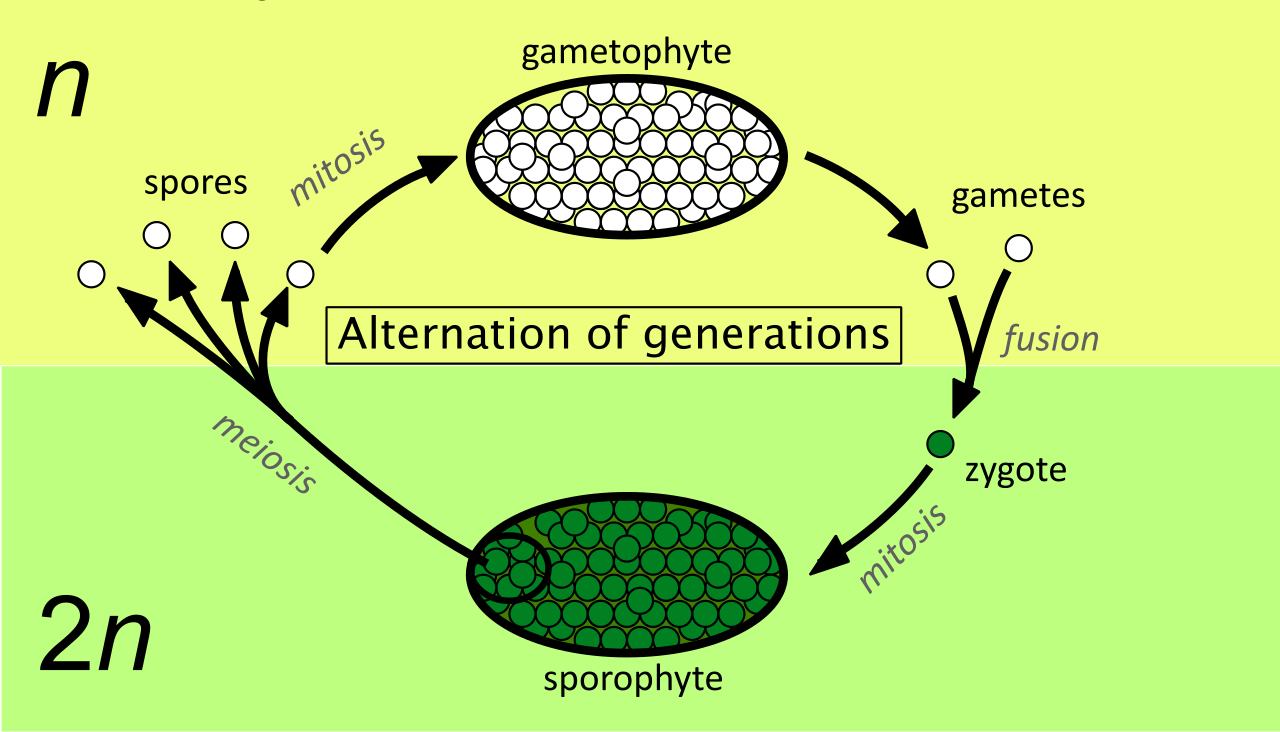
alternation of generations
mitosis, gametophyte, mitosis, gametes fuse to from zygote, then goes through mitosis to form sporaphyte, and meiosis then turns into spores.
seedless vascular plants
grows higher off the ground, nheeds water for reproduction. Ex: ferns, belong to phylum pterophyta. known for large leaves called fronds
seed bearing plants
contain embryo, food and a coat, allows plants to disperse to new place, protects the embryo from dehydration.
gymnosperms
vascular plant whose seeds are not enclosed in a fruit, naked seeds, most are cone bearing. Ex: conifers, most common gymnosperm.
angiosperm
vascular plants are enclosed in a fruit, enclosed seed, belongs to phylum anthophyta, sepals are outermost layer of developing flower used for protection.
stamen
male part of flower for seed bearing plants, anther produces pollen grains, filament supports the anther.
carpel
the female structure, has a stigma which is a sticky tip, style a tube leading from stigma to ovary. ovary produces female gametophyte.
pollination
transfer of pollen from antehr to stigma, 2 types: wind and animal
wind: small flowers/ large amounts of pollen
animal: have larger flowers/less pollen
pollen grain
produced in anthers by meiosis into male gametophyte and forms 2 haploid cells, gebnerative cells, tube cell.
fertilization
tube cell forms pollen tube, generative cell forms 2 sperm cell that ravel down tube, one sperm fuses w egg and other with the polar nuclei