chapter 33 study guide part 1
 Call Kai
 Learn
Learn Practice Test
 Spaced Repetition
 Match
Match Flashcards
 Knowt Play
1/59

There's no tags or description
Looks like no tags are added yet.
Name | Mastery | Learn | Test | Matching | Spaced | Call with Kai |
|---|
No analytics yet
Send a link to your students to track their progress
60 Terms
1. What are sponges and what phylum do they belong to?
Sponges are in phylum Porifera and are considered basal animals because they lack true tisses.
1a. What are the body plan characteristics of sponges
- asymmetrical
- lack true tissues
- lack a body cavity (acoelomate)
- body is full of pores (ostia) that allow water flow
- stationary (sessile)
sponge characteristics
Body plan: asymmetrical, no tissues, acoelomate, pores (ostia/osculum), sessile
Digestion: intracellular only (choanocytes + amoebocytes)
Reproduction: hermaphroditic; sexual + asexual (budding/fragmentation)
Excretory/Circulatory: none (diffusion)
2a. What is intracellular digestion and what animals use it?
- Intracellular digestion occurs inside cells. Food particles are engulfed by cells via phagocytosis and digested in food vacuoles using lysosomal enzymes.
- Occurs in: sponges (primary method)
2b. Describe how sponges feed.
Sponges are filter feeders:
- Water enters through ostia (pores)
- Moves through canals into central cavity
- Exits through osculum
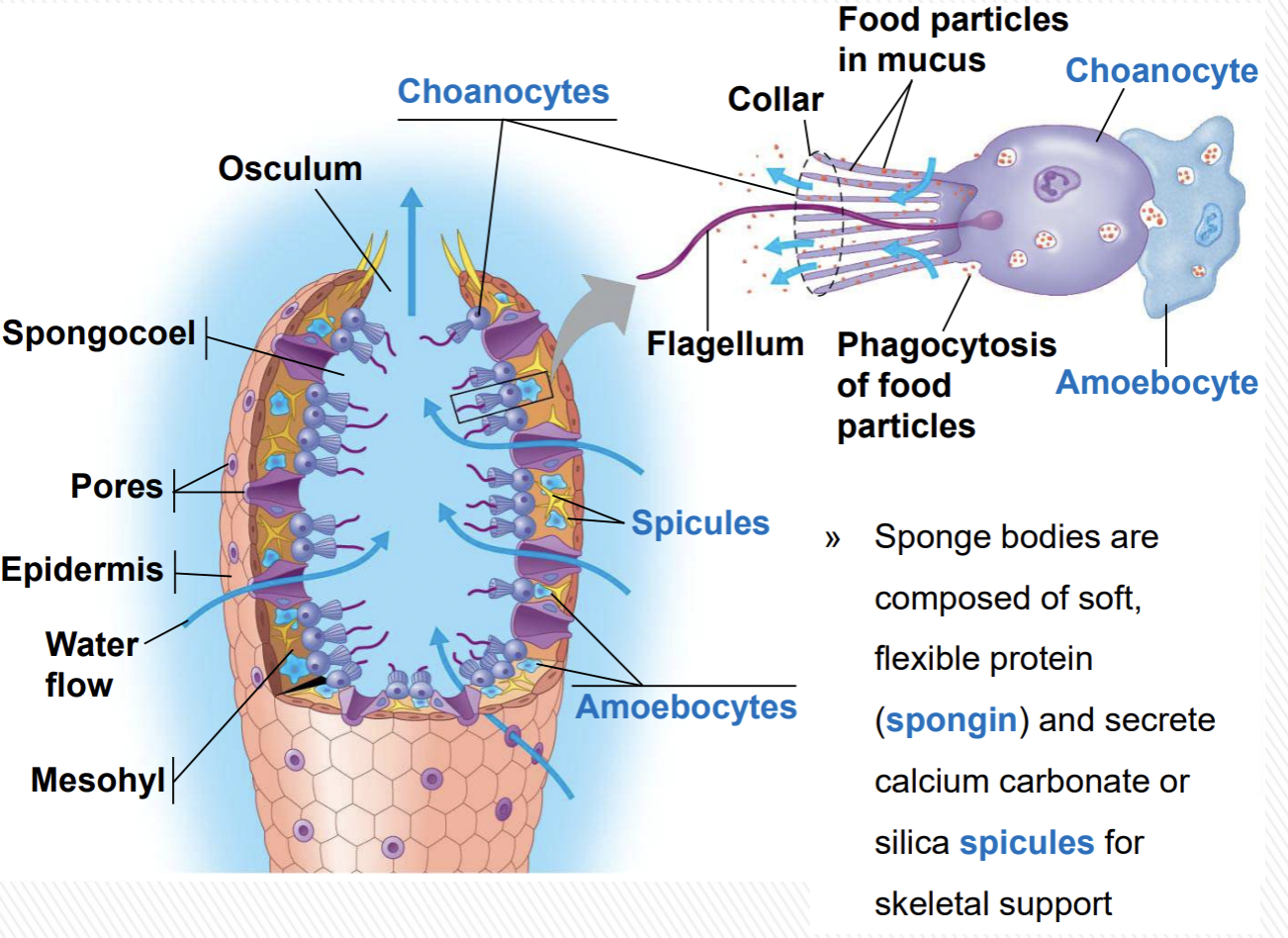
2b. What are the roles of choanocyte cells and amoebocyte cells in sponges?
Choanocytes create water currents and trap food particles, while amoebocytes digest the food and distribute nutrients throughout the sponge.
2c. What is extracellular digestion and what animals use it?
Extracellular digestion occurs outside cells, within a digestive cavity or tract where enzymes break down food.
- Found in: cnidarians, flatworms, molluscs, annelids, and most animals
- More efficient and allows larger body size
3. What are cnidarians and what phylum do they belong to?
Cnidarians belong to Phylum Cnidaria (eumetazoans). They include hydra, jellyfish, corals, and sea anemones.
cnidarian characteristics
Body plan: radial symmetry, diploblastic, acoelomate, polyp & medusa forms
Digestion: gastrovascular cavity (1 opening); extracellular + intracellular
Structures: tentacles with cnidocytes (nematocysts)
Reproduction: asexual (budding) + sexual (often medusa stage)
Excretory/Circulatory: none (diffusion + gastrovascular distribution)
3a. Describe the polyp and medusa forms of cnidarians
The polyp form is sessile (attached), cylindrical in shape, with tentacles and the mouth facing upward, while the medusa form is free-swimming, bell-shaped, with tentacles and mouth facing downward.
Polyp:
- Asexual reproduction common
- Example: Hydra, coral
Medusa:
- Sexual reproduction stage
- Example: jellyfish
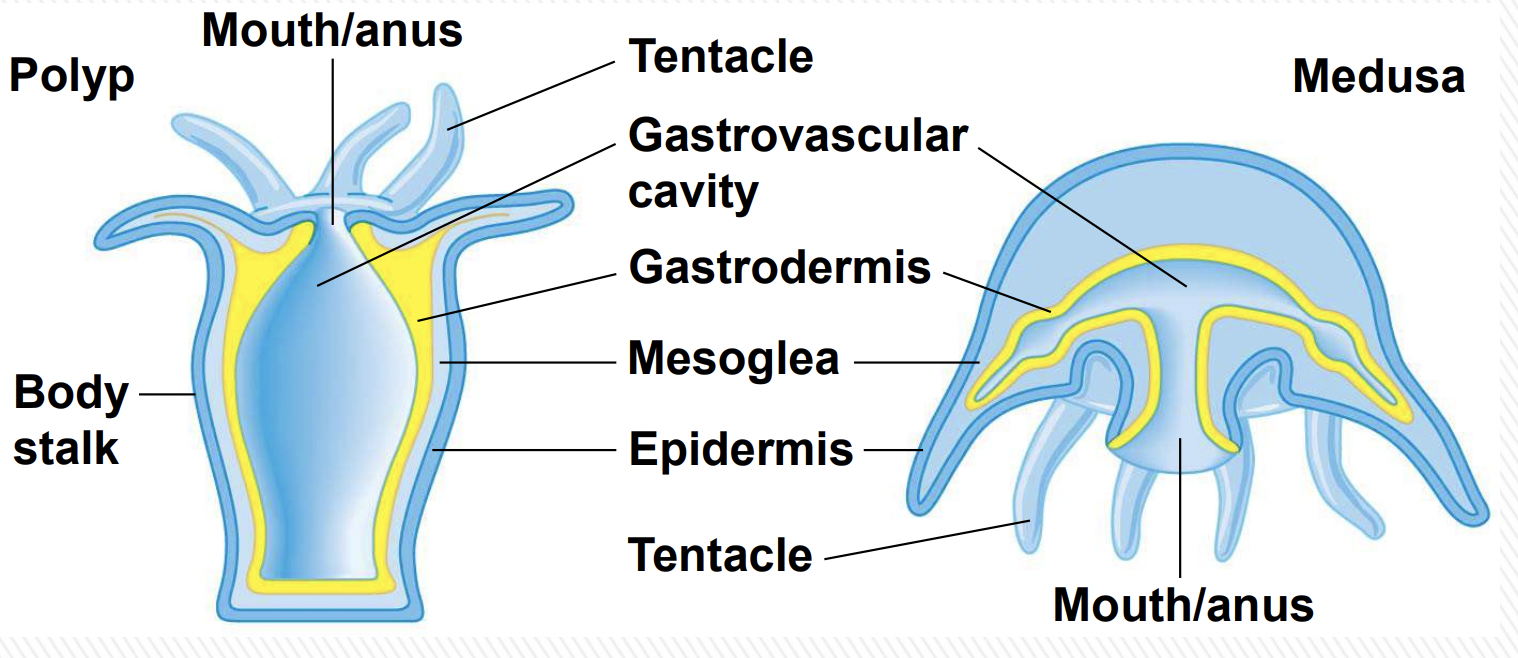
3a. Describe the body plan characteristics of cnidarians
- radially symmetrical
- diploblastic
- without a coelom (acoelomate)
- single opening (mouth = anus)
- central digestive cavity: gastrovascular cavity
4. What is a gastrovascular cavity?
A gastrovascular cavity is a central digestive chamber with a single opening that functions in digestion, distribution of nutrients, and gas exchange.
4a. Describe how the hydra uses a gastrovascular cavity to feed.
1. Tentacles capture prey
2. Prey enters mouth
3. Enzymes digest food in cavity
4. Nutrients distributed through branched cavity
4b. What are the function of radial canals in jellies?
Radial canals distribute nutrients from central stomach throughout body and connect to circular canal for circulation of materials.
5. Describe the structure and function of the stinging cells for which cnidarians are named.
Cnidocytes: specialized stinging cells used for defense and prey capture
Nematocysts: organelles inside cnidocytes that explosively fire a barbed thread with toxins
Function:
- Immobilize prey
- Defense against predators
6. Describe the general characteristics of hydrozoans.
Hydrozoans are cnidarians that often alternate between polyp and medusa forms, with the polyp stage typically being dominant, and they commonly reproduce asexually by budding and sexually through medusae.
6. Describe the general characteristics of scyphozoans.
Scyphozoans are cnidarians in which the medusa form is dominant, meaning they are mostly free-swimming jellyfish, and they typically have a reduced or brief polyp stage.
6. Describe the general characteristics of anthozoans.
Anthozoans are cnidarians that exist only in the polyp form and include corals and sea anemones, many of which live in the ocean and form hard skeletons or symbiotic relationships with algae.
7. What are flatworms and what phylum do they belong to?
Flatworms belong to Phylum Platyhelminthes within Lophotrochozoa (Bilateria). They include free-living forms like planarians and parasitic forms like flukes and tapeworms.
flatworm charcteristics
Body plan: bilateral, triploblastic, acoelomate, flattened
Digestion: gastrovascular cavity (1 opening)
Gas exchange: diffusion across body surface
Reproduction: hermaphroditic; sexual + asexual (fission/regeneration)
7a. Describe the body plan characteristics of flatworms
- bilaterally symmetrical
- triploblastic
- without a coelom (acoelomates).
7b. Why are flatworms flat?
Flatworms are flat to increase their surface area, allowing for efficient gas exchange and nutrient distribution by diffusion since they lack a circulatory system.
7b. Describe the digestive system of flatworms.
- Have a gastrovascular cavity
- Only one opening (mouth = anus)
- Highly branched cavity distributes nutrients
- Digestion is extracellular first, then intracellular
7b. Describe the excretory system of flatworms.
- Use protonephridia (flame cells)
- Ciliated cells that push fluid through tubules
- Remove excess water and metabolic waste
- Maintain osmotic balance
7b. Where does gas exchange take place in flatworms?
Gas exchange takes place across the surface, and protonephridia or flame cells, regulate the osmotic balance
7c. What ways can a planarian reproduce?
Sexual reproduction:
- Hermaphrodites (both male and female reproductive organs)
- Cross-fertilization is common
Asexual reproduction:
- Fission (splitting into two)
8. What are rotifers and what phylum do they belong to?
Rotifers belong to Phylum Rotifera. They are microscopic but complex animals found in freshwater, marine, and moist soil environments.
rotifer characteristics
Body plan: bilateral, triploblastic, pseudocoelom, microscopic, ciliated corona
Digestion: complete digestive tract (alimentary canal)
Structures: trophi (jaws)
Reproduction: parthenogenesis (mostly female), some sexual
Excretory/Circulatory: no circulatory system; pseudocoelom distributes materials
8a. Why are most rotifers female?
- Most reproduce through parthenogenesis
- Females produce eggs without fertilization
- Males are rare or seasonal in many species
- Allows rapid population growth in stable environments
8a. How do rotifers move and feed?
Movement
- Move using a corona (crown of cilia)
- Cilia beat to:
Pull them through water
Direct food toward mouth
Feeding
- Suspension feeders
- Use cilia to draw in particles
- Food is ground by trophi (jaw-like structures) in the pharynx
8b. Describe the body plan characteristics of rotifers
- bilaterally symmetrical
- triploblastic animals
- complete digestive tract
- pseudocoelom
8c. What is the evolutionary advantage of a complete digestive tract (alimentary canal)?
A complete digestive tract allows food to move in one direction from mouth to anus, making digestion more efficient because different regions can specialize in digestion and absorption.
8c. What are some invertebrate animals that have an alimentary canal?
Rotifers
Molluscs
Annelids
Arthropods
Vertebrates
9. What are molluscs and what phylum do they belong to?
Molluscs belong to Phylum Mollusca. They are soft-bodied animals, many with external or internal shells, and include snails, clams, squids, and octopuses.
phylum mollusca classes
˃ Gastropoda (snails and slugs)
˃ Bivalvia (clams, oysters, and other bivalves)
˃ Cephalopoda (squids, octopuses, cuttlefish,
and chambered nautiluses)
9a. Describe the general body characteristics of molluscs.
- bilaterally symmetrical
- triploblastic animals
- complete digestive tract
- true coelom (eucoelomates).
molluscs characteristics
Body plan: bilateral, triploblastic, coelomate; foot, visceral mass, mantle
Digestion: complete digestive tract; radula (except bivalves)
Reproduction: mostly dioecious; trochophore larva; glochidium (mussels)
Circulatory: open (most), closed (cephalopods)
Excretory: nephridia-like organs
9b. Describe the general body plan that all molluscs share.
All molluscs share three main structures:
- Muscular foot: movement or attachment
- Visceral mass: internal organs (digestive, reproductive, excretory)
- Mantle: tissue that secretes shell (if present)
9c. What is the difference between an open and a closed circulatory system?
In an open circulatory system, the circulatory fluid (hemolymph) flows freely through body spaces, while in a closed circulatory system, blood is contained within vessels and remains separate from the interstitial fluid.
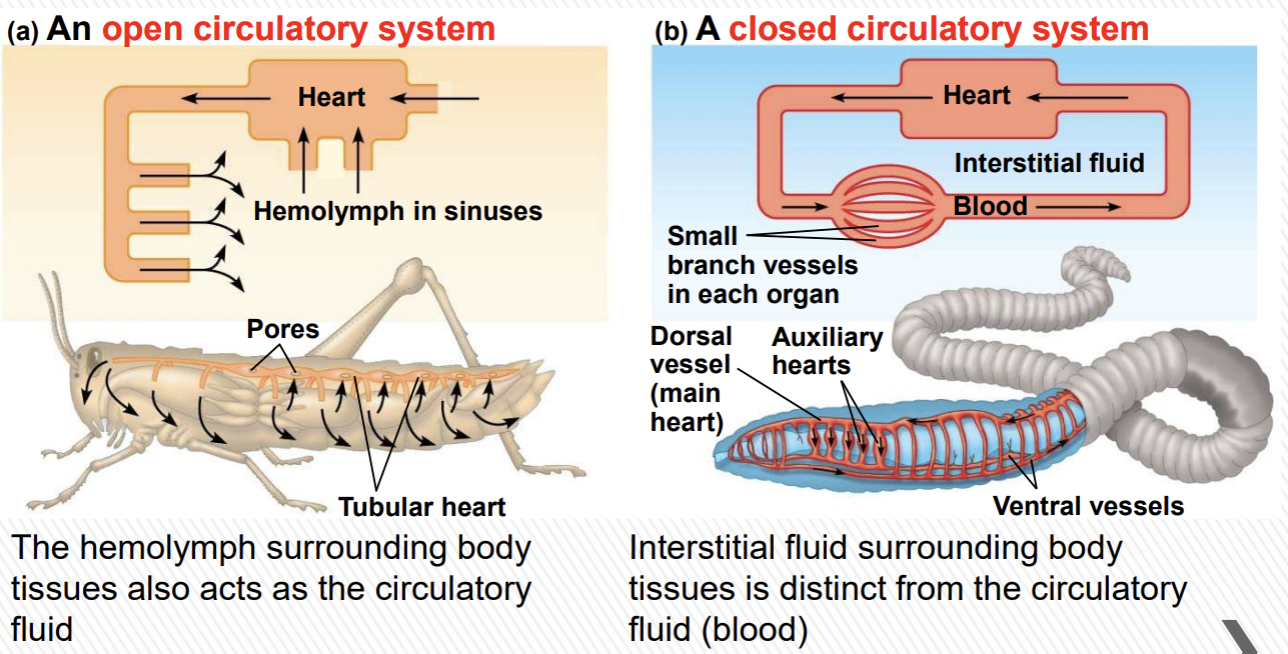
9c. Which animal groups have an open circulatory system?
Most molluscs
Arthropods
9c. Which animal groups have a closed circulatory system?
Annelids
Cephalopods
Vertebrates
9c. Which group of molluscs have a closed circulatory system?
Cephalopods
9d. What is a trochophore?
Trochophore larva:
- Free-swimming larva
- Dispersed by ocean currents
9d. What is a glochidium?
Glochidium (freshwater mussels only):
- Parasitic larva
- Attaches to fish gills
- Develops while using host nutrients
- Helps spread upstream populations
9d. Explain how freshwater mussels distribute their offspring upstream.
Freshwater mussels release larvae called glochidia that attach to fish gills or fins; the fish then carry them upstream, and the larvae later detach and develop into adult mussels in new locations.
9e. Describe the general characteristics, feeding, and or reproductive methods of class gastropoda.
1. Gastropoda (snails, slugs)
- Move using muscular foot (gliding motion)
- Undergo torsion during development
- Shell present in snails, absent in slugs
- Use radula (rasp-like feeding structure)
- Mostly herbivores, some predators
9e. Describe the general characteristics, feeding, and or reproductive methods of class bivalvia.
2. Bivalvia (clams, oysters, mussels)
- Two-part shell (valves)
- No head or radula
- Suspension feeders
- Feed by filtering water through gills
- Use incurrent and excurrent siphons
- Mostly sedentary
9e. Describe the general characteristics, feeding, and or reproductive methods of class cephalopoda.
3. Cephalopoda (squid, octopus, nautilus)
- Highly intelligent predators
- Foot modified into tentacles and siphon
- Closed circulatory system
- Jet propulsion movement
- Complex nervous system
9e. Which of the cephalopods has retained their external shell?
Nautilus
9e. Which cephalopod has a reduced internal shell?
Squid
10. What are annelids and what phylum do they belong to?
Annelids belong to Phylum Annelida and are segmented worms, polychaetes, oligochaetes (i.e. earthworms), and leeches.
annelid characteristics
Body plan: bilateral, triploblastic, coelomate, segmented (“tube within a tube”)
Digestion: complete digestive tract
Reproduction: mostly hermaphroditic; cross-fertilization; some asexual
Circulatory: closed
Excretory: metanephridia
10a. Describe the body plan charcteristics of annelids.
- bilaterally symmetrical
- triploblastic animals
- true coelom (eucoelomates)
- segmented body (metamerism)
10b. Do annelids have a closed or open circulatory system. Explain.
Closed circulatory system
- Blood confined to vessels
- Includes dorsal and ventral vessels
- Pumped by aortic arches ("hearts")
10c. Briefly describe the digestive and excretory system of annelids.
Digestive system
- Complete digestive tract
- Specialized regions (mouth → pharynx → intestine → anus)
- Efficient nutrient absorption
Metanephridia
- Found in each segment
- Collect coelomic fluid
- Reabsorb nutrients
- Excrete waste via pores
10c. How does the digestive and excretory systems of annelids compare to flatworms?
Comparison to flatworms
- Flatworms → flame cells (simpler, less efficient)
- Annelids → metanephridia (more advanced, selective reabsorption)
10c. Annelid anatomy can be described as having "a tube within a tube" body plan. Explain.
Annelids have a “tube within a tube” body plan because the digestive tract is a tube inside the body wall, and it is surrounded by a fluid-filled coelom that separates it from the outer body and allows movement and organ support.
10d. Describe the morphological differences and similarities between polychaetes and earthworms.
Polychaetes
- Mostly marine
- Have parapodia
- Used for movement and gas exchange
- Many bristles (chaetae)
Earthworms (Oligochaetes)
- No parapodia
- Move using two muscle layers:
Circular muscles → elongate body
Longitudinal muscles → shorten body
- Hydrostatic skeleton helps movement
- Hermaphroditic but cross-fertilize
- Important for soil nutrient cycling
10d. What structures do polychaetes use for movement?
Polychaetes have a pair of paddle-like or ridge-like structures called parapodia ("beside feet") on each body segment
10d. Describe how the earthworm uses two sets of muscles to move.
- The longitudinal muscles make up the inner layer of muscle. When they contract, the worm gets shorter.
- The circular muscles surround the longitudinal muscle. When they contract, the worm gets thinner.