Chapter 7 Social Psychology
 Call Kai
 Learn
Learn Practice Test
 Spaced Repetition
 Match
Match Flashcards
 Knowt Play
1/27

There's no tags or description
Looks like no tags are added yet.
Name | Mastery | Learn | Test | Matching | Spaced | Call with Kai |
|---|
No analytics yet
Send a link to your students to track their progress
28 Terms
Social Influence
Process whereby attitudes and behavior are influenced by the real or implied presence of other people
Norms
Attitudinal and behavioral uniformities that define group membership and differentiate between groups
Compliance
Superficial, public and transitory change in behavior and expressed attitudes in response to requests, coercion, or group pressure
Reference Group
Kelley’s term for a group that is psychologically significant for our behavior and attitudes
Membership Group
Kelley’s term for a group to which we belong by some objective external criterion
Dual-process Dependency Model
General model of social influence in which two separate processes operate—dependency on others for social approval and for information about reality
Power
Capacity to influence others while resisting their attempts to influence
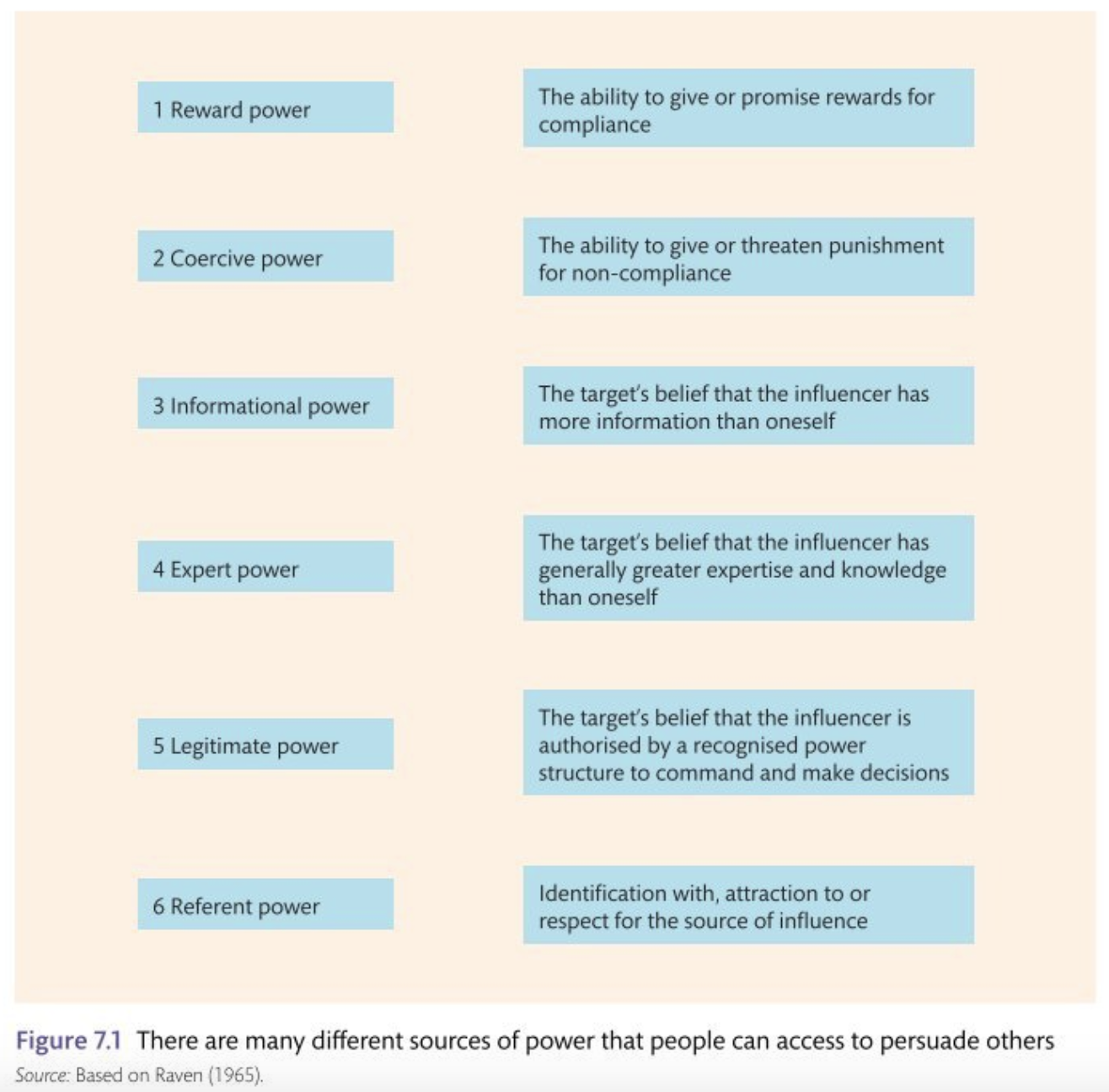
Six Different Types of Power
Reward Power
Coercive Power
Informational Power
Expert Power
Legitimate Power
Referent Power
Agentic State
A frame of mind thought by Milgram to characterize unquestioning obedience, in which people as agents transfer personal responsibility to the person giving orders
Factors Influencing Obedience
Immediacy of the victim (may prevent dehumanization)
Immediacy of the authority figure (absence may lead to reduced obedience)
Group pressure (confirms power to be legitimate or illegitimate)
The principal components of psychology’s code of ethics:
Participation must be based on fully informed consent
Participants must be explicitly informed that they can withdraw, without penalty, at any stage of the study
Participants must be fully and honestly debriefed at the end of the study
Conformity
Deep-seated, private and enduring change in behavior and attitudes due to group pressure
Frame of Reference
Complete range of subjectively conceivable positions on some attitudinal or behavioral dimension, which relevant people can occupy in a particular context
(um so this definition is super confusing… I think it just means the context that filters the way we perceive the world)
Autokinesis
Optical illusion in which a pinpoint of light shining in complete darkness appears to move about
Factors Influencing Conformity
Culture (collectivist cultures tend value conformity)
Group size (larger the majority, the more easily swayed)
Group unanimity (increases conformity)
Informational Influence
An influence to accept information from another as evidence about reality
Normative Influence
An influence to conform to the positive expectation of others, to gain social approval, or to avoid social disapproval
Social Identity Theory
Theory of group membership and intergroup relations based on self-categorization, social comparison, and the construction of a shared self-definition in terms of ingroup-defining properties
Referent Informational Influence
Pressure to conform to a group norm that defines oneself as a group member
Meta-contrast Principle
The prototype of a group is that position within a group that has the largest ratio of “differences to ingroup positions” to “differences to outgroup positions”
Minority Influence
Social influences processes whereby numerical or power minorities change the attitudes of the majority
Conformity Bias
Tendency for social psychology to treat group influence as a one-way process in which individuals or minorities always conform to majorities
The three social influence modalities that define how people respond to within-group conflict:
Conformity (majority persuades minority)
Normalization (mutual compromise)
Innovation (minority creates conflict to persuade majority to adopt minority viewpoint)
Conversion Theory
Moscovici argued that majorities and minorities exert influence through different processes:
Majority influence produces direct public compliance for reasons of normative or informational dependence. Comparison process to fit in. Majority views passively accepted.
Minority influence produces indirect, often latent, private change in opinion due to the cognitive conflict and restructuring that deviant ideas produce. People engage in a validation process. Conversion effect.
Conversion Effect
When minority influence brings about a sudden and dramatic internal and private change in the attitudes of a majority
Convergent-divergent Theory
Minority groups stimulate divergent thinking in majority groups. Majority groups stimulate stress and convergent thinking in minority groups.
Attribution
The process of assigning a cause to our own behavior and that of others
Social Impact
The effect that other people have on our attitudes and behavior, usually as a consequence of factors such as group size, and temporal and physical immediacy