Patho Exam 1 (Burns)
 Call Kai
 Learn
Learn Practice Test
 Spaced Repetition
 Match
Match Flashcards
 Knowt Play
1/16

There's no tags or description
Looks like no tags are added yet.
Name | Mastery | Learn | Test | Matching | Spaced | Call with Kai |
|---|
No analytics yet
Send a link to your students to track their progress
17 Terms
normal capillary exchange
-not all capillaries in a bed are always open
—changes depending on what cells need to take in or get rid of
—inflammation increases permeability
-movement of fluid is based on net HP in arterial end and net OP in venous end
inflammation
-vasodilation, blood flow increases to injured area → warmth
-increased capillary permeability → fluid leaves vessels and enters tissue → swelling
-RBCs become more concentrated b/c fluid is leaving vessels → redness
-WBCs: adhere to vessel lining and then migrate out of blood into tissue
-S/S: redness, warmth, swelling, pain, loss of function
steps of inflammation
-injury
-bradykinin released from injured cells
—activates pain receptors
-mast cells & basophils release histamine
-bradykinin & histamine dilate capillaries
—increased blood flow to injured area
-bacteria enter tissue
-neutrophils and monocytes come to injury site and enter tissue from blood
-WBCs phagocytize bacteria
-macrophages leave blood and enter tissue to phagocytize
causes of burns
-thermal
—heat: contact with hot air
—flame: contact with fire
—scald: contact with hot liquid
—contact: touching a hot object
-non-thermal
—chemical:
contact: touching a strong chemical (often extreme pH)
inhaled: breathing in chemical fumes (or smoke)
ingested: eating a dangerous chemical
-electricity: contact with an electric current (e.g. lightning)
-radioactive: exposure to radiation
1st degree burns*
-superficial (only burns epidermis)
-S/S: pain, redness, maybe blisters (after 24 hr), blanches
-may lead to chills, HA, edema, N/V
-most common example is sunburn
-dangerous in young or old pt
2nd degree burns*
-superficial partial thickness (all of epidermis and part of dermis)
—blisters and vesicles that may rupture → more pain
—most painful type
—3-4 weeks to heal (w/o complications)
—tx: nutrition
—scarring is rare
-deep partial thickness (entire dermis)
—waxy and white appearance (similar to full thickness)
—may take weeks to heal
—tx: surgical excision of dead tissue, skin graft
—may lead to hypertrophic scar
3rd degree burns*
-full thickness (all of epidermis and dermis, into SQ)
-appearance: white, dry, leathery
-edema, no elasticity, decreased circulation distal to site (d/t pressure from edema)
—edema also compresses nerves
-no pain (nerves destroyed)
*4th degree: all of SQ and into muscle or deeper
compartment syndrome*
-nerves and blood vessels are compressed by swelling from injury, burn, etc
-leads to hypoxia, ischemia, necrosis
-S/S distal to injury site: pallor, weak pulses, numbness or tingling
escharotomy*
procedure to create an incision into scar tissue
-full thickness circumferential burns lead to eschar (nonviable)
—may lead to compartment syndrome, which leads to tissue death
-need surgery to divide eschar and give underlying tissue room to expand
-prevents necrosis that could necessitate amputation
how to assess burns
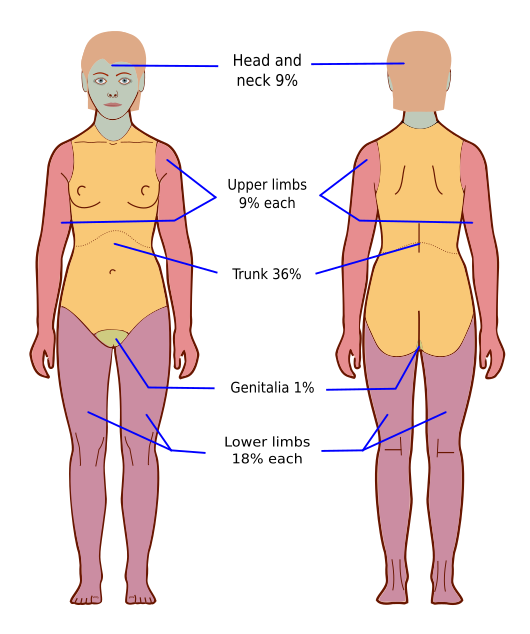
-use rule of 9s (for adults) to know % of TBSA burned
—20% of TBSA = major
—use Lund and Browder scale for peds
-burns are OFTEN combined with other injures
—e.g. smoke inhalation → ARDS is usually the cause of death in fire victims
criteria to go to burn unit
-partial thickness burns >10% TBSA
-burns on face, hands, feet, genitalia, or joints
-3rd degree
-electric or chemical burns
-inhalation injury (e.g. smoke)
-preexisting problem
-burn + other major trauma
-young or old pt
-socioemotional or long term rehab needed
burn shock*
-burns → inflammation → increased capillary permeability → fluid leaves bloodstream and enters tissue
—low blood volume
-decreased cardiac output and contractility from release of myocardial depressant factors
-EPI and NE released because of SNS activation
—blood is shunted away from visceral organs
→ oliguria b/c kidneys are not getting blood
toxins and bacteria leak from gut → endotoxemia → sepsis
-low BV and low CO → hypovolemic shock
—S/S: tachycardia, weak thready pulse, hTN
burn shock and pH*
—hypovolemia → low O2 to tissues → anaerobic glycolysis and protein breakdown for ATP → lactic acid byproduct → metabolic acidosis
how does shock end?*
-end point of shock = capillary seal (after 24 hr)
—b/c increased permeability stops
—so giving IVF actually will work now to increase BV (and BP)
body’s response to burns*
-impaired Na+-K+ pump
-metabolism
—increased catecholamines
—increased cortisol, glucagon, and insulin
—increased oxygen use
—increased clot factors from liver → hypercoagulable state
-decreased immune response (risk for sepsis)
—d/t decreased phagocytosis and loss of skin barrier
-risk of pulmonary edema (b/c inflammatory mediators are going to lungs)
—may → ARDS
phases of burn response
-emergent
—72 hr
—fluids move to interstitial d/t increased permeability
causes protein loss from blood to decrease OP and cause more fluid shifts to the interstitial
causes edema and shock, and hemolysis
—increased Hct b/c of fluid loss
—Na+ and K+ shifts
—coagulation causes necrosis
—decreased immunity (because of loss of skin barrier)
—may lead to AKI
-acute
—fluid balance begins to restore → diuresis
—may cause electrolyte problems
-rehab
—wounds mostly healed (by 2 wk to 8 mo)
other types of burns
electric
-often skin does not appear severely burned, damage is far more extensive internally than on surface
chemical
-d/t contact with acid, base, or vesicant
-FIRST priority is getting the chemical off the skin via flushing
—do NOT get the chemical on yourself!
frostbite
-can happen from cold air or contact with cold object
-ice crystals form in cells → anoxia and impaired metabolism
-categorized same as burns