3- ACID & BASE
 Call Kai
 Learn
Learn Practice Test
 Spaced Repetition
 Match
Match Flashcards
 Knowt Play
1/24

There's no tags or description
Looks like no tags are added yet.
Name | Mastery | Learn | Test | Matching | Spaced | Call with Kai |
|---|
No analytics yet
Send a link to your students to track their progress
25 Terms
b. Decrease
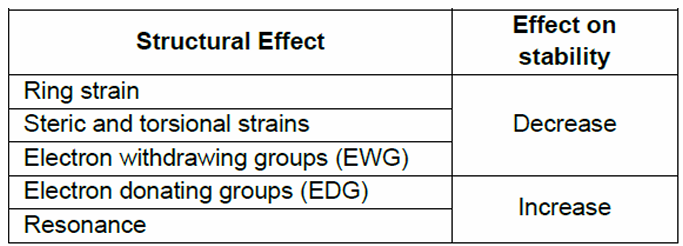
[ACIDITY & BASICITY]
Ring Strain effect on stability
a. Increase
b. Decrease
b. Decrease
[ACIDITY & BASICITY]
Steric and Torsional Strain effect on stability
a. Increase
b. Decrease
b. Decrease
[ACIDITY & BASICITY]
Electron Withdrawing Grough (EWG) effect on stability
a. Increase
b. Decrease
a. Increase
[ACIDITY & BASICITY]
Electron Donating Group (EDG) effect on stability
a. Increase
b. Decrease
a. Increase
[ACIDITY & BASICITY]
Resonance effect on stability
a. Increase
b. Decrease
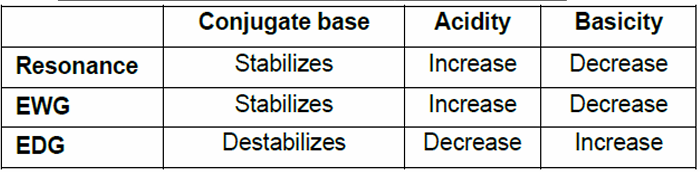
[ACIDITY & BASICITY]
What is the effect of Resonance on the following:
Conjugate base: [Stabilizes/ Destabilizes]
Acidity: [Increase/ Decrease]
Basicity: [Increase/ Decrease]
[ACIDITY & BASICITY]
What is the effect of EDG on the following:
Conjugate base: [Stabilizes/ Destabilizes]
Acidity: [Increase/ Decrease]
Basicity: [Increase/ Decrease]
[ACIDITY & BASICITY]
What is the effect of EWG on the following:
Conjugate base: [Stabilizes/ Destabilizes]
Acidity: [Increase/ Decrease]
Basicity: [Increase/ Decrease]
“The more stable the conjugate base, the more acidic a compound”
[ACIDITY & BASICITY]
“The more [unstable/stable] the conjugate base, the [more acidic/ more basic] a compound”
d. Weak Base
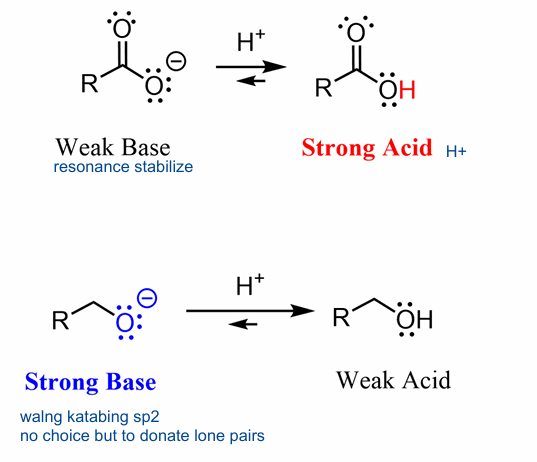
[ACIDITY & BASICITY]
A carboxylate anion (RCOO⁻) that is resonance stabilized, making it reluctant to accept a proton
a. Strong Base
b. Weak Acid
c. Strong Acid
d. Weak Base
c. Strong Acid
[ACIDITY & BASICITY]
A carboxylic acid (RCOOH) that readily donates its proton due to the resonance stability of its conjugate base
a. Weak Acid
b. Strong Base
c. Strong Acid
d. Weak Base
d. Strong Base
[ACIDITY & BASICITY]
An alkoxide anion (RCH₂O⁻) with no adjacent sp2 carbon, having no choice but to donate lone pairs
a. Weak Base
b. Strong Acid
c. Weak Acid
d. Strong Base
b. Weak Acid
[ACIDITY & BASICITY]
An alcohol (RCH₂OH) whose conjugate base is not resonance stabilized, making it a poor proton donor
a. Strong Acid
b. Weak Acid
c. Strong Base
d. Weak Base
c. Resonance stabilization
[ACIDITY & BASICITY]
The structural feature present in RCOO⁻ that distributes negative charge, increasing its stability and decreasing its basicity
a. Inductive effect
b. Hyperconjugation
c. Resonance stabilization
d. Electronegativity difference
c. sp2 carbon
[ACIDITY & BASICITY]
The property of RCH₂O⁻ that forces it to be a strong base due to the absence of this adjacent carbon hybridization
a. sp3 carbon
b. sp carbon
c. sp2 carbon
d. sp3d carbon
d. Acetic acid
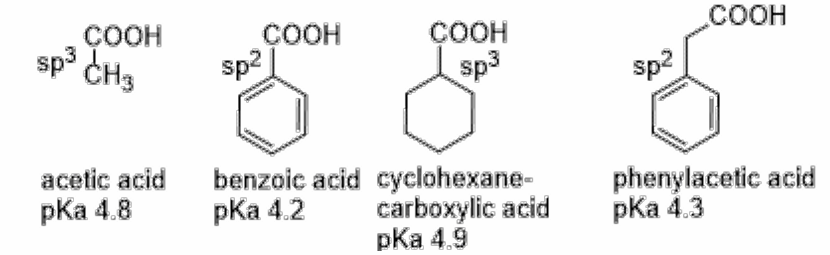
[ACIDITY & BASICITY]
A carboxylic acid with an sp³ carbon attached to COOH group with pKa of 4.8
a. Benzoic acid
b. Cyclohexanecarboxylic acid
c. Phenylacetic acid
d. Acetic acid
c. Benzoic acid
[ACIDITY & BASICITY]
A carboxylic acid with an sp² carbon directly attached to COOH group with pKa of 4.2
a. Phenylacetic acid
b. Acetic acid
c. Benzoic acid
d. Cyclohexanecarboxylic acid
a. Cyclohexanecarboxylic acid
[ACIDITY & BASICITY]
A carboxylic acid with an sp³ cyclohexane ring attached to COOH group with pKa of 4.9
a. Cyclohexanecarboxylic acid
b. Benzoic acid
c. Acetic acid
d. Phenylacetic acid
d. Phenylacetic acid
[ACIDITY & BASICITY]
A carboxylic acid with an sp² phenyl ring but a CH₂ spacer between the ring and COOH group, with pKa of 4.3
a. Acetic acid
b. Benzoic acid
c. Cyclohexanecarboxylic acid
d. Phenylacetic acid
c. Halogen (EWG)
[ACIDITY & BASICITY]
An electron withdrawing group on acetic acid that increases acidity by lowering pKa
a. Alkyl group
b. Hydroxyl group
c. Halogen (EWG)
d. Amino group
a. Halogen (EWG)
[ACIDITY & BASICITY]
An electron withdrawing group on acetic acid that increases acidity by lowering pKa
a. Halogen (EWG)
b. Halogen (EDG)
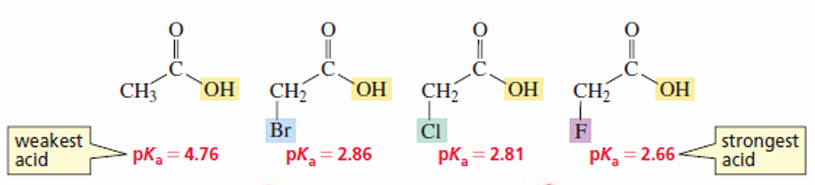
[ACIDITY & BASICITY]
Arrange from weak to strong acid
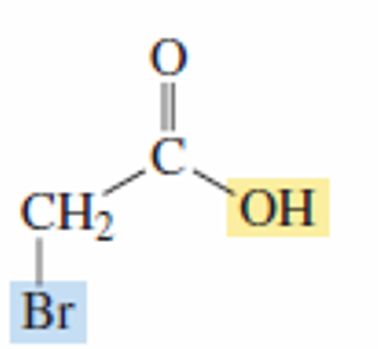
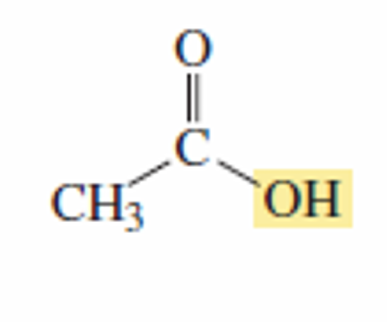
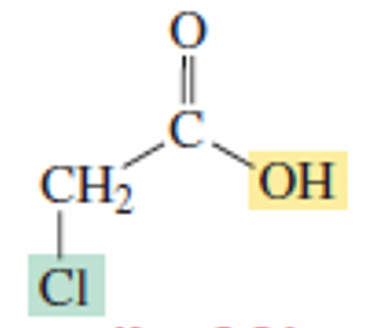
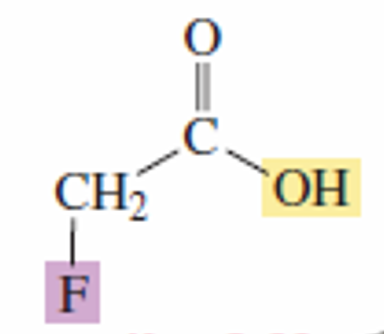
a. formic acid
[ACIDITY & BASICITY]
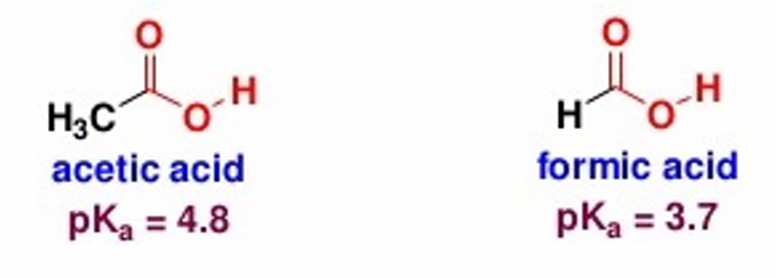
Which is more acidic
a. formic acid
b. acetic acid
d. methyl group
[ACIDITY & BASICITY]
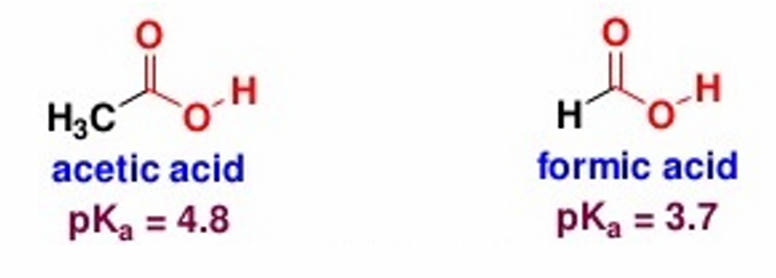
Compared to formic acid, acetic acid is a weaker acid due to:
a. ether fg
b. ester fg
c. halogen
d. methyl group
b. Isomers
[ISOMERISM]
Existence of 2 or more compounds with same formula but different structures
a. Resonance
b. Isomers
c. Allotropes
d. Polymorphs