pes
 Call Kai
 Learn
Learn Practice Test
 Spaced Repetition
 Match
Match Flashcards
 Knowt Play
1/126

There's no tags or description
Looks like no tags are added yet.
Name | Mastery | Learn | Test | Matching | Spaced | Call with Kai |
|---|
No analytics yet
Send a link to your students to track their progress
127 Terms
5 mental stratgies
goal setting
relaxation
imagery
performance routine
self-talk
goal setting
“The process of taking active steps to achieve your desired outcomes”
-setting goal is a very important step for any person or athlete
-this gives an athlete something to strive for, but also makes them take the time to decide what they want to achieve
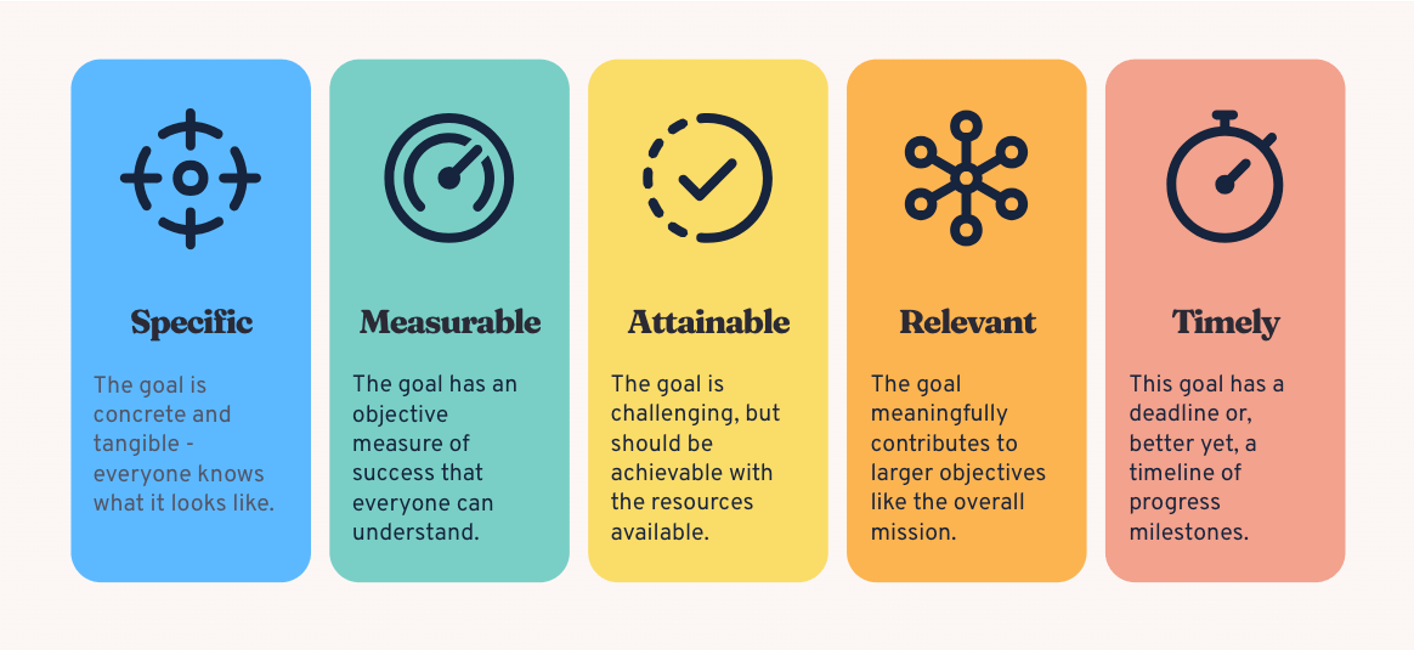
-goals are important if they are SMART
-specific, measurable, attainable, relvent, timley
SMART goals
Relaxation
“The process of using a specific strategy to calm your body down physical/mentally”
-•Specific strategy should be matched to the type of stress or anxiety felt. Physical strategy for physical tension, mental strategy for psychological worry.
•Some examples of relaxation strategies include:
Progressive muscle relaxation
Breath control
Music
Thought stopping
Meditation
Imagery
“The process when an individual engages as many senses as possible to recreate the performance”
-more than just visualisation but includes using smell, sound, taste, touch
-should always be positive/perfect performance
Performance Routines
“A sequence of task relevant thoughts and actions which an athlete engages in systematically prior performance”
-must be related to appropriate thoughts otherwise its just a superstition
-often includes breathing or sport specific actions associated with verbal cues
Self Talk
“The process in which an athlete engages in dialogue with themselves either internally or out loud”
-Important to be positive as often as possible, can be negative for motivation purposes
-may be a part of routine
menta outcomes
stress
concentration
arousal
motivation
self-confidence
stress
“The process in which there is a substantial imbalance between demand and response capability under conditions where failure has important consequences”
environmental demand
individuals perception of demand
stress response: cognitive (mental) or somatic (physcial)
-different strategies will affect different parts of the stress process
-we would always want to decrease stress
strategies to decrease stress
Relaxation: helps with stage 3 of the stress process. You can match the type of stress with the type of relaxation used. Relaxation strategies can be used prior or during performance. E.g. if you have physical stress (increased HR) you could use a physical strategy such as breath control
Performance Routines: Can help with stress by helping with the perception (stage two) sticking to a routine can help the athlete remember they have done this many times or is just like any other game. A routine can also help with stress if it involves use of breathing or specific words as this can take an athletes mind of the demand, reducing stress.
Imagery: Can help with stage 2 of the stress process as it can remind the athlete that they have successfully performed this before, thus reducing the perception of the demand.This can also help with stage 3 of the process if the athlete has used imagery well, they should feel like they have already experienced it - so you can try and remember things went well.
Self Talk: Can help with stage one and two of the process depending on what is said. If the athelete says “you got this” this may reduce the cognitive stress response by calming the mind.
Goal Setting: Can help with stage 1 and 2 of the stress process. Can help with stage 1 as if the athlete has set realistic goals they should experience stress trying to reach them. It can help stage 2 as if the athlete is slowly ticking off their goals they can remind themselves if there on track
Concentration
“The ability to focus on the task at hand and the relevant cues of the performance, whilst blocking out the irrelevant cues of the environment”
-Always try to increase concentration
-Concentration involves the ability to maintain focus over a period of time, possess situational awareness and shift attentional focus
Strategies to increase concentration
Performance routines: remember that a good performance routine should help athlete focus on relevant cues- which will then improve concentration. For example, a cricket batter could tap his bat on the ground three times and say “watch the ball” this is a physical action associated with a verbal cue that attends the athlete to relevant cues
Self Talk: Can help concentration alot as long as what they say is associated with the cues or performance.For example, if a coach has told an athlete to keep their elbow high on a free throw they can say “elbow high” just as they are about to shoot the free throw,.
Imagery: Can help with concentration if as part of the imagery process, they involve decision making about specific cues or shifting their focus. •For example, a gymnast could recreate the performance and think if they feel themselves losing balance this is what they need to to.
Arousal
“The level of activation and readiness experienced by an athlete”
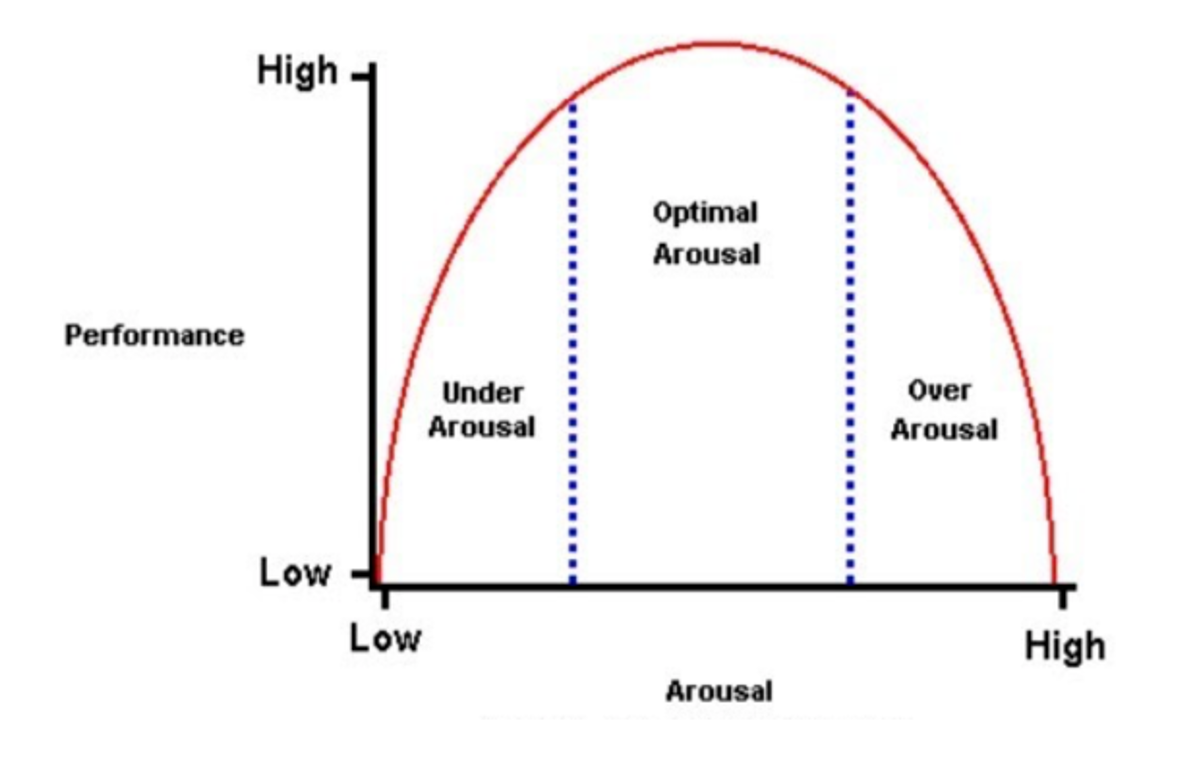
-inverted u hypothesis (optimum level of arousal and over and under arousal)
-different sports require different levels of arousal
strategies to increase arousal
self talk: can help an athlete increase their activation and readiness is they use the words that can help “pump themselves up”. This would especially work if the phrase was positive and spoken out loud.
performance readiness: Can increase arousal and readiness espeically if performed over a long period of time and are used frequently.With the conditioning process it can get them in the mindset they need to be in. For example, the routine could involve jumping up and down whilst thinking about the game – if they do this every game it remind them to switch on.
imagery: Can help to increase arousal as the imagery process can get an athlete excited about the performance. This is espcially true if the imagery goal involves the outcome e.g. standin on the podium
goal setting: can increase arousal as it gives the athlete a reason to prepare for the performance or the athlete gets excited about being able to reach their goal
strategies to decrease arousal
Relaxation: physically calming the body down to get them into the appropriate zone. Some athletes might be too pumped up so they need to use a strategy to bring them back down
Performance Routines: can help to decrease arousal if it involves breathing control or makes the athlete narrow their focus, so there ready to perform.•For example, a basketball free throw routine could get them to think about the specific techniques they need to use rather than other external factors.
Imagery: Can decrease arousal by reminding the athlete of a succsesful performance or to remind them to know what they need to perform
Self Talk: help to decrease arousal if they are terms that can calm the athlete down and decrease their physical activation.For example, if an athlete is over-aroused or “bouncing off the walls” they could say “okay time to calm now”
motivation
“The direction and intensity of effort by a performer towards a given task”
-often categorised into intrinsic and extrinsic motivatino
-important to understand what motivates and athlete when trying to improve it
-always trying to increase motivation
strategies to increase motivation
Goal setting: •Goal Setting and motivation go hand in hand, if an athlete is struggling with their motivation the first thing to do would be to set goals.
•Goals can improve the intensity but in particular the direction of effort.
•There is no elite athlete that doesn’t use goal setting.
Self Talk: Self-Talk can influence the direction or intensity of the effort, depending on what is said. They could say “I need to put more pressure on my opponent so we can win” – this might just be “pressure on”
Imagery: Imagery can help with motivation, especially if part of the imagery process the athlete thinks about their potential positive outcome. They could see themselves winning a medal or the crowd screaming for them
Self Confidence
“The belief that you can successfully perform a desired behaviour”
-Most of the time you would be trying to increase self-confidence, however important to note that some athletes can be overconfident.
Strategies to increase self confiedence
Imagery: Imagery can increase self-confidence if the athlete recreated a past successful performance so they can remind themselves they have completed it before
Self Talk: Self-Talk can be used to improve self-confidence by reminding the athlete of what they have achieved or good behaviour they have done.
• For example, ”come on, you got every first serve in last time”
•It can remind them of a positive performance
Goal Setting
•Goal Setting can increase self-confidence as long as they have set realistic goals and are tracking along with them.
•For example, if they have process goal they are achieving on the way to a big goal this can reassure them they are on track
4. Performance Routines
•Performance routines can help with an athlete's self-confidence by either reminding them they have done this many times in training and it is just another performance OR the routine could involve things that show their high skill level
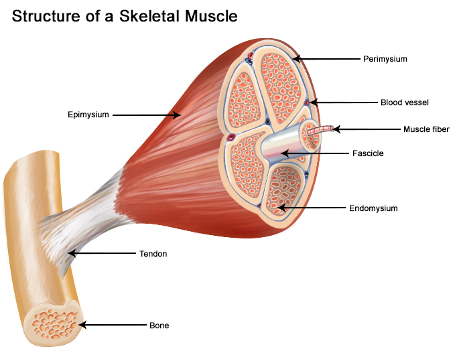
what is the structure of a skeletal muscle
1. epimysium
2. muscle belly
3. perimysium
4. fascicle
5. endomysium
6. muscle fibre
7. myofibril
8. sarcomere
9. myofilaments
epimysium
Connective tissue that surrounds the muscle belly, holding all components together. Made up of connective tissue
Muscle Belly
Fattest part of the muscle. Made up of lots of fasciles.
Perimysium
Connective tissue surrounding individual fascicles. Made up of connective tissue
Fascicle
A bundle of muscle fibres banded together. Made up of lots of muscle fibres
Endomysium
Connective tissue surrounds individual muscle fibre. Made up of connective tissue
Muscle Fibre
The cell of the muscle, determines nerve connection and type of fibre. Made up of lots of myofilaments
Myofibril
Long filaments that run parallel to each other that form muscle fibres that contain the myofilaments. Made up of lots of sarcomeres and myofilaments
Sarcomere
Run along the myofibril, contractile unit of the muscle. Made up of lots of Myofilaments
Myofilaments
Protein filaments. Made up of Myosin and Actin.
diagram of skeletal muscle
Structure of sarcomere
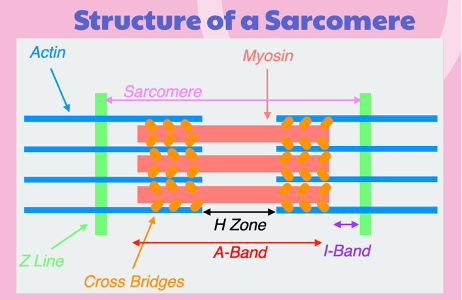
sarcomere
Functional unit of the muscle fibre, space between two z-lines
myosin
Thick protein filament, that HAS cross-bridges
cross bridges
Stick out from Myosin, play large part in contraction
actin
Thin protein filament, attached to z-lines
z line
Membrane found at either end of the sarcomeres
h zone
Space between actin filaments, includes myosin only.
I Band
Gap between the end of a myosin and the z-line, actin only
A Band
Length of myosin filament, sometimes includes both actin and myosin
Concentric
Occurs when the muscle shortens while contracting. Bicep Curl (up)
Eccentric
Occurs when the muscle lengthens while still creating a force (contracting). Bicep Curl (down)
Isometric
Occurs when the muscle length remains unchanged while contracting. Plank
Sliding Filament Theory
1.Motor Neuron
2.Calcium
3.Binding Sites
4.Cross Bridge
5.ATP
6.Power Stroke
7.Slide
8.Detachment
motor neuron
motor neuron receives signal from CNS, stimulates muscle fibre with impulse.
calcium
this impulse causes calcium to be released into the sarcomere.
binding Sites
presence of calcium causes actin to change shape to reveal binding sites for myosin
Cross Bridge
myosin attaches to actin filaments creating a cross-bridge.
ATP
breakdown of ATP releases energy which stimulates the cross-bridge.
Power Stroke
myosin performs a power stroke (oscillates)
slide
actin slides over myosin, causing sarcomere to shorten.
detachment
ATP releases energy causing myosin to detach from actin and cross-bridge is broken. Calcium leaves the sarcomere preventing further cross-bridges forming.
sarcomere in contractions
concentric: shortens
eccentric: lengthens
Myosinin in contractions
concentric: stays the same
eccentric: stays the same
cross bridges in contractions
concentric: oscillate
eccentric: oscilliate
actin in contractions
concentric: Stays the Same
eccentric: Stays the Same
Z-Line in contractions
concentric: Come closer together
eccentric: Move further apart
H Zone
concentric: Gets smaller, may disappear
eccentric: Gets larger
I Band
concentric: Gets smaller, may disappear
eccentric: Gets larger
a band
concentric: same length (more actin)
eccentric: Same Length (less actin)
myosin in SFT
role of myosin is to attach to actin (to create a cross-bridge). Myosin pulls on the actin filaments during muscle contraction.
actin in SFT
changes shape with presence of calcium to reveal BINDING SITES which creates a structure for cross-bridges to attach to. Also ATTACHED to Z-lines which means sarcomere shortens during contraction.
sarcomere in SFT
functional unit of the muscle fibre, runs along the myofibril and contains actin and myosin proteins to allow contraction.
calcium ions
bind to actin which causes them to change shape revealing binding sites. Allows myosin heads to attach to actin.
force velocity relationship
relationship between the velocity of muscle contraction to the amount of force exerted by the contraction
concentric muscle contraction
•Maximum force is achieved at MINIMUM velocity
•The force a muscle can create decreases with the increasing velocity
•We can alter the force we produce by changing the velocity of contraction
•So if we want to lift something very heavy (concentric way) we need to contract muscles slowly to allow maximum number of cross-bridges
Force-Length Relationship
4.relationship between the length of muscle to the potential amount of force it can exert
force-length (shortened, mid-length, lengthened)
The Key Rule for force length relationship
More Crossbridges = More Force Produced
Shortened
•Less cross-bridges due to actin covering each others binding sites
•Large overlap of Actin/Myosin
•Means less force is produced
Mid-Length
•Maximum number of cross-bridges can be produced at mid-length
•This means that force output is maximal
Lengthened
•Less cross-bridges due to cross-bridges being unable to reach actin due to stretching
•Less overlap of Actin/Myosin
Means less force is produced
1.Brain (CNS)
•Initiates voluntary AND involuntary contractions.
•In a contraction:
1.Receives information from sensory neurons
2.Interprets this information and makes decision based on inputs
3.Transmits signal via spinal cord/motor neurons
2.Spinal Cord (CNS)
•Relays information from the body to the brain, and the brain to the body
•Also involved in reflexes
•In a contraction:
1.Receives information from the brain
2.Transmits electrical signals to the motor neuron
Nerves (PNS)
•Motor and Sensory Neurons transmit signals to and from the CNS
Sensory Neurons
•Get signals from all of our sensory receptors
•Sends this information to the brain for processing
•In a contraction:
1.Receives signal from sensor to initiate contraction (ears - hearing starter signal)
2.Sends this information to the brain
Motor Neurons
•"The unit of components responsible for transmitting messages from the CNS to the muscles."
•Receives electrical signal from the spinal cord/brain and transmits this signal to the muscle fibre to innervate
•In a contraction:
1.Receives signal from spinal cord/brain and sends to muscle fibres
2.This occurs at Neuromuscular Junction (NMJ) also known as Motor End Plate
cell body
•Directs activity of the neuron
•Gets information from the dendrite, then sends down the axon
axon
•Transmits information AWAY from cell body to the muscle fibre via NMJ
dendrite
•Receives signal from CNS
•Sends this information to the cell body
myelin sheath
•Surrounds an Axon
•Improves conductivity
NMJ
•Point of "attachment" between motor neuron and muscle fibre
•May initiate multiple muscle fibres so may be lots of these
motor unit
the motor neuron plus all the muscle fibres that it innervates.
•Motor Units may be quite large - so one unit innervates LOTS of muscle fibres
•They may also be small, so one motor neuron only innervates a few or one muscle fibre
•Size depends on function of the muscle
all or none law
"If an electrical stimulus reaches a THRESHOLD level, then ALL of the muscle fibres associated with that unit will contract to their MAXIMUM level at the SAME TIME"
Controlling the Force of a Contraction
•When we decide to lift something, your body will already have made a prediction on the type of fibres needed, number of motor units and size of motor units needed.
•However, if we need to increase force of contraction, we can ONLY do this by:
1.Increasing the number of motor units recruited
2.Increase size of motor units recruited - larger motor units (and therefore more fibres)
3.Increase the strength of nerve signal
4.Increase the frequency of nerve signal
5.Recruiting the correct muscle fibre type (we will talk about this later)
In a muscle contraction
1.Sensory Neuron: transmits information from the senses (eyes) to the brain
2.Brain: Processes information from the senses, makes a decision and sends this information down the spinal cord
3.Spinal Cord: transmits this information from the brain to the relevant motor neuron(s)
4.Motor Neuron: receives this information from the CNS, transmits to the muscle fibres associated with the neuron.
5.Motor Unit: made up of the motor neuron and the muscle fibres it innervates, carries out the muscle contraction based on the signal from CNS.
fibre recruitment
•Preferential recruitment: the body's recruitment of muscle fibres depending on the demands of the muscle contraction
•Your body will first recruit smaller motor units, as these have a lower threshold of activation
•This obviously generates less tension
•If more tension or force is required, then progressively larger motor units are activated
•The TYPE of muscle fibre also comes into play, but we will talk about this later
fibre table
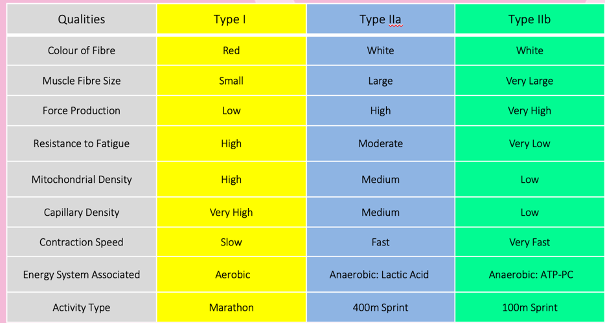
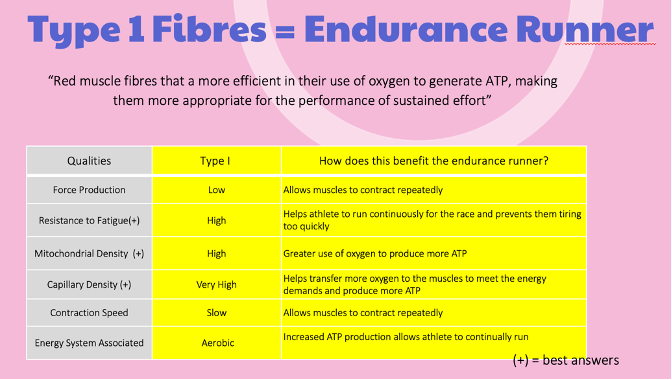
type 1 fibres
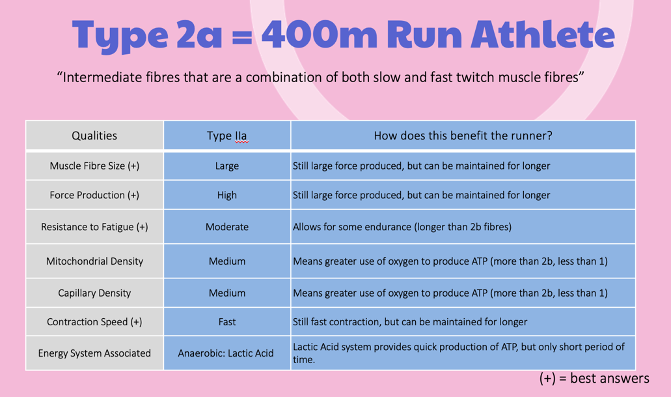
type 2a
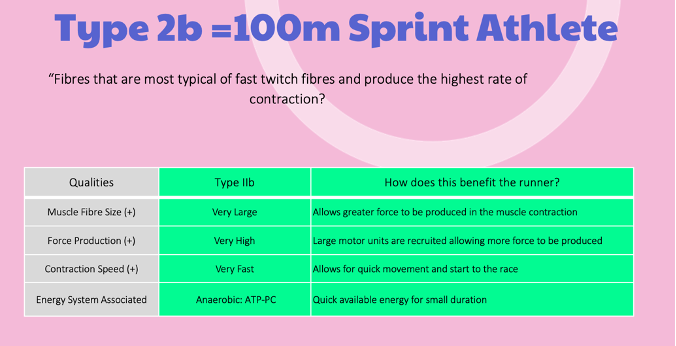
type 2b
linear momentum
Linear Momentum: defined as the product of an object's mass multiplied by it's velocity. P=m.v
P=linear momentum
m=mass
v= velocity
we can increase our momentum by increasing:
• Mass
• Velocity
• Both
This is the Fly Half; their job is to run with the ball and get it down the field (they need to DODGE and run QUICKLY)
impulse
Impulse is a mechanical variable we use to talk about PRODUCTION of movement and to STOP movement.
the change in momentum
∆𝑝=F.t
∆𝑝=impulse
F = Force
t = time
Both the magnitude (force) and the duration of the force (time) determine the effect of an object's motion.
• The application of force over time will change the momentum of an object.
impulse force production
When we are applying the force, if we apply the force for a longer period of time, we get a larger impulse! Shot Put without the spin, we have reduced time, so we have less impulse (and therefore less change in momentum)
Shot Put with the spin, we have increased time that we apply the force, meaning we have a larger force and impulse. When we are trying to produce maximal force, we often want to increase both the magnitude and duration of the force.
Magnitude:
• We will try to maximise force using other biomechanical
principles
• For example, we might try to increase number of segments used
Duration
• The biggest change we can make is to the time we produce the
force. We could do this by run-up or swing or follow through.
Time Based Example:
• HOWEVER, we can't always
increase the time to apply the
force
• Especially if we are in a time-
based event
• If a swimmer maximised the time
they apply force to the blocks
they will not win the race
impulse force absorption
When we are absorbing a force we CANNOT reduce the amount of
force/impulse experienced, we can only increase the time we absorb the force with and therefore decreased PEAK FORCE. Catching a ball with no give, decreased time you experience force so PEAK FORCE is high.
Catching a ball with give, increased time you experience force so PEAK FORCE is decreased.
Area under the curve is the SAME
Coefficient Of Restitution
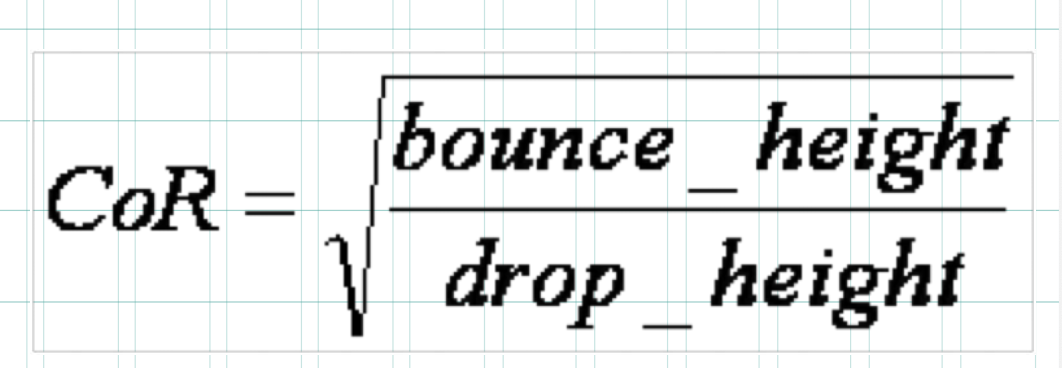
CoR = A value representing the ratio of the velocity after
an impact compared with the velocity before an impact.
CoR is a value representing the bounciness of an object
• When an object bounces against a surface, that object
changes shape – this causes a loss of energy. The more it
changes shape the more energy is lost.
• As it is a square root, it is ALWAYS a value between 0-1
perfectly elastic collision
This is when the CoR = 1
• All energy that existed remains after the bounce
• All linear momentum is conserved
Partially Inelastic Collision
Partially Inelastic Collision
• This is when the CoR is <1 and >0
• Some energy is lost to the bounce
• Most collisions are in this category
• Energy is lost due to change of shape,
heat and sound
Perfectly Inelastic Collision
Perfectly Inelastic Collision
• This is when the CoR is 0
• No energy remains after the
bounce
There are three factors that influence the value
of the CoR:
There are three factors that influence the value
of the CoR:
1. Equipment and Surfaces (materials)
2. Velocity of the Collision
3. Temperature of Materials Involved
CoR- Equipment and Surfaces
• Newer materials will often have higher CoR than older
• More elastic materials will have higher CoR
• Often the CoR at competitions is regulated
CoR-Velocity
Higher velocities will REDUCE the CoR due to greater
compression and therefore greater change of shape
• This is velocity of ball AND the implement that may be
used to hit the ball