History WWII
 Call Kai
 Learn
Learn Practice Test
 Spaced Repetition
 Match
Match Flashcards
 Knowt Play
1/42

There's no tags or description
Looks like no tags are added yet.
Name | Mastery | Learn | Test | Matching | Spaced | Call with Kai |
|---|
No analytics yet
Send a link to your students to track their progress
43 Terms
What event officially started WWII?
Germany invaded Poland in 1939
Who were the main dictators?
Hitler (Germany)
Mussolini (Italy)
Stalin (Soviet Union)
Japanese militarists (Japan)
Who believed fascism, and what was it?
Strong central government, no opposition, violence, state over individual
Mussolini (Italy)
Who believed Nazism, and what was it?
Hitler (Germany)
Extreme nationalism, antisemitism, expansion, loyalty to Hitler
Who believed communism, and what was it?
Stalin (Soviet Union)
Government controls economy/resources
Who believed militarism, and what was it?
Japanese militarists (Japan)
Strong military + expansion for resources
What alliance did Germany, Italy, and Japan form?
Axis powers
What aggressive actions did Hitler take?
Took Austria, Czechoslovakia, invaded Poland
Violated Treaty of Versailles
What did Mussolini do?
Invaded Ethiopia
What did Japan do?
Invaded China (R*pe of Nanjing)
Why did the U.S. avoid entering WWII at first?
Isolationism
Used FDR’s speech to show this
What did the Neutrality Acts do?
Banned arms sales, loans, and travel to war zones
What was FDR’s “I Hate War” idea?
He wanted to avoid war and reflect public fear of involvement
What was Cash and Carry and why was it important? (Helping Allies Without Fighting)
Countries buy goods with cash and transport themselves
Helped Allies but kept U.S. out of war
What was the Lend-Lease Act? (Helping Allies Without Fighting)
U.S. gave/lent weapons to Allies
What did “Arsenal of Democracy” mean? (Helping Allies Without Fighting)
U.S. supplying weapons to support Allies
What was the MAIN reason the U.S. entered WWII?
Pearl Harbor
What events led up to Pearl Harbor?
Helping Allies
tension with Japan
oil embargo
Why did Japan attack?
U.S. cut off oil and blocked expansion
because they hated us since in WWI we did not give them what they wanted with the treaty
What happened in the attack and what was the result?
Planes destroyed ships and planes in Hawaii
U.S declared war on Japan entering WWII
Germany & Italy declared war on U.S.
How were soldiers recruited?
Draft (Selective Service Act) + volunteers (enlisted after Pearl Harbor)
Was the army segregated and how?
Yes, for people of color they had segregated Units commanded by white officers
Name minority groups that served.
African Americans, Mexican Americans, Japanese Americans, Native Americans
How did WWII affect the economy?
Ended the Great Depression
What did factories produce?
War materials (planes, ships, weapons)
What role did women play?
had to work (worked in factories) for their family as the men were in war
What was propaganda used for?
Encourage support
Unite people
Influence opinions
What was the U.S’s strategy?
U.S. chose “Europe First” (defeat Hitler before Japan)
What were the early victories for the U.S?
North Africa & Italy
What was D-Day, and why was it important?
Allied invasion of France
VERY IMPORTANT:
Gave Allies a foothold in Europe
the start of pushing Germany back
What is V-E Day?
Victory in Europe (Germany defeated)
What was island hopping, and why did we use it? (War in the Pacific (Japan))
Taking key islands to move closer to Japan (moving from island to island)
Avoid strong defenses and save resources
What was the Battle of Midway?
Turning point—U.S. destroyed Japanese carriers
Why was Iwo Jima important?
Base to attack Japan
Very high casualties
What happened at Okinawa?
Heavy casualties + kamikaze attacks
After the War what was decided at the Yalta Conference?
Germany divided into 4 zones
Stalin promised free elections
Soviet Union said they would help fight Japan
Plan for United Nations
Why did the U.S. drop the atomic bomb?
End war quickly
Avoid invasion of Japan
Save American lives
Japan wouldn’t surrender
Show power (especially to Soviet Union)
Where were bombs dropped?
Hiroshima and Nagasaki
Argument FOR the bomb?
Ended war quickly
Japan had not surrendered even after losing major battles, so the bomb forced a quick end to the war. This prevented the fighting from dragging on for months and causing even more destruction.
saved american lives
A U.S. invasion of Japan would have been extremely deadly. Battles like Iwo Jima and Okinawa showed that Japanese forces would fight to the death, so leaders believed the bomb would prevent massive American casualties.
japan showed they would not surrender easily
Japan kept fighting despite heavy losses and used kamikaze attacks, showing how determined it was. Because of this, U.S. leaders believed strong action was needed to force surrender.
Argument AGAINST the bomb?
Mostly civilians killed and Moral/ethical concerns
Most of the people killed in Hiroshima and Nagasaki were innocent civilians, not soldiers. 90% civilians
This made the bomb morally wrong because it caused massive suffering to people who were not directly fighting.
Survivors suffered radiation sickness and long-term health problems
Japan was already close to defeat and other options could have been tried first
By 1945, Japan had lost important battles (Midway, Iwo Jima, and Okinawa), had weak resources and suplly shortage (no oil from US), and was struggling to continue the war.
Japan was already in a bad position, the bomb not necessary to end the war
The United States could have continued pressure, negotiated, or demonstrated the bomb without dropping it on cities. Since alternatives existed, using such a destructive weapon right away is harder to justify.
increased tensions and helped start the cold war
Dropping the atomic bomb didn’t just end WWII—it also showed the world, especially the Soviet Union, how powerful the United States was. This created fear and distrust between the two countries. Instead of cooperation after the war, it led to competition and an arms race, where both sides built more and more nuclear weapons. This tension eventually became the Cold War. Because the bomb contributed to long-term global conflict and fear of nuclear war, it makes the decision harder to justify beyond just ending WWII.
The world lived under fear of nuclear war for decades
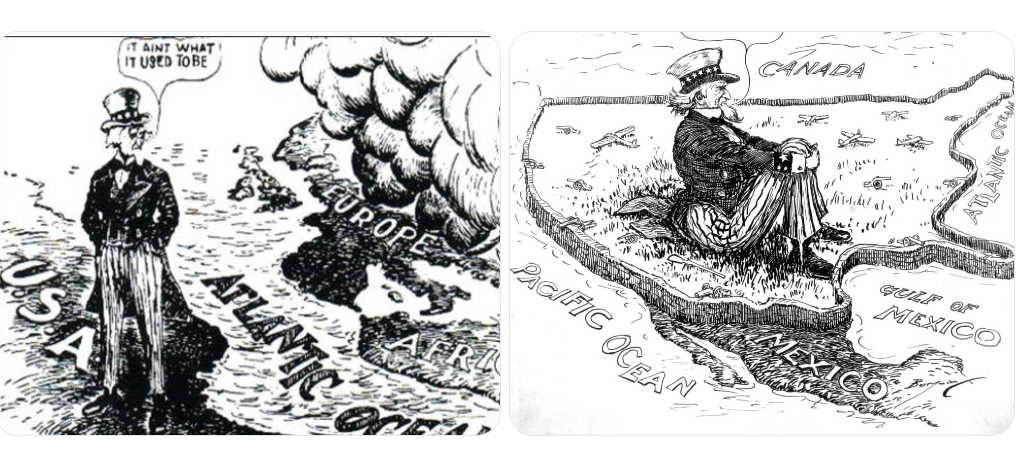
What is the main idea being expressed in this cartoon?
A. The United States is actively fighting in Europe
B. The United States is remaining isolated while war spreads in Europe
C. Europe is becoming more peaceful
D. The United States is helping rebuild Europe
B. The United States is remaining isolated while war spreads in Europe
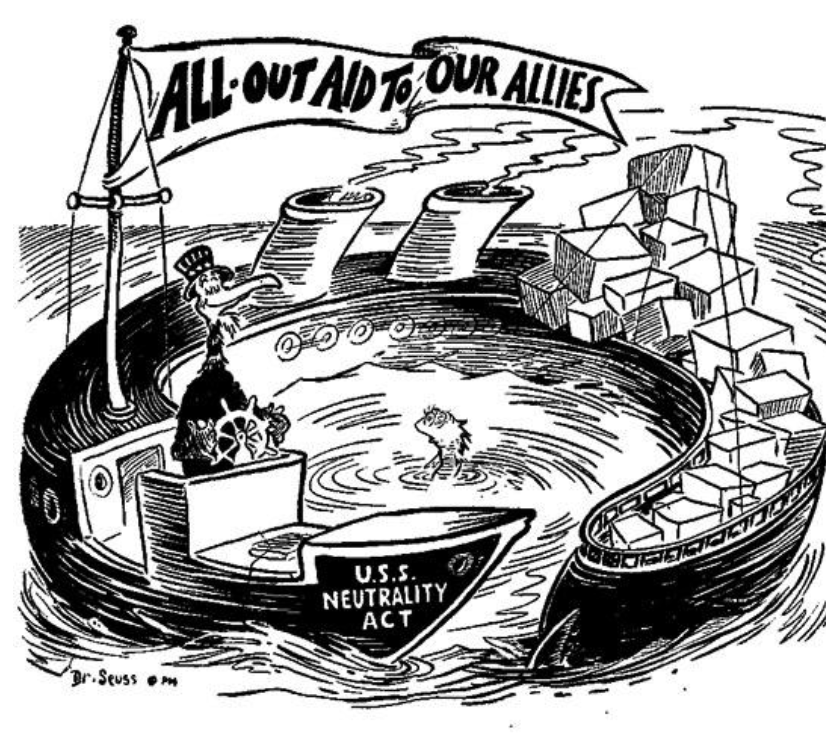
What is the main message of this cartoon?
A. U.S. neutrality policies are effective and protective
B. The U.S. should avoid helping any other countries
C. Neutrality is dangerous and the U.S. should aid its allies
D. The U.S. should support the Axis powers
C. Neutrality is dangerous and the U.S. should aid its allies
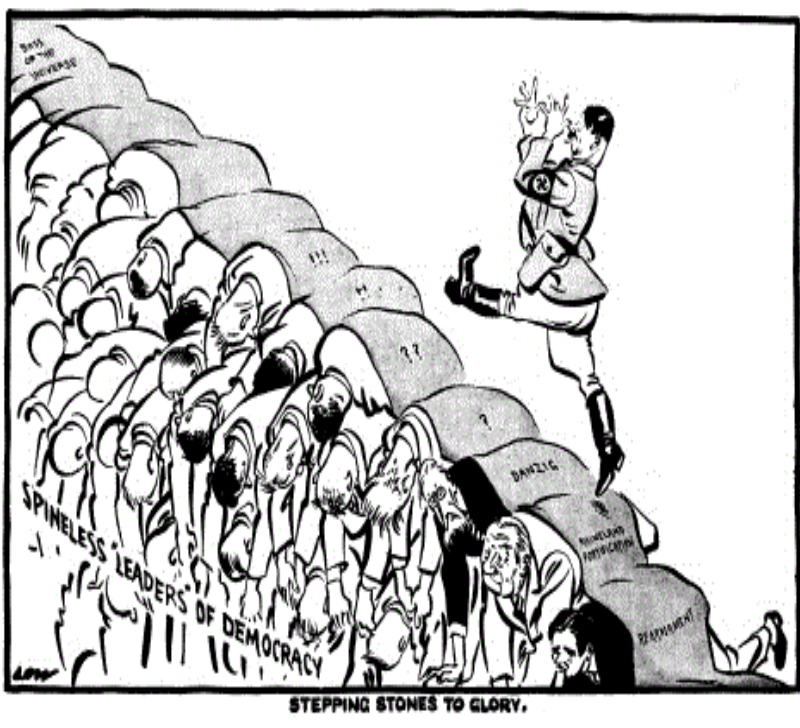
What is the main idea of this cartoon?
A. Democratic leaders successfully stopped Hitler
B. Hitler relied on military strength alone to gain power
C. Democratic nations allowed Hitler to grow stronger through appeasement
D. Hitler was supported equally by all European nations
C. Democratic nations allowed Hitler to grow stronger through appeasement