physics 2 homework 8 steps An electromagnetic rail gun can fire a projectile using a magnetic field and an electric current. Consider two conducting rails that are 0.640 m apart with a 67.1-g conducting rod connecting the two rails as in the given figure. A magnetic field of magnitude 0.860 T is directed perpendicular to the plane of the rails and rod. A current of 2.00 A passes through the rod.
 Call Kai
 Learn
Learn Practice Test
 Spaced Repetition
 Match
Match Flashcards
 Knowt Play
1/9

There's no tags or description
Looks like no tags are added yet.
Name | Mastery | Learn | Test | Matching | Spaced | Call with Kai | Chat |
|---|
No analytics yet
Send a link to your students to track their progress
10 Terms
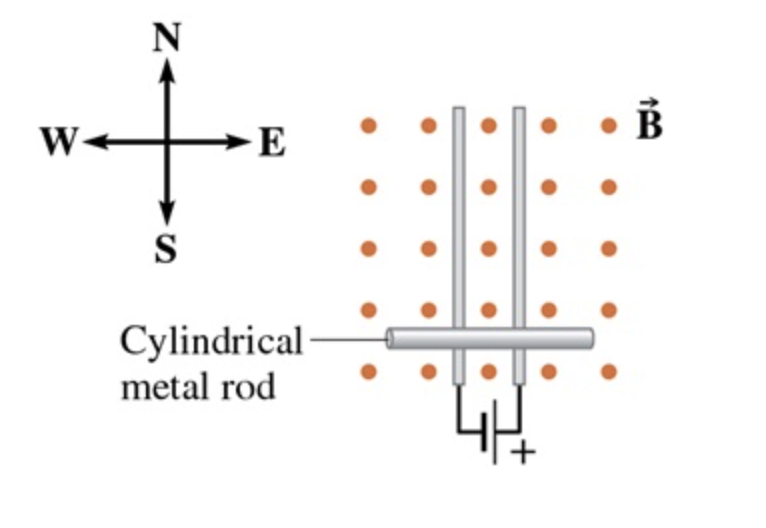
An electromagnetic rail gun can fire a projectile using a magnetic field and an electric current. Consider two conducting rails that are 0.640 m apart with a 67.1-g conducting rod connecting the two rails as in the given figure. A magnetic field of magnitude 0.860 T is directed perpendicular to the plane of the rails and rod. A current of 2.00 A passes through the rod.
What direction is the force on the rod?
convert mass to kilograms (divide by 1000)
use the magnetic force formula (F=ILB)
Find the acceleration using newtons second law (F=ma)
Use a kinematic equation to find velocity ( v² = v²i + 2as)
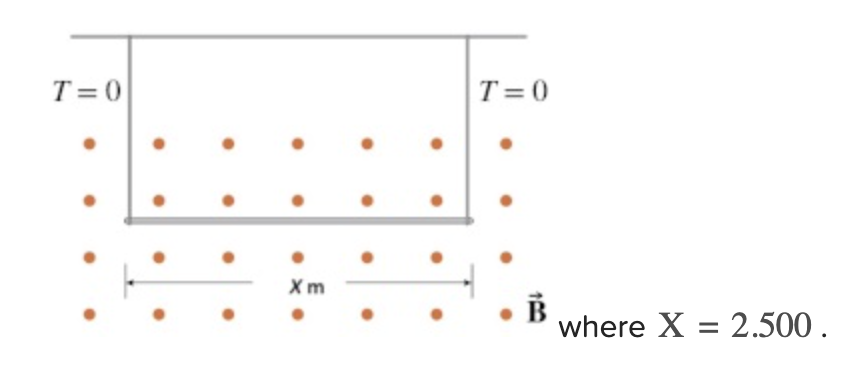
A straight, stiff wire of length 2.500 m and mass 61.00 g is suspended in a magnetic field B=0.720 T . The wire is connected to an emf.
How much current must flow in the wire so that the wire is suspended and the tension in the supporting wires is zero? (Round the final answer to three decimal places.)
Write the force balance ( F B = F g )
solve for current ( I = mg/ LB)
convert mass to kilograms
plug in known values
Solve for current
A straight, stiff wire of length 2.500 m and mass 61.00 g is suspended in a magnetic field B=0.720 T . The wire is connected to an emf.
What is the direction of the current so that the wire is suspended and the tension in the supporting wires is zero?
The current flows to the left.
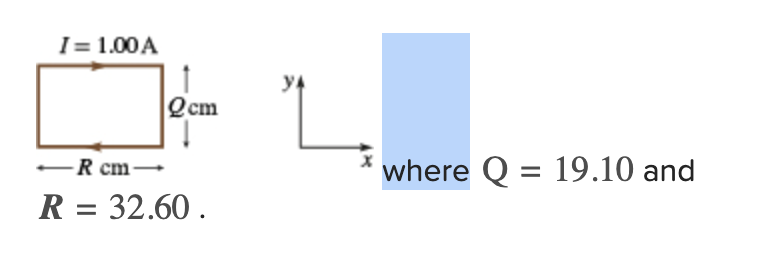
A 19.10 cm×32.60 cm rectangular loop of wire carries 1.00 A of current clockwise around the loop. The magnetic field is 2.100 T out of the page.
What is the magnetic force on the top side? If the magnetic force is in the −y -direction, enter a negative value. (Round the final answer to three decimal places.)
identify the length of the top side (the bottom side is horizontal, so its length is R) and convert from cm → m
list the known values
Calculate the magnitude of the force ( F= ILB )
determine the direction using the right-hand rule (fingers are right, curl out of the page, and thumb points down)
Apply the sign (since the force is -y, it must be negative)
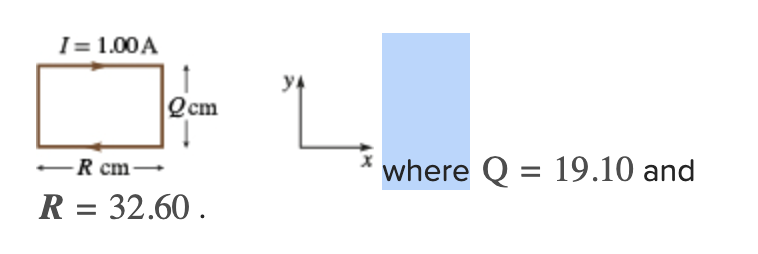
A 19.10 cm×32.60 cm rectangular loop of wire carries 1.00 A of current clockwise around the loop. The magnetic field is 2.100 T out of the page.
What is the magnetic force on the bottom side? If the magnetic force is in the −y -direction, enter a negative value. (Round the final answer to three decimal places.)
identify the length of the bottom side (the bottom side is horizontal, so its length is R) and convert from cm → m
list the known values
calculate the magnitude
determine the direction using the right hand rule (fingers are left, curl out of the page, and thumb points up)
Apply the sign (since the force is +y, the value is positive)
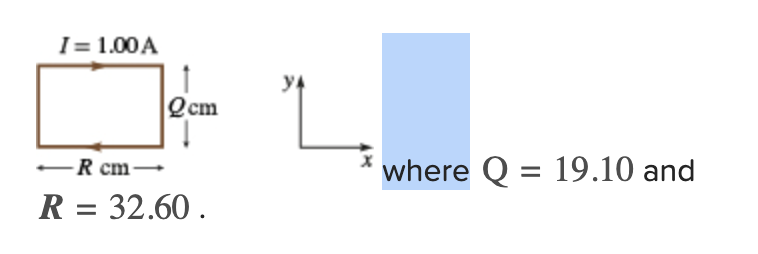
A 19.10 cm×32.60 cm rectangular loop of wire carries 1.00 A of current clockwise around the loop. The magnetic field is 2.100 T out of the page.
What is the magnetic force on the left side? If the magnetic force is in the −x -direction, enter a negative value. (Round the final answer to three decimal places.)
determine the length of the left side (since the left side is vertical its length is Q) and convert cm → m
list the known values
calculate the magnitude
determine the direction using the right hand rule (fingers are up bc of current, curl out of the page bc of magnetic field, thumb is left)
apply the sign (since the force is in the +x direction, the value is positive)
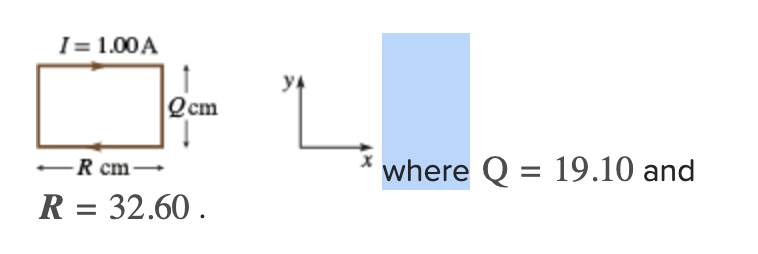
A 19.10 cm×32.60 cm rectangular loop of wire carries 1.00 A of current clockwise around the loop. The magnetic field is 2.100 T out of the page.
What is the magnetic force on the right side? If the magnetic force is in the −x-direction, enter a negative value. (Round the final answer to three decimal places.)
determine the length of the left side (since the left side is vertical its length is Q) and convert cm → m
list the known values
calculate the magnitude
determine the direction using the right hand rule (fingers are down bc of current, curl out of the page bc of magnetic field, thumb is left)
apply the sign (since the force is in the -x direction, the value is positive)
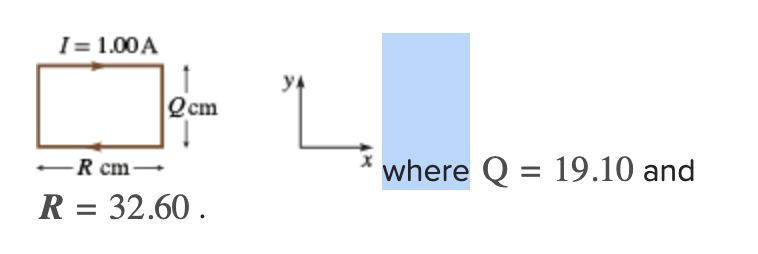
A 19.10 cm×32.60 cm rectangular loop of wire carries 1.00 A of current clockwise around the loop. The magnetic field is 2.100 T out of the page.
What is the net magnetic force on the loop?
add up top side and bottom side
add up left side and right side
add these together
In an electric motor, a coil with 129 turns of radius 1.000 cm can rotate between the poles of a magnet. The magnetic field magnitude is 0.200 T. When the current through the coil is 45.7 mA, what is the maximum torque that the motor can deliver? (You may enter your calculation using scientific notation.)
convert radius to meters cm → m
find the area of the coil (A=pie r²)
Substitute this into the torque formula ( T = NIAB)
Calculate
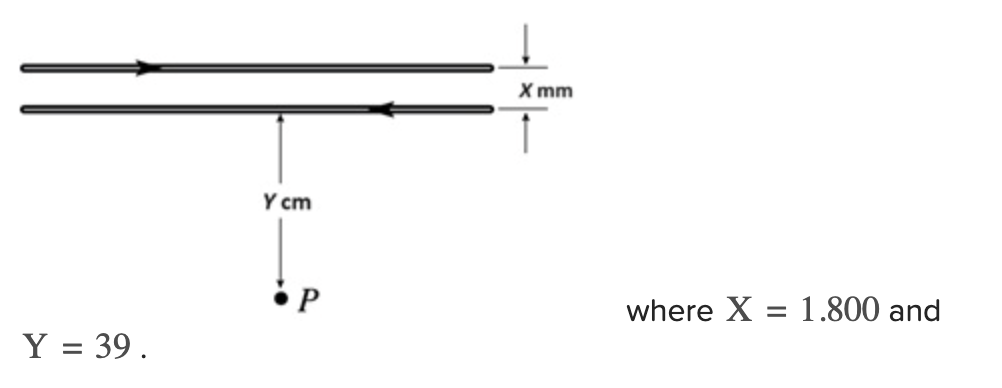
Two wires each carry 10.0 A of current (in opposite directions) and are 1.800 mm apart. What is the magnetic field 39 cm away at point P, in the plane of the wires? If the net field is into the page, enter a negative value. (You may enter your calculation using scientific notation.)