Lecture 4 - Functions of Globular Proteins and Enzymes pt 1
 Call Kai
 Learn
Learn Practice Test
 Spaced Repetition
 Match
Match Flashcards
 Knowt Play
1/47

There's no tags or description
Looks like no tags are added yet.
Name | Mastery | Learn | Test | Matching | Spaced | Call with Kai |
|---|
No analytics yet
Send a link to your students to track their progress
48 Terms
storage of ions and molecules (myoglobin and ferritin)
transport of ions and molecules (hemoglobin, serotonin transporter)
defense against pathogens (antibodies, cytokines)
muscle contraction (actin, myosin)
biological catalysis (chymotrypsin, lysozyme)
5 functions of globular proteins
ligand (typically a small molecule)
molecule that binds to a protein
binding site
region in the protein where the ligand binds
noncovalent
ligand binds via some _________ forces that dictate protein structure
association rate constant (ka)
kinetics of binding of ligand to protein is described by what constant
dissociation rate constant (kd)
kinetics of unbinding of ligand from protein is described by what constant
the association rate constant and the dissociation rate of constant
when process reaches equilibrium what is equal?
the equilibrium constant (Ka)
the equilibrium composition is characterized by what constant
Ka = [PL] / [P] x [L] = ka / kd
equilibrium constant equation
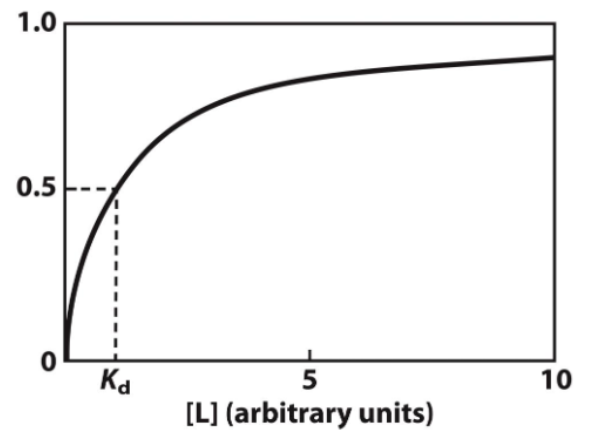
fraction of occupied binding sites
what is θ
θ = [L] / [L] + Kd
equation of θ in terms of equilibrium dissociation constant
θ = fraction of occupied binding sites
what is on the y-axis at Kd intersection?
[P][L] / [PL]
what does Kd equal?
M-1
association constant units
M
dissociation constant units
Kd < 10 nM (strong)
Kd > 10 uM (weak)
strong and weak binding magnitudes
size
shape
charfe
hydrophobic/hydrophilic character
what are the binding site and ligand complementary in (creates high specificity)
preformed
“Lock and Key” model assumes that complementary surfaces are ____
induced fit
conformational changes occur upon ligand binding is known as what
tighter binding of the ligand AND high affinity for different ligands
what does induced fit allow for
true
true or false: both the ligand and the protein can change their conformations
protein side chains lack affinity for O2
transition metals would generate free radicals if free in solution and bind O2
heme is suitable but Fe2+ in free heme would be oxidized to Fe3+
solution → capture the oxygen molecule with heme that is protein bound (hemoglobin, myoglobin)
what is the issue and solution with binding oxygen?
consists of a complex organic ring structure, protoporphyrin IX, with a bound iron atom in its ferrous (Fe2+) state
structure of heme
it has a similar size and shape to O2: it can fit to the same binding site and binds better because it has a filled lone electron pair that can be donated to vacant d-orbitals on the Fe2+ (blocks function of myoglobin, hemoglobin, and mitochondrial cytochromes)
why is carbon monoxide dangerous?
O2 binds at an angle (also oxygen is hydrogen bonded to distal Histidine) while CO binds in a straight line
difference in angle of binding of O2and CO to heme group
pO2 in lungs is about 13 kPa (binds oxygen well) while pO2 in tissues is about 4 pKa (releases oxygen)
how does hemoglobin know when to bind and release O2
positive cooperativity
first binding event increases affinity at remaining sites
negative cooperativity
first binding event reduces affinity at remaining sites
concerted cooperativity
all subunits are postulated to be in the same conformation
sequential cooperativity
a conformational change in one subunit makes a similar change in an adjacent unit
allosteric protein
binding of a ligan to one site affects the binding properties of a different site, on the same protein (can be positive or negative)
homotropic
normal ligand of the protein is the allosteric regulator
heterotropic
different ligand affects binding of the normal ligand
positive homotropic regulation
what type of regulation is cooperativity
cooperatively
hemoglobin binds oxygen __________
2 subunits (alpha and beta) both of which are structurally similar to myoglobin
how many subunits is hemoglobin
the sequences are not similar
what is different between hemoglobin and myoglobin
large change at the a1B2 contact with several ion pairs broken (goes from tense to relaxed state)
after oxygen binding, what happens to the structure of hemoglobin
T (tense) state
what state is deoxyhemoglobin molecules in
more interactions, more stable, lower affinity for O2
tense state of hemoglobin
fewer interactions, more flexible, higher affinity for O2
relaxed state of O2
T → R conformational change (involved breaking ion pairs between the a1-B2 interface)
O2 binding to hemoglobin triggers what change
T state the iron ball is slightly protruding from heme group
R state the iron ball is in the middle of the heme group
iron ball in middle of heme group difference in T vs R state
Bohr effect
the pH different between lungs and metabolic tissues increased efficiency of the O2 transport
protons trigger T-state causing release of O2 molecule
what does increase in protons do to hemoglobin
pH of blood in the lungs is 7.6
pH of blood in the tissues is 7.2
pH of blood in the lungs vs in the tissues
binds to the central cavity of hemoglobin and stabilizes the T state heterotopic regulator) → allows for O2 release in the tissues and adaption to changed in altitude
what does 2,3-BPG do
Glu→ val in the B chain of hemoglobin → valine side chain and bind to a different hemoglobin molecule to a form a strand which sickles the red blood cells
sickle-cell anemia mutation