Exam 4 - Chapter 18
 Call Kai
 Learn
Learn Practice Test
 Spaced Repetition
 Match
Match Flashcards
 Knowt Play
1/24

There's no tags or description
Looks like no tags are added yet.
Name | Mastery | Learn | Test | Matching | Spaced | Call with Kai |
|---|
No analytics yet
Send a link to your students to track their progress
25 Terms
What causes the reduction of transcription?
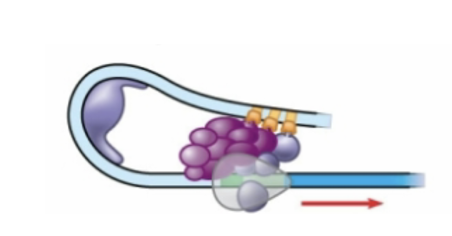
Describe the process happening in the picture below. Hint - think of the promoters and enhancers
The transcription initiation complex is assembling at a eukaryotic gene. General transcription factors (such as TFIID, which binds the TATA box in the promoter) and RNA polymerase II are recruited to the promoter region. Enhancers located farther away on the DNA are bound by activator proteins, and the DNA loops so that these activators can interact with the transcription initiation complex through mediator proteins. This interaction helps phosphorylate the CTD (carboxy-terminal domain) of RNA polymerase II, allowing the polymerase to escape the promoter and begin elongating the RNA transcript.
What are the two types of cell-type specific regulation?
Transcriptional control (regulating which genes are transcribed by transcription factors and enhancers) and post-transcriptional control (regulating RNA processing, stability, and translation, including alternative splicing).
During RNA processing, what process can occur?
5′ capping, 3′ polyadenylation (addition of a poly‑A tail), and splicing (removal of introns and joining of exons). Additionally, alternative splicing can produce different mRNA isoforms from the same primary transcript.
What is left after the mRNA has been spliced?
Exons remain joined together, along with the 5′ cap and the 3′ poly‑A tail. The introns have been removed and degraded.
Exons
Coding sequences that are retained in the mature mRNA and will be translated into protein
Introns
Non-coding intervening sequences that are transcribed into pre‑mRNA but are removed by splicing and are not present in the mature mRNA.
What is the protein complex that miRNA binds to to block translation?
RISC complex (RNA-induced silencing complex)
What is the first step of post-transcriptional regulation of gene expression?
The miRNA precursor folds back on itself
What is the second step of post-transcriptional regulation of gene expression?
An enzyme called a dicer cuts RNA into shorter segments
What is the third step of post-transcriptional regulation of gene expression?
One strand of RNA is degraded, and the other strand associates with the RISC complex of proteins
What is the fourth step of post-transcriptional regulation of gene expression?
The bound miRNA can base pair with any target mRNA that contains the complementary sequence
What is the fifth step of post-transcriptional regulation of gene expression?
The miRNA-protein complex prevents gene expression either by degrading the target mRNA or blocking its translation
What kind of regulation is ubiquitination?
Post-translational regulation.
What is the function of a proteasome?
A large protein complex that degrades ubiquitin-tagged proteins into small peptides, recycling amino acids and regulating protein levels within the cell.
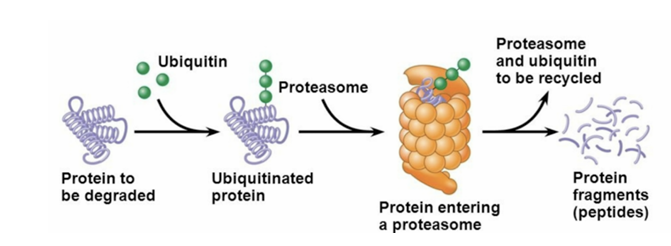
What is the process also known as?
Post-Translational Regulation: Ubiquitination
What has to bind to a protein for it to go through the kiss of death?
ubiquitin