Week 8: Sequencing Genomes
 Call Kai
 Learn
Learn Practice Test
 Spaced Repetition
 Match
Match Flashcards
 Knowt Play
1/47

There's no tags or description
Looks like no tags are added yet.
Name | Mastery | Learn | Test | Matching | Spaced | Call with Kai |
|---|
No analytics yet
Send a link to your students to track their progress
48 Terms
What is the difference between PCR and Sanger sequencing with regard to the materials needed to perform these reactions?
Primers are needed in PCR but not in Sanger sequencing.
DNA polymerase is needed in PCR but not in Sanger sequencing.
Primers are needed in Sanger sequencing but not in PCR.
DNA polymerase is needed in Sanger sequencing but not in PCR.
Dideoxynucleotides are needed in Sanger sequencing but not in PCR.
Dideoxynucleotides are needed in Sanger sequencing but not in PCR.
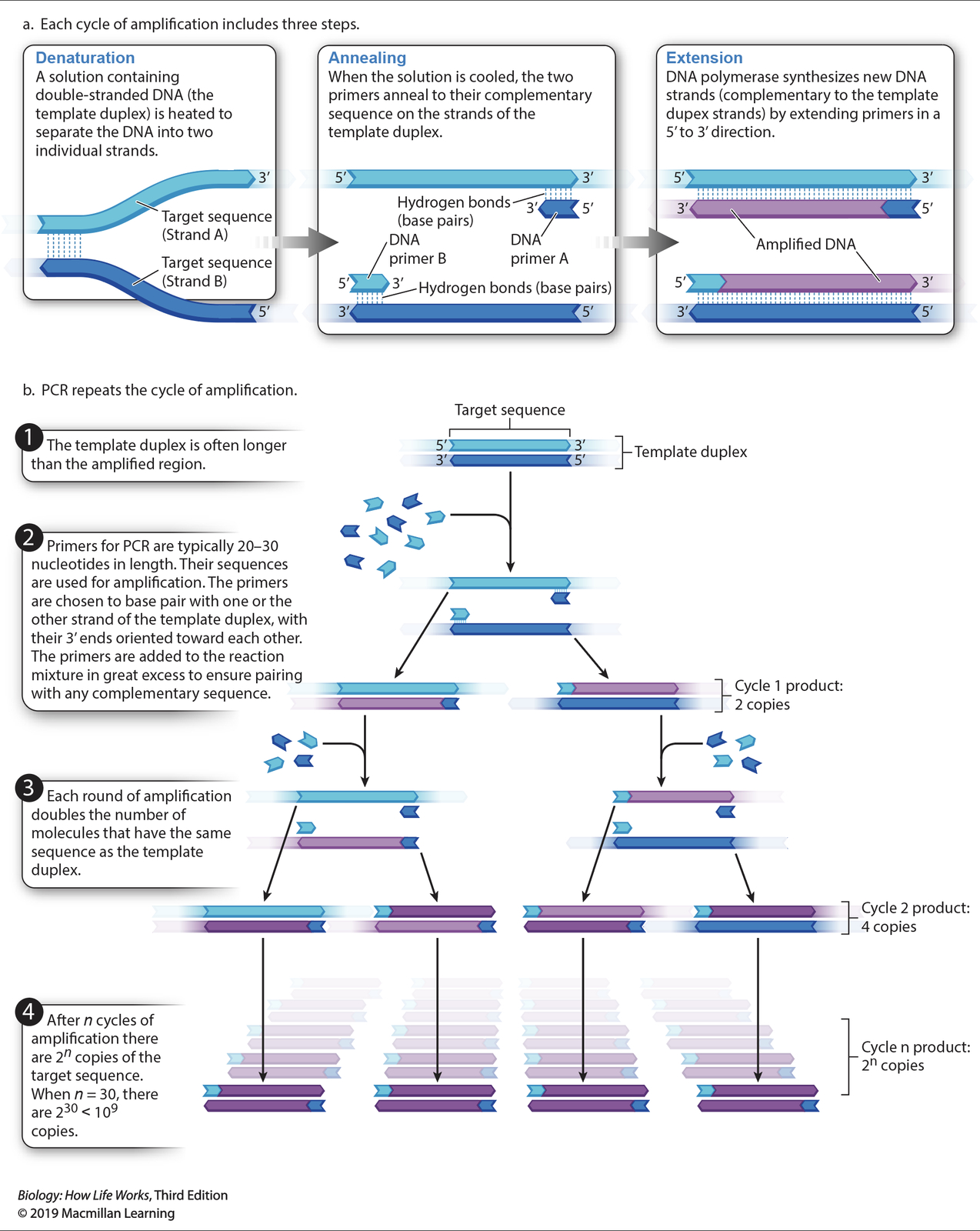
T/F: Restriction enzymes are an essential component of PCR.
False
Modern methods of massively parallel sequencing include devices for detecting fluorescence or visible light as each:
dideoxynucleotide in turn terminates synthesis.
nucleotide passes through a gel.
nucleotide is incorporated during synthesis.
nucleotide is released from a strand by DNase.
nucleotide is incorporated during synthesis.
Which factors make sequencing by the Sanger chain-termination method possible? Select all that apply.
Complementary single-stranded nucleic acid sequences can come together to form a duplex molecule.
A DNA strand whose 3′ end terminates in a dideoxynucleotide cannot be elongated.
Duplex nucleic acid molecules can be separated by size by means of gel electrophoresis.
New nucleotides are added only to the 3′ end of a growing DNA strand.
Single-stranded nucleic acid molecules can be immobilized on certain types of filter paper.
Complementary single-stranded nucleic acid sequences can come together to form a duplex molecule.
A DNA strand whose 3′ end terminates in a dideoxynucleotide cannot be elongated.
Duplex nucleic acid molecules can be separated by size by means of gel electrophoresis.
New nucleotides are added only to the 3′ end of a growing DNA strand.
T/F: In DNA sequencing, the newly synthesized DNA strand that is complementary and anti-parallel to a template DNA strand is called a sequence read.
True
T/F: To maintain the accuracy of the genome sequence, the DNA should not be cut into small pieces before sequencing.
False
Repeated DNA sequences represent a special challenge in genome sequence assembly.
Which would be harder to assemble correctly, assuming the number of copies of the repeat can be determined?
sequences containing repeats longer than the DNA fragments to assemble
sequences containing repeats shorter than the DNA fragments to assemble
sequences containing repeats longer than the DNA fragments to assemble
Which pair of people has the exact same genome?
mother and daughter
father and son
dizygotic twins
None of the other answer options is correct.
monozygotic twins
monozygotic twins
Which step comes first in shotgun sequencing?
reconstructing the long sequence of nucleotides
breaking the DNA into small fragments
sequencing the DNA
putting the sequences in the correct order
matching regions of overlap
breaking the DNA into small fragments
Which group lists the levels of genetic information in order from smallest to largest?
genome; gene; chromosome; exon
exon; gene; genome; chromosome
exon; gene; chromosome; genome
gene; chromosome; exon; genome
exon; chromosome; gene; genome
exon; gene; chromosome; genome
Genome annotation includes all of the followings except:
regulatory sequences
locations of genes
start codons
none of these answers are correct
conserved sequences
none of these answers are correct
How can researchers distinguish exons from introns in a segment of DNA?
Exons have a characteristic sequence.
Only exons contain three‑base sequences that can code for amino acids.
The sequence of exons complements mRNA molecules in the cell.
Primers will not bind to introns.
The sequence of exons complements mRNA molecules in the cell.
Which is a type of sequence identified by gene annotation?
simple‑sequence repeat
open reading frame (ORF)
All of these choices are correct.
tandem repeat
noncoding RNA
All of these choices are correct.
T/F: All DNA sequences are transcribed into RNA.
False
Which are examples of sequence motifs?
promoters
open reading frame (ORF)
hairpin structures
All of these choices are correct.
coding region
All of these choices are correct.
T/F: When an open reading frame (ORF) is identified, it may not actually correspond to the amino acid sequence of any polypeptide in the cell.
True
Imagine a genomic researcher who is analyzing the genome of different types of cats. She finds that a particular sequence in the North American Bobcat genome is identical to a sequence found in the common house cat, whereas most other sequences between the genomes of these cats differ at many nucleotides. Bobcats and house cats diverged an estimated 6.8 million years ago, plenty of time for mutation to generate DNA sequence variation.
Which statements could explain the identical sequence in these otherwise differing genomes? Select all that apply.
The sequence is from an intron of a gene that encodes a muscle protein.
The sequence is contained in a retrovirus that has infected both species.
The sequence encodes a protein critical for the production of fur color.
The sequence encodes a gene that is critical for life and that cannot retain its function if mutated.
The sequence is contained in a retrovirus that has infected both species.
The sequence encodes a gene that is critical for life and that cannot retain its function if mutated.
Humans do not have significantly more genes than some other animals, for instance, the nematode worm C. elegans.
What accounts for the diversity of cell types and functions in humans relative C. elegans or D. melanogaster? Select all that apply.
Humans cells frequently gain more genes through horizontal gene transfer.
Most genes in the other animals are inactive.
Complexity arises from differential gene expression.
Complexity arises from different combinations of proteins.
Many human genes can encode multiple proteins.
Complexity arises from differential gene expression.
Complexity arises from different combinations of proteins.
Many human genes can encode multiple proteins.
T/F: The complexity of an organism is proportional to the number of genes in its genome.
False
Which property of transposable elements allows them to contribute to the C‑value paradox?
Their replication is controlled by genes found on the transposable element itself.
All of these choices are correct.
Their copy number can increase from one generation to the next.
Copies of transposable elements can appear on multiple chromosomes.
All of these choices are correct.
If a researcher tried shotgun sequencing with a single chromosome from a single cell, would the process work?
No, there would be no overlap because there is only one piece of double‑stranded DNA that is fragmented.
Yes, there would still be significant overlap after sequencing between adjacent fragments
Yes, there would still be significant overlap because there is one piece of double‑stranded DNA that is fragmented.
No, there would not be significant overlap because the single chromosome would be broken into individual nucleotides.
No, there would be no overlap because there is only one piece of double‑stranded DNA that is fragmented.
After completing the sequencing reactions, how is the entire genome from an organism assembled?
Computer programs are used to automate finding sequence overlaps.
Researchers manually piece together the fragments looking for areas of overlap.
Computer programs are used to automate finding sequence overlaps.
In order to answer this question, you will need to read and understand the content in the Extension and Application Information section in the interactive How Do You Know figure.
The human Y chromosome contains about 58 million base pairs. Which distance in air miles between US cities is closest to the pop‑bead length of the human Y chromosome?
New York, NY–Raleigh, NC (699 km, 434 miles)
New York, NY–Atlanta, GA (1226 km, 762 miles)
New York, NY–Richmond, VA (475 km, 295 miles)
New York, NY–Washington, DC (366 km, 227 miles)
New York, NY–New Brunswick, NJ (64.3 km, 40 miles)
New York, NY–Raleigh, NC (699 km, 434 miles)
Which of the phrases could be assembled from these fragments?
ose is
a rose i
rose
All of the answer options are correct.
a rose is a rose is
a rose is
a rose is a rose is a rose is a rose is
a rose is a rose is a rose is
All of the answer options are correct.
What is the hypothesis of the sequencing approach described in the figure?
There will be no overlap if the genome is sequenced from random fragments.
If the genome is randomly broken up, then sequencing the fragments will lead to significant overlap for re‑alignment.
If the genome is randomly broken up, then sequencing the fragments will lead to little overlap for re‑alignment.
If the genome is randomly broken up, then sequencing the fragments will lead to significant overlap for re‑alignment.
In order to answer this question, you will need to read and understand the content in the Extension and Application Information section in the interactive How Do You Know figure.
One complete set of human chromosomes, such as found in a haploid sperm or egg, contains DNA molecules that, laid end to end, would extend for 3.2 Gb (3.2 billion base pairs). Which distance is the closest to the pop‑bead length of the human genome?
the distance from Earth to the moon (384,472 km, 238,900 miles)
a tunnel from Earth’s surface to its center (6371 km, 3959 miles)
a tunnel through the Earth (12,743 km, 7918 miles)
the circumference of Earth (40,074 km, 24,901 miles)
the circumference of Earth (40,074 km, 24,901 miles)
A point mutation that causes an amino acid replacement is called a:
nonsynonymous (missense) mutation.
nonsense mutation.
synonymous (silent) mutation.
transition mutation.
stop mutation.
nonsynonymous (missense) mutation.
A point mutation that changes a UAC codon into a UAG codon is a:
missense mutation.
frameshift mutation.
silent mutation.
nonsense mutation.
nonsense mutation.
Mutation rate in germ-line cells occur___________________ in somatic cells.
more often than
less often than
at the same rate as
less often than
Which of the statements applies to frameshift mutations?
Frameshift mutations cause the insertion or deletion of a single amino acid from the polypeptide chain.
Frameshift mutations are known risk factors in most forms of cancer, including breast and colon cancer.
Frameshift mutations change the amino acid sequence downstream from the site of the mutation.
Frameshift mutations create a premature stop codon at the site of the mutation.
Frameshift mutations are known risk factors in breast cancer, but not colon cancer.
Frameshift mutations change the amino acid sequence downstream from the site of the mutation.
Point mutations can impair a protein if they result in which of the answer choices? Select all that apply.
nonsense codon
synonymous codon
shift in reading frame
nonsynonymous codon
nonsense codon
shift in reading frame
nonsynonymous codon
A chromosomal mutation where a segment breaks off, flips, and then reattaches itself is called a(n):
reciprocal translocation.
duplication.
deletion.
translocation.
inversion.
inversion.
The following are examples of small-scale mutations except:
single nucleotide insertion
frame shift mutation
single nucleotide deletion
base substitution
translocation
translocation
Aneuploidy can result due to which type of mutation(s).
base insertion
base substitution
nonsense mutation
translocation
duplication
frame shift mutation
deletion
translocation
duplication
deletion
When nonhomologous chromosomes exchange parts, a(n) ______ has occurred.
mismatch
base exclusion
reciprocal translocation
inversion
closed reading frame
reciprocal translocation
In organisms with large genomes, inversions are more likely to be tolerated if the breakpoints occur in:
open reading frames.
coding DNA.
noncoding DNA.
closed reading frames.
reciprocal translocations.
noncoding DNA.
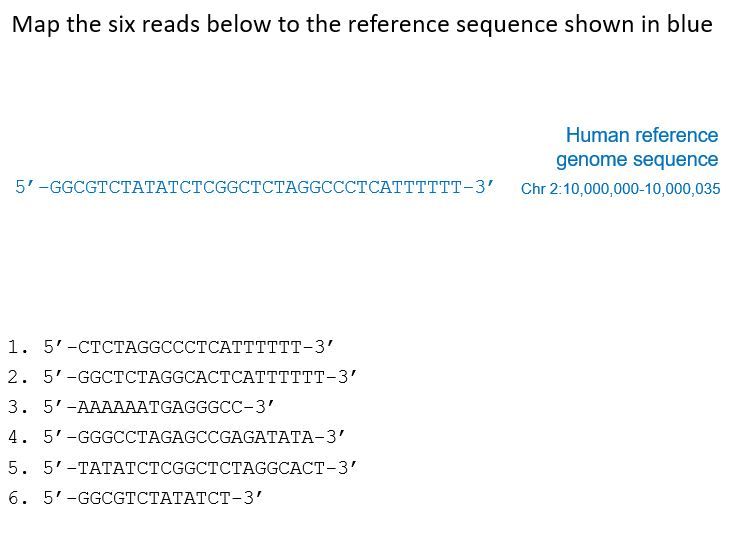
The six sequence reads listed below were generated using sequencing by synthesis. The blue reference sequence was obtained from the Human Genome Browser at position Chr 2: 10,000,000-10,000,035. By convention only one strand of DNA is given although two strands exist.
Based on the data, sequence read 2 is identical to the reference genome sequence shown.
True/False
Cannot be determined
False
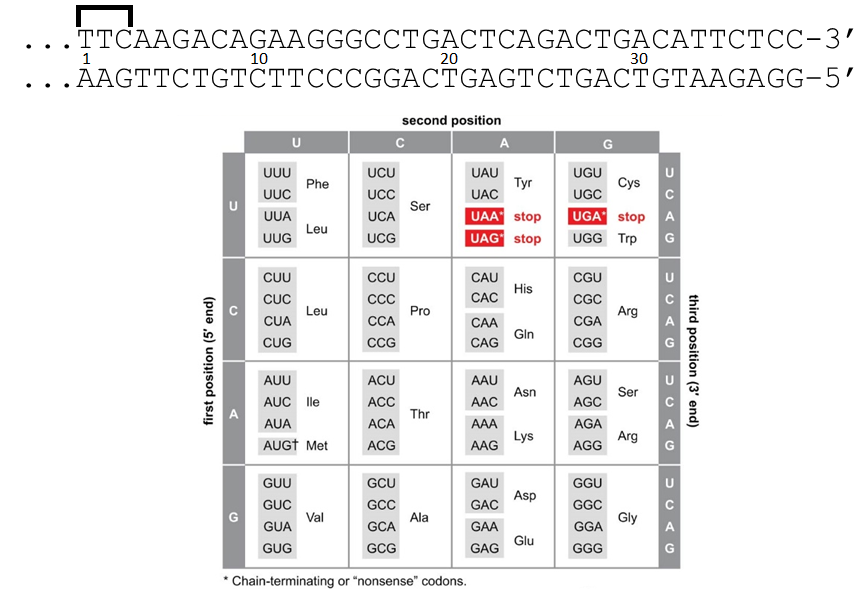
The DNA sequence shown below comes from part of the TP53 gene. It encodes the last amino acids of the p53 protein, which is normally 393 amino acids long. The bracketed codon indicates the correct reading frame of this gene. The lower strand of the gene is used as the template during the transcription of mRNA from this gene. The first T on the 5' end is at position 1.
T/F: A mutation that changes the nucleotide at position 20 from A to G is a silent mutation.
False
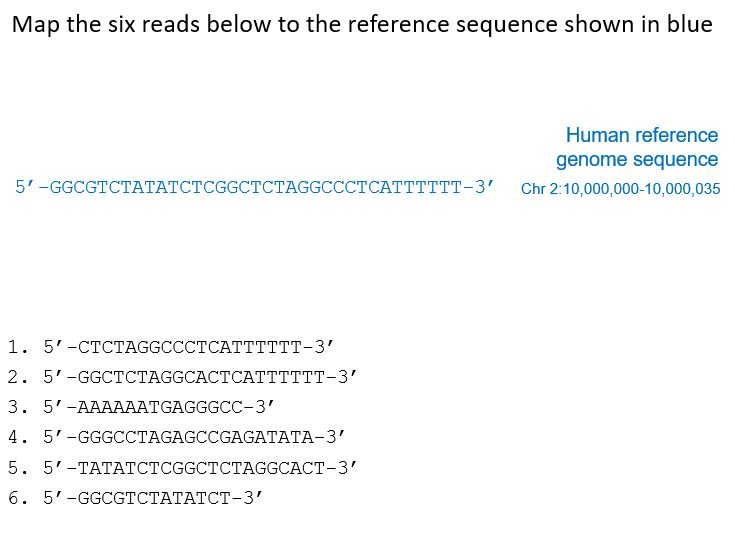
The six sequence reads listed below were generated using sequencing by synthesis. The blue reference sequence was obtained from the Human Genome Browser at position Chr 2: 10,000,000-10,000,035.
By convention only one strand of DNA is given although two strands exist.
Sequence read 3 was synthesized by sequencing which strand of DNA?
5' --> 3' strand
3' --> 5' strand
neither 5' --> 3' and 3' --> 5' strands
both 5' --> 3' and 3' --> 5' strands
5' --> 3' strand
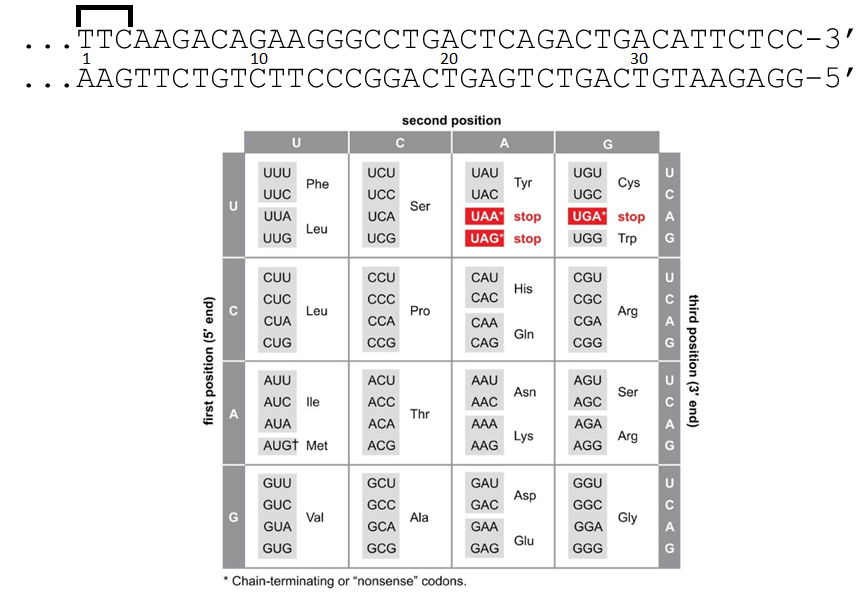
The DNA sequence shown below comes from part of the TP53 gene. It encodes the last amino acids of the p53 protein, which is normally 393 amino acids long. The bracketed codon indicates the correct reading frame of this gene. The lower strand of the gene is used as the template during the transcription of mRNA from this gene. The first T on the 5' end is at position 1.
T/F: A mutation that changes the nucleotide at position 23 from C to G is a nonsense mutation.
True
Suppose that, on another planet, life had evolved with double‑stranded DNA containing four pairs of complementary bases; for example, A–T, G–C, U–V, and W–X, instead of Earthly DNA with only two pairs, A–T and G–C.
Compared with shotgun sequencing of Earthly DNA with two base pairs, would genome assembly be easier or harder on this other planet where DNA contains four base pairs? Why?
DNA with four base pairs would be easier to assemble because DNA with two base pairs requires longer overlaps to find matches.
DNA with four base pairs would be harder to assemble because DNA with two base pairs requires shorter overlaps to find matches.
DNA with four base pairs would be harder to assemble because DNA with two base pairs has fewer repeated sequences.
None of the other answer options is correct.
DNA with four base pairs would be easier to assemble because DNA with two base pairs has more repeated sequences.
DNA with four base pairs would be easier to assemble because DNA with two base pairs requires longer overlaps to find matches.
Which of the sentence fragments can be assembled together by matching their overlaps?
o matter. Try Again.
thout losing your enthusiasm.
Success is the abi
bility to go from failure to failure with
gain. Fail again. Fail better.
Ever tried. Ever failed. No
1, 3, 4 can be assembled together and 2, 5, 6 can be assembled together
1, 4, 5 can be assembled together and 2, 3, 6 can be assembled together
1, 2, 3 can be assembled together and 4, 5, 6 can be assembled together
1, 5, 6 can be assembled together and 2, 3, 4 can be assembled together
None of the other answer options is correct.
1, 5, 6 can be assembled together and 2, 3, 4 can be assembled together
In order to answer this question, you will need to read and understand the content in the Extension and Application Information section in the interactive How Do You Know figure.
The length of the human X chromosome is about 153 Mb (153 million base pairs). If a base pair in the human X chromosome were the same size as a pop bead, which distance in air miles between US cities is closest to the pop‑bead length of the human X chromosome?
San Diego, CA–La Jolla, CA (17 km, 10 miles)
San Diego, CA–Seattle, WA (1737 km, 1079 miles)
San Diego, CA–Chicago, IL (2613 km, 1748 miles)
San Diego, CA–Charlotte, NC (3957 km, 2458 miles)
San Diego, CA–San Francisco, CA (733 km, 455 miles)
San Diego, CA–Denver, CO (1370 km, 851 miles)
San Diego, CA–Seattle, WA (1737 km, 1079 miles)
Imagine a gene in which the sequence that is transcribed has a GAG codon, which specifies glutamic acid.
If the codon mutated to GUG, which specifies valine, what type of mutation would it be?
base pair deletion
silent
missense
nonsense
frameshift
missense
A single base deletion within the open reading frame of a gene’s DNA sequence can result in ____________.
replacement of multiple correct amino acids with alternative amino acids
replacement of a correct amino acid with a premature stop codon
all of the answer choices are correct
replacement of a correct amino acid with an alternative amino acid
replacement of multiple correct amino acids with alternative amino acids
replacement of a correct amino acid with a premature stop codon
Deletions that eliminate a multiple of three nucleotides can:
All of these choices are correct.
cause frameshift mutations in an open reading frame.
delete amino acids in a polypeptide chain.
cause nonsense mutations in an open reading frame.
delete amino acids in a polypeptide chain.
In what situation can a harmful deletion in a chromosome persist in a population?
if the deletion is in the centromere
if the homologous chromosome lacks the deletion
if it is homozygous
if a transposon replaces the deleted region
if the homologous chromosome lacks the deletion
Sequencing the genome of cancer cells from patients can detect:
none of these choices are correct
point mutations such as base substitutions
single nucleotide deletions
large scale chromosome mutations such as a translocation and inversion
protein isoforms
point mutations such as base substitutions
single nucleotide deletions
large scale chromosome mutations such as a translocation and inversion