Topic 11- Plant Control Systems
 Call Kai
 Learn
Learn Practice Test
 Spaced Repetition
 Match
Match Flashcards
 Knowt Play
1/61

There's no tags or description
Looks like no tags are added yet.
Name | Mastery | Learn | Test | Matching | Spaced | Call with Kai |
|---|
No analytics yet
Send a link to your students to track their progress
62 Terms
Signal transduction
how respoonsse is carried out in plant
consists of: receeption, transduction, responsee
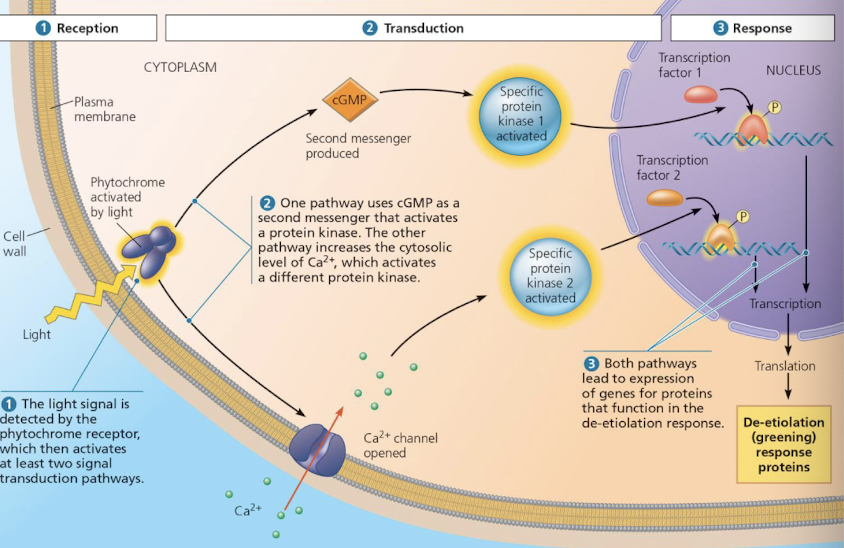
Reception (de-etiolation example)
llight signal is detected by a pytochrome receptor located in the cytooplasm
this activates at least 2 signal transduction pathways
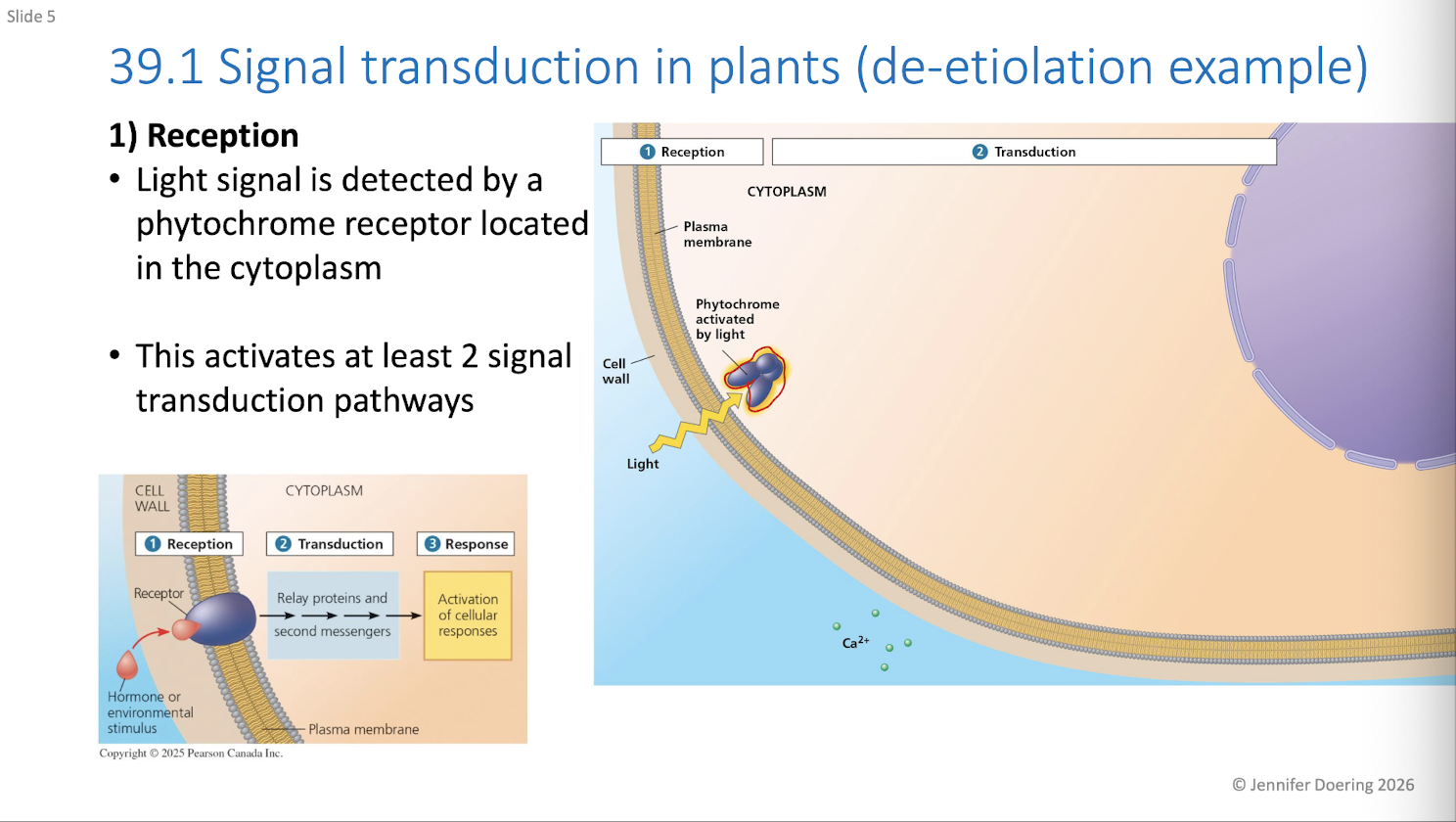
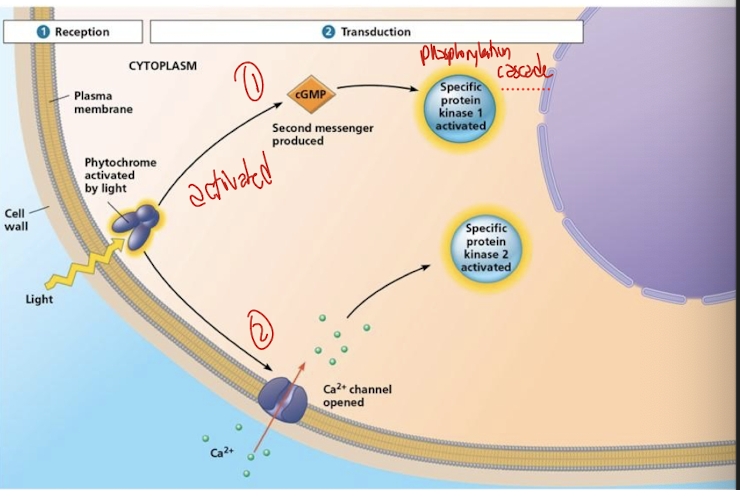
Transduction (de-etiolation example)
first pathway: cGMP
weak levels of light trigger the phytochrome and initiates the secondary messenger cGMP
activates guanlyl cyclase
cGMP then activates a protein kinase
carries the signal into a response
second pathway Ca2+ ions
phytochrome activation opens up Ca2+ channels, floodng the cytossol with increase in Ca2+
this activates a different protein kinase to initate a response
both pathways must be induced for full de-etilotation to occur
Response (de-etiolation example)
both pathways lead too the expression ofo genes for proteins that function in that de-etiolation process
post transcriptional modificiation of proteins
phosphorylation and dephosphorylation
Transcription regulation
transcription factors bind to specific regions of DNA to control transcription of genes on DNA
activators: increase transcriptioon
repressors: decrease transcription
How do plants and hormones work?
plants produce hormones (plant growth regulators)
produced in one tissue/organ and acts on a different one
produced in small amounts
each hormone can have a multitude of effects depending on which tissue it is acting in, its concentration, and the developmental stage of the plant
transported in phloem sap
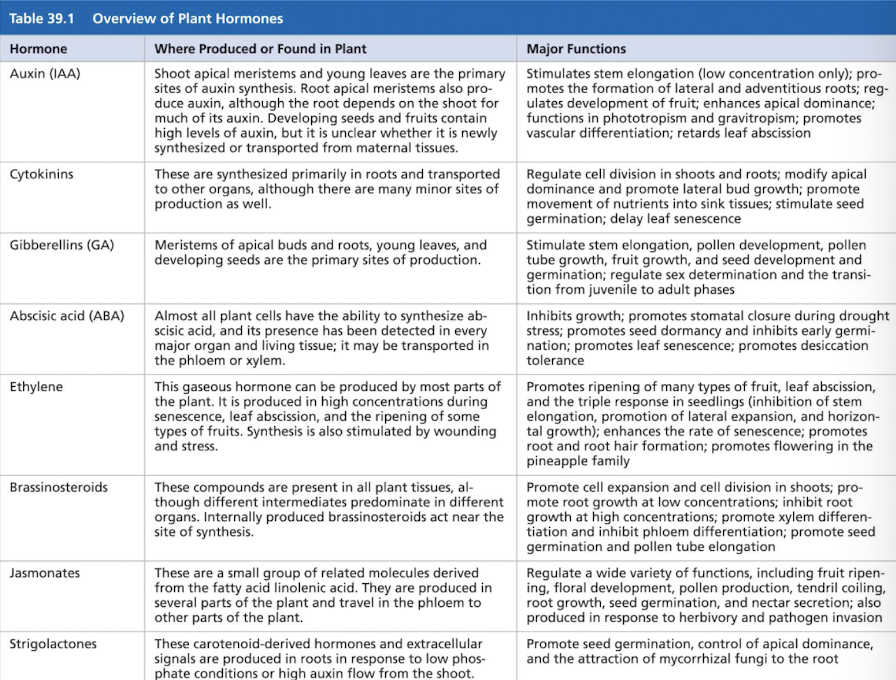
phototropism
plants tend to generally grow towards the light
tropism: plant orogans curving toward or away from a stimulus
usually due to stem elongation
Auxins
indoleacetic acid
promotes growth/elongation of coleoptiles (a sheath protecting a young shoot tip in a grass)
produced predominantly in shoot tips SAM
moves unidirectional shoot tip to shoot basee → polar transport (unrelated to gravity)
Auxins: Role in Plant Development
auxin produced in shoot tip controls spatial organizations of the plants
affects size, shape, environmnet of branches and steps
when auxin production decreases, lateral branches allloweed to development
involved in phyllotaxy (leaf arrangement) → local peaks in auxin determine site oof leaf primoridia
polar transport in leaf margins affect formatioon fo leaf vienss
less auxin = more secondary leaf veinss and loosely organizeed main veins
reduction of auxin at the end of the growing season stimulates the reduction in the vasscular cambium activity
Auxins: Role in Stem Elongation
binds to receptors in the plasma membranee to initiat ecell expansion (acid-growtht hypothessis)
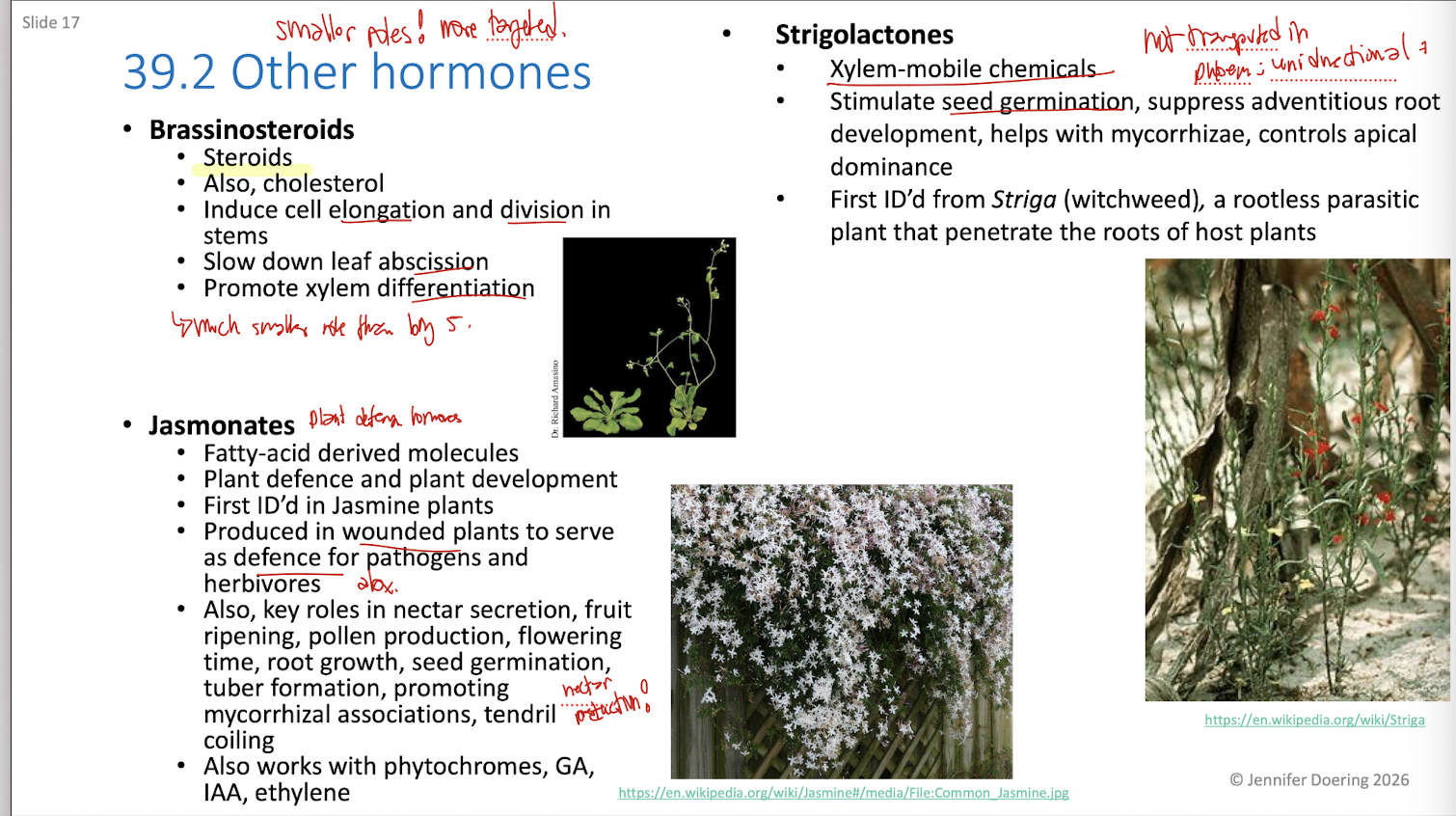
stimulates growth at low concentrations (10-8 - 10-4 )
also stimulates gene expreession to produce proteins, increease cytoplasmatic fluids, and cell wall material
Acid Growth Hypothesis
auxin stimulatess H+ pumps along plasma membranee, increassing the membrane voltage and lowering pH inside of the cell
acidification of the cell wall activates expansins, proteins that break H Bonds in cell wallss
increasee water pottentital due to increased ion intake due to increasing membrane potential → high turgor pressure
the cell iss free to expand and contribute to stem elongation
Auxins: Role in Horticulture
roooting hormonee fo vegeative propagation
synthetic auxins are used as herbicides
synthetic auxins increase fruit production
Cytokinins
stimulates cytokinesis
produced in actively growing tisues, particularly in roots, embryoss, and fruits
transported via xylem sap
Role of Cytokinins in Cell Division
Works with auxins to promote cell divisioon and differentiation
if just auxin is present, cells will go large but won’t divide
if just cytokinins are present, there will be no effect
cytokinin:auxin ratio controlls differentiation
more cytokinins = shoot buds
more auxin = rotos
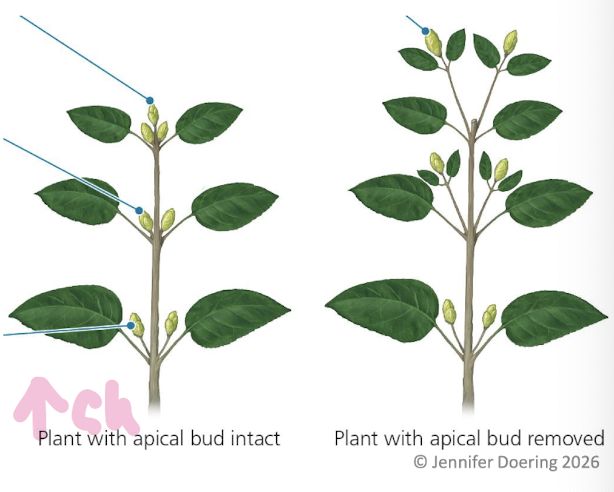
Role of Cytokinins in Lateral bud growth
Apical bud suppresses growth of axillary buds
Role of Cytokinins in antiaging
slows apoptosis in ceellls
inhibits protein breakdown, stimulates RNA production and protein synthesiss
mobilizes nutrients from surrounding tissues
Gibberellins (GA)
produceed in young roots and leaves
Role of Gibberlins in Stem elongation
stimulates both cell division and elongation
dwarf plants grow tall in presence of gibberellins
Role of Gibberlins in fruit growth
both auxins and gibberelins must be present for fruit to develop
in grapes, commercially applide gibberellins makese the grapes grow larger and elongate stems allowing for more space and therefore airflow
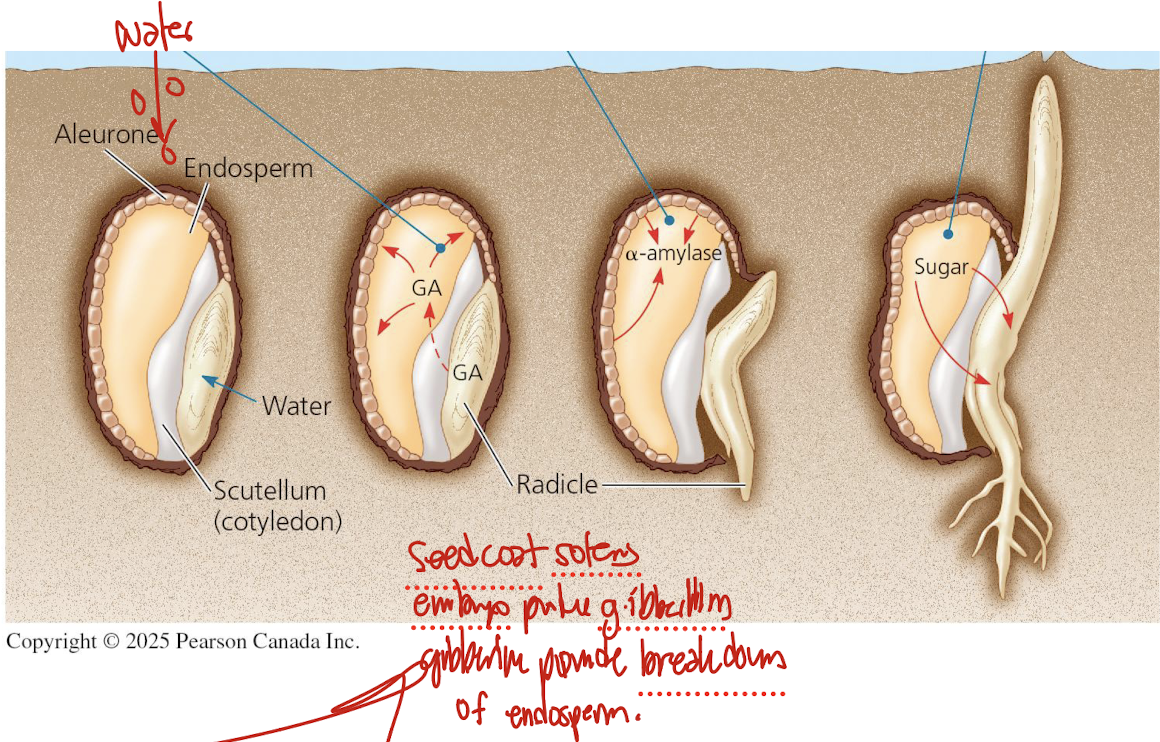
Role of Gibberlins in germination
signals seed to break dormancy, stimulates digestive enzymes for endosperm breakdown
Abscisic Acid
slow growth
Role of Abscisic Acid in Seed Dormancy
increases likelihood that seeds will germinate only when the environment is suitable (ie. enough light, water and nutrients)
prevents seedss form germinating ini the dark, moist interior of the fruit
when ABA concentration decreases, seed geermination occurss
decrease is caused by water washing away ABA, light inactivating ABA
ratio of ABA:GA determines if the seed is dormant or will germinate
Role of Abscisic Acid in Drought tolerancee
ABA closes the stomata to prveent water loss by affecting CA2+ secondary messengeers, resulting in K+ channels t open in the guard cells
Ethlyene
only hormone that is gas
only hormone that is not produced all the time, but is stress induced!
stressors involve drought, flooding, mechanical pressure, injury, and infection
also produced during fruit ripening and programmed cell death
auxin also induces production of ethylene in plants
4 main effects: mechanical stress, ssenescence, leaf abcission, fruit ripening
Role of Ethylene in ‘Triple Response’
shoots avoid obstacles via horizontal growth
stem elongation
thickening on the stem
curvature of the stem
Role of Ethylene in ‘Senescence’
ie. leaf/flower shedding
programmed cell death of cells and organs or the entiree plant
a burst of eethylene initiatess the cascade of apoptosis
enzymes break down chemical components, cell organelles, DNA, RNA, chlorophyll, etc. and recycles it back to the plant
Role of Ethylene in Leaf Absscission
ie. loss of leaves
common in deciduous trees and plants
helps manage climatic stress during seasonal changes
esssential nutrients are salvagde in the plant and storeed in stem parenchyma cells
recycled back to developing leaves in the spring
the breaking point is called the abscissionlayer
enzymes break down the cell walls of thee cells on this layer
weight of leaf eentually causes the weak wall to break and the leaf falls
cork will form a protective scar to heal the wound
aging leavess have lesss auxin and moree eethylene
Role of Ethylene in Fruit Ripening
fruit starts off tart and unappealling too herbivores
proteects the seeds until they’re mature
when ready, a burst of ethlyenee ttriggers enzymattic break down of cell walls, allowing the fruit too softne, convert starch to sugars too make it sweetere
herbivores are now attracted to fruit and theey’lll disperse seeds
Ethylene chain rxn
ethylenee promotes ripening and ripening produces more ethylene
can speed up fruit ripening by leaving them in a paper bag or putting them in the fridge beside the apples
commercial produces will storee fruit in CO2 to slow the productioon of eethylene or spray with ethylenee to promote ripening
photomorphogenesis
effect of light on plant growth and development
allows plants too measure day length, time of year, seasons
action spectra depicts the relative effectiveness of different wavelengths of light on processes
can help determine what photoreceptors are active in a response
What are the two main photoreceptors
Blue light photoreceptors (450-500nm):
phototropissm, light induced opening of the stomata, light induced hypocotyl growth reduction after breaking ground
Phytochromes (red (660nm) and far red (730nm)
red and far red have reversible, opposite effects
red: germinationo
far red: inhibits germination
How do phytochromes work in germination?
the light absorbing part is photoreversible with exposure to other light
Phytochrome red absorbs red light and is converted to Phytochrome far red
red light promotes seed germination
Pfr absorbs far red light and is converted back to Pr
far red light inhibits germination
How do phytochromes acess the quality of light
during the day the conversion between phytochrome states Pr and Pfr reach equilibrium
Ratio of Pr and Pfr helpss the plant assess relative amountss of light wavelengths
shade avoidance: if plant is shaded, Phytochroome ratio of Pr is higher
leaves in canopy absorb reed light in chlorophyll, leaving behind far reed
shift allows allocation of more resources for growing taller
if ratio of Pfr is higher, lateral branchess develop rather than height
Plant circadian rhythms
plants respond to the daily changes in light, temperaturess and relative humidity
some responses occur on 24 hour cycle, without a known underlying cause
controlled by gene transcription
Photoperiodism
response to seasons
A plant’s physiological response to the length of day/night (photoperiod).
What triggers flowering in short-day plants?
Short days / long nights (longer darkness period).
What triggers flowering in long-day plants?
Long days / short nights (shorter darkness period).
What triggers flowering in day-neutral plants?
Maturity, not day length.
Is flowering controlled by day length or night length?
Night length (dark period).
What is the “critical dark period”?
The minimum length of uninterrupted darkness required for flowering.
What happens if the dark period is interrupted by light?
Flowering is prevented (especially in short-day plants).
How does a flash of light affect short-day plants?
Stops flowering (breaks required long night).
How does a flash of light affect long-day plants?
Promotes flowering (makes night effectively shorter).
What is vernalization?
Exposure to cold (<10°C) to promote flowering.
What is florigen? Where is florigen triggered?
A signaling molecule that promotes flowering. In leaves (even a small amount of light can trigger it).
Plant response to gravity
gravitropism: allows plants to grow towards the light, regardless of position
roots display positive gravitropism (grow down)
shoots display negative gravitropism (grow against)
statoliths
starch containing plastids in plant tissues that settle due to gravity
roots contain these near the root cap
settle near basal ends of ends of the cells, triggeering redistribution of calcium and lateral transport of auxin within the root
auxin accumulates on the lower side of the zone of elongation
higher concentrations inhibit elongation, allowing the top of the root to elongatee and bend and reoorient the root to growing down
Plant response to mechanical stimuli
thigmonomorphogenesis: changes in morphology due to physical / mechanical perturbations
short stocky trees in super windy areas
plants are super sensitive to touch
thigmotropism: directional growth due to much
tendrils coil around supports too support the growing stem
mimosa pudica (sensitive plant) results from a loss turgor due to touch and action potentials in the leaf cells
Plant response to environmental stressors; flooding, drought, salt
flooding
too much water suffocates roots
oxygen deprivation stimulates ethylene which initiates apoptosis to kill off cells in the roots to make their own air spaces
drought
closing of stomata during the day/response to water defficit due to the production of ABA
rolling up of grass leaves reduces transpiration
some species shed their leaves
salt stress
exces salt lowers the water potential, resullting in less water uptake by the plant
excess sodium and other ions can be toxic to plants at high concentration
can overcome this by producing their own solutes so they don’t acquire the toxic ones
Plant response to environmental stressors; heat stress and cold stress
heat stress
excessive heat can denature plant proteins, disrupting metabolisms
transpiration can cool leaves, until water loss becomes overwhelming
most plants can produce heat shock proteins that provent protein denaturation in the plant body
cold stresss
cooler temper change the plasma membrane fluidity since lipids become lockede into cryssttaline structuress
altterss solute transport acrosss membraness and protein function
plants can alter lipid composition in their membranes → increase unsaturated fatty acids
can take days to adjust
freezing is also a problme
ice forms in cell walls and intracellular spaces
cytosol has lots of solutes, so it has a lower freezing point
ice in cell walls lowers water potential resultting in water loss from the cytoplasm
cold adapted plantts have anti freeze protins, which prevent crystalization of ice in large amountss within the cells
Plant defences against pathogens
epidermis
chemicals
immunity
How does the epidermis protect against pathogens
epidermis covered in waxy cuticle
periderm also first line in wood plant lacking epidermis
however, pathogens can still enter via natural pores (stomata, lenticels)
How do chemicalss protect against pathogens
plants produce many chemicals that are toxic to invaders or inhibit their growth within the plant
How does PAMP triggered immunitty work
a chemical attack on the pathogeen that isolates and preventss its spread from the site of infection
the plant recognizes pathogen associatted molecular patterns
these PAMPS are recognizd by Toll-like receptorss oon the plant that initiate the innate immune system
doominant immune system in plants, fungi, insectss, and primitive multicellular organisms
plants do nto have an adaptive immune response
PAMP recognition triggers signal transduction pathways to produce a respones
How do effectors work/come tot be?
PAMP triggereed iimmunity can be overcome by the evolution of pathogeens over time (arms race)
these pathogens deliver effectors which are pathogen encoded proteeins that cripples the host immune system directly into the plant host ceell
Disease resistance genes (R)
each R gene codes for an R protein that is activated in the presence of the effector; signal transduction will then initiatate rsponsees
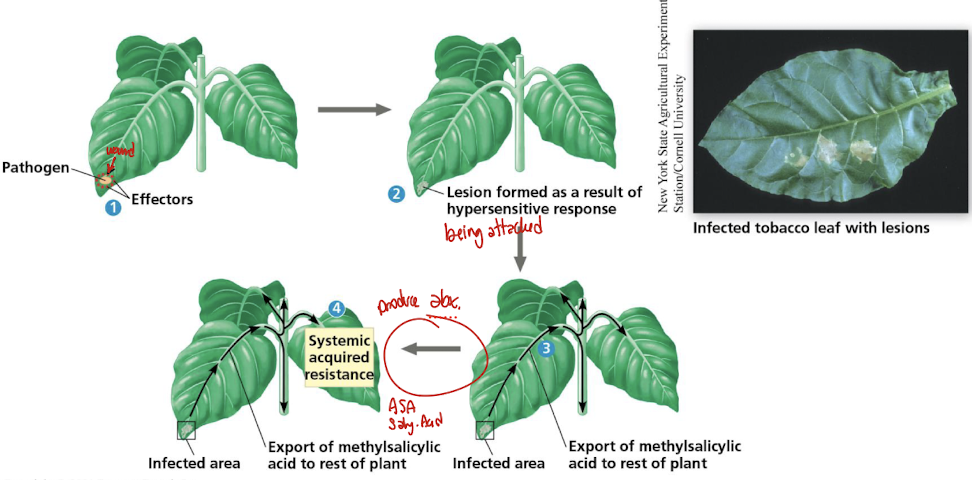
hypersensetive response
localized cell and tissue death that occurs near or at the infection site - results in lesions
increases production of lignin and cell wall cross linkages
restricts the spread of the pathogen
production of enzymes and chemicals that impair the pathogen’s cell wall integrity, metabolism, or reproduction
systemic acquireed resistance
pllant wide expression of defence genes, non specific against a diversity of pathogens
methylsalicylic acid is produced at the infection site, carried by phloem, and converted to salicylic acid which promotes signal transductiona and the production of more defence further in the plant
Outline the process of effector triggered immunity
pathogens infect leaf cells and secrete effectors, by passing PAMP triggered immunity
Hypersensitive response occurs in cells near or on the infection siste, creating a lesion
before infected cells die, they releasee metthylssalicylic acid which is carried via phloem throughout the plant body (systemic acquired resistance)
cells in other areas convert methylsalicyllic acid to salisylic acid, initating biochemical ressponsees that proteect the plant from pathogenss for several dayss
What are the effects of herbivory on a plant
mechanical stress
reduced plant size
reduced photosynthetic capacity
restricts growth as plants divert energy and resources too anti-herbivory defence mechanisms
opens sites for infection by pathogens
What are some plant adaptations to herbivory
physical: thorns, trichomes
chemical: tastes bad, toxic, hallucinogenic
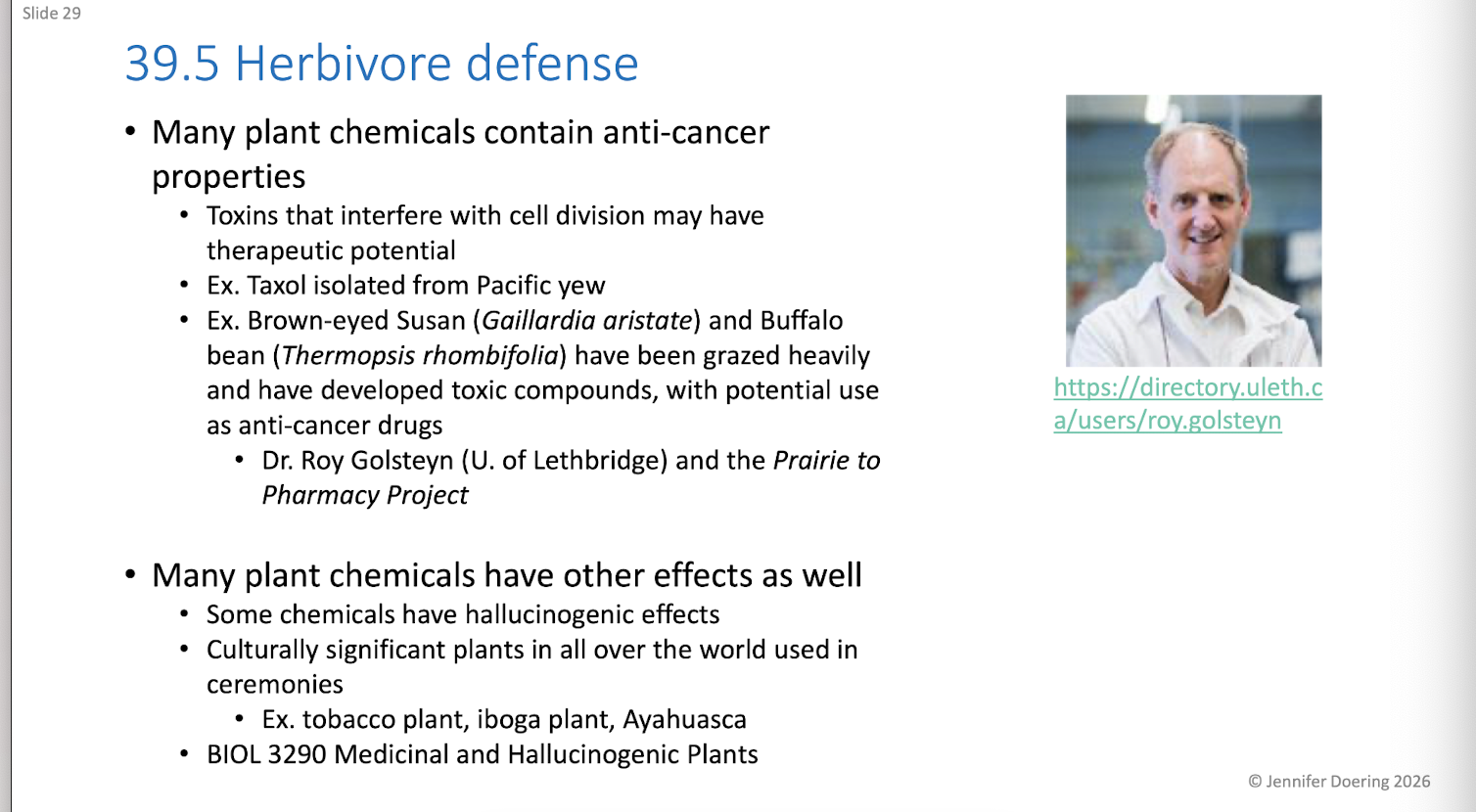
combination of both: burning sap, irritants