herp test 3
 Call Kai
 Learn
Learn Practice Test
 Spaced Repetition
 Match
Match Flashcards
 Knowt Play
1/130

There's no tags or description
Looks like no tags are added yet.
Name | Mastery | Learn | Test | Matching | Spaced | Call with Kai |
|---|
No analytics yet
Send a link to your students to track their progress
131 Terms
3 ways to study ecology?
natural history, experimental, comparative spproaches (far flung, long term, historical studies)
natural history approach involves… it s missing…
detailed observations over long periods to describe what was happening; no hypothesis or manipulations
artificial experimental approach allows you to
reduce variation found in natural settings
natrual experimental app
done in natural situation by maniuplating certain aspects of the environment
comparative approach
commpares community assemblages thorugh space or time, includes far flung studies comparin diff comm’s in similar habitats and long term studies comparing a single community through time
long term approach tells you
pop stability, resource partioning, inter and intraspeccific interactions
far flung tells you
convergent and parallel evolution; ecological equivalents and g diversity; community replicability, spillover effects; how communities have already adapted evolutionarilly; varying distance btw sites proportionally varies evolutionary time?
ecomorph
local variety of a species whose appearance, behavior, and structural habitat (niche) are determined by its ecological environment. Primarily used to describe Caribbean Anolis lizards, they are distinct from subspecies or separate species, representing a form of convergent evolution where similar adaptations evolve independently in similar habitats; horned lizard is another example
dissimilar often have…leading to…
disssimilar abiotic and biotic presssures leading to dissimilar communities
long term approach deal with blank time periods bcs
ecological; comm changes 1 year to next; focuses on how natural phenomena influence comm’s
convergent evolution ex
anoles in caribbean islands- twig anoles on one island more closely related to trunk anoles on other islands but physiology is similar
niche modeling
using statistical models to determine why a species has its current distriution based on specific characteristics of the environment; what habitat variables does a species need to exist, the fundamental niche
biogeography
study of species distribution across space and time; diversification due to evolution is important here as well as geology and pangea
theory of island biogeography
made predictive science out of biogeography like number of species in given area; island size, immigration, extinction rates are imp here, focuses on ecological time
ecological biogeography vs historical
geographical patterns in strucure of communities focusing on resource utilization; relationships and origins of taxa, focusing on evolutionary histories and historical distributions
niche conservatism
retaining ecological traits similar to those of sister or ancestral taxa; animals that don’t change much over time—crocs
niche evolution
divergence from sister taxa or ancestral taxa in ecological traits; like ecomorphs of anoles
review final slides from this presi
why are herps resilient to env change?
they can aestivate bcs they are ectotherms, don’t need a lot of energy, r selection helps too
physiological tolerations explain
why herps are or aren’t present
biomes trouped based on
similarity of overall structure of plant comm
biogeographic realms based on
evolutionary and historic distributional patterns of plants and animals
animal comp is more inlfuenced by
taxonomic affinity and less by climate; this is why the same biome in diff places can have diff compositions
new world vs old world
new world to the west, old world to the east; both have diff species
origin of bufonids sign.
originated in s america, immigrated to affrica and diversified and then went to asia, and then made way to n america; supports multiple dispersal events
central american anurans sign
sa to mesoamerica to caribbean islands to lesser antilles and then exch btw ma and sa; supports multiple dispersal events; biogeography and phylogenetics tells us this
biogeography of malagasy reptiles is a big…
mystery; land bridge connections? how did they get all over the place?
gene sequencings allows us to
examine recent speciation events and recent biogeography; what we consider species based on morphology could be wrong
lissamphibia includes… synapomorphies include
extant amphibs; gymnophiona, caudates, anurans
– Cutaneous respiration
– Pedicellate teeth
– Two types of skin glands
– Absence of an amnion
gymnophiona traits
most fossorial, some aquatic, most lack post cloacal vertebrate (tails) (the ancestral condition); end of organism is the cloaca; limbless, lack pectoral and pelvic girdle, segmented bodies that can very in prominence, dermal scales but also moist skin like amphib, internal fert, viviparous or oviparous, direct development or larval stage, may have eversible copulatory organ, modified skulls w no thick bone on skull roof zygokrotraphic; stegokrotaphic can also be present derived state to have thick bone on roof of skull for burrowing in fossorial ones, retroarticular process where lower mandible extends far back along body, masseter adductor muscle more developed in more derived clades to rely less on jaws and more on muscle for stronger bite bcs they don’t wide head bcs they live underground; other herps will just widen their head to get stronger bite, reduced eyes covered in skin, sensory tentacle on front of head which connects to optical nerve bcs vision is not as imp underground
how do coecilians move, 3 types
lateral undulation, whole body concertina, internal concertina (stretching and collapsing like the instrument through anchoring of head or tail; skin attached to body so concertina of vertebrae
gmymnophiona taxonomy- what families?
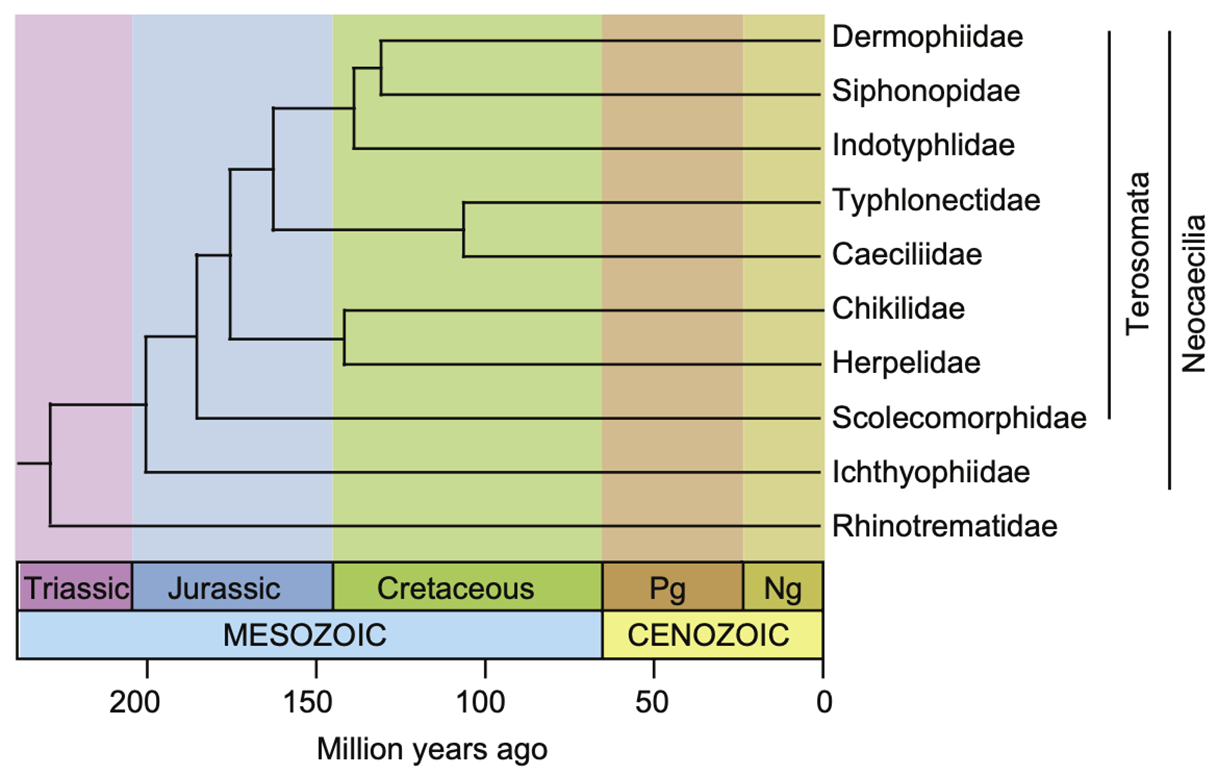
rhinatrematidae includes
american tailed caecilians w 2 genera; have true tails where post clocal segment has vertebrae. are oviparous, biphasic and lack extra jaw muscle
icthyophiidae includes
asian tailed caecilians and has 3 genera, terrestrial; similar to lst one in traits except they do have extra jaw muscle;
scolemorphidae
buried eyed caecilians, 2 genera, reduced annuli, eyes beneath skulll bones atttached to tentacles, tentacles more posterior
herpelidae
african caecilians, 2 genera, larvae have altricial underdeveloped period w unique teeth for feeding and epidermal cells filled with lipids, direct developers, oviparous
chikilidae
oviparous, parental care, direct developers, neast indian caecilians, 1 species
caecilidae
common caecilians, eyes covered by bone in one genera but not the other, maybe oviparous, relatively large
typholonectidae
aquatic caecilians, 5 genera, nonprotrusible tentacles, pretty well developed eyes, some have fins, viviparous w 3 embryo stages
indotyphlidae
indoafrican caecilians 7 genera, oviparous and viviparous, visible eyes, relatively small
siphonopidae
south american caecilians, 7 genera, oviparous, dd or biphasic development, one is dermatophagous which may be precursor to oviduct feeding
dermophiidae
neotropical and tropical african caecilians, 4 genera, all viviparous, some feed on oviductal secretions, both biphasic and dd
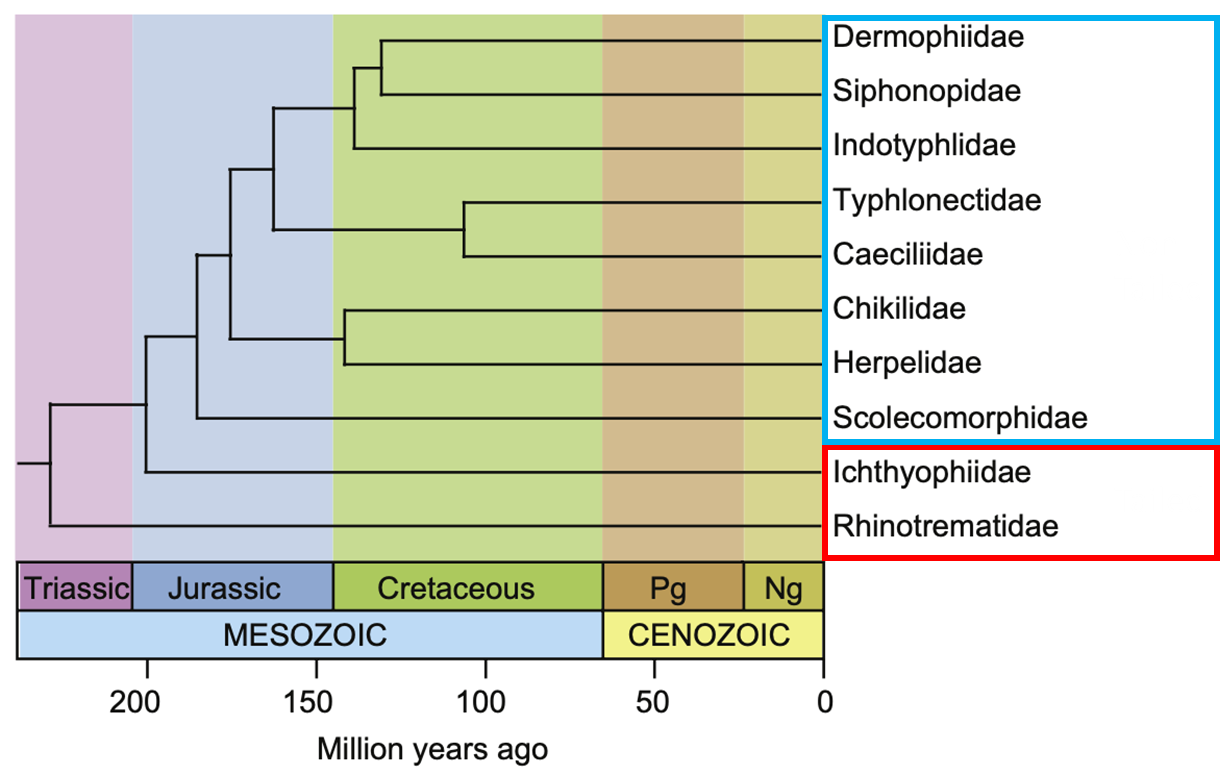
eye loss in caecilians
ancestral condition is eyes in orbit, some have eyes under bone a trait that evolved independently 4 diff times as convergent evolution in…
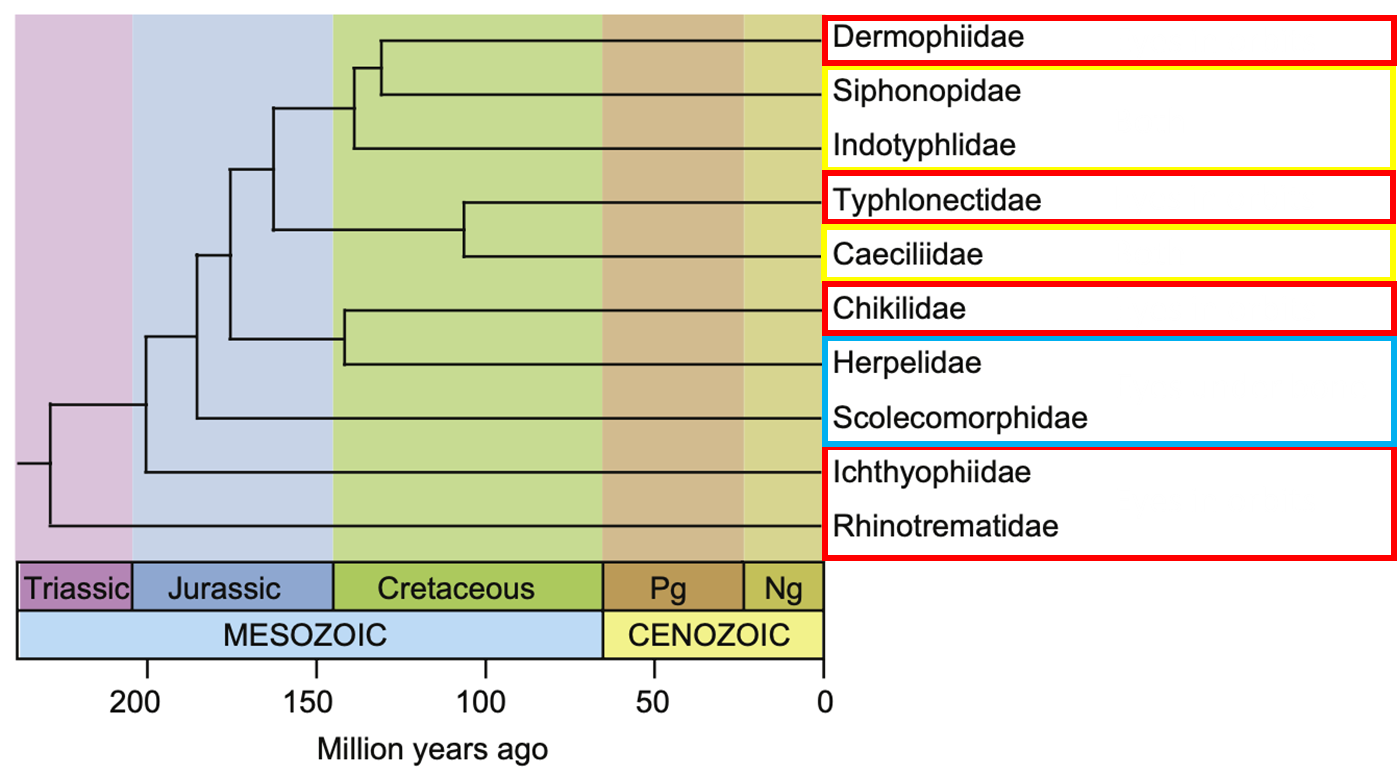
tail loss, only 2 more ancestral species are tailed
lissamphibia synapomorphies
pedicellate, bicuspid teeth (crown and base separated by fibrous tissue), moist skin cutaneous respiraton with mucous and granular glands, specialized inner ear structures
caudate traits
10 families, diverse especially in southern Appalachians, mostly in northern temp regions, don’t like it hot like caecilians, well developed tails and limbs that can be regenerated, paedomorphosis (entire species has trait) and paedogenesis (populations have trait) (only in caudates), retention of larval traits as adults like ext gills and slits, no eyelids, ext fert is ancestral condition, internal fert done wout copulatory organ, most are oviparous but some are biphasic (has larval stage) (may be ancestral, traditional norm), can have direct development, huge genomes w lots of nucleotides and gigabases GB 2nd largest of any vertebrate may be ecologically constraining bcs having lots of dna means mitosis is made more difficult and energy exp and requires more development time, larger cells, and lower metabolic rates
caudate taxonomy 10 families
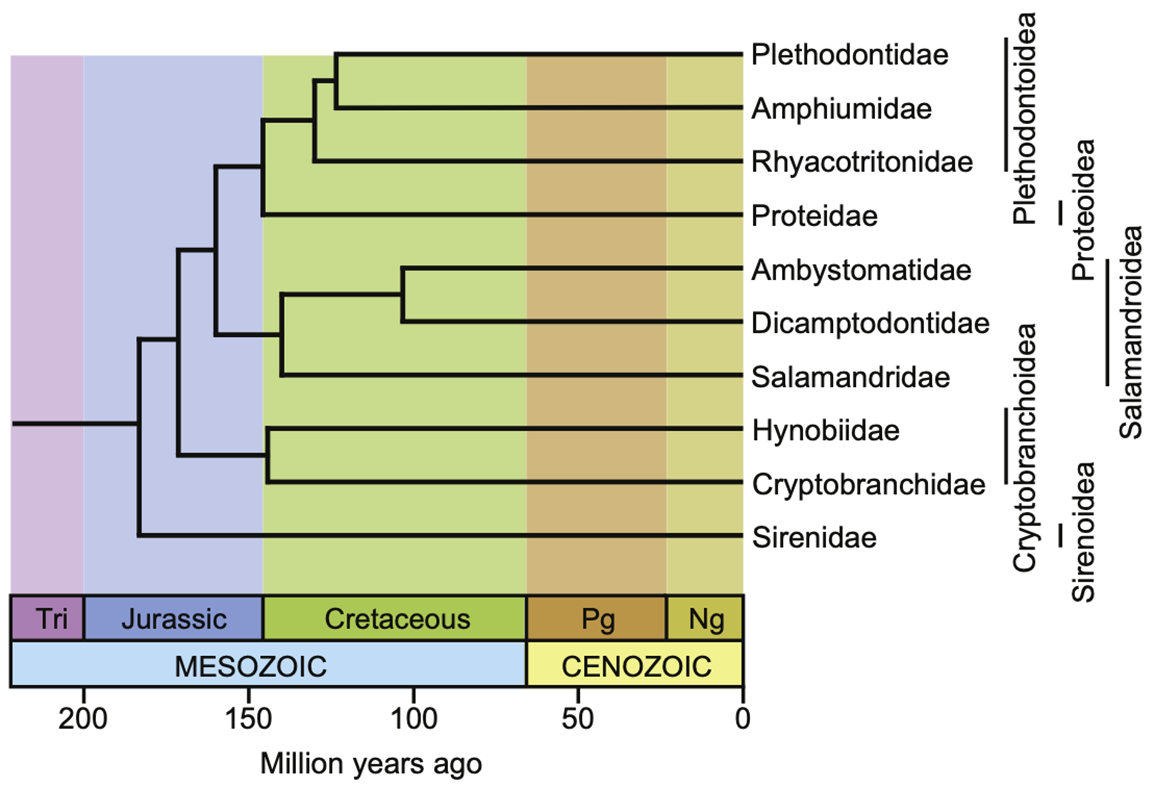
sirenidea
biology poorly known but thought to have ext fert, no spermatophores, lots of microchromosomes, lack hindlimb and pelvic girdle, all are paedomorphic- aquatic w ext gills, 2 genera, no teeth, live in lotic systems, can aestivate in dry conditions
cryptobranchoidea
2 families –Cryptobranchids and Hynobiids, ext fert, lots of microchromosomes, includes giant salamanders, hellbenders,
Cryptobranchid 2 genera, giant salamanders, paedomorphic, stout bodied, developed limbs and flattened tail, folded skin for respiration (wrinkles for respiratory surface), aquatic in cool clear streams, threatened, farmed in caves in China,
Hynobiids asitatic salamanders 9 genera, temperate regions in tropics, small, biphasic, some are paedogenic, most do ext fert but one species uses spermatophore that female lays eggs on top off
salamandroidea 3 families and 3 traits
3 families salamandridae, dicamptodontidae, ambystomatidae, Internal fertilization
• Reduction in chromosome number
• Paedomorphism and peaedogenesis
Salamandridae –
Newts and European salamanders, 3 sub families; Have granular or rugose skin (drier, wartier), poison glands, brightly colored, metamorphosis and Paedogenesis, some may be triphasic aquatic, terrestrial, then aquatic again, only family that gives birth to live young with Viviparous Salamandra and Lyciasalamandra species, seasonal sexual traits,
Salamandroidea - 2 Dicamptodontidae
•Pacific Mole Salamanders
•One genus and four species
•Largest living terrestrial salamanders
•Heavy-bodied with a laterally flattened tail
cool mountain streams
•One paedomorphic species, a few metamorph, some are paedogenic
Salamandroidea - 3 Ambystomatidae
• Mole Salamaders
•One genus with 33 species
•Sister to Dicamptodontidae
•Heavy bodied with a thick bodied tail
•Well developed lungs
•Use ponds for breeding
Paedomorphic and Paedogenic
can morph into cannibalistic version
some are unisexual
•Ambystoma maculatum only vertebrate with symbiotic algae in egg and tissue of salamander
•Proteidae – 3 types and 2 genera
Olm, Mudpuppies, Water Dogs
•Sister to the Plethodontoidea
•2 genera and 6 species
•Paedomorphic
•Large compressed tails
•Necturus – stout bodied salamanders, surface dwellers
•Olm – slender salamanders, –cave dweller
•Clear water environments
Plethodontoidea 3 families and traits
internal fert, diverse,
Plethodontidae
•– Lungless Salamanders, uses gills or skin, most are terrestrial
• Four subfamilies
• Nasolabial grooves, cirri, mental glands
• Many are direct developers
biphasic or paedomorphic
very diverse, Bolitoglossinae has over 200 species in temperate regions of central and s america along tropical mtn slopes
Amphiumidae – Amphiumas
• One genus with three species
eel like body, reduced limbs, spermatophore inserted, live in swamps
•Rhyacotritonidae – Torrent Salamanders
• One genus and four species
• Semi-aquatic salamanders
– Biphasic lifecycle
• Live in cool, fast streams
•Synapomorphies of the Lissamphibia?
Cutaneous respiration, Pedicellate teeth, Two types of skin glands, Absence of an amnion
lissamphibia- anurans
very specious, half are in new world tropics, –
unique body form, Short, tailless
•Shortened vertebral column
•Robust pectoral girdle
–Long muscular hindlimbs
•Elongated pelvis
–Fused limb bones
–Broad, flat heads with large mouths
most have mating calls and external fert w amplexus
most are biphasic w/ major metamorphic diff’s
Anuran Taxonomy
Archeabatrachia old frogs including Amphicoela and Costata and Mesobatrachia middle frogs including Xenoanura Anomocoela and Neobatrachia
Amphicoela
•One family – Leiopelmatidae – Tailed Frogs
–Two genera
Leiopelmatidae
•“Tail” is a copulatory organ
•Tadpoles are partially endotrophic
•Unique skeletal structure
Costata
•Two families, Atylidae and Bombinatoridae
Alytidae
•Midwife Toads and Painted Frogs
–Two genera
Alytidae
•Two genera have very different life histories
Bombinatoridae
•– Fire Bellied Toads
Two genera
•Diurnal and highly aquatic
•Warty, granular skin with toxic secretions
•Only known lungless frog in this family
Xenoanura
•Two families, Rhinophrynidae and Pipidae; •Adults are very dissimilar, but tadpoles share unique synapomorphies
•Rhynophrinidae –
Mexican Burrowing Toad
–Burrowing, ant specialist
–Lack ribs
•Pipidae –
Clawed Frogs and Suriname Toads
•Five genera and 33 species; tropical and african species
•Entirely aquatic
•Lack vocal cords and sacs
–Produce sound from the hyoid apparatus
includes african clawed frog, worst invasive amphib in world, responsible for chytrids? pregnancy tests
south american pipa pipa has direct and indirect development, eggs implanted into epidermis
Anomocoela
•Four families, Scaphiopodidae, Pelobatidae, Pelodytidae,and Megophryidae
Scaphiopodidae
•– New World Spadefoots
–Two genera and seven species
–Known for their tadpole phenotypic plasticity
burrowers, cannibalistic morph
Pelobatidae
•– Old World Spadefoots
–One genus with four species
burrowers
Megophryidae
•– Asian Toad Frogs
–Ten genera with 156 species
–Most specious family outside of Neobatrachia
–Excellent at camouflage
–Unique tadpole feeding w fleshy upturned mouth for topwater feeding
–Seasonal sexual characteristics
may have spines on lip
Neobatrachia 3 groups
vertical, elliptical, or round pupil, inguinal or axillary amplexus; includes Hyloidea tree frogs 3k species, Sooglossoidea 4 species, Ranoidea pond frogs tree frogs 3k species
Hyloidea 5 groups
Helophrynidae Calyptocephalellidae Mybatrachidae Lymnodynastidae Nobleobatrachia
Helophrynidae
•Ghost Frogs
–Two genera and 7 species
–Tadpoles have suctorial discs
Calyptocephalellidae
•Helmeted Water Toad and Chilean False Toad
–Two genera and five species
–Large tadpoles
high elevation areas,
Myobatrachidae
•Australian Toadlets and Turtle Frogs
–Thirteen genera and 85 species
–Known for their diversity
•Morphological and reproductive
males brood eggs in stomach and mouth
Lymnodynastidae
•Australian Ground Frogs
•Eight genera and 43 species
•Known for their reproductive routine
Nobleobatrachia
•~2,800 species and 17 families
•Almost entirely new world
•Morphologically very dissimilar clade
true toads and new world tree frogs
Allophrynidae
•Resplendent Frogs
•Only two species
have necks
toes come to a ‘T’
Centrolenidae
•Glass Frogs
•Two subfamilies with 11 genera and 146 species
•Parental care is common
toes are pointed, only morphological diff from Allophrynidae
•Two subfamilies differ in male combat and egg placement
–Hyalinobatrachinae
•Upper leaf combat, under leaf eggs
–Centroleninae
•Under leaf combat, upper leaf eggs
Leiuperidae
•Foam Nesting Frogs
•Seven genera and 86 species
•Unique defense
Hyloidea
•Dendrobatidae
–Poison Frogs
–13 genera and 172 species
–Many sequester alkaloids from diet
•Aromabatidae
–Cryptic Forest Frogs
–5 genera and 103 species
Cycloramphidae
•Mouth Brooding, Smooth Horned Frogs
•14 genera and 105 species
•Unique reproductive mode, mouth brooding in some
Bufonidae
•True Toads and Harlequin Frogs
•48 genera and 558 species
•Tremendous diversity
Hylidae
•Ameroaustralian Tree Frogs
•46 genera and 901 species
•Tremendous diversity
Ceratophryidae
•Horned and Water Frogs
–6 genera and 86 species
–Morphotype adaptation, may be horned or have extra skin for breathing
Hemiphractidae
•Horned and Marsupial Frogs
•Six genera and 96 species
•All species are direct developers
•Females transport large eggs in specialized sacs like marsupials, less eggs
Eluetherodactylidae
•Rain Frogs
•4 genera and 201 species (+55)
•Nearly all are direct developers, greenhouse frog, direct dev’s
Sooglossoidea
•Two families
–Nasikabatrachidae and Sooglossidea
–Very different morphologies
–very weird, purple rain frog
Ranoidea
•About 3,000 species and 17 families
•Share a highly modified pectoral girdle
•Almost entirely Old World with the exclusion of two families
–Microhylidae
–Ranidae
Ranidae
•True Frogs
•16 genera and 347 species
•Extremely abundant
•Usually large frogs
Ceratobatrachidae
•Triangle Frogs
–Five genera and 84 species
–Direct developers
Rhacophoridae
•Afroasian Tree Frogs
–14 genera and 321 species
Pyxicephalidae
•African Bullfrogs
–13 genera and 68 species
–Fanglike projections
parental care
Phrynobatrachidae
•Puddle Frogs
–One genus with 82 species
–Widespread and polymorphic
Mantellidae
•Malagasy Poison Frogs
•12 genera and 191 species
•Very diverse
•Many share alkaloid poison with Dendrobatids
–Convergent evolution
Hyperoliidae
•African Reed Frogs
•18 genera and 209 species
•Old World equivalent to glass frogs
Microhylidae
•Narrow-Mouthed Frogs
•69 genera and 489 species
very diverse
Adaptive Convergence
species w similar morphological and ecological traits in distantly related groups
ecomorph
species that have similar morphology due to similar ecology like treefrog and aquatic ecomorphs