Chp 16 (Sensory, Motor, Integrative Systems)
 Call Kai
 Learn
Learn Practice Test
 Spaced Repetition
 Match
Match Flashcards
 Knowt Play
1/27

There's no tags or description
Looks like no tags are added yet.
Name | Mastery | Learn | Test | Matching | Spaced | Call with Kai |
|---|
No analytics yet
Send a link to your students to track their progress
28 Terms
Responsibilities of Spinal Cord, Brain Stem, Cerebral Cortex
Cord: reflexes
Stem: complex reflexes (eg; change in HR)
Cortex: conscious awareness of stimuli
Perception
Conscious awareness + interpretation of sensation
Involves cortex and its memories
Sensation
Any stimuli body is aware of
chemoreceptors, baroreceptors (pressure), themroreceptors, nociceptors (pain)
What sensations do we have but cant perceive?
Insulin levels, O2 saturation in blood
Receptors still sense things
Sensory Modality
= A specific type of sensation
touch, pain, temp, hearing, vision, vibration
-a specific sensory neuron carries info for ONE modality (receptor specificity)
2 classes:
general senses (somatic n visceral
Special senses (smell, taste, vision, hearing, n equilibrium)
1st Step in Process of Sensation
Stimulation of Receptor
-sensory receptors demonstrate selectivity: respond to one stimuli
-can be dendrites on cell or specialized cells
-stimulus must occur in receptive field
2nd Step in Process of Sensation
Transduction (conversion)
-conversion of stimulus into GP: converts stimuli into electrical signal (open ion channels)
-vary in amplitude depending on stimulus strength and isnt propogated
3rd Step in Process of Sensation
Generation of Impulses
-generates when GP reaches threshold and sends it towards the CNS
-neurons that conduct impulses from PNS directly to the CNS are called first order neurons
4th Step in Process of Sensation
Integration of Sensory Input by CNS
3 Classifications of Sensory Receptors
Structural Classification
Receptor Location & Stimuli Origin
Type of Stimulus they detect
Structural Classification of Sensory Receptors
-receptor responds to stimulus by generating a receptor potential (RP)
A GP that can lead to either generate an AP or release a ntm
Amplitude of a RP varies with the intensity of stimulus
Frequency of NI or release of NTM conveys strength of stimulus
3 Types of Sensory Receptors (Structural)
Free Nerve Endings
Bare dendrites
Pain, temp, tickle, itch, light touch, smell
Encapsulated Nerve Endings
dendrites enclosed in CT capsule (Eg; lamellar corpuscles)
Pressure, vibration, deep touch
Separate Receptors Cells
specialized cells, respond to stimuli w/ release of NTM
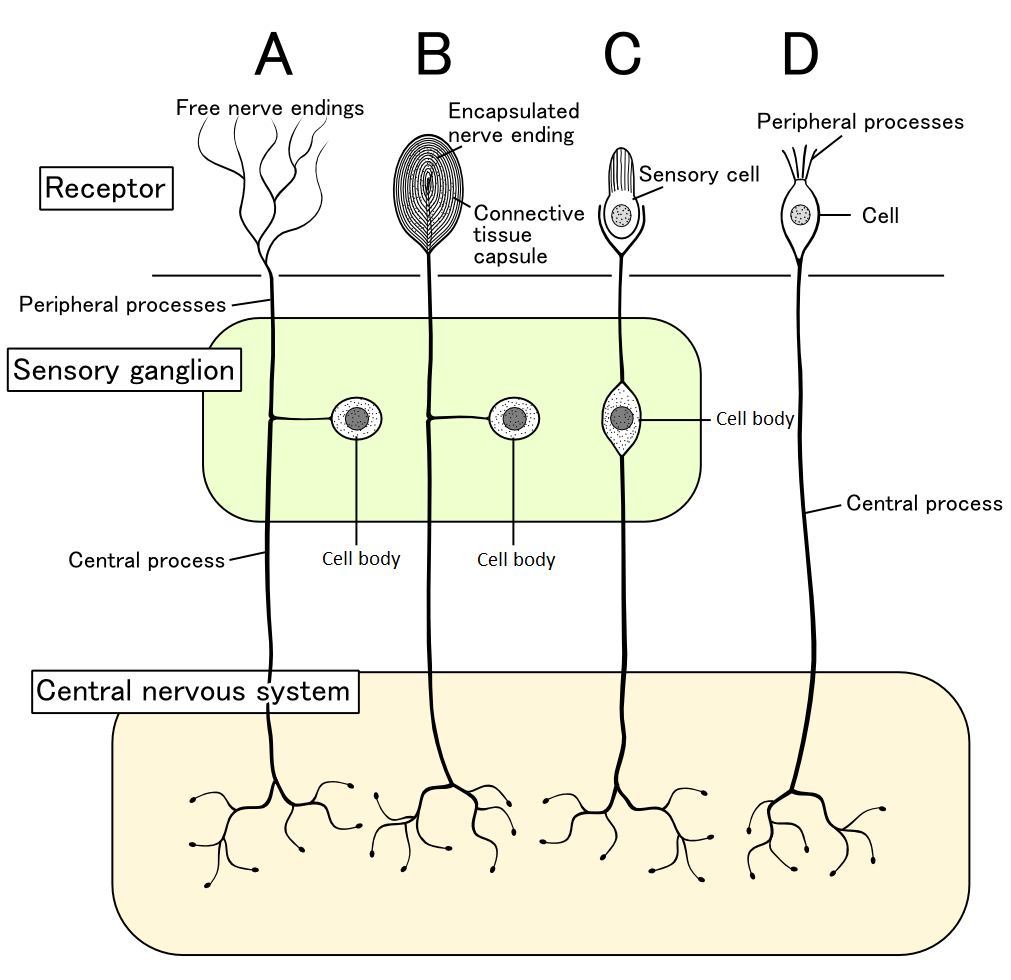
3 Types of Sensory Receptors (location)
Exteroceptors
near surface of body
External stimulus, vision, smell, taste, touch, temp, vibration, pressure
Interoceptors
inside and monitor int. Environment (eg; vessels, muscles, nervous system)
Proprioceptors
muscles, tendons, joints, inner ear
Body position movement, equlibrium
6 Types of Sensory Receptors (Stimuli)
Mechanoreceptors
mechanical stimuli (eg; deformation, stretching, bending)
Touch, pressure, BP, proprioception, hearing, vibration
Thermoceptors: temp
Nociceptors: pain
Photoceptors: light
Chemoreceptors: detect molecules (taste, smell, changes in body fluid chemistry)
Osmoreceptors: osmotic pressure in fluids
Adaptation of Sensory Receptors
-most exhibit adaptation
tendency for RP to dec. in amplitude during a constant stimulus
With adaptation, perception of sensation may fade or disappear even though the stimulus persists
Rapidly Adapting Receptors (smell, pressure, touch)
specialized for detecting changes in environment
Slowly Adapting Receptors (Pain, body position)
AP continue as long as stimulus persists
Somatic Sensations
= stimulation of sensory receptors in skin, mucous membrane, muscles, and more
Tactile
Thermal
Pain
Proprioceptive
Tactile Sensations
-touch, pressure, vibration, itch, tickle
-tactile corpuscles, hair root plexuses, merkel’s discs, ruffini corpuscles, lamellar corpuscles, free nerve endings
Rapidly and Slowly Adapting Receptors (Touch)
Rapidly: tactile copuscles, hair root plexuses
Slowly: merkel’s discs, ruffini’s corpuscles
Tactile Corpuscles
-Dendrites enclosed in CT in dermal papillae of hairless skin
-touch + low frequency vibration
-rapidly
-generate impulses mainly at onset of touch
Hair Root Plexus
-free nerve endings found around follicles, detects hair movement
-rapidly
Merkel’s Discs
-flattened free dendrites touching cells of stratum basale
-slowly
-used in continuous touch n pressure
Bulbous Corpuscle
-encapsulated receptors found deep in dermis of skin, ligaments and tendons
-detect skin stretching, continuous touch, & pressure
Lamellar Corpuscle
-onion like CT capsule enclosing dendrites
-subq tissues + some viscera
-rapidly adapting
-deep pressure high frequency vibrations
Pressure
-sustained sensation felt over larger area than touch
-longer lasting, less intensity variation than touch, slowly adapting
Vibration
-result from rapidly repetitive sensory signals from tactile receptors
Itch and Tickle
-these receptors are free nerve endings
-stimulated by inflammation or chemicals (eg; histamine, mosquito saliva)
Thermal Sensations
-free nerve endings on skin surface/mucous membranes
-cold receptors in stratum basale respond to temps btw 10-35C
-warm receptors in dermis respond to temps btw 30-45C
-both rapidly at first, but continue to gen. Impulses at low frequency
-pain receptors are activated <10 and 45> (why u feel pain)
Pain Sensations
-signals tissue damaging conditions
stretching prolonged muscular contractions, muscle spasms, ischemia
-nociceptors are free nerve endings that are located in all body tissue but brain
-little to no adaptation
-tissue injury releases chemicals that stimulate nociceptors (eg; potassium)
-pain can still remain after stimulus cuz chemicals are still present