NBRC TMC Practice Exam
 Call Kai
 Learn
Learn Practice Test
 Spaced Repetition
 Match
Match Flashcards
 Knowt Play
1/139

There's no tags or description
Looks like no tags are added yet.
Name | Mastery | Learn | Test | Matching | Spaced | Call with Kai |
|---|
No analytics yet
Send a link to your students to track their progress
140 Terms
1. A patient's sputum is purulent, green in appearance, has separated into layers, and has a foul odor. What is the most likely cause?
A. Aspiration
B. Tuberculosis
C. Emphysema
D. Bronchiectasis
D. Bronchiectasis
2. A patient in the ICU complains of light headedness, nausea, and chest pains. The patient is diaphoretic and has a blood pressure of 90/60mmHg. What should the RT recommend?
A. Lidocaine HCl
B. Cardioversion
C. Defibrillation
D. Epinephrine
B. Cardioversion
3. A patient with Guillain-Barre syndrome has a vital capacity of 625mL. An RT should recommend which of the following be performed FIRST?
A. MIP evaluation
B. Edrophonium Chloride (Tensilon) test
C. MVV test
D. EMG and nerve conduction study
A. MIP
4. Which of the following beside pulmonary function testing results for a patient with multiple sclerosis most strongly indicates the need for ventilatory assistance?
A. 5% decrease in peak expiratory flow
B. FEV1/FVC 85%
C. MIP of -23cmH2O
D. Vital Capacity of 5 mL/kg
D. Vital capacity of 5mL/kg
5. A 23-year-old patient is in moderate respiratory distress while receiving oxygen.
ABG=7.42/ 31/ 38/ 20/ -3/ 71%
How should these results be interpreted?
Chronic Respiratory Alkalosis with severe hypoxemia
6. What is the patient's TLC?
Vital Capacity= 3.6L
FRC= 6.0 L
ERV = 1.0
8.6
7. A COPD patient becomes hypotensive following a drug overdose. Following intubation VC A/C ventilation should be initiated with which of the following oxygen concentrations?
A. 0.21
B. 0.50
C. 0.70
D. 1.0
D. 1.0
8. A patient has been receiving VC ventilation for 24 hours. A respiratory therapist is called to the bedside because the high pressure alarm is sounding with each breath. What should the RT do first?
Manually ventilate the patient
9. Just prior to removing the endotracheal tube, a respiratory therapist should do what?
Deflate the cuff
10. While preparing to assist with a chest tube insertion , an RT learns that pleurodesis will follow. What equipment would the RT provide?
Hemostat and 3-way stopcock
11. What is the formula for dynamic compliance?
VT/ (PIP-PEEP)
12. A 52-year-old patient with newly diagnosed OSA undergoes a CPAP titration study. With a CPAP of 12cm H2O, the AHI is 3 and the lowest observed oxygen saturation is 90%. The patient continues to snore, what should the RT do?
Increase the CPAP level
13. What is the target FiO2 range of nasal cannula in a patient with normal minute ventilation?
0.24-0.40
14. An RT is called to the ED to assist with the intubation of an alert, agitated patient in respiratory failure. 2 intubation attempts were unsuccessful. In addition to a neuromuscular blockade, which of the following drugs will best facilitate intubation?
A. Propranolol HCl (Inderal)
B. Midazolam HCl (Versed)
C. Amlodipine (Norvasc)
D. Nitroprusside Sodium
B. Midazolam HCl (Versed)
15. A 14 year old male who is 163cm /5ft4in tall and weighs 51kg/112lbs is brought to the ED for suspected drug overdose. He is intubated receiving VC AC ventilation.
Mandatory Rate: 14
Tidal Volume: 300mL
Inspiratory Flow: 20L/min
Pressure limit: 50cm H2O
The physician wants the RT to adjust the I:E from 1:1.2 to 1:3
What should the RT increase?
The inspiratory flow
16.A 180-cm (5ft 11in) 75kg (165lb) male had a cardiac arrest and is admitted to the ICU. The patient is apneic, receiving 100% O2 by a bag valve mask resuscitator, and has an SpO2 of 94%. Which is the most appropriate ventilator setting?
1. SIMV/FiO2 1.0/Rate 10/VT 400/PEEP +3
2. SIMV/FiO2 0.40/Rate 12/VT 750/PEEP +5
3. AC/ FiO2 1.0/Rate 12/VT 600/PEEP +5
4. AC/FiO2 0.40/Rate 10/VT 550/PEEP +3
3. AC/ FiO2 1.0/Rate 12/VT 600/PEEP +5
17. While instructing a 9-year-old with pneumonia in use of PEP therapy device a respiratory therapist observes the child is consistently unable to keep the seal around the mouthpiece. What should the RT recommend?
Select a mask rather than a mouthpiece
18.What can be used to confirm the correct endotracheal tube position?
CXR
Lung fields appear whiter on a chest radiograph when the imaging technique is ____________
Underexposed
A 71-year-old man who has a femur fracture had a chest CT angiogram due to increased shortness of breath. An RT observes multiple pulmonary arterial thrombi. SpO2 is 94% while receiving oxygen at 2L/min by nasal cannula. What should the RT recommend?
Intravenous heparin
A 49-year-old female with polyneuropathy has received mechanical ventilation for 74 days. For the past week the patient has been receiving an FiO2 of 0.28 by tracheostomy collar for progressively longer periods of time. Data collected for the weaning trial are:
30 Minutes:
HR=99/RR=22/SpO2=96%
2 Hours:
HR=103/RR=24/SpO2=94%
3 Hours:
HR=132/RR=36/SpO2=88%
How much time should the RT recommend performing the weaning trial the next day?
2 hours
VC A/C Ventilation has been initiated on a 38-year-old ARDs patient who is 180cm( 5ft 11in) tall and weighs 85kg (187lb). The patient's cardiovascular status is stable. Vent and ABGs after 30 minutes:
FiO2= 0.80
Mandatory Rate= 16
Total Rate= 18
VT= 500
PEEP +5
7.36/32/57/18 -6 90%
What should the RT recommend?
Increase the PEEP to 10cm H2O
To determine the etiology of a pleural effusion what should an RT recommend?
Thoracentesis
After receiving a nebulizer treatment with 3% saline a patient complains of shortness of breath. What should the RT do?
Discontinue therapy
An RT is asked to perform an apnea test on a patient for whom brain death is clinically suspected. What should the RT confirm prior to performing the test?
Body temperature greater than 36C (96.8F)
An RT arrives to perform a vibratory PEP on a patient with cystic fibrosis. The patient confides he has begun coughing up blood, but does not want anyone to know. What should the RT do?
Hold the therapy and inform the physician about the hemoptysis
A CXR for a 21-year-old patient shows multilobar infiltrates in the right lung. SpO2 is 85% while receiving 80% oxygen by HHFNC at 50L/min. To improve oxygenation an RT should place the patient in which position?
Left lateral decubitus
A sedated 152cm (5ft) 42kg (93lb) patient with pneumonia has been receiving VC AC ventilation for 3 days and has a worsening chest radiograph.
FiO2=0.85
Mandatory Rate=24
Total Rate=24
VT=400
PEEP=+14
PIP=45
Pplat=29
7.25/62/68/27/ -2 94%
What should the RT change?
A. VT to 500
B. Mode to PC/AC
C. Mandatory Rate to 36
D. PEEP to +10
B. Change to PC/AC
An RT returns to the room of a 63 year-old patient and finds her less responsive. The patient's HR is 154/min, RR 8/min and a weak pulse. She is receiving 2L/min nasal cannula what should the RT do first?
A. Contact the physician for patient evaluation
B. Activate the medical emergency team
C. Recommend a CXR to evaluate pulmonary status
D. Increase nasal cannula to 4L/min and monitor with pulse oximetry
B. Activate the medical emergency team
When assessing the airway of a patient prior to intubation, a Mallampati score of 4 is observed. What should the RT recommend to facilitate intubation?
Video Laryngoscopy
(Bronchoscope)
An adult patient who weighs 62kg (136lb) requires a minute ventilation of 15L/min to maintain a PaCO2 of 36mmHg while receiving mechanical ventilation. What could explain these ventilatory requirements?
1. Excessive caloric intake
2. Increased dead space ventilation
3. Febrile patient
While performing beside spirometry on a patient, the following FEV1 values are obtained from 3 maneuvers:
3.13
3.75
2.85
What should the RT conclude about these results?
The effort was inconsistent
An RT is assisting a physician with a needle biopsy of a lung mass during fiberoptic bronchoscopy. The biopsy site begins to hemorrhage. What should the RT have ready for instillation?
Iced saline
An adult patient with a tracheostomy tube is receiving a heated aerosol with an FiO2 of 0.30 by T-piece. An RT observes that the t-piece often becomes disconnected from the tracheostomy tube. What should the the therapist do>
Exchange the T-piece for a tracheostomy collar
An RT will assist a physician perform cardioversion for a spontaneously breathing patient with supraventricular tachycardia. The patient is alert and awake. What steps should be performed in preparation for this procedure?
1. Supplemental O2
2. Gather airway equipment
3. Sedate the patient
Do NOT intubate the patient
What should a tracheostomy stoma site be cleaned with?
Normal saline
Which device provides 100% humidity at body temperature?
Heated-wick humidifier
While examining a chest radiograph from an adult patient an RT notes the presence of air bronchograms. What is the most likely cause?
Pneumonia
A patient who is 188cm (6ft2in) tall is intubated with an 8.0mm ID endotracheal tube that is secured with a 18-cm mark adjacent to the incisor. An RT hears a gurgling sound with each inhalation and observes the exhaled VT is 300mL less than the inhaled VT. The RT increases the cuff pressure from 16cm to 24cm. There is no change in the sound or exhaled VT. What should the RT do?
Deflate the cuff before advancing the tube 4cm
According to the ATS Standards a patient's FEV1 must increase by a minimum of what percent, to demonstrate a significant postbronchodilator improvement
12
A patient with dyspnea, tachypnea, and expiratory wheeze is unresponsive to bronchodilator therapy. After reviewing the CXR the RT should conclude the patient has what?
Pulmonary Edema
A 132kg (291lb) 168cm(5ft6in) female who underwent a tracheostomy 2 weeks ago remains in the ICU receiving VC ventilation. After the patient is repositioned in the bed, the high pressure alarm sounds with each breath. The suction catheter can be passed only 10cm into the tracheostomy tube and no secretions are evident. SpO2 is 80%. What should the RT do first?
Remove the tracheostomy tube
A patient is being evaluated for blunt chest trauma. An RT palpates crepitus near the patient's right clavicle. What does this most likely indicate?
Subcutaneous Emphysema
A 24-year-old male is admitted to the ED after being pulled from a burning building. The patient has 2nd degree burns on the face and chest. The following vital signs are observed
HR 145/RR 32/SpO2 100%
BP: 131/85
Skin tone is normal. What should the RT recommend first?
Carboxyhemoglobin level
An adult patient is receiving PC AC ventilation and has a blood pressure of 64/42.
The patient is currently on continuous norepinephrine infusion and the SpO2 monitor does not consistently display a waveform or saturation value. What should the RT do first?
Change to a forehead sensor
The RT notes a prolonged inspiratory time and variable cycling to exhalation for a patient receiving PS ventilation. The circuit is verified to be intact. What should the RT do next?
Check for the integrity of the endotracheal tube cuff
Results of a sleep study reveal a patient has OSA with marked oxygen desaturation. What therapy should be recommended for the patient during sleep?
Nasal CPAP
5 minutes after starting a 2.5mg albuterol nebulizer treatment a patient complains of palpitations, headache and tremors. What should the RT do?
Terminate the treatment
A suction canister from the bronchoscopy suite was used for a patient with Hep B. How should the canister be disposed?
Place it in a biohazard waste bag
A patient with cystic fibrosis, who usually expectorates white sputum, complains of increased cough and dark yellow sputum production. She is febrile and a CXR reveals a right middle lobe infiltrate. What do these clinical findings suggest?
Pneumonia
A patient is receiving PC AC ventilation. The RT is assisting with an uncomplicated thoracentesis during which 1200mL of fluid is drained from the patient's pleural space. What change should the RT expect to observe?
Increased VT
A 58 year-old male who is 175cm (5ft9in) tall and weighs 85kg (187lb) is receiving VC SIMV with the following settings
FiO2 40%
Mandatory Rate 8
Total Rate 12
VT 565
PS 5
PEEP +8
The physician asks the RT to change the settings to reduce the patient's PCO2, but prefers to keep the mandatory rate at 8. What should the RT offer?
Increase PS
Which of the following pulmonary function tests measures FRC, RV and TLC?
A. DLCO
B. Spirometry
C. MVV
D. Body Plethysmography
D. Body Plethysmography
According to ACLS guidelines, the correct placement for a needle during decompression of a tension pneumothorax is where?
Over the third rib in the mid-clavicular line
4 hours post-CABG a patient is receiving supplemental oxygen through a nasal cannula at 2L/min. What is the most appropriate method for an RT to evaluate the patient's response to the oxygen therapy?
Measure the SpO2
An RT is performing postural drainage and percussion to the lateral basal segment of the right lower lobe for a patient with chronic bronchitis. The patient complains of shortness of breath after being positioned for 10 minutes. What modification should the RT make to the procedure?
Decrease the time the patient is being positioned
Trendelenburg position for postural drainage is contraindicated after a patient has had what?
Intracranial Surgery
A manometer is being used to monitor a continuous-flow mask CPAP device set at 10cm H2O. Each time the patient inhales the pressure decreases to 2cmH2O then returns to 10cmH2O on exhalation. What is the most likely cause?
The flow of gas to the patient system is insufficient
Immediately after an ABG to a patient's radial artery, what should the RT do?
Compress the site
A 30-year-old female with PBW of 50kg (110lb) is admitted to the ED for a drug overdose. Upon arrival she is hypotensive, nonresponsive, and subsequently vomits and aspirates. VC AC ventilation is initiated. Two days later a chest radiograph shows bilateral infiltrates. The ventilator data observed:
FiO2 80%
Mandatory rate 12
VT 450
PEEP +5
PIP 45
Pplat 38
ABG:
7.30/30/60/15 -15 91%
What vent setting should the RT recommend?
1. PRVC SIMV: VT 350/RR 12/PEEP +5
2. PRVC SIMV: VT 300/RR 16/ PEEP +10
3. VC AC: VT 450/RR 10/PEEP +10
4. VC SIMV: VT 400/RR 20/PEEP +5
2. PRVC SIMV: VT 300/RR 16/ PEEP +10
A 22-year-old patient is being considered for extubation after being treated with status asthmaticus for the last 48 hours. BS are clear and no current distress is noted. While receiving FiO2 40%/PS 10/PEEP +5 her vital signs are:
HR 87
RR 18
SpO2 96%
After breathing through a T-Piece for 30 minutes with an FiO2 of 40% vital signs reveal:
HR 95
RR 20
SpO2 90%
What should the RT conclude?
The patient is ready for extubation
A 1400g, 28-week gestational age infant was delivered after a precipitous vaginal delivery. The infant is receiving nasal CPAP with an FiO2 of 50% in the delivery room and has an SpO2 of 85%. What is the most appropriate next course of treatment?
Administer surfactant
While performing MVV maneuvers a patient repeatedly terminates the test between 8 to 10 seconds. What should the RT do?
Reschedule testing at a later time
A 68-year old man with a history of COPD is admitted to the hospital for increasing shortness of breath and a nonproductive cough. Chest auscultation reveals expiratory wheezes. What the most appropriate choice to improve the patient's clinical condition?
Ipratropium (Atrovent)
What is the best instruction for a patient receiving a small-volume nebulizer bronchodilator therapy?
Breath normally with an occasional deep inspiratory hold
What is the most simple method of preventing postoperative atelectasis in a patient with no preoperative pulmonary problems?
Cough and deep breathing
What are the potential complications associated with obtaining an ABG through an indwelling radial arterial catheter?
1. Infection
2. Arteriospasm
3. Finger Ischemia
What is the amount of the air that can be forcibly exhaled from the lungs after taking the deepest breath possible?
FVC
An 18-year old male with muscular dystrophy is receiving treatment for recurrent pneumonia and atelectasis. What should the RT recommend in addition to HFCWO?
Mechanical insufflation and exsufflation
An RT is checking a jet nebulizer with an entrainment setting 35%. A properly calibrated oxygen analyzer measures the concentration at 45%. What best explains this finding?
Water in the tubing
Which of the following patients upon discharge should the RT recommend apnea monitoring for home use?
1. Preterm neonate who has been treated with caffeine
2. Neonate who was diagnosed with cystic fibrosis
3. Term infant who exhibits intermittent acrocyanosis
4. 3 y/o following surgery for an intestinal obstruction
1. Preterm neonate who has been treated with caffeine
While reading a chart, an RT notes that an 18-month-old with a history of asthma was admitted with severe respiratory distress. Wheezing is auscultated over the right lung only. What are these findings most consistent with?
Foreign body aspiration
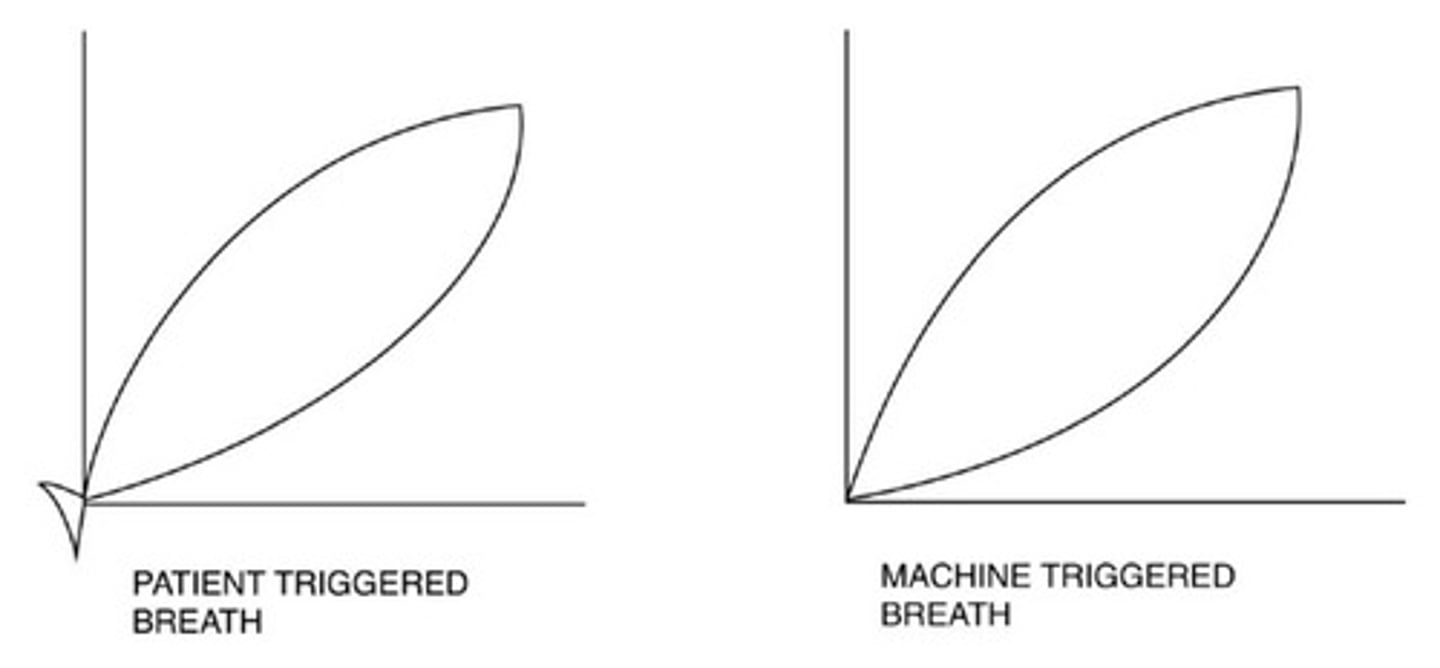
The following graphic is displayed for a patient receiving mechanical ventilation in the SIMV mode.
Which type of breath does the graph represent?
1. Patient triggered mandatory
2. Spontaneous
3. Pressure supported
4. Pressure controlled
1. Patient triggered mandatory
A right heart catherization is scheduled to assess vaso-responsiveness in a 45-year-old patient with pulmonary hypertension. An RT should expect titrate inhaled ____________
Nitric Oxide
A 188-cm (6ft2in)male who weighs 100kg(220lb) is receiving SIMV with the following settings:
FiO2 80%
Mandatory Rate 10
Total Rate 32
Set VT 650
Spontaneous VT 100
PS 5
PEEP +12
What should the RT increase?
1. PEEP
2. VT
3. Mechanical Deadspace
4. Pressure Support
4. Pressure Support
A 56-year-old female with a diagnosis of bilateral basilar pneumonia is in the ICU and receiving VC AC ventilation. A respiratory therapist observes that her SpO2 has dropped from 95% to 84%. Her current FiO2 is 50% with +12 PEEP. Her PaCO2 values have remained within normal range. What should the RT increase first?
Increase the FiO2
A patient requires frequent nasotracheal suctioning. The patient begins to cough violently after an RT places a nasopharyngeal airway. Which of the following actions should the therapist recommend?
1. Wait 10 minutes for the patient to adapt to the airway
2. Wait until the patient falls asleep to insert an airway
3. Insert a nasal airway that is wider
4. Insert a nasal airway that has a shorter length
4. Insert a nasal airway that has a shorter length
Common emotional manifestations of chronic pulmonary disability could include what?
Depression
Anger
Hostility
A 71 year-old male with COPD is admitted to the ED with shortness of breath, tachypnea, and confusion. Oxygen is initiated at 2L/min by nasal cannula and the ABG reveals:
7.32/80/50/41 11 85%
What should the RT recommend?
Initiate bilevel ventilation
A 41-year-old female who is 168cm (5ft6in) and weighs 70kg (154lb) is receiving PS ventilation with the following settings:
FiO2 30%
Exhaled VT 525
PEEP +5
PS 5
Following a 45 minute SBT the following information is obtained:
RR 24
Minute Ventilation 8.5
What should the RT recommend?
Extubating the patient
Recent ABG analysis results for an intubated patient:
7.39/37/50/22 -2 85%
What should the RT interpret the results as?
Hypoxemia
An RT is performing quality control on a blood gas analyzer. To be accepted the results must occur within how many deviations of established limits?
+/- 2
A patient is receiving VC ventilation. The RT notices the PIP has increased from 20 to 30 after 6 hours. What explains the change?
Increased airway resistance + decreased pulmonary compliance
An RT reviews the following ABG analysis results for a patient who is receiving FiO2 of 30%
7.36/43/288/24 -2 100%
What do the results most likely indicate?
Laboratory Error
Which of the following will lower mean airway pressure (MAP) on a patient receiving VC ventilation?
1. Decrease the inspiratory time
2. Increase the VT
3. Increase the PEEP
4. Decrease the trigger sensitivity
1. Decrease the inspiratory time
A 183cm (6ft) 80kg (176lb) male was receiving PSV with an FiO2 of 35% before surgery. After surgery the following data is obtained while the patient is receiving VC AC Ventilation?
FiO2 75%
Mandatory rate 16
VT 600ml
PEEP +5
7.32/45/50/23 -3 85%
What should the RT recommend?
A lung recruitment maneuver
A 32-year old 168cm(5ft6in) 60kg (132lb) female with Guillain-Barre syndrome is receiving intravenous immunoglobulin (IVIg) and an FiO2 of 24% by air entrainment mask.
Day 1:
Vital Capacity= 950
MIP= -24
Day 2:
Vital Capacity= 850
MIP= -20
Day 3:
Vital Capacity= 700
MIP= -18
What should the RT do?
1. Initiate bilevel NPPV
2. Maintain current care
3. Perform nasotracheal suctioning
3. Recommend a tracheostomy
1. Initiate bilevel NPPV
One day following a cholecystectomy, a 25-year old male with muscular dystrophy is returned to his home settings for NPPV in spontaneous mode. He is receiving intravenous hydromorphone (Dilaudid) for pain management. The follow data is available:
FiO2 21%
IPAP 18
EPE 8
HR 100/RR 6
7.26/70/60/31/ +2 91%
What should the RT recommend?
Administer Naloxone HCl (Narcan)
In a healthy adult, which of the following pulmonary measurements is the largest?
1. Vital Capacity
2. Inspiratory Capacity
3. Functional Residual Capacity
4. Expiratory Reserve Volume
1. Vital Capacity
During an SBT an adult patient who is 157cm(5ft2in) + 50kg(110lbs) has a RR of 12 and exhaled VT of 300. The patient is awake and following commands. Which of the following should the RT recommend?
1. PC Ventilation
2. VC Ventilation
3. Extubation
4. PS Ventilation
3. Extubation
RSBI= RR/VT
A patient with a tracheostomy tube has transitioned from an HME to a heated aerosol. Acute dyspnea has developed. What is a likely explanation?
Secretions expanded as they became hydrated.
A patient is receiving mechanical ventilation at home. Which device should be available to provide temporary support in the even of a power failure?
Bag-valve Resuscitator
Which of the following provides the best indication of the adequacy of alveolar ventilation?
1. Vital Capacity
2. ABG Analysis
3. VT
4. MVV
2. ABG Analysis
A patient has been receiving invasive mechanical ventilation with heated humidification for 4 days. When suctioning the RT notices that the secretions are becoming tenacious. What should the RT confirm?
Ensure the proximal airway temperature is at least 35C(95F)
A patient presents with fever and left lower lobe necrotizing pneumonia. The following ABG is obtained while on room air:
7.46/33/53/23 0 87%
Broad spectrum antibiotic therapy is started. What additional therapy is appropriate?
Titrate oxygen to maintain SpO2 greater than 92%
An RT is assisting with triage following a bus crash. Which of the following patients should receive priority for mechanical ventilation?
1. 14 y/o with open skull fracture and GCS of 5
2. 56 y/o who is receiving CPR for cardiac arrest
3. 28 y/o with flail chest w/multiple pulmonary contusions
4. 75 y/o with 3rd degree burns over 25% of BSA
3. 28 y/o with flail chest w/multiple pulmonary contusions
An RT is performing high calibration on a nitric oxide analyzer. What is the expected ppm value?
45= high
Starts at 20ppm
Which of the following should be used to administer 80/20 heliox to a 9 y/o boy
1. Nasal Cannula
2. Air-Entrainment Mask
3. Simple Mask
4. Nonrebreathing Mask
4. Nonrebreathing Mask
What is the best position for drainage of the anterior segments of the upper lobes on a patient who is able to tolerate position hanges?
- Supine with pillow under knees
*Trying to drain from front upper to middle of chest
A 56-year-old female is admitted to the ED following a motor vehicle crash. The RT notes the HR is 130 and RR 33.
ABG:
7.44/35/52/24 0 97%
The RT should anticipate orders for what?
A chest x-ray