Chapter 29: Development
 Call Kai
 Learn
Learn Practice Test
 Spaced Repetition
 Match
Match Flashcards
 Knowt Play
1/90

There's no tags or description
Looks like no tags are added yet.
Name | Mastery | Learn | Test | Matching | Spaced | Call with Kai |
|---|
No analytics yet
Send a link to your students to track their progress
91 Terms
Define the embryonic period
extends from fertilization thru the 8th week of development
define fertilization
merging of genetic info from haploid sperm & haploid secondary oocyte
Trace the path of sperm fertilizing the secondary oocyte
swim from vagina → cervix
pass thru the uterus & uterine tubes
penetrate the corona radiata → zona pellucida → plasma membrane of the secondary oocyte → cytoplasm of secondary oocyte
The ____ of the sperm’s acrosome, along w/ _________, allow the sperm to penetrate the corona radiata
enzymes
tail movement
As the sperm penetrates the secondary oocyte, ________ in the zona pellucida is a receptor for the sperm. Membrane proteins in the sperm head bind to this receptor, & acrosomal enzymes are released to digest a path in the zona pellucida.
Glycoprotein ZP3
During fertilization, the haploid nucleus in the head of the sperm becomes the _______, and the haploid nucelus of the fertilized ovum becomes the _________. When the 2 merge (syngamy), the ________ is formed.
male pronucleus
female pronucleus
diploid zygote
Define cleavage
mitotic division of the zygote that begins ~24 hrs after fertilization
Describe cleavage (day 1)
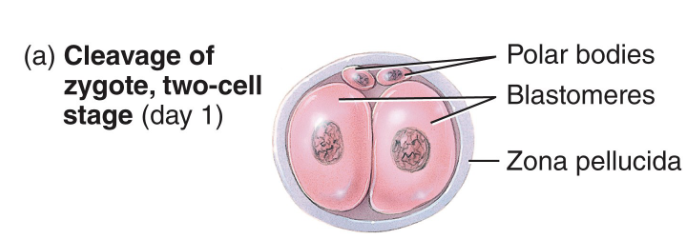
Describe cleavage (day 2)
by 2nd day after fertilization, 2nd cleavage is completed, yielding 4 cells
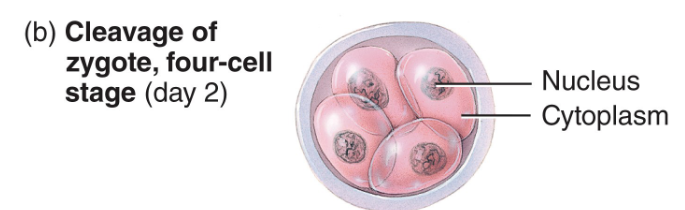
Describe cleavage (day 3)
by end of 3rd day, there are 16 cells
each division yields smaller & smaller cells → blastomeres
Describe cleavage (day 4)
by 4th day, the cluster of cells resembles a mulberry → morula
(still surrounded by zona pellucida & is still the size of a zygote)
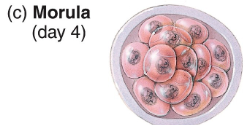
Describe cleavage (day 4-5)
morula enters uterine cavity & is nourished by uterine milk (a glycogen-rich secretion from endometrial glands in addition to stored nutrients from the cytoplasm)
32-cell stage → the fluid now inside the morula rearranges the blastomeres into a large, fluid-filled blastocyst cavity (blastocoel)
the mass is now called a blastocyst (still the same size as the OG zygote)
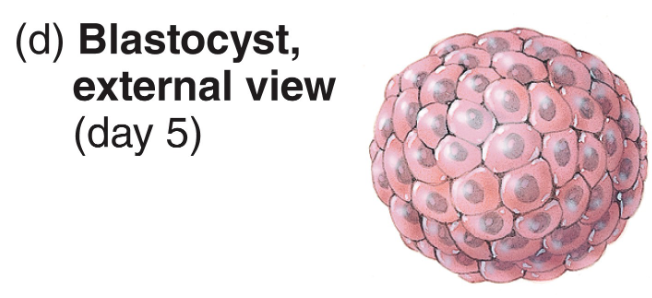
As the blastocyst formed, 2 diff. cell populations arose:
Embryoblast → (inner cell mass) will develop into the embryo
Trophoblast → (outer cell mass) will develop into the outer chorionic sac surrounding the fetus, & the fetal portion of the placenta
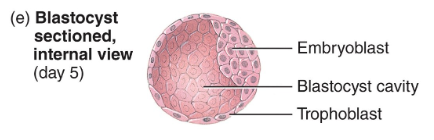
The blastocyst remains free in the uterine cavity for ~2 days, then implants by attaching to the ________ at ~6 days after fertilization
endometrium
implantation usually occurs in either the _________ or the __________. The inner cell mass (embryoblast) orients toward the _______
posterior portion of the fundus
body of the uterus
endometrium
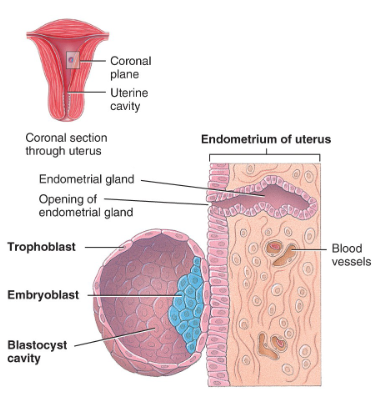
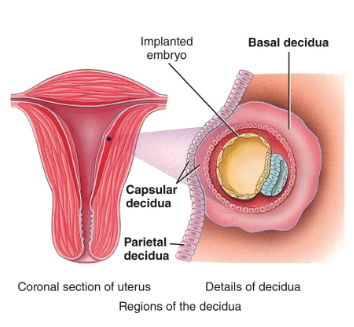
After implantation, the endometrium is called the _______. This structure separates from the endometrium after the fetus is delivered.
decidua
Name the different regions of the decidua
basal decidua
capsular decidua
parietal decidua
Summarize the events during the 1st week of development
FERTILIZATION → occurs within uterine tube 12-24 hrs after ovulation
CLEAVAGE → 1st cleavage completed ~30 hrs after fertilization
MORULA → 3-4 days after fertilization
BLASTOCYST → 4.5-5 days after fetiliztion
IMPLANTATION → ~6 days after fertilization
After ~8 days after implantation, the trophoblast develops into the _________ & __________
synctiotrophoblast
cytotrophoblast
At ~8 days, the embryoblast also develops into 2 layers: the _________ & _________. Cells of these structures form a flat disc called the _________.
hypoblast (primitive endoderm)
epiblast (primitive ectoderm)
bilaminar embryonic disc
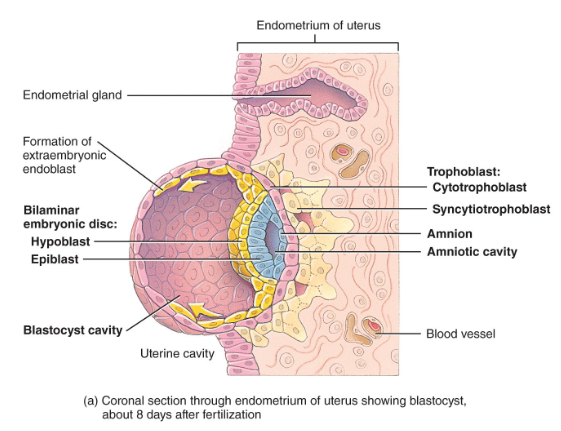
The ______ forms the epiblast
amniotic cavity
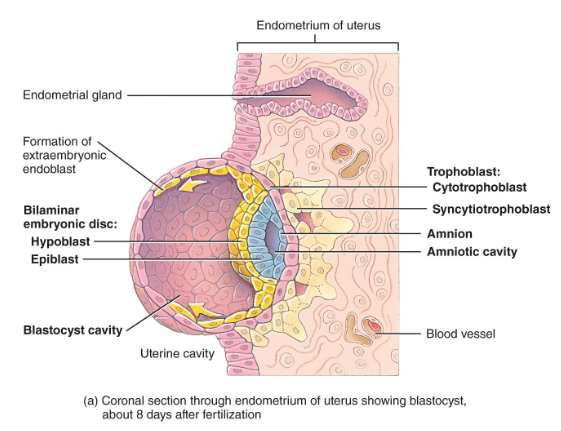
Also on the 8th day, the exocoelomic membrane forms, which, tgt w/ the hypoblast, forms the _______
yolk sac
On day 9, small spaces called ______ form
lacunae
By the 12th day, the lacunae fuse to form ______
lacunar networks
On the 12th day after fertilization, the ____________ develops. The cells form a CT layer around the ____ and _______
extraembryonic mesoderm
amnion
yolk sac
The extraembryonic mesoderm and the trophoblast, together, form the ______, which surrounds the ____ & later, the _____.
chorion
embryo
fetus
Describe the 3 main functions of the chorion
blocks antibody production by the mother
promotes production of T lymphocytes to suppress the immune response in the uterus
produces human chorionic gonadotropin (hCG)
The first major event of the 3rd week of development is _________
gastrulation
Define gastrulation
the bilaminar embryonic disc tranforms into a trilaminar embryonic disc (ectoderm, mesoderm, endoderm)
associated w/ the rearrangement & migration of cells from the epiblast
Describe the events of gastrulation
1st step → formation of the primitive streak
establishes the head & tail ends of the embryo
2nd step → cells of the epiblast move inward below the primitive streak & undergo invagination
the 3 germ layers form:
endoderm
mesoderm
ectoderm
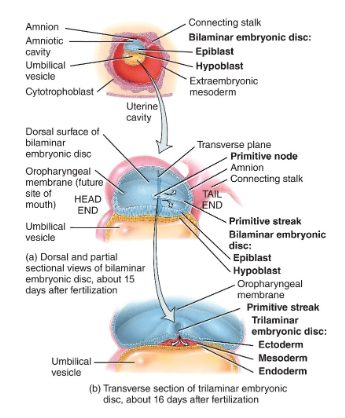
~16 days after fertilization, the _____ process forms. By days 22-24, this process becomes the _____
notochordal
notochord
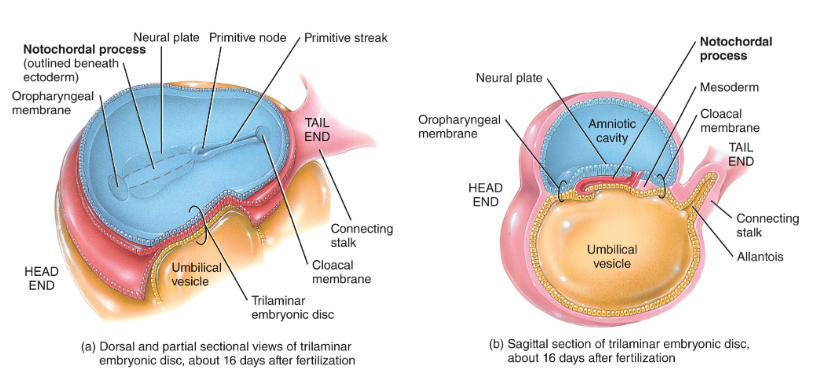
Describe the functions of the notochord
induction → process whereby the inducing tissue stimulates development of a responding tissue to develop into a specific structure (e.g development of…
vertebral bodies
neural plate (forms the neural tube))
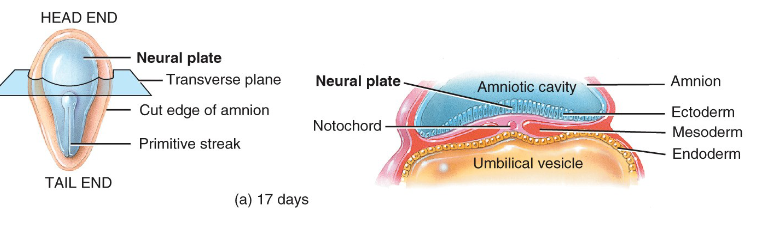
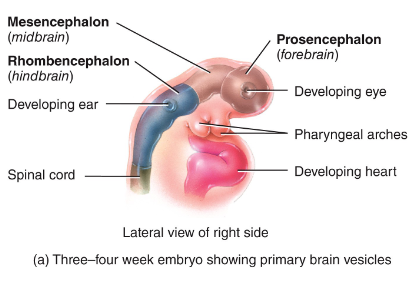
At ~4 weeks after fertilization, the head end of the _______ develops into 3 enlarged areas called __________.
neural tube
primary brain vesicles
Explain the significance of neurulation
Formation of the CNS → neurulation creates the neural tube, which becomes the brain & spinal cord
Neural crest cell development
Establishes the embryo’s head-to-tail axis
List the primary brain vesicles
Prosencephalon (forebrain)
Mesencephalon (midbrain)
Rhombencephalon (hindbrain)
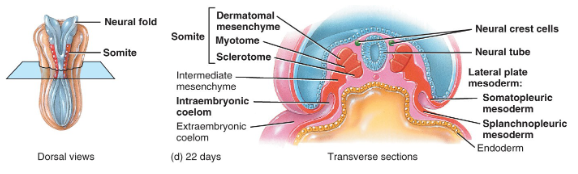
At ~17th day after fertilization, paired, cube-shaped structures called _______ form
somites
Each somite differentiates into a ________, a ________, & a ________
myotome (neck, trunk, & limb)
dermatome
sclerotome (vertebrae/ribs)
On days 18 & 19, the heart begins to develop in the head end of the embryo in a region of mesodermal cells called the ________. ______ Embryonic tissue invades the uterine wall & erodes uterine blood vessels, developing ______
cardiogenic area
chrionic villi
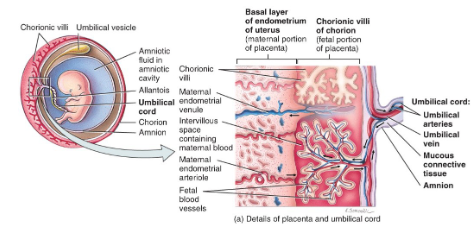
By the end of the 3rd week, blood vessels develop in the _____ & connect to the embryonic heart. The vessels connecting to the heart do so by way of the _______ & _________ through the connecting stalk which eventually becomes the ________
chorionic villi
umbilical arteries
umbilical vein
umbilical cord
Define placentation and placenta
placentation → process of forming the placenta
placenta → site of exchange of nutrients & wastes between mother & fetus; produces hormones used to sustain the pregnancy
By the beginning of the 12th week, the placenta has 2 parts:
fetal portion (chorionic villi)
maternal portion (decidua basalis of the endometrium)
All major organs develop between the 4th-8th week (AKA _______)
organogenesis
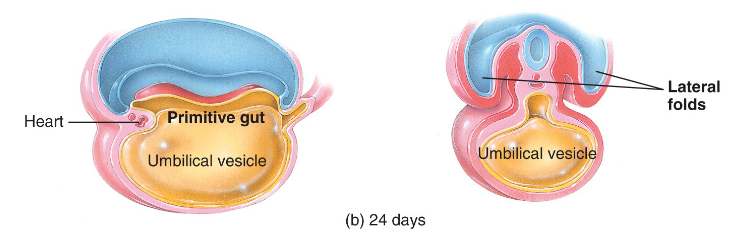
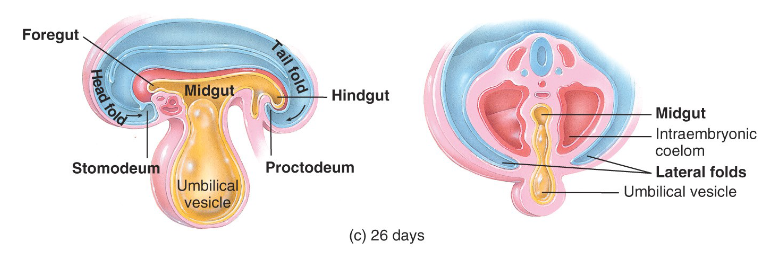
_________ (when the flat embryo folds into a 3D cylinder) occurs during the 4th week
embryonic folding
During embryonic folding, lateral folds form and , as they move toward the midline, they incorporate the ______ into the embryo as the _________
yolk sac
primitive gut
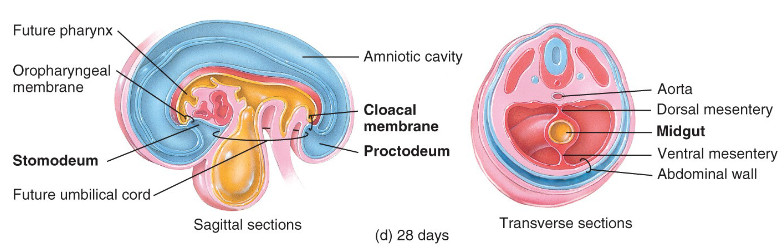
On the outside of the embryo is a cavity in the tail region called the ______
proctodeum
Separating the cloaca from the proctodeum is the _______
cloacal membrane
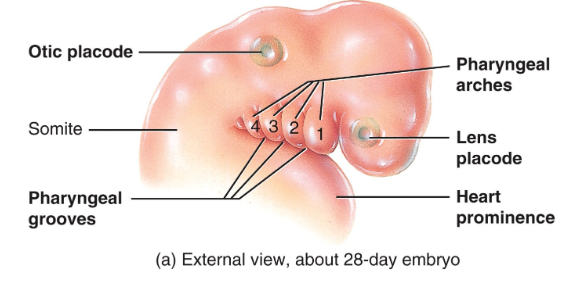
5 pairs of _________ develop on each side of the future head & neck regions of the embryo during the 4th week
pharyngeal arches/clefts (branchial arches)
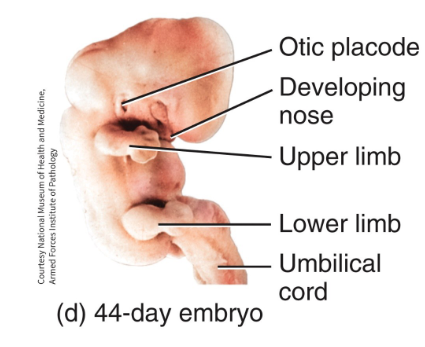
By the ___ week, the regions of the limbs become distinct & digits appear
7th
Describe the fetal period
begins at 9th week after fertilization
tissues & organs that developed during the embryonic period grow & differentiate
very few new structures appear during this period
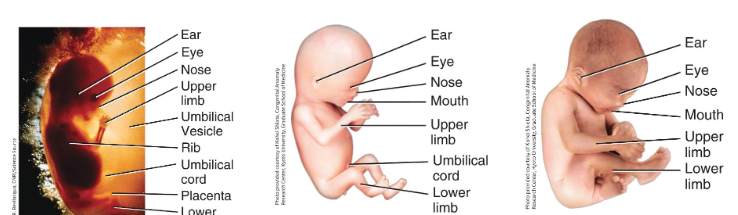
Any agentor influence that is able to cause developmental defects in an embryo or fetus is a ________. Provide a few examples
teratogen
alcohol
viruses
industrial chemicals
antibiotics
cocaine
What are prenatal diagnostic tests?
medical tests during pregnancy used to detect fetal abnormalities, genetic disorders, & well-being
List the 4 prenatal diagnostic tests
Fetal Ultrasonography
Amniocentesis
Chorionic Villi Sampling
Maternal alpha-fetoprotein (AFP)
Describe Fetal ultrasonography
determines a more accurate fetal age when the date of conception is in doubt
also…
confirms pregnancy
determines fetal position
identifies multiple pregnancies
Describe Amniocentesis
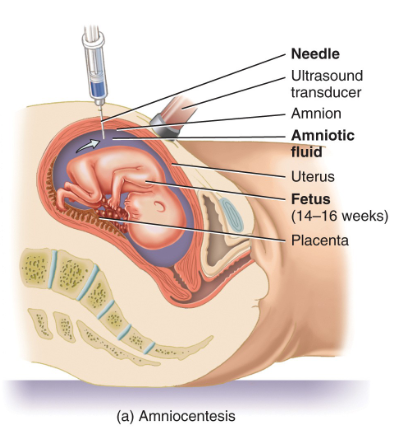
involves removing some amniotic fluid surounding the developing fetus, & analyzing it & fetal cells for genetic abnormalities
needle used to collect the fluid is guided by ultrasound to avoid damage to fetus or umbilical cord
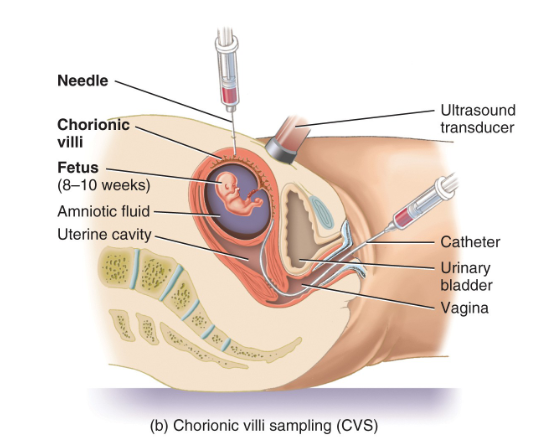
Describe Chorion Villi Sampling
done under ultrasound guidance, but usual procedure is to insert a catheter through the vagina & cervix to collect a tissue sample from the chorionic villi
goal → identify same genetic defects as seen w. amniocentesis
procedure may be done thru the abdominal wall as w/ amniocentesis
Describe Maternal Alpha-fetoprotein (AFP)
requires blood sample from mother
detects AFP (a protein produced by the fetus at its highest levels between weeks 12-15) after the 16th week of pregnancy — when levels go to zero
after the 16th week, high levels of AFP indicate a neural tube defect (birth defects of the brain, spine, or spinal cord; happen during 1st month of pregnancy)
to interpret, must know gestational age, twin status, maternal health status, & race
During the 1st 3-4 months of pregnancy, the corpus luteum secretes _____ & _______ in low levels
progesterone
estrogens
From the 3rd month to the end of pregnancy, the placenta produces high levels of _____ & ________
progesterone
estrogensT
The ______ secretes ______ to stim. the corpus luteum to produce estrogens & progesterone to inhibit menstruation until the placenta takes over
chorion
hCG
List the hormones that the placenta secretes during pregnancy
Human Chorionic Gonadotropin (hCG)
Progesterone/estrogens
Relaxin
Human Choorionic Somatomammotropin (hCS)
Corticotropin-releasing hormones
Describe the function of hCG duirng pregnancy
rescues corpus luteum from degeneration until the 3-4 month of pregnancy
Describe the 3 functions of progesterone/estrogens during pregnancy
maintains endometrium
prepares mammary glands for lactation
prepare mother’s body for birth of baby
Describe the 2 functions of relaxin during pregnancy
increase flexibility of pubic symphysis
helps dilate uterine cervix during labour
Describe the 3 functions of Human Chorionic Somatomammotropin (hCS) during pregnancy
prepares mammary glands for lactation
enhances growth by increasing protein synth.
decreases glucose use & increases fatty acid use for ATP production
Describe the 2 functions of Corticotropin-releasing hormone during pregnancy
establishes the timing of birth
increases secretion of cortisol → needed for maturation of fetal lungs
define labor
process that expels the fetus from the uterus thu the vagina
List the 3 requirements for labor to begin
oxytocin must be released
estrogen elvels must rise
effects of progesterone must be inhibited
Contrast True labor & False labor
true labor → begins when uterine contractions occur at regular intervals
false labor → associated w/ irregular contractions & no “show” (a discharge of blood w/ mucus)
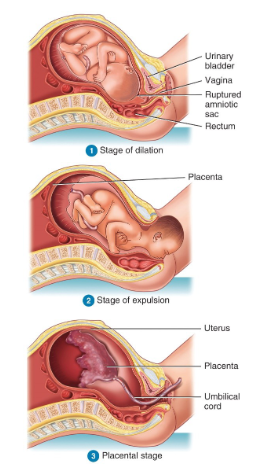
True labor is divided into 3 stages:
Stage of dilation
Stage of expulsion
Placental stage
Describe the respiratory adjustments of infants at birth
lungs able to exchange oxygen & CO2 thanks to surfactant
repiratory rate at birth drops from 45 breaths/min to the normal 12 breaths/min within 2 weeks
Describe the cardiovascular adjustments of infants at birth
foramen ovale closes to become the fossa ovalis (in heart)
ductus arteriosus closes to become the ligamentum arteriosum (in heart)
umbilical arteries fill w/ connective tissue
umbilical vein becomes the ligamentum teres of the liver
______ (secreted by the anterior pituitary) is the main hormone in stim. milk production
prolactin (PRL)
The hormone, _____, causes release of milk into the mammary ducts via the _______
oxytocin
milk ejection reflex
Describe the milk ejection reflex (positive feedback loop)
stimulation: suckling of baby on nipple
→ causes increasing
controlled condition: touch sensations
receptors: touch-sensitive sensory neurons in nipple
→ input: nerve impulses
control center: hypothalamus & posterior pituitary
→ output: increased oxytocin in blood
effectors: myoepithelial cells in mammary glands
→ contraction of myoepithelial cells
response: milk ejection
(possible interruption of cycle: baby ceases to suckle)
positive feedback: milk availibility encourages continued suckling, so touch sensations on nipple & oxytocin release continue
List the benefits associated w/ breast feeing an infant
chem. composition of mother’s milk is ideal for the baby’s brain development, growth, & digestion
several types of WBCs are in the milk → immunity
antibodies present
reduction in several diseases
define inheritance & genetics
inheritance → passage of hereditary traits from one generation to the next
genetics → study of inheritance
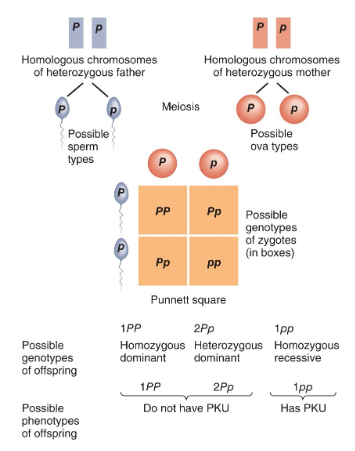
What is a punnett square used for
to show the possible genes inherited from 2 parents
Define allele
genes for the same trait that are in the same location on each homologue
Define genotype vs phenotype
genotype → actual genetic makeup relating to a trait
phenotype → physical expression of the genotype
Define dominant vs recessive (allele)
dominant (allele) → allele that dominates or masks the presence of another allele; represented by UPPERCASE letter
recessive (allele) → allele whose presence is completely masked; represented by lowercase letter
Define homozygous vs. heterozygous
homozygous → 2 identical alleles for a gene (e.g. AA)
heterozygous → 2 diff. alleles for a gene (e.g. Aa)
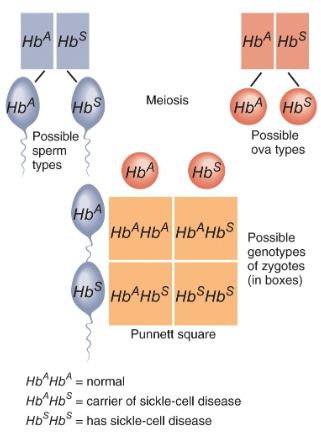
Define incompelte dominance
situation where neither member of the pair of alleles is dominant over the other
e.g. sickle cell anemia
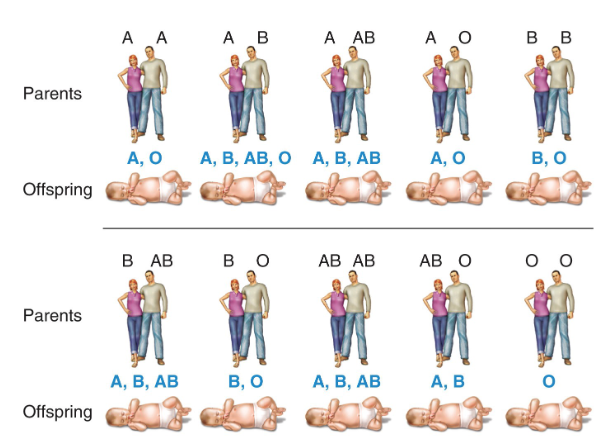
Describe mutiple-allele inheritance
occurs when genes have more than 2 alternative forms
e.g. inheritance of the ABO blood group
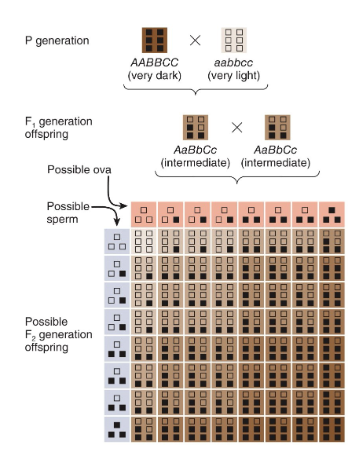
Describe polygenic inheritance
when a trait is controlled by the combined effects of 2+ genes
Describe complex inheritance and lsit examples of complex traits
when a trait occurs due to the combined effects of many genes & environmental factors
complex traits:
skin, hair, eye colour
height
metabolic rate
body build
Define karyotype
entire set of chromosomes arranged in decreasing size order & according to the position of the centromere
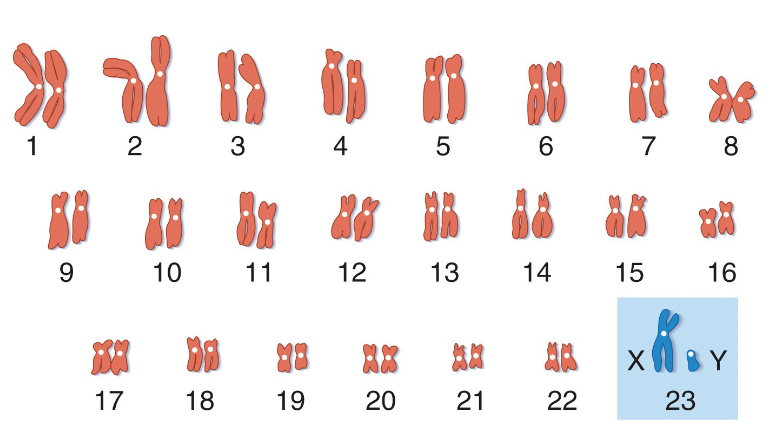
The 23 pairs of human chromosomes include ____ pair(s) of _____ & ___ pair(s) of _______
22
autosomes
1
sex chromosomes (X & Y)
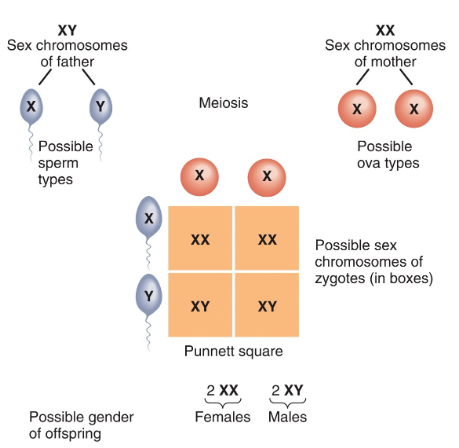
List the sex chromosomes that correspond to male and female & explain what determines the gender of the zygote
male → X & Y
female → 2 X (one is automatically inactivated)
whether the sperm that fertilizes an egg carries an X or Y chromosomes determines teh gender of the zygote
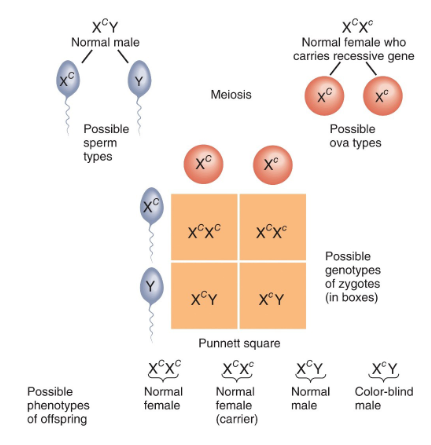
A person who is heterozygous for a recessive gene will…
show the recessive phenotype
possible have child who shows the recessive phenotype
have 2 identical alleles
show a mutation of one allele
act as a carrier of the recessive gene for male offspring
Explain why mitochondrial DNA comes from the mother
mitochondria are in cytoplasm of cell
egg cell (mother) contributes a lot of cytoplasm and, resultantly, a lot of mitochondria
sperm cell (father) contributes mostly just its nucleus (DNA)
the sperm’s mitochondria either don’t enter the egg or are broken down after entry
Explain how to analyze a karyotype to detect genetic defects
count chromosome → normal = 46 total
check for trisomy (3 copies of chromosome) or monosomy (only 1 copy)