IS201: Database Theory - Entity Relationship modelling
 Call Kai
 Learn
Learn Practice Test
 Spaced Repetition
 Match
Match Flashcards
 Knowt Play
1/19

There's no tags or description
Looks like no tags are added yet.
Name | Mastery | Learn | Test | Matching | Spaced | Call with Kai |
|---|
No analytics yet
Send a link to your students to track their progress
20 Terms
ERM (entity relationship model)
Forms basis of ERD (Entity relationship diagram)
Represents the conceptual database viewed by end user
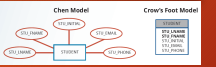
ERD Main components
Entities
Attributes
Relationships
Required attribute
An attribute that must have a value and cannot be left empty
Optional attribute
Does not require a value and can be left empty
Single-valued attribute
An attribute that has only a single value
Multivalued attribute
Attributes that have many values
Derived attribute
An attribute whose value is calculated from other attributes
Connectivity
describes the relationship classification (1:1, 1:M, M:N)
Cardinality
Expresses the min and max number of entity occurrences associated with one occurrence of the related entity
Format: x (min), y (max)
Existence dependence (weak entity)
An entity that can exist in the database only when associated with another related entity
entity has a mandatory foreign key
Weak (non-identifying) relationship
Represented by dashed line
Exists if primary key of related entity does not contain primary key component of parent entity
occurs between two strong entities
Strong (identifying) relationship
Represented by solid line
Primary key of related entity contains a primary key component of the parent entity
occurs between one strong and one weak entity
Conditions for an entity to be classified as weak
Entity is existence-dependent
Has a primary key partially or totally derived from the parent entity
Types of relationship participation
Optional and mandatory participation
Optional participation
One entity occurrence does not require a corresponding entity occurrence in a relationship
Mandatory participation
One entity occurrence requires a corresponding entity occurrence
Relationship degrees
Indicates the number of entries/participants associated with a relationship
Types of relationship degrees
Unary relationship
Binary relationship
Ternary relationship
Recursive relationships (where it maintains multiple versions of itself basically)
Associative (composite/bridge) entity
Used to represent an M:N relationship by breaking it into 2 1:M relationships
Composed of the primary key attributes of each parent entity