Bus Law 207 Ethics
 Call Kai
 Learn
Learn Practice Test
 Spaced Repetition
 Match
Match Flashcards
 Knowt Play
1/25

There's no tags or description
Looks like no tags are added yet.
Name | Mastery | Learn | Test | Matching | Spaced | Call with Kai |
|---|
No analytics yet
Send a link to your students to track their progress
26 Terms
Corporate Social Responsibility (CSR)
The idea that businesses have social role beyond just earning profit — decisions advance greater goods
How was business historically viewed in terms of social responsibility?
Historically, business was not viewed as having a social role. It was expected to meet one goal: production of goods or services to earn a profit. A possible social role started being discussed in the 1950s.
Milton Friedman's view on CSR (Profit Maximization)
There is one and only one social responsibility of business — to increase its profits as long as stays within the rules of the game (open/free competition, no deception or fraud).
Corporations should not make charitable contributions; shareholders should.
Long-Term Company Interest view of CSR
In company's best interest to be concerned with social issues. Maximizing profits is still the primary concern, but social responsibility is viewed as contributing to the long-term sustaining of profits and as the right thing to do.
Triple Bottom Line
A more modern view of social responsibility that measures success in 3 ways:
Financial Returns (profits)
Social Returns (employees, community)
Environmental Returns (sustainability, impact).
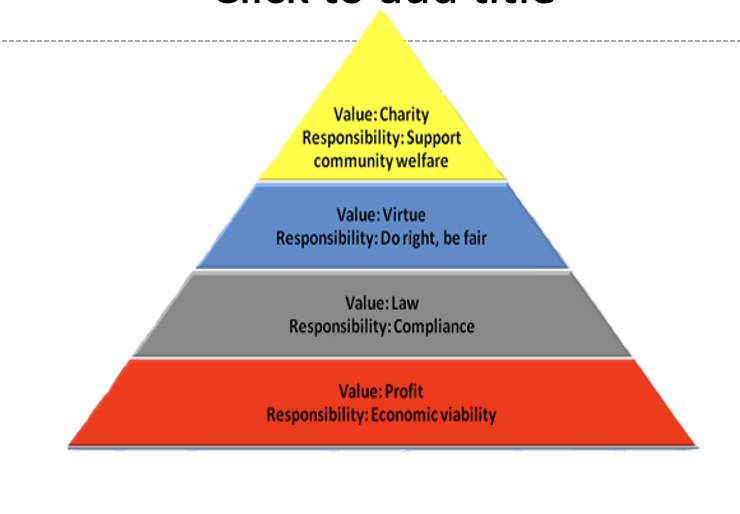
Who created the Social Responsibility Pyramid and when?
Archie Carroll, Prof at Georgia, 1991
What pressures led to Carroll's Social Responsibility Pyramid?
Pressure from social activists in the 1960s on corporate America to consider more than financial return, plus legislation promoting environmental protection, consumer protection, and occupational safety.
What does Carroll's Social Responsibility Pyramid advocate?
Business leaders have to take into account 4 things from bottom to top
Profit Responsibility (make money)
Law Responsibility (compliance)
Virtue (be fair)
Value (Charity, support community)
When do ethical issues typically arise?
Ethical issues arise when there is a conflict or tension between different duties — e.g., a supervisor tells you to hire Cal Poly grad cause you are all alums, but HR policy says everyone should be treated equal.
What are the 4 steps for analyzing an ethical decision?
Step 1: Identify the ethical issue.
Step 2: Identify the stakeholders.
Step 3: Recognize a primary solution and alternative solutions.
Step 4: Recognize the consequences of each solution.
What is the Trolley Problem?
A classic ethical dilemma used to explore moral decision-making — how we weigh action vs. inaction when both choices lead to harm. WATCH HERE:
What are 5 ethical frameworks
Deontology
Consequentialism
Principle Ethics
Virtue Ethics
Ethics of Care
micro-ethics vs macro-ethics
Micro-ethics concerns your own responsibilities/decisions/actions. Macro-ethics: concerns collective ethics/integrity of the profession.
Deontology
An ethical theory (from Greek "deon" = duty) that determines the rightness or wrongness of actions by examining the actions themselves — without focusing on their consequences. It is duty-based.
Consequentialism (Utilitarianism)
An ethical theory that judges actions as right or wrong based on their consequences. A morally right act is one that produces good results — the more good results, the more right the act.
Not everyone agrees on what the "right" actions are.
You may not have all the information needed to foresee all consequences.
An approach that recognizes ethical principles to balance, rather than strictly following deontology or consequentialism.
(1) Beneficence – promoting welfare of others;
(2) Non-maleficence – avoiding and preventing harm;
(3) Autonomy – fostering others' right to make their own decisions; (4) Justice – distributing benefits and burdens equally;
(5) Fidelity – honoring commitments and keeping promises;
(6) Veracity – being honest and telling the truth.
Beneficence, Autonomy, Justice
A framework argued to be ideal for engineering ethics founded on the first four principles of principle ethics.
An ethical framework that focuses on the character traits of the individual rather than specific rules or problem-solving processes. It asks to what extent one lives in accordance with their values.
It focuses on becoming a good person rather than following a checklist.
Aristotle in the Nicomachean Ethics. It centers on a vision of the "good life" — what constitutes flourishing for individuals, communities, and the species.
Virtues = Integrity, Trust, Honesty, Self-Control, and Fairness.